
Recent from talks
Polyamorphism
Knowledge base stats:
Talk channels stats:
Members stats:
Polyamorphism
Polyamorphism is the ability of a substance to exist in several different amorphous modifications. It is analogous to the polymorphism of crystalline materials. Many amorphous substances can exist with different amorphous characteristics (e.g. polymers). However, polyamorphism requires two distinct amorphous states with a clear, discontinuous (first-order) phase transition between them. When such a transition occurs between two stable liquid states, a polyamorphic transition may also be referred to as a liquid–liquid phase transition.
Even though amorphous materials exhibit no long-range periodic atomic ordering, there is still significant and varied local structure at inter-atomic length scales (see structure of liquids and glasses). Different local structures can produce amorphous phases of the same chemical composition with different physical properties such as density. In several cases sharp transitions have been observed between two different density amorphous states of the same material. Amorphous ice is one important example (see also examples below). Several of these transitions (including water) are expected to end in a second critical point.
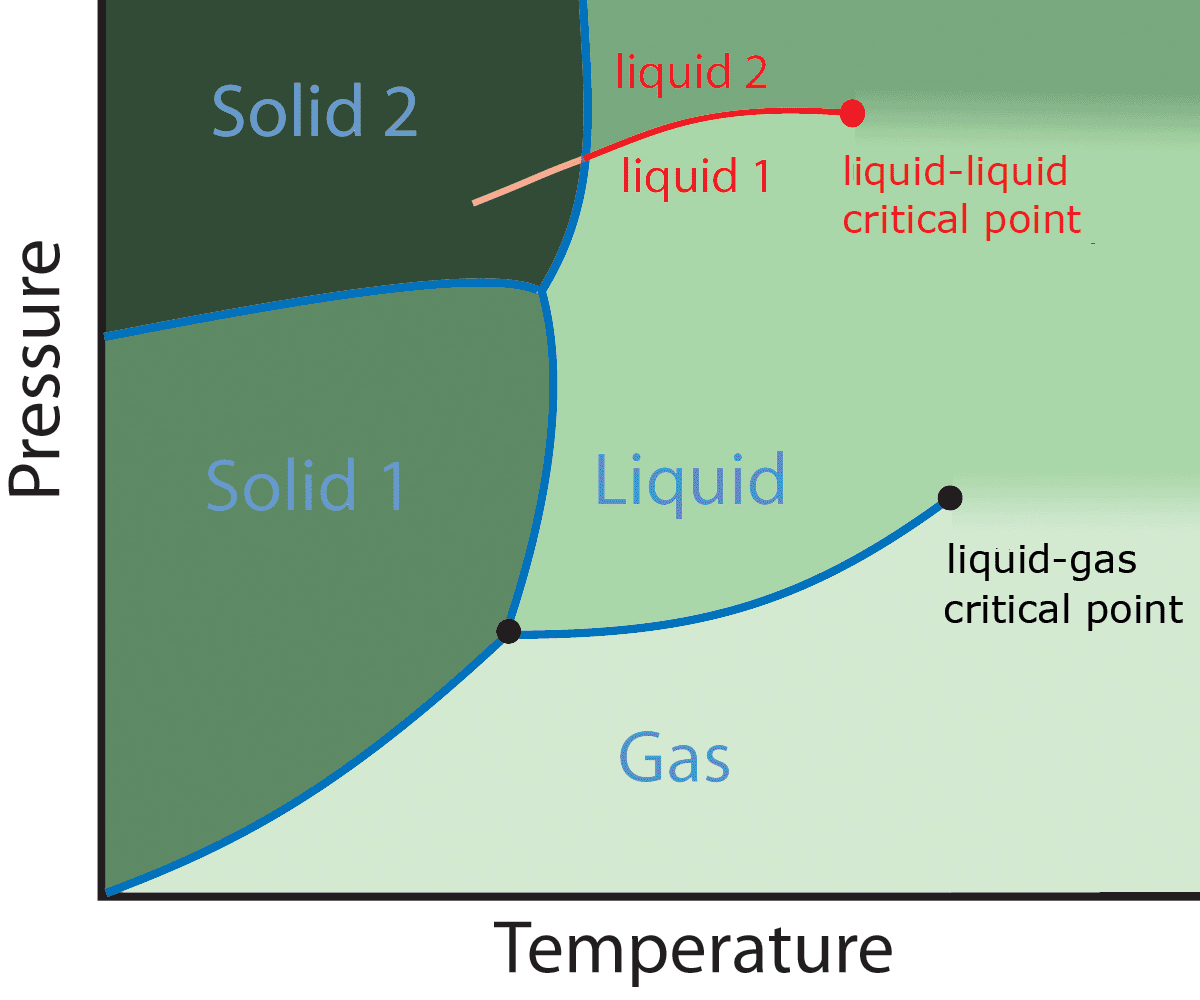
Polyamorphism may apply to all amorphous states, i.e. glasses, other amorphous solids, supercooled liquids, ordinary liquids or fluids. A liquid–liquid transition however, is one that occurs only in the liquid state (red line in the phase diagram, top right). In this article liquid–liquid transitions are defined as transitions between two liquids of the same chemical substance. Elsewhere the term liquid–liquid transition may also refer to the more common transitions between liquid mixtures of different chemical composition.
The stable liquid state unlike most glasses and amorphous solids, is a thermodynamically stable equilibrium state. Thus new liquid–liquid or fluid-fluid transitions in the stable liquid (or fluid) states are more easily analysed than transitions in amorphous solids where arguments are complicated by the non-equilibrium, non-ergodic nature of the amorphous state.
Liquid–liquid transitions were originally considered by Rapoport in 1967 in order to explain high pressure melting curve maxima of some liquid metals. Rapoport's theory invokes a two-state model for liquids consisting of coexisting low-density liquid (LDL) and high-density liquid (HDL) phases. These phases have local structures reminiscent of their low- and high-pressure solid polymorphic states.
One physical explanation for polyamorphism is the existence of a double well inter-atomic pair potential (see lower right diagram). It is well known that the ordinary liquid–gas critical point appears when the inter-atomic pair potential contains a minimum. At lower energies (temperatures) particles trapped in this minimum condense into the liquid state. At higher temperatures however, these particles can escape the well and the sharp definition between liquid and gas is lost. Molecular modelling has shown that addition of a second well produces an additional transition between two different liquids (or fluids) with a second critical point.
Polyamorphism has been experimentally observed or theoretically suggested in silicon, liquid phosphorus, triphenyl phosphate, mannitol, and in some other molecular network-forming substances.
The most famous case of polyamorphism is amorphous ice. Pressurizing conventional hexagonal ice crystals to about 1.6 GPa at liquid nitrogen temperature (77 K) converts them to the high-density amorphous ice. Upon releasing the pressure, this phase is stable and has density of 1.17 g/cm3 at 77 K and 1 bar. Consequent warming to 127 K at ambient pressure transforms this phase to a low-density amorphous ice (0.94 g/cm3 at 1 bar). Yet, if the high-density amorphous ice is warmed up to 165 K not at low pressures but keeping the 1.6 GPa compression, and then cooled back to 77 K, then another amorphous ice is produced, which has even higher density of 1.25 g/cm3 at 1 bar. All those amorphous forms have very different vibrational lattice spectra and intermolecular distances. A similar abrupt liquid-amorphous phase transition is predicted in liquid silicon when cooled under high pressures. This observation is based on first principles molecular dynamics computer simulations, and might be expected intuitively since tetrahedral amorphous carbon, silicon, and germanium are known to be structurally analogous to water.
Hub AI
Polyamorphism AI simulator
(@Polyamorphism_simulator)
Polyamorphism
Polyamorphism is the ability of a substance to exist in several different amorphous modifications. It is analogous to the polymorphism of crystalline materials. Many amorphous substances can exist with different amorphous characteristics (e.g. polymers). However, polyamorphism requires two distinct amorphous states with a clear, discontinuous (first-order) phase transition between them. When such a transition occurs between two stable liquid states, a polyamorphic transition may also be referred to as a liquid–liquid phase transition.
Even though amorphous materials exhibit no long-range periodic atomic ordering, there is still significant and varied local structure at inter-atomic length scales (see structure of liquids and glasses). Different local structures can produce amorphous phases of the same chemical composition with different physical properties such as density. In several cases sharp transitions have been observed between two different density amorphous states of the same material. Amorphous ice is one important example (see also examples below). Several of these transitions (including water) are expected to end in a second critical point.
Polyamorphism may apply to all amorphous states, i.e. glasses, other amorphous solids, supercooled liquids, ordinary liquids or fluids. A liquid–liquid transition however, is one that occurs only in the liquid state (red line in the phase diagram, top right). In this article liquid–liquid transitions are defined as transitions between two liquids of the same chemical substance. Elsewhere the term liquid–liquid transition may also refer to the more common transitions between liquid mixtures of different chemical composition.
The stable liquid state unlike most glasses and amorphous solids, is a thermodynamically stable equilibrium state. Thus new liquid–liquid or fluid-fluid transitions in the stable liquid (or fluid) states are more easily analysed than transitions in amorphous solids where arguments are complicated by the non-equilibrium, non-ergodic nature of the amorphous state.
Liquid–liquid transitions were originally considered by Rapoport in 1967 in order to explain high pressure melting curve maxima of some liquid metals. Rapoport's theory invokes a two-state model for liquids consisting of coexisting low-density liquid (LDL) and high-density liquid (HDL) phases. These phases have local structures reminiscent of their low- and high-pressure solid polymorphic states.
One physical explanation for polyamorphism is the existence of a double well inter-atomic pair potential (see lower right diagram). It is well known that the ordinary liquid–gas critical point appears when the inter-atomic pair potential contains a minimum. At lower energies (temperatures) particles trapped in this minimum condense into the liquid state. At higher temperatures however, these particles can escape the well and the sharp definition between liquid and gas is lost. Molecular modelling has shown that addition of a second well produces an additional transition between two different liquids (or fluids) with a second critical point.
Polyamorphism has been experimentally observed or theoretically suggested in silicon, liquid phosphorus, triphenyl phosphate, mannitol, and in some other molecular network-forming substances.
The most famous case of polyamorphism is amorphous ice. Pressurizing conventional hexagonal ice crystals to about 1.6 GPa at liquid nitrogen temperature (77 K) converts them to the high-density amorphous ice. Upon releasing the pressure, this phase is stable and has density of 1.17 g/cm3 at 77 K and 1 bar. Consequent warming to 127 K at ambient pressure transforms this phase to a low-density amorphous ice (0.94 g/cm3 at 1 bar). Yet, if the high-density amorphous ice is warmed up to 165 K not at low pressures but keeping the 1.6 GPa compression, and then cooled back to 77 K, then another amorphous ice is produced, which has even higher density of 1.25 g/cm3 at 1 bar. All those amorphous forms have very different vibrational lattice spectra and intermolecular distances. A similar abrupt liquid-amorphous phase transition is predicted in liquid silicon when cooled under high pressures. This observation is based on first principles molecular dynamics computer simulations, and might be expected intuitively since tetrahedral amorphous carbon, silicon, and germanium are known to be structurally analogous to water.
Recent media