
Recent from talks
Crystallite
Knowledge base stats:
Talk channels stats:
Members stats:
Crystallite
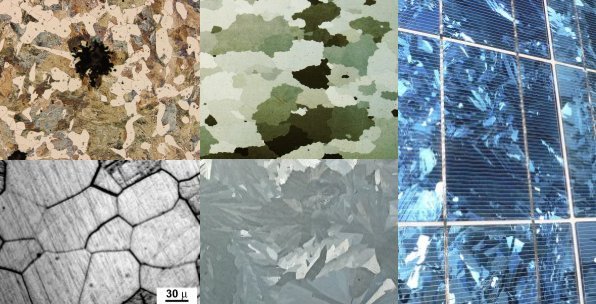
A crystallite is a small or even microscopic crystal which forms, for example, during the cooling of many materials. Crystallites are also referred to as grains.
Bacillite is a type of crystallite. It is rodlike with parallel longulites.
The orientation of crystallites can be random with no preferred direction, called random texture, or directed, possibly due to growth and processing conditions. While the structure of a single crystal is highly ordered and its lattice is continuous and unbroken, amorphous materials, such as glass and many polymers, are non-crystalline and do not display any structures, as their constituents are not arranged in an ordered manner. Polycrystalline structures and paracrystalline phases are in between these two extremes. Polycrystalline materials, or polycrystals, are solids that are composed of many crystallites of varying size and orientation. Most materials are polycrystalline, made of a large number crystallites held together by thin layers of amorphous solid. Most inorganic solids are polycrystalline, including all common metals, many ceramics, rocks, and ice.[citation needed] A related term oligocrystalline material is a microstructure consisting of a few coarse grains, often columnar and parallel to the longitudinal ingot axis. This microstructure can be found in the ingots produced by electron beam melting.
The areas where crystallites meet are known as grain boundaries.
Crystallite size in monodisperse microstructures is usually approximated from X-ray diffraction patterns and grain size by other experimental techniques like transmission electron microscopy. Solid objects large enough to see and handle are rarely composed of a single crystal, except for a few cases (gems, silicon single crystals for the electronics industry, certain types of fiber, single crystals of a nickel-based superalloy for turbojet engines, and some ice crystals which can exceed 0.5 meters in diameter). The crystallite size can vary from a few nanometers to several millimeters.
The extent to which a solid is crystalline (crystallinity) has important effects on its physical properties. Sulfur, while usually polycrystalline, may also occur in other allotropic forms with completely different properties. Although crystallites are referred to as grains, powder grains are different, as they can be composed of smaller polycrystalline grains themselves. Generally, polycrystals cannot be superheated; they will melt promptly once they are brought to a high enough temperature. This is because grain boundaries are amorphous, and serve as nucleation points for the liquid phase. By contrast, if no solid nucleus is present as a liquid cools, it tends to become supercooled. Since this is undesirable for mechanical materials, alloy designers often take steps against it (by grain refinement).
Material fractures can be either intergranular or a transgranular fracture. There is an ambiguity with powder grains: a powder grain can be made of several crystallites. Thus, the (powder) "grain size" found by laser granulometry can be different from the "grain size" (rather, crystallite size) found by X-ray diffraction (e.g. Scherrer method), by optical microscopy under polarised light, or by scanning electron microscopy (backscattered electrons).
If the individual crystallites are oriented completely at random, a large enough volume of polycrystalline material will be approximately isotropic. This property helps the simplifying assumptions of continuum mechanics to apply to real-world solids. However, most manufactured materials have some alignment to their crystallites, resulting in texture that must be taken into account for accurate predictions of their behavior and characteristics. When the crystallites are mostly ordered with a random spread of orientations, one has a mosaic crystal. Abnormal grain growth, where a small number of crystallites are significantly larger than the mean crystallite size, is commonly observed in diverse polycrystalline materials, and results in mechanical and optical properties that diverge from similar materials having a monodisperse crystallite size distribution with a similar mean crystallite size.
Hub AI
Crystallite AI simulator
(@Crystallite_simulator)
Crystallite
A crystallite is a small or even microscopic crystal which forms, for example, during the cooling of many materials. Crystallites are also referred to as grains.
Bacillite is a type of crystallite. It is rodlike with parallel longulites.
The orientation of crystallites can be random with no preferred direction, called random texture, or directed, possibly due to growth and processing conditions. While the structure of a single crystal is highly ordered and its lattice is continuous and unbroken, amorphous materials, such as glass and many polymers, are non-crystalline and do not display any structures, as their constituents are not arranged in an ordered manner. Polycrystalline structures and paracrystalline phases are in between these two extremes. Polycrystalline materials, or polycrystals, are solids that are composed of many crystallites of varying size and orientation. Most materials are polycrystalline, made of a large number crystallites held together by thin layers of amorphous solid. Most inorganic solids are polycrystalline, including all common metals, many ceramics, rocks, and ice.[citation needed] A related term oligocrystalline material is a microstructure consisting of a few coarse grains, often columnar and parallel to the longitudinal ingot axis. This microstructure can be found in the ingots produced by electron beam melting.
The areas where crystallites meet are known as grain boundaries.
Crystallite size in monodisperse microstructures is usually approximated from X-ray diffraction patterns and grain size by other experimental techniques like transmission electron microscopy. Solid objects large enough to see and handle are rarely composed of a single crystal, except for a few cases (gems, silicon single crystals for the electronics industry, certain types of fiber, single crystals of a nickel-based superalloy for turbojet engines, and some ice crystals which can exceed 0.5 meters in diameter). The crystallite size can vary from a few nanometers to several millimeters.
The extent to which a solid is crystalline (crystallinity) has important effects on its physical properties. Sulfur, while usually polycrystalline, may also occur in other allotropic forms with completely different properties. Although crystallites are referred to as grains, powder grains are different, as they can be composed of smaller polycrystalline grains themselves. Generally, polycrystals cannot be superheated; they will melt promptly once they are brought to a high enough temperature. This is because grain boundaries are amorphous, and serve as nucleation points for the liquid phase. By contrast, if no solid nucleus is present as a liquid cools, it tends to become supercooled. Since this is undesirable for mechanical materials, alloy designers often take steps against it (by grain refinement).
Material fractures can be either intergranular or a transgranular fracture. There is an ambiguity with powder grains: a powder grain can be made of several crystallites. Thus, the (powder) "grain size" found by laser granulometry can be different from the "grain size" (rather, crystallite size) found by X-ray diffraction (e.g. Scherrer method), by optical microscopy under polarised light, or by scanning electron microscopy (backscattered electrons).
If the individual crystallites are oriented completely at random, a large enough volume of polycrystalline material will be approximately isotropic. This property helps the simplifying assumptions of continuum mechanics to apply to real-world solids. However, most manufactured materials have some alignment to their crystallites, resulting in texture that must be taken into account for accurate predictions of their behavior and characteristics. When the crystallites are mostly ordered with a random spread of orientations, one has a mosaic crystal. Abnormal grain growth, where a small number of crystallites are significantly larger than the mean crystallite size, is commonly observed in diverse polycrystalline materials, and results in mechanical and optical properties that diverge from similar materials having a monodisperse crystallite size distribution with a similar mean crystallite size.
Recent media