Hubbry Logo
PolydolopimorphiaPolydolopimorphiaMain
Open search
Polydolopimorphia
Community hub
Polydolopimorphia
logo
8 pages, 0 posts
0 subscribers
Be the first to start a discussion here.
Polydolopimorphia
Polydolopimorphia
from Wikipedia

Polydolopimorphia
Temporal range: PaleocenePliocene, 66–2.6 Ma
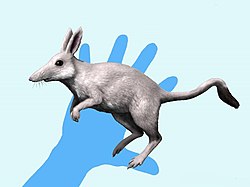
Argyrolagus palmeri
Scientific classification Edit this classification
Kingdom: Animalia
Phylum: Chordata
Class: Mammalia
Clade: Metatheria
Clade: Marsupialiformes
Order: Polydolopimorphia
Archer, 1984
Subgroups

Polydolopimorphia is an extinct order of metatherians, closely related to extant marsupials. Known from the Paleocene-Pliocene of South America and the Eocene of Antarctica, they were a diverse group during the Paleogene, filling many niches, before declining and becoming extinct at the end of the Neogene.[1] It is divided into two suborders, Bonapartheriiformes, and Polydolopiformes[2] Most members are only known from jaw fragments, which have their characteristically generally bunodont teeth.[3] The morphology of their teeth has led to proposals that polydolopimorphians may be crown group marsupials, nested within Australidelphia,[4] though this proposal, has been questioned, with other analyses finding them outside of crown-group Marsupialia.[3] The monophyly of the group has been questioned, due to the possibility of the characteristic bunodont teeth emerging convergently in unrelated groups, rather than reflecting a true phylogenetic relationship.[5] The group contained omnivorous, frugivorous and herbivorous forms.[4]

Taxonomy

[edit]

Taxonomical subdivision of the Polydolopimorphia:[6]

References

[edit]
Revisions and contributorsEdit on WikipediaRead on Wikipedia
from Grokipedia
Polydolopimorphia is an extinct order of metatherian mammals, representing a diverse clade of marsupial-like forms that flourished primarily in South America from the Paleocene to the late Pliocene epochs, spanning over 50 million years. Characterized by their distinctive diprotodont lower dentition—featuring enlarged, procumbent anterior teeth—and a range of molar morphologies from low-crowned, bunodont forms in early taxa to hypsodont or hypselodont teeth in later argyrolagoids, polydolopimorphians exhibited adaptations suggestive of omnivorous to herbivorous diets. Their cranial features often include a large alisphenoid tympanic process and small palatal fenestrae, reflecting specialized auditory and masticatory structures. The phylogenetic affinities of Polydolopimorphia remain contentious, with analyses placing them variably as stem marsupials outside crown Marsupialia, as relatives of (shrew opossums), or within alongside and ; some studies even suggest the group may be polyphyletic, with argyrolagids potentially aligning more closely with paucituberculatans. Fossils are predominantly from South American localities such as the Itaboraí Basin in (early Eocene, ~50–53 Ma) and Patagonian sites in , with isolated records from the middle Eocene La Meseta Formation in and questionable fragments from and . The oldest known member, Cocatherium lefipanum from the Lefipán Formation in , (Danian, ~64 Ma), underscores their early diversification following the Cretaceous-Paleogene extinction. Polydolopimorphia is subdivided into three suborders—Hatcheriformes, Polydolopiformes, and Bonapartheriiformes—encompassing families such as Prepidolopidae, Polydolopidae, Bonapartheriidae (including the genus Epidolops), Gashterniidae, and Argyrolagidae (featuring cursorial forms like Argyrolagus). Notable genera include Polydolops, Roberthoffstetteria, Sillustania, and Bonapartherium, which illustrate the group's morphological diversity from small, insectivorous forms to larger, potentially folivorous species. These mammals played a key role in the endemic South American metatherian radiation, coexisting with sparassodont carnivores and true marsupials until their extinction near the end of the , possibly influenced by biotic interchange with North American immigrants.

Description

Anatomy

Polydolopimorphians exhibited a range of body sizes, typically small and comparable to modern rats or , with estimates varying from approximately 83–153 g in early Eocene taxa like Pujatodon ektopos to around 400 g in Eocene species such as Epidolops ameghinoi. Later forms, including argyrolagids like Argyrolagus scagliai, maintained similarly modest masses near 150 g. These sizes reflect adaptations to terrestrial niches in and South American and environments, though postcranial fossils are scarce, limiting precise reconstructions across the clade. Cranial morphology in polydolopimorphians featured short to moderately elongated and robust , supporting a strong masticatory apparatus. In Epidolops ameghinoi, the rostrum is relatively long with a maximum zygomatic width of about 37 mm, formed by the jugal and squamosal bones, and lacking a masseteric process at the anterior zygomatic arch. Early Kramadolops mckennai displays an elongate, narrow rostrum that widens posteriorly across the molar row toward the zygomatic arches. Argyrolagids, such as Microtragulus bolivianus, show more derived traits including an elongated snout, large orbits, and prominent zygomatic processes, with inflated tympanic bullae and wide incisive foramina. Limb structure indicates quadrupedal locomotion in early polydolopimorphians, with limited postcranial suggesting generalized terrestrial adaptations. Tentatively referred tarsals in Epidolops ameghinoi feature a small peroneal process, a single calcaneocuboid facet, and separate ectal and sustentacular facets, consistent with ambulatory movement. In contrast, late argyrolagids evolved specialized elongation for saltatorial locomotion, including lengthened tibia-fibula and metatarsals, reduced phalanges, and powerful extensor muscles at the hip, knee, and ankle joints, enabling bipedal hopping akin to some . Forelimbs in Argyrolagus were shortened with stabilized glenohumeral and humeroulnar joints, well-developed retractors and flexors, facilitating digging alongside jumping. Postcranial elements like vertebrae are rare, but available fossils suggest flexible spinal morphology in some genera, supporting agile terrestrial behaviors.

Dentition

Polydolopimorphians are characterized by a bunodont featuring low-crowned molars with rounded cusps and thick, often wrinkled enamel, adaptations that facilitated a range of masticatory functions from grinding to shearing. Upper molars typically exhibit a quadrate outline, with four principal cusps: the paracone and metacone positioned labially, and the protocone and hypocone (often derived from a metaconule) lingually, connected by weak transverse lophs that enhance occlusal during transverse or propalinal movements. Lower molars complement this pattern, displaying a trigonid basin and a reduced talonid, with stylar cusps B and D prominently placed near the paracone and metacone, respectively, contributing to the overall bunodont morphology. The dental formula varies across families, reflecting evolutionary specializations. In Polydolopidae, such as Epidolops ameghinoi, the formula is approximately I1-3/i1-3, C1/c1, P1-3/p1-3, M1-4/m1-4, with enlarged, plagiaulacoid third s (P3/p3) bearing serrated edges for initial , and a size gradient decreasing posteriorly among molars. Argyrolagidae, in contrast, show reductions in premolar count alongside euhypsodont molars that are prismatic, with central dentine encased in thick and enamel layers, suited for prolonged grinding of abrasive materials; premolars are notably reduced, often to 1-2 per quadrant, emphasizing the molars' role in mastication. Dental microwear analysis reveals patterns consistent with frugivory and herbivory, including fine scratches from fibrous matter and pitting from tougher or gritty foods, as observed in bonapartherioids through occlusal wear facets formed during propalinal and ectental movements. In genera like Bonapartherium, the molars display a progression toward bilophodont patterns with increasingly developed transverse crests, indicating specialized folivory where leaves and tough vegetation were sheared and ground, supported by the acquisition of hypsodonty in later forms for handling abrasive diets.

Classification and phylogeny

Higher classification

Polydolopimorphia is recognized as an extinct order within , specifically placed either as part of the crown-group Marsupialia or as stem-metatherians closely allied to the base of Marsupialia, based on shared metatherian features such as epipubic bones and a marsupial pouch inferred from related taxa. The of Polydolopimorphia has been debated, with some analyses supporting it as a cohesive group defined by dental and cranial traits, while others propose , particularly suggesting that argyrolagids (a family traditionally included) may instead align more closely with due to shared derived tarsal and cranial morphologies like a tripartite calcaneocuboid facet and an elongate rostral tympanic process. Phylogenetic relationships of Polydolopimorphia vary across studies; in several morphological analyses, it appears as the to Didelphimorphia (the order containing modern ), forming part of the clade alongside , supported by plesiomorphic dental patterns and absence of certain australidelphian specializations. However, alternative phylogenies position Polydolopimorphia within , potentially as a basal offshoot linking to or even , based on cladistic analyses that emphasize shared bunodont occlusal patterns and early divergences in southern Gondwanan metatherians. Key synapomorphies uniting core polydolopimorphians include a bunodont with low-crowned, quadrate molars featuring reduced crests and a brachyodont structure adapted for omnivory, distinguishing them from the more carnassial-like dentition of sparassodonts and the dilambdodont of many South American metatherians. Cranially, they exhibit small maxillopalatine fenestrae in core taxa (but large in argyrolagids), a variable alisphenoid tympanic process (absent in core taxa like Epidolops but large in argyrolagids), and a type II petrosal with a tiny rostral tympanic process and deep internal carotid groove, features that set them apart from other South American metatherians like microbiotherians or paucituberculatans.

Internal classification

Polydolopimorphia is divided into three suborders: the earliest Hatcheriformes, the Bonapartheriiformes, and the more diverse, later Polydolopiformes. The suborder Hatcheriformes encompasses primitive early forms with bunodont dentition, including the family Glasbiidae (e.g., Glasbius from the middle Eocene La Meseta Formation in ) and possibly other basal taxa like Eobrasiliidae. The suborder Bonapartheriiformes encompasses the family Bonapartheriidae, represented by the genus Bonapartherium (e.g., B. hinakusijum), known from early Eocene deposits in Patagonia. This suborder also includes the late-surviving family Argyrolagidae, with genera such as Argyrolagus and Anargyrolagus, as well as Microtragulus bolivianus, which exhibit specialized adaptations and are recorded from to strata in . In contrast, the suborder Polydolopiformes includes the family Polydolopidae, with key genera such as Antarctodolops, Amphidolops (including species like A. minimus and A. intermedius), Kramadolops (e.g., K. hernandezi), and Eudolops (e.g., E. tetragonus). Another family within this suborder is Sillustaniidae, exemplified by Sillustania quechuense from early sites in . Recent phylogenetic revisions of Polydolopidae have restricted the Polydolops to its P. thomasi, erected the new Hypodolops (with H. sapoensis), and revalidated Pliodolops for species including P. primulus, P. rothi, P. kamektsen, and P. winecage, based on cladistic analyses of dental morphology.

Evolutionary history

Origins and diversification

Polydolopimorphians first appear in the fossil record during the earliest of , , with Cocatherium lefipanum representing the oldest known member of the clade. This species, based on an isolated lower molar from the Lefipán Formation in , dates to approximately 66–64 Ma and exhibits dental features characteristic of polydolopimorphians, such as a triangular occlusal outline and a well-developed paracristid. As a metatherian mammal, C. lefipanum likely derives from Gondwanan ancestors, marking the survival and initial post-extinction persistence of this lineage in following the Cretaceous-Paleogene (K-Pg) boundary event. Diversification accelerated during the Eocene, with a rapid radiation evident in early Eocene assemblages from the Itaboraí Basin in southeastern Brazil. Here, Epidolops ameghinoi, a member of the family Polydolopidae, is one of the most abundant polydolopimorphians, known from over 100 craniodental specimens dated to approximately 53–50 Ma, indicating early adaptive success in forested environments. By the middle Eocene (Lutetian-Bartonian stages, ~48–40 Ma), the clade reached peak diversity, with more than 10 genera within Polydolopidae alone, including Polydolops, Eudolops, Kramadolops, and Archaeodolops, distributed across southern from to . This Eocene radiation was driven by post-K-Pg ecological recovery and the geographic isolation of , which facilitated endemic niche exploitation among small, faunivorous to omnivorous metatherians in humid, forested habitats. Evidence of broader Gondwanan distribution comes from middle Eocene (~50 Ma) fossils on , Antarctica, in the La Meseta Formation, where polydolopids such as Antarctodolops suggest trans-Antarctic dispersal pathways before fully separated these landmasses.

Decline and extinction

Polydolopimorphians experienced a gradual decline beginning in the middle Eocene (~48 Ma), with significant diversity reduction by the early (~33 Ma), following their peak Paleogene diversity. The family Polydolopidae, a major early component of the order, went extinct by the early , around 33 million years ago, amid a broader pattern of gradual diversity loss that began in the middle Eocene. This early extinction is attributed to climatic deterioration at the Eocene-Oligocene transition, characterized by and increased , which diminished forested habitats essential for these marsupialiforms. In contrast, the family Argyrolagidae exhibited greater longevity, persisting into the with notably low diversity compared to earlier polydolopimorphian clades. Records indicate local extinctions by the middle to , as argyrolagids became scarce in southern regions, while northern populations endured longer. The last known polydolopimorphian, represented by species such as Argyrolagus palmeri from the early Monte Hermoso Formation (approximately 4 million years ago), highlights a protracted fade-out rather than abrupt disappearance. Additional remains from the Uquía Formation in northwestern extend argyrolagid occurrences to the middle through early , around 2.6 million years ago, underscoring regional variability in their terminal range. Several hypotheses explain the Neogene decline and ultimate extinction of polydolopimorphians, emphasizing environmental and biotic pressures. Ongoing climatic cooling and aridification throughout the and drove floristic shifts from humid, closed-canopy forests to open, grassy biomes, disrupting the ecological niches of these primarily frugivorous and insectivorous taxa. Additionally, the arrival of North American placental mammals via the Great American Biotic Interchange, initiated around 3 million years ago, is proposed to have intensified competition for resources, particularly affecting the last argyrolagid holdouts in northern . These factors collectively contributed to the order's complete extinction by the , without evidence of a singular mass event.

Paleobiogeography and paleoecology

Distribution

Polydolopimorphians are primarily known from fossil localities in and , with questionable fragments reported from and ; the primary geographic range encompasses in , as well as sites in , , and . The earliest records date to the Tiupampa Formation in central , where primitive polydolopimorphians such as Roberthoffstetteria have been documented. Eocene assemblages are particularly abundant in the Itaboraí Basin of southeastern , yielding diverse taxa including Epidolops ameghinoi and other polydolopids. fossils occur in the Formation of central . In , deposits at Laguna Umayo in the Amazonian Basin have produced remains of sillustaniids, such as Sillustania, representing one of the northernmost extensions of the order. Antarctic records are limited but significant, consisting of polydolopids from the middle Eocene La Meseta Formation on , including the genus Antarctodolops (e.g., A. dailyi). These finds indicate faunal connections between and prior to the full separation of the continents. Stratigraphically, polydolopimorphians first appear in the , achieve peak diversity during the Eocene across multiple South American basins, and persist sparsely into the and . The latest records belong to the Argyrolagidae, found in to sediments of the Andean foothills in northwestern (e.g., India Muerta and Uquía Formations) and southern . For instance, Microtragulus bolivianus is documented from levels in and early sites in .

Ecology

Polydolopimorphians primarily inhabited humid forests and woodlands across , including tropical and subtropical environments in regions such as and the Itaboraí Basin during the early Eocene. Later argyrolagids, however, occupied semi-arid desert-like settings in southern , adapting to more open, arid landscapes. Dietary habits among polydolopimorphians ranged from omnivorous to herbivorous, with variations across families reflecting specialized adaptations. Early bonapartheriids were likely frugivorous, consuming fruits in forested habitats, as indicated by their bunoid molars suited for soft plant material. Polydolopids exhibited folivorous or omnivorous diets, incorporating leaves and mixed vegetation, based on dental microwear patterns suggesting abrasive folivory alongside softer foods. Argyrolagids, in contrast, were possibly insectivorous or granivorous, with specialized teeth for capturing or processing seeds in arid environments, akin to modern heteromyid . As mid-sized herbivores and omnivores, polydolopimorphians occupied ecological niches comparable to those of modern and , serving as generalist feeders in South American ecosystems without evidence of carnivorous behavior. Their frugivorous members likely acted as seed dispersers and potential pollinators in humid forests, contributing to similar to extant marsupials.

References

Add your contribution
Related Hubs
User Avatar
No comments yet.