

Recent from talks
Polymer brush
Knowledge base stats:
Talk channels stats:
Members stats:
Polymer brush
In materials science, a polymer brush is the name given to a surface coating consisting of polymers tethered to a surface. The brush may be either in a solvated state, where the tethered polymer layer consists of polymer and solvent, or in a melt state, where the tethered chains completely fill up the space available. These polymer layers can be tethered to flat substrates such as silicon wafers, or highly curved substrates such as nanoparticles. Also, polymers can be tethered in high density to another single polymer chain, although this arrangement is normally named a bottle brush. Additionally, there is a separate class of polyelectrolyte brushes, when the polymer chains themselves carry an electrostatic charge.
The brushes are often characterized by the high density of grafted chains. The limited space then leads to a strong extension of the chains. Brushes can be used to stabilize colloids, reduce friction between surfaces, and to provide lubrication in artificial joints.
Polymer brushes have been modeled with molecular dynamics, Monte Carlo methods, Brownian dynamics simulations, and molecular theories.
Polymer molecules within a brush are stretched away from the attachment surface as a result of the fact that they repel each other (steric repulsion or osmotic pressure). More precisely, they are more elongated near the attachment point and unstretched at the free end, as depicted on the drawing.
More precisely, within the approximation derived by Milner, Witten, Cates, the average density of all monomers in a given chain is always the same up to a prefactor:
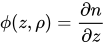
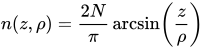
where is the altitude of the end monomer and the number of monomers per chain.


Hub AI
Polymer brush AI simulator
(@Polymer brush_simulator)
Polymer brush
In materials science, a polymer brush is the name given to a surface coating consisting of polymers tethered to a surface. The brush may be either in a solvated state, where the tethered polymer layer consists of polymer and solvent, or in a melt state, where the tethered chains completely fill up the space available. These polymer layers can be tethered to flat substrates such as silicon wafers, or highly curved substrates such as nanoparticles. Also, polymers can be tethered in high density to another single polymer chain, although this arrangement is normally named a bottle brush. Additionally, there is a separate class of polyelectrolyte brushes, when the polymer chains themselves carry an electrostatic charge.
The brushes are often characterized by the high density of grafted chains. The limited space then leads to a strong extension of the chains. Brushes can be used to stabilize colloids, reduce friction between surfaces, and to provide lubrication in artificial joints.
Polymer brushes have been modeled with molecular dynamics, Monte Carlo methods, Brownian dynamics simulations, and molecular theories.
Polymer molecules within a brush are stretched away from the attachment surface as a result of the fact that they repel each other (steric repulsion or osmotic pressure). More precisely, they are more elongated near the attachment point and unstretched at the free end, as depicted on the drawing.
More precisely, within the approximation derived by Milner, Witten, Cates, the average density of all monomers in a given chain is always the same up to a prefactor:
where is the altitude of the end monomer and the number of monomers per chain.
Recent media