


Community hub
Recent from talks
Contribute something to knowledge base
Content stats: 0 posts, 0 articles, 1 media, 0 notes
Members stats: 0 subscribers, 0 contributors, 0 moderators, 0 supporters
Subscribers
Supporters
Contributors
Moderators
Hub AI
Polyunsaturated fat AI simulator
(@Polyunsaturated fat_simulator)
Hub AI
Polyunsaturated fat AI simulator
(@Polyunsaturated fat_simulator)
Polyunsaturated fat
In biochemistry and nutrition, a polyunsaturated fat is a fat that contains a polyunsaturated fatty acid (abbreviated PUFA), which is a subclass of fatty acid characterized by a backbone with two or more carbon–carbon double bonds. Some polyunsaturated fatty acids are essentials. Polyunsaturated fatty acids are precursors to and are derived from polyunsaturated fats, which include drying oils.
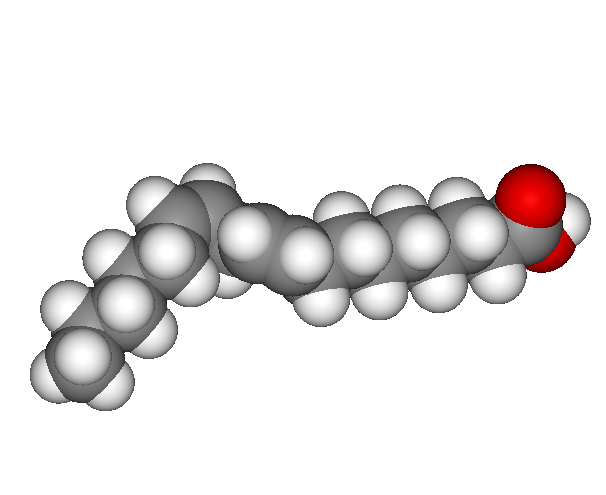
The position of the carbon-carbon double bonds in carboxylic acid chains in fats is designated by Greek letters. The carbon atom closest to the carboxyl group is the alpha carbon, the next carbon is the beta carbon and so on. In fatty acids the carbon atom of the methyl group at the end of the hydrocarbon chain is called the omega carbon because omega is the last letter of the Greek alphabet. Omega-3 fatty acids have a double bond three carbons away from the methyl carbon, whereas omega-6 fatty acids have a double bond six carbons away from the methyl carbon. The illustration below shows the omega-6 fatty acid, linoleic acid.
Polyunsaturated fatty acids can be classified in various groups by their chemical structure:
Based on the length of their carbon backbone, they are sometimes classified in two groups: All feature pentadiene groups.
PUFAs with 18 carbon atoms, which are the most common variety, are not produced by mammals. Since they have important dietary functions, their biosynthesis has received much attention. Plants produce PUFAs from oleic acid. Key enzymes are called fatty acid desaturases, which introduce additional double bonds. Desaturases convert oleic acid into linoleic acid the precursor to alpha-linolenic acid, gamma-linolenic acid and dihomo-gamma-linolenic acid.
Industrial PUFAs are generally obtained by hydrolysis of fats that contain PUFAs. The process is complicated by the sensitive nature of PUFAs, leading to side reactions and colorization. Thus, steam hydrolysis often fails for this reason. Alkaline hydrolysis of fats followed by acidification is expensive. Lipases, a family of enzymes, show potential as mild and green catalysts for the production of PUFAs from triglycerides.
In general, outside of dietary contexts, PUFAs are undesirable components of vegetable oils, so there is great interest in their removal from, say, olive oil. One technology for lowering the PUFA contact is by selective formation of derivatives with ureas.
From the perspective of chemical analysis, PUFA's have high iodine numbers. These high values are simply a reflection of the fact that PUFAs are polyunsaturated. Hydrogenation of PUFAs gives less unsaturated derivatives. For unsaturated products from partial hydrogenation often contain some trans isomers. The trans monounsaturated C20 species elaidic acid can be prepared in this way.
Polyunsaturated fat
In biochemistry and nutrition, a polyunsaturated fat is a fat that contains a polyunsaturated fatty acid (abbreviated PUFA), which is a subclass of fatty acid characterized by a backbone with two or more carbon–carbon double bonds. Some polyunsaturated fatty acids are essentials. Polyunsaturated fatty acids are precursors to and are derived from polyunsaturated fats, which include drying oils.
The position of the carbon-carbon double bonds in carboxylic acid chains in fats is designated by Greek letters. The carbon atom closest to the carboxyl group is the alpha carbon, the next carbon is the beta carbon and so on. In fatty acids the carbon atom of the methyl group at the end of the hydrocarbon chain is called the omega carbon because omega is the last letter of the Greek alphabet. Omega-3 fatty acids have a double bond three carbons away from the methyl carbon, whereas omega-6 fatty acids have a double bond six carbons away from the methyl carbon. The illustration below shows the omega-6 fatty acid, linoleic acid.
Polyunsaturated fatty acids can be classified in various groups by their chemical structure:
Based on the length of their carbon backbone, they are sometimes classified in two groups: All feature pentadiene groups.
PUFAs with 18 carbon atoms, which are the most common variety, are not produced by mammals. Since they have important dietary functions, their biosynthesis has received much attention. Plants produce PUFAs from oleic acid. Key enzymes are called fatty acid desaturases, which introduce additional double bonds. Desaturases convert oleic acid into linoleic acid the precursor to alpha-linolenic acid, gamma-linolenic acid and dihomo-gamma-linolenic acid.
Industrial PUFAs are generally obtained by hydrolysis of fats that contain PUFAs. The process is complicated by the sensitive nature of PUFAs, leading to side reactions and colorization. Thus, steam hydrolysis often fails for this reason. Alkaline hydrolysis of fats followed by acidification is expensive. Lipases, a family of enzymes, show potential as mild and green catalysts for the production of PUFAs from triglycerides.
In general, outside of dietary contexts, PUFAs are undesirable components of vegetable oils, so there is great interest in their removal from, say, olive oil. One technology for lowering the PUFA contact is by selective formation of derivatives with ureas.
From the perspective of chemical analysis, PUFA's have high iodine numbers. These high values are simply a reflection of the fact that PUFAs are polyunsaturated. Hydrogenation of PUFAs gives less unsaturated derivatives. For unsaturated products from partial hydrogenation often contain some trans isomers. The trans monounsaturated C20 species elaidic acid can be prepared in this way.
Recent media
Recent media