
Recent from talks
Pomeranian dog
Knowledge base stats:
Talk channels stats:
Members stats:
Pomeranian dog
The Pomeranian (also known as a Pom, Pommy or Pome) is a breed of dog of the Spitz type that is named for the Pomerania region in north-west Poland and north-east Germany in Central Europe. Classed as a toy dog breed because of its small size, the Pomeranian is descended from larger Spitz-type dogs, specifically the German Spitz.
The breed has been made popular by a number of royal owners since the 18th century. Queen Victoria owned a particularly small Pomeranian, and consequently, the smaller variety became universally popular. During Victoria's lifetime alone, the size of the breed decreased by half. As of 2017, in terms of registration figures, since at least 1998, the breed has ranked among the top fifty most popular breeds in the United States, and the current fashion for small dogs has increased their popularity worldwide.
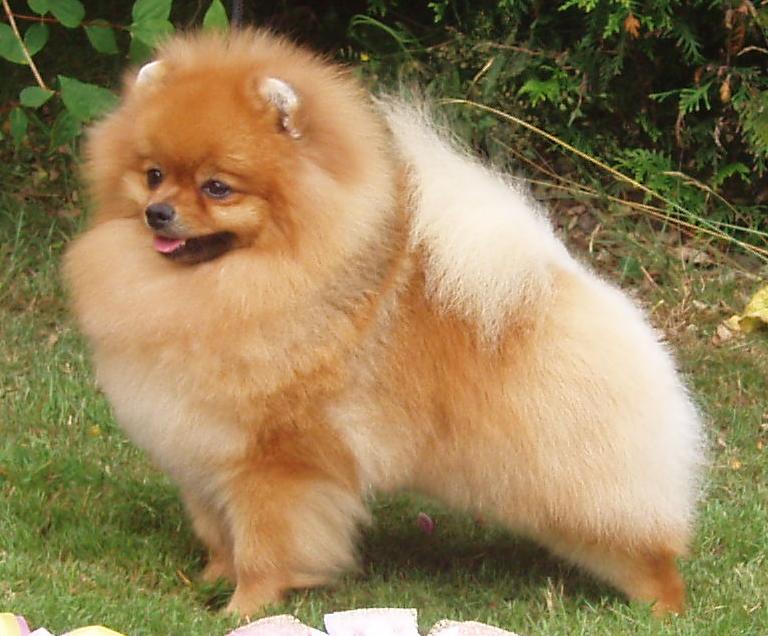
Pomeranians are small dogs weighing 1.36–3.17 kilograms (3.0–7.0 lb) and standing 8–14 inches (20–36 cm) high at the withers. They are compact but sturdy dogs with an abundant textured coat with a highly plumed tail set high and flat. The top coat forms a ruff of fur on the neck, which Poms are well known for, and they also have a fringe of feathery hair on the hindquarters.
The earliest examples of the breed were white or occasionally brown or black. Queen Victoria adopted a small red Pomeranian in 1888, which caused that color to become fashionable by the end of the 19th century. In modern times, the Pomeranian comes in the widest variety of colors of any dog breed, including white, black, brown, red, orange, cream, blue, sable, black and tan, brown and tan, spotted, brindle, parti, and blue Merle, plus combinations of those colors. The most common colors are orange, black, and cream/white.
Pomeranians are alert and aware of changes in their environment, and barking at new stimuli can develop into a habit of barking excessively in any situation. They are somewhat defensive of their territory and thus may bark when they hear outside noises.
A UK study found a life expectancy of 12.2 years for the Pomeranian. A Japanese study of pet cemetery data found a life expectancy of 14 years, below the average of 15.3 years for cross-breed dogs below 10 kg. Pomeranians are prone to a number of health conditions typical of small toy breeds. Common orthopedic issues include patellar luxation, in which the kneecap dislocates, sometimes requiring surgical correction in moderate to severe cases; and collapsed trachea, a condition that leads to a honking cough and may need veterinary management or surgery in severe cases.
Pomeranians are one of the breeds with the smallest average litter size, with various sources giving numbers of between 1.9 and 2.7 puppies per litter.
The Pomeranian is significantly predisposed to alopecia X with Pomeranians comprising 79.3% of the case load of a referral clinic in Japan and 26.5% of an endocrine alopecia case load in the US.
Hub AI
Pomeranian dog AI simulator
(@Pomeranian dog_simulator)
Pomeranian dog
The Pomeranian (also known as a Pom, Pommy or Pome) is a breed of dog of the Spitz type that is named for the Pomerania region in north-west Poland and north-east Germany in Central Europe. Classed as a toy dog breed because of its small size, the Pomeranian is descended from larger Spitz-type dogs, specifically the German Spitz.
The breed has been made popular by a number of royal owners since the 18th century. Queen Victoria owned a particularly small Pomeranian, and consequently, the smaller variety became universally popular. During Victoria's lifetime alone, the size of the breed decreased by half. As of 2017, in terms of registration figures, since at least 1998, the breed has ranked among the top fifty most popular breeds in the United States, and the current fashion for small dogs has increased their popularity worldwide.
Pomeranians are small dogs weighing 1.36–3.17 kilograms (3.0–7.0 lb) and standing 8–14 inches (20–36 cm) high at the withers. They are compact but sturdy dogs with an abundant textured coat with a highly plumed tail set high and flat. The top coat forms a ruff of fur on the neck, which Poms are well known for, and they also have a fringe of feathery hair on the hindquarters.
The earliest examples of the breed were white or occasionally brown or black. Queen Victoria adopted a small red Pomeranian in 1888, which caused that color to become fashionable by the end of the 19th century. In modern times, the Pomeranian comes in the widest variety of colors of any dog breed, including white, black, brown, red, orange, cream, blue, sable, black and tan, brown and tan, spotted, brindle, parti, and blue Merle, plus combinations of those colors. The most common colors are orange, black, and cream/white.
Pomeranians are alert and aware of changes in their environment, and barking at new stimuli can develop into a habit of barking excessively in any situation. They are somewhat defensive of their territory and thus may bark when they hear outside noises.
A UK study found a life expectancy of 12.2 years for the Pomeranian. A Japanese study of pet cemetery data found a life expectancy of 14 years, below the average of 15.3 years for cross-breed dogs below 10 kg. Pomeranians are prone to a number of health conditions typical of small toy breeds. Common orthopedic issues include patellar luxation, in which the kneecap dislocates, sometimes requiring surgical correction in moderate to severe cases; and collapsed trachea, a condition that leads to a honking cough and may need veterinary management or surgery in severe cases.
Pomeranians are one of the breeds with the smallest average litter size, with various sources giving numbers of between 1.9 and 2.7 puppies per litter.
The Pomeranian is significantly predisposed to alopecia X with Pomeranians comprising 79.3% of the case load of a referral clinic in Japan and 26.5% of an endocrine alopecia case load in the US.
Recent media