Recent from talks
Nothing was collected or created yet.
Poppy Flowers
View on Wikipedia| Poppy Flowers | |
|---|---|
| Artist | Vincent van Gogh |
| Year | 1887 |
| Catalogue | |
| Type | Still life |
| Medium | Oil on canvas |
| Dimensions | 65 cm × 54 cm (26 in × 21 in) |
| Location | Switzerland |
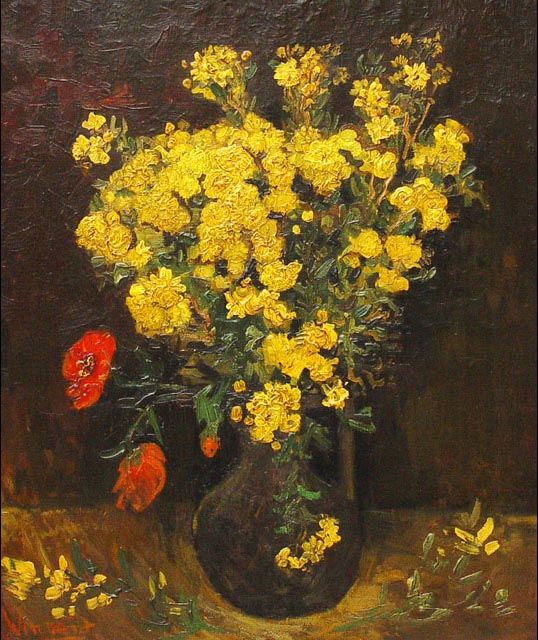
Poppy Flowers (also known as Vase And Flowers and Vase with Viscaria) is a painting by Vincent van Gogh with an estimated value of US$55 million[1] which was stolen from Cairo's Mohamed Mahmoud Khalil Museum twice; first in 1977 (and recovered after a decade), then again in August 2010.[2]
The painting is small, measuring 65 x 54 cm, and depicts yellow and red poppy flowers.[3] It is believed that van Gogh painted it in 1887, three years before his suicide.[4] The painting, which is of a vase of yellow and red poppies, contrasted against a dark ground is a reflection of Van Gogh's deep admiration for Adolphe Monticelli, an older painter whose work influenced him when he first saw it in Paris in 1886.[5]
1977 theft
[edit]The painting had been stolen from Cairo's Mohamed Mahmoud Khalil Museum on June 4, 1977, and was recovered ten years later[4] in Kuwait.[6]
2010 theft
[edit]The painting was once again stolen from the same museum in August 2010. Egyptian officials erroneously believed they had recovered the painting only hours after its theft when two Italian suspects attempted to board a plane to Italy at Cairo International Airport.[7]
Reaction to theft
[edit]In October 2010, an Egyptian court found 11 culture ministry employees, including Deputy Culture Minister Mohsen Shaalan, guilty of negligence and professional delinquency.[2] Each was sentenced to three years in jail but subsequently released on bail of about $1,750 pending appeal.[2] After the appeal, Shaalan served a one-year prison term ending in 2013.[8]
Egyptian billionaire Naguib Sawiris put up a $175,000 or 1,000,000 Egyptian pounds reward for information leading to the return of the painting.[9]
See also
[edit]References
[edit]- ^ "Egypt culture chief sleepless over Van Gogh theft". Reuters. August 24, 2010. Retrieved August 26, 2010.
- ^ a b c "Egyptian ministry officials jailed over Van Gogh theft". BBC News. 12 October 2010.
- ^ "Egypt Court Jails Officials Over Van Gogh's "Vase with Viscaria" Stolen in August". artdaily.org. April 22, 2011. Retrieved 2011-05-06.
- ^ a b "Van Gogh painting stolen in Cairo". BBC News. 21 August 2010. Retrieved 21 August 2010.
- ^ Staff (2010-08-22). "Stolen Van Gogh painting still missing". The Guardian. ISSN 0261-3077. Retrieved 2024-01-03.
- ^ "Egyptian minister says Van Gogh picture still missing". BBC News. 22 August 2010. Retrieved 22 August 2010.
- ^ "Faulty alarms blamed for Van Gogh theft in Egypt". BBC News. 22 August 2010. Retrieved 22 August 2010.
- ^ Elkamel, Sara. "Egypt's jailed culture ministry official creates art behind bars". Ahram Online. Retrieved 5 April 2020.
- ^ "Egyptian tycoon offers reward for Van Gogh theft". Reuters. 25 August 2010. Retrieved 19 June 2016.
External links
[edit]Poppy Flowers
View on GrokipediaDescription and Provenance
Artistic Characteristics
"Poppy Flowers," also known as "Vase with Viscaria," is an oil on canvas still life measuring 65 by 54 centimeters, featuring a bouquet of vibrant poppy flowers arranged in a simple vase. The composition centers the floral arrangement, with the stems and blooms filling much of the frame, evoking a sense of immediacy and natural abundance typical of Van Gogh's flower studies during his Paris period in 1886.[8][9] The painting showcases Van Gogh's post-impressionist style through bold, expressive use of color, with the intense reds of the poppies contrasted against a dark, textured background that heightens their luminosity and draws the viewer's eye to the delicate petals and leaves. Brushwork is a defining characteristic, employing varied techniques: finer, more controlled strokes to render the intricate details of the flowers, juxtaposed with thicker, impulsive impasto applications in the background that impart movement and emotional depth.[8][9] This approach reflects Van Gogh's evolution in Paris, where exposure to impressionist exhibitions and artists like Adolphe Monticelli prompted a shift from his earlier muted earth tones to brighter, more saturated palettes, while retaining his distinctive rhythmic contours and textural emphasis to convey inner vitality rather than mere optical replication. The work's simplicity in subject belies its technical innovation, prioritizing subjective expression over realistic depiction, a hallmark that distinguishes Van Gogh's contributions to modern art.[8]Creation and Early History
Vincent van Gogh painted Poppy Flowers, also known as Vase with Viscaria, in Paris during the summer of 1886. This oil-on-canvas still life, measuring 65 by 54 centimeters, features a bouquet of red and pink viscaria (Lychnis viscaria) flowers arranged in a simple vase against a dark background, exemplifying Van Gogh's transition to brighter palettes and looser brushwork amid his immersion in the Parisian art scene.[10] Living with his brother Theo, an art dealer, Van Gogh produced numerous flower still lifes during this period, often using affordable market flowers as subjects due to the high cost of hiring models.[11] The work reflects influences from Impressionists like Claude Monet and the Japanese prints Van Gogh collected, evident in the vivid coloration and decorative composition.[8] Catalogued as F324a in Jacob Baart de la Faille's standard oeuvre, it dates precisely to Van Gogh's early Paris phase, before his move to Arles in 1888.[10] Following Van Gogh's death in 1890, the painting passed through the estate managed by Theo van Gogh and later his widow Jo van Gogh-Bonger, entering the European art market. It was acquired in Paris by Egyptian businessman Mohamed Mahmoud Khalil, likely in the 1920s.[12] Khalil, who married Frenchwoman Emilienne Chastrau, built a collection of Impressionist and Post-Impressionist works, including this piece, which his widow donated to establish the Mohamed Mahmoud Khalil Museum in Cairo after his death in 1953.[12]Acquisition and Museum Display
Poppy Flowers, an 1887 oil on canvas by Vincent van Gogh, was acquired by Egyptian businessman and diplomat Mohamed Mahmoud Khalil Pasha as part of his extensive collection of European Impressionist artworks assembled primarily before 1928.[13] Khalil, who served as Egypt's minister of finance, died on 13 November 1953.[14] His widow, Ethne Habert de Boulogne (also known as Emiline Lock), donated their Beaux-Arts style villa in Giza—overlooking the Nile River—and the entire collection of approximately 300 paintings and 50 sculptures to the Egyptian state upon her death in 1960.[12][15] This bequest established the Mohamed Mahmoud Khalil Museum, which opened to the public on 23 July 1962 as a showcase for 19th- and 20th-century European art.[16] The painting was displayed prominently in the museum's opulent interiors, which retained much of the original residential layout, including gilded salons and period furnishings, highlighting its status as one of the institution's most valuable pieces estimated at $55 million.[17] It remained on view in the museum's permanent collection until its theft on 7 June 1977, despite the venue's reputation for lax security even at inception.[18] Following recovery around 1987, Poppy Flowers was reinstalled with purported improvements to protective measures, continuing public exhibition until its second theft on 21 August 2010.[19] The incident prompted indefinite closure of the museum for security renovations; it reopened on 4 April 2021 without the artwork, which remains missing.[13]Thefts and Recoveries
1977 Theft
In 1977, Vincent van Gogh's Poppy Flowers (1887), also known as Vase with Viscaria or Vase and Flowers, was stolen from the Mohamed Mahmoud Khalil Museum in Cairo, Egypt. The museum, established to house the Impressionist collection bequeathed by Egyptian Prime Minister Mohamed Mahmoud Khalil Pasha upon his death in 1957, featured the painting as a centerpiece among works by artists including Corot, Degas, Monet, and Renoir. Specific details of the theft, including the exact date and method of entry, have not been publicly disclosed by Egyptian authorities, contributing to the murkiness surrounding the incident.[18][20] The theft occurred during a period when the museum's security measures were evidently inadequate, as evidenced by the subsequent 2010 incident at the same location. Reports indicate the canvas was removed from its frame, though accounts vary on whether it involved breaking through a window or other means, with some describing it as a bold operation reminiscent of a cinematic heist. No arrests were immediately made, and the perpetrators' identities remain unknown, reflecting limited transparency from official investigations at the time. The event highlighted vulnerabilities in protecting high-value art in non-Western institutions, where enforcement and documentation practices differed from European or American norms.[13][19]Recovery of 1977 Theft
Following the 1977 theft of Vincent van Gogh's Poppy Flowers from Cairo's Mohamed Mahmoud Khalil Museum, Egyptian authorities conducted an investigation but disclosed few details about the circumstances of the crime.[17] The painting, valued at the time in the millions, was reportedly located in Kuwait through an extensive search operation involving international cooperation.[21] It was subsequently repatriated to Egypt, though timelines for the recovery vary across reports, with some indicating it occurred approximately two years after the theft in 1978 or later.[22] [23] The opacity surrounding the recovery reflects broader patterns of limited transparency in Egyptian handling of the incident, with no public arrests or prosecutions linked to the theft documented in available records.[17] Upon return, the artwork was restored to the museum's collection, where it remained on display until the subsequent 2010 theft.[18] This event underscored vulnerabilities in the museum's security, contributing to criticisms of inadequate protective measures for high-value items.[24]2010 Theft
On August 21, 2010, Vincent van Gogh's Poppy Flowers (also titled Vase with Flowers), an 1887 oil painting depicting a vase of yellow poppies, was stolen in broad daylight from the Mahmoud Khalil Museum in Cairo, Egypt.[25] [26] The theft occurred during museum hours, with visitors present, highlighting severe lapses in security protocols.[27] Thieves accessed the painting, which was displayed on the second floor, by climbing onto a nearby sofa and using a cutter to slice it from its frame, leaving the canvas detached and the frame damaged.[28] An alarm triggered during the incident, but museum guards dismissed it as a malfunction, possibly mistaking it for a false alert caused by an animal or technical error; in reality, none of the museum's alarms were operational at the time.[27] [29] Of the museum's 43 security cameras, only 10 were functional, and staffing was inadequate with limited guards on duty.[29] The theft was discovered the following day, August 22, when museum staff noticed the empty frame.[17] Egyptian authorities estimated the painting's value at approximately $55 million, making it one of the most valuable artworks stolen in the region.[17] [28] In the immediate aftermath, a security official at the museum was arrested on suspicion of complicity, as investigations pointed to insider knowledge facilitating the quick extraction.[30] The painting, previously recovered from a 1977 theft at the same museum, has remained missing since 2010, with no confirmed sightings or recoveries reported.[26] [31]Investigations and Security Failures
Probes into the Thefts
Following the 1977 theft of Poppy Flowers from the Mohamed Mahmoud Khalil Museum in Cairo, Egyptian authorities conducted an investigation, but specific details remain scarce and undisclosed in public records. The painting was recovered approximately two years later in Kuwait, suggesting some level of international cooperation, though no perpetrators were publicly identified or prosecuted.[17][32] In contrast, the probe into the August 21, 2010, theft—also from the same museum during opening hours—focused extensively on internal security lapses. Egypt's prosecutor general, Abdel-Meguid Mahmoud, oversaw the inquiry, which revealed that none of the museum's 54 theft alarms were operational and only 7 out of 47 surveillance cameras were functioning at the time of the incident. Guards' patrol routines failed to meet basic security protocols, exacerbating vulnerabilities.[32][17] The investigation led to immediate accountability measures, including the suspension of the museum director, public fine arts sector officials, and other staff for negligence, with 15 individuals barred from leaving the country pending further review. Police examined available camera footage and interrogated employees, while border controls at air and sea ports were intensified to prevent smuggling. A senior culture ministry official was arrested for overseeing inadequate security arrangements.[33][34] By October 2010, the probe culminated in jail sentences for several Egyptian ministry officials directly responsible for the museum's security shortcomings, underscoring systemic failures rather than progress in apprehending the thief, who used a box cutter to excise the canvas. Despite these efforts, no leads on the perpetrator or the artwork's location have yielded recovery, with the painting remaining missing as of 2025.[25]Criticisms of Museum and Government Handling
The Mohamed Mahmoud Khalil Museum faced significant criticism for its inadequate security measures following the 2010 theft of Poppy Flowers, which occurred on August 21 during public opening hours when a thief cut the canvas from its frame without triggering alarms. An official investigation revealed that none of the museum's alarm systems were functional, and only 7 out of 43 surveillance cameras were operational at the time, allowing the perpetrator to escape undetected despite the museum's location in an upscale Cairo neighborhood.[32][35] These lapses were attributed to chronic underfunding and neglect of maintenance, with museum staff reportedly aware of the vulnerabilities but unable to address them due to bureaucratic inertia.[36] Critics highlighted the museum's failure to learn from the 1977 theft of the same painting, which had been recovered in 1978 after similar security shortcomings enabled the initial removal. Despite the prior incident, no substantial upgrades—such as reinforced frames, motion sensors, or increased staffing—were implemented, reflecting a pattern of complacency in Egypt's state-run cultural institutions. Art security experts noted that the Khalil Museum, housing a private collection donated in 1975, operated with minimal oversight, lacking even basic protocols like visitor bag checks or perimeter patrols that are standard in comparable venues.[17][33] Egyptian government handling drew rebukes for its delayed and ineffective response, including the dismissal of three security guards and the arrest of two museum employees on suspicion of complicity, yet the painting remains unrecovered over a decade later. Culture Minister Farouk Hosni publicly acknowledged the theft but faced accusations of downplaying institutional negligence to avoid broader scrutiny of Egypt's antiquities management amid rising thefts from other sites, such as the 2009 incident at the Mohammed Ali Museum. Independent observers, including Interpol liaisons, criticized the government's opacity, with limited forensic analysis of the crime scene and no international alerts issued promptly, potentially allowing the artwork to enter black markets.[23][12] This approach contrasted with more proactive recoveries in other nations, underscoring systemic underinvestment in cultural heritage protection, where annual budgets for museum security were dwarfed by allocations for tourism promotion.[37]Theories on Perpetrators
The 1977 theft of Poppy Flowers occurred amid the chaos of the Mohamed Mahmoud Khalil Museum's relocation to a new building in Cairo, suggesting opportunistic exploitation of disorganized security rather than a sophisticated external operation.[18] Recovery of the painting in Kuwait approximately one year later implicated a small group of local actors, with unconfirmed reports pointing to a trio of Egyptians as potential perpetrators who may have transported it across borders for resale.[18] No arrests or formal charges were publicly documented, leaving the exact roles—whether insiders facilitating access or external thieves capitalizing on lax oversight—unresolved, though the rapid recovery implies limited involvement of international networks.[17] In contrast, theories surrounding the 2010 theft emphasize insider complicity due to the brazen execution: a single perpetrator sliced the canvas from its frame in broad daylight during museum hours, evading detection despite the presence of guards and visitors.[12] Egyptian Interior Minister Habib al-Adly explicitly stated that a museum employee was the most probable culprit, citing premeditated knowledge of the facility's vulnerabilities, including only 7 of 43 security cameras functioning and none of 54 alarms operational.[38] [31] This assessment aligned with an official probe revealing "flagrant shortcomings" in protocols, such as guards failing to patrol adequately, which enabled the theft without triggering alerts.[39] Initial suspicions briefly fell on two Italian tourists detained at Cairo International Airport hours after the discovery, who had visited the museum and exhibited suspicious behavior, but they were released without charges as the painting was not recovered from them, shifting focus back to internal actors.[40] [31] While 11 culture ministry employees, including senior officials, were convicted of negligence in October 2010 and sentenced to one-year terms (later suspended), no direct perpetrator has been identified or prosecuted for the theft itself, fueling speculation of a cover-up or involvement by protected insiders possibly linked to resale on black markets.[25] The absence of ransom demands or subsequent sightings supports theories of targeted acquisition by private collectors rather than opportunistic crime, though evidentiary gaps persist due to the Egyptian authorities' handling.[18]Reactions and Impact
Media and Public Response
The 2010 theft of Vincent van Gogh's Poppy Flowers from Cairo's Mohamed Mahmoud Khalil Museum garnered widespread international media attention, with outlets such as the BBC, The Guardian, and The New York Times highlighting the brazen nature of the daytime heist, where the canvas was cut from its frame undetected.[33][26][41] Reports emphasized the painting's estimated $50–55 million value and its prior theft in 1977, framing the incident as a symptom of systemic vulnerabilities in Egyptian cultural institutions.[17][42] Media coverage frequently criticized the museum's security lapses, including non-functional alarms, only seven operational out of 43 surveillance cameras, and the absence of immediate intervention despite visitors present.[27][32] Egyptian state media and officials initially claimed a swift recovery at Cairo International Airport, a statement later retracted, amplifying perceptions of incompetence.[43] Bloomberg and CBS News drew parallels to a 2009 theft of 18 artifacts from the nearby Muhammad Ali Palace, underscoring recurring failures in perimeter controls and internal safeguards.[44][32] Public reaction in Egypt and abroad manifested as outrage over the loss of a national treasure, with local outlets like Egypt Independent decrying the exposure of "poor security conditions in Egyptian museums" and calling for accountability.[45] International commentators, including in The Christian Science Monitor, portrayed the theft as emblematic of "easy" exploitation by thieves, fueling debates on underfunding and mismanagement of heritage sites amid Egypt's political instability pre-Arab Spring.[36] Arrests of a senior culture ministry official and guards followed, reflecting public and official pressure, though no recovery ensued.[34][37] The 1977 theft received comparatively muted contemporary coverage but was invoked in 2010 reports to underscore the museum's history of vulnerability, with recovery in Kuwait after about a year noted as a rare positive outcome amid otherwise lax protocols.[17][33] Overall, the incidents prompted broader discourse on art security, though skepticism persists regarding government reforms given the painting's ongoing absence.[46]Art World and Cultural Implications
The repeated thefts of Vincent van Gogh's Poppy Flowers (1887) from Egypt's Mohamed Mahmoud Khalil Museum exposed systemic vulnerabilities in global art security, prompting art world experts to advocate for enhanced international standards. The 2010 daytime heist, involving the canvas being cut from its frame, revealed operational failures such as non-functional alarms and only seven of 43 surveillance cameras working, leading to convictions for negligence against 11 Egyptian culture ministry employees.[25][18] These incidents underscored the risks of housing multimillion-dollar Impressionist works in under-resourced institutions, potentially deterring international loans and collaborations with museums perceived as high-risk.[12] In the art market, the unrecovered painting's status has fueled discussions on the opacity of illicit trade networks, where stolen masterpieces like this $55 million Van Gogh often evade detection through private sales or underground collections. Art crime analysts note that Van Gogh's popularity makes his works prime targets, with recovery rates for such thefts remaining low despite Interpol listings, emphasizing the need for proactive measures like blockchain provenance tracking and stricter export controls.[36] The case illustrates how thefts diminish public access to canonical pieces, affecting scholarly analysis of van Gogh's Paris-period still lifes, which exemplify his bold use of color and post-Impressionist experimentation. Culturally, the losses represented a national embarrassment for Egypt, as the painting—donated to the state by industrialist Mohamed Mahmoud Khalil—symbolized aspirational Western cultural acquisition amid postcolonial institution-building. Public outrage following the 2010 theft, amplified by media coverage, highlighted governmental lapses in safeguarding donated heritage, with billionaire Naguib Sawiris offering a $175,000 reward for its return, reflecting private initiative compensating for official shortcomings.[18] The events, occurring amid rising regional instability, reinforced perceptions of cultural patrimony at risk in politically volatile contexts, prompting broader debates on equitable global resource allocation for art protection.[17]Economic and Legal Consequences
The 2010 theft of Poppy Flowers from the Mahmoud Khalil Museum in Cairo resulted in legal accountability primarily for negligence rather than the theft itself. An Egyptian court convicted 11 employees of the culture ministry, including security personnel and senior officials, of failing to prevent the heist due to inadequate safeguards; they were sentenced to three years in prison on October 12, 2010.[25][47] Initial probes revealed critical lapses, such as only 7 of 43 surveillance cameras operational and non-functional alarms, prompting charges against 15 officials for dereliction of duty.[39][48] No perpetrators of the actual theft were apprehended or prosecuted, mirroring the 1977 incident where the painting was recovered approximately two years later without reported arrests of thieves.[37] Economically, the 2010 loss deprived Egypt of a national asset valued at $55 million, donated to the state by industrialist Mahmoud Khalil in 1978 following its prior recovery.[17][49] The museum, reliant on public visitation for cultural promotion, faced immediate operational disruptions, though quantified impacts on tourism or revenue remain undocumented in official reports. The 1977 theft incurred temporary costs for recovery efforts but no lasting financial detriment, as the artwork was returned intact by 1979.[37] Broader fiscal repercussions included heightened scrutiny of state museum budgets, leading to unquantified expenditures on post-theft security audits and potential upgrades across Egyptian institutions.[39]Current Status
Valuation and Insurance
The Poppy Flowers painting, also titled Vase and Flowers, was valued at approximately $50 million by art experts and Egyptian officials following its 2010 theft from the Mohamed Mahmoud Khalil Museum.[26] [41] Egypt's Culture Minister Farouk Hosni specifically estimated its worth at $55 million, citing its status as a rare Van Gogh still life from 1887 depicting a vase of yellow poppies.[17] These figures reflect market appraisals for comparable Van Gogh floral works, though one analysis from a Van Gogh specialist site questioned the $50 million estimate as potentially inflated given the painting's modest size of about 25.5 by 21 inches.[29] No public records detail an insurance policy specifically covering the Poppy Flowers at the state-run museum, and Egyptian authorities have not reported any insurance claims or payouts related to the theft.[50] The artwork's prior theft in 1977 and recovery in 1987 without noted insurance involvement suggests limited or undisclosed coverage for high-value items in the collection.[12] As a government-owned piece, its protection relied primarily on institutional security rather than commercial insurance, contributing to criticisms of vulnerability in Egypt's cultural heritage management.[36] Current valuation remains speculative due to the painting's stolen status, which prohibits legal sale and complicates authentication on the black market; however, rising auction prices for Van Gogh still lifes—such as Still Life: Vase with Daisies and Poppies fetching $61.8 million in 2014—indicate potential appreciation beyond 2010 estimates.[51] Recovery efforts by Interpol and Egyptian officials continue without reliance on insurance-funded rewards or private investigators.[31]Ongoing Search Efforts
The search for Poppy Flowers persists through international mechanisms established shortly after the August 21, 2010, theft from Cairo's Mohamed Mahmoud Khalil Museum. Egyptian authorities immediately alerted Interpol, which disseminated notifications to member countries to aid in detection and recovery efforts.[52][53] The painting was entered into Interpol's Stolen Works of Art database, enabling real-time sharing of images and details with law enforcement worldwide to flag any border crossings, auction appearances, or illicit transactions.[17] Ongoing monitoring involves collaboration between Egyptian police, Interpol, and private art loss registries such as the Art Loss Register, which cross-reference sales records and provenance documents against known stolen items.[12] Despite these protocols, no verified sightings or recoveries have occurred since 2010, with experts noting the challenges posed by the painting's likely export to black-market networks outside Egypt.[54] As of October 2025, the work remains unresolved in Interpol's records and is flagged in global databases, underscoring persistent vigilance amid low recovery prospects for high-value stolen masterpieces held privately.[55][56]Broader Lessons on Art Security
The theft of Poppy Flowers from the Mohamed Mahmoud Khalil Museum underscored the critical need for functional alarm systems in securing high-value artworks, as investigators determined that faulty alarms failed to alert staff during the August 21, 2010, incident, allowing thieves to cut the canvas from its frame undetected.[27] Similar lapses contributed to the painting's prior theft in 1977, highlighting how repeated failures in basic perimeter defenses can enable opportunistic crimes in under-resourced institutions.[17] A key lesson emerged regarding insider threats, with Egyptian officials suspecting museum employees or accomplices due to the absence of forced entry and familiarity with security routines, prompting arrests of 11 culture ministry personnel for negligence in October 2010.[25] This case illustrated the necessity of rigorous employee vetting, background checks, and access controls to mitigate risks from those with internal knowledge, a vulnerability echoed in other art heists where staff complicity facilitated breaches.[38] The absence of operational CCTV footage and inadequate guard presence further exposed deficiencies in human oversight, as the museum relied on outdated protocols that allowed the theft to go unnoticed for hours.[32] In response, Egypt's Culture Ministry announced plans for a centralized control room to monitor national museums, signaling a shift toward integrated surveillance networks, though implementation challenges in resource-constrained environments often delay such reforms.[46] Physically securing artworks against extraction methods, such as embedding canvases in unbreakable frames or using tamper-evident glazing, proved essential, as the unarmored display of Poppy Flowers enabled its swift removal—a preventable flaw that post-theft analyses recommended addressing through standardized mounting protocols.[28] Broader implications include the imperative for regular security audits and funding prioritization in public institutions, particularly in regions with institutional underfunding, where the Khalil Museum's decade-long closure until 2021 reflected systemic inertia despite the $55 million loss.[57] These failures reinforce that prevention through layered defenses—combining technology, personnel, and policy—outweighs reactive recovery efforts, which in this instance yielded no leads despite international alerts.[22]References
- https://commons.wikimedia.org/wiki/File:Van_Gogh_-_Vase_mit_Pechnelken.jpeg
