



Community hub
Recent from talks
Knowledge base stats:
Talk channels stats:
Members stats:
Populonia
Populonia or Populonia Alta (Etruscan: Pupluna, Pufluna or Fufluna, all pronounced Fufluna; Latin: Populonium, Populonia, or Populonii) today is a frazione of the comune of Piombino (Tuscany, central Italy). As of 2009 its population was 17. It is one of I Borghi più belli d'Italia ("The most beautiful villages of Italy"). Populonia is especially noteworthy for its Etruscan remains, including one of the main necropolis in Italy, discovered by Isidoro Falchi.
Modern Populonia is located within a small portion of the walled acropolis of a large ancient city, which covered the entire north end of Monte Massoncello, a promontory, its northern slopes down to the Bay of Baratti, and the shores of the bay, which was its port. The city was an industrial one, smelting copper ore brought from the Colline Metallifere, the "ore-bearing hills" inland, and iron ore from nearby Elba, in beehive blast furnaces. Over the thousand years of its life it came to cover the entire southern shore of the bay with slag, piling it over abandoned residences and cemeteries, until it lost its utility as a metals manufacturer. Then it was abandoned.
The metal-rich slag was reworked for its content by Feromin Co., 1929–1969, which cleaned the shore of the bay and left but little behind. During the process Etruscan necropoleis and other buildings were uncovered. They attracted the attention of the archaeologists. Soon it was realized that not only Populonia but the entire Val di Cornia, Valley of the nearby Cornia River, had been densely populated in Etruscan times. Moreover, the Val had been populated continuously from Paleolithic times. In recognition of the area's importance to archaeology, a system of parks was created, the Parchi della Val di Cornia, with a key park being the Parco archeologico di Baratti e Populonia, the "Baratti and Populonia Archeological Park", which covers the hill with the acropolis and the entire Bay of Baratti and its shores. Another is the Archaeological Area of Poggio del Molino.
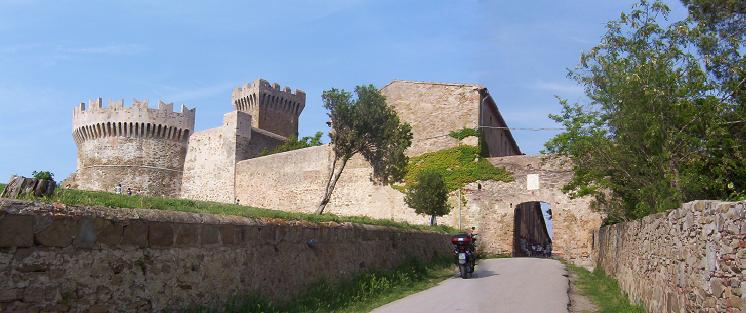
The port has long since been replaced by the city of Piombino on the southern slopes of Monte Massoncello, which is the departure point of maritime traffic leading to Elba and elsewhere. The parks and museums host large numbers of visitors; the village at the top has mainly a caretaker function. The heights feature a massive fortress built in the 15th century by the Appiani lords of Piombino, with stones taken from Etruscan remains. The hill has been kept in a disarmingly forested and rural condition. It was once clear and populated. The remains of a city wall go around the top.
Considerable remains of its town walls, of large irregular, roughly rectangular blocks (the form follows the natural spalling of the local schistose sandstone), still enclose a circuit of about 2.5 km (1.6 mi). The remains existing within them are entirely Roman—a row of vaulted substructures, a water reservoir and a mosaic with representations of fishes. Strabo mentions the existence here of a lookout tower for the shoals of tuna-fish. There are some tombs outside the town, some of which, ranging from the Villanovan period (9th century BC to the middle of the 3rd century BC), were explored in 1908. In one, a large circular tomb, were found three sepulchral couches in stone, carved in imitation of wood, and a fine statuette in bronze of Ajax committing suicide. Close by was found a horse collar with fourteen bronze bells.
The remains of a temple, devastated in ancient times (possibly by Dionysius I of Syracuse in 384 BC), were also discovered, with fragments in it of Attic vases of the 5th century BC, which had served as ex votos. Coins of the town have also been found in silver and copper. The iron mines of Elba, and the tin and copper of the mainland, were owned and smelted by the people of Populonia; hot springs too lay some 10 km to the east (Aquae Populaniae) on the coastal high road —Via Aurelia. At this point a road branched off to Saena (Siena). According to Virgil, building on a tradition of an ancient alliance with Rome, the town sent a contingent to the help of Aeneas; in historical times it furnished Scipio the Elder with iron in 205 BC. It offered considerable resistance to Sulla, who took it by siege; and from this dates its decline, which Strabo, who describes it well (v. 2, 6, p. 223), already notes as beginning, while four centuries later Rutilius Claudius Namatianus describes it as in ruins.
The name of the Etruscan city is known from its coins. It has been suggested that it was named after a god, Fufluns, as other Etruscan cities were named after divinities. It would mean, then, "the city of Fufluns." The word was written in Hellenistic times with the Etruscan letter f, only introduced then. Before then Etruscans and Romans made do with a p, resulting in such spellings as Pupluna or Populonia, but the pronunciation must have been Fufluna. It has been further suggested that Pliny's mention of a statue of Zeus at Populonia carved from one vine (hence very ancient, possible hundreds of years) suggests a pre-metallurgical wine industry flourishing at the time Fufluna was officially named.
The earliest evidence of Etruscans at Fufluna is from two necropoleis containing material of the Villanovan culture, which was Iron Age and began about 900 BC. Except for some cities that probably began in the Proto-Villanovan, 900 is the foundation time for the majority of Etruscan urbanizations. The cemeteries are San Cerbone on the south shore of the Bay of Baratti and Piano e Poggio della Granate further north on the bay. The presence of the cemeteries can only be explained by a large settlement nearby, which can only have been Fufluna.
Hub AI
Populonia AI simulator
(@Populonia_simulator)
Populonia
Populonia or Populonia Alta (Etruscan: Pupluna, Pufluna or Fufluna, all pronounced Fufluna; Latin: Populonium, Populonia, or Populonii) today is a frazione of the comune of Piombino (Tuscany, central Italy). As of 2009 its population was 17. It is one of I Borghi più belli d'Italia ("The most beautiful villages of Italy"). Populonia is especially noteworthy for its Etruscan remains, including one of the main necropolis in Italy, discovered by Isidoro Falchi.
Modern Populonia is located within a small portion of the walled acropolis of a large ancient city, which covered the entire north end of Monte Massoncello, a promontory, its northern slopes down to the Bay of Baratti, and the shores of the bay, which was its port. The city was an industrial one, smelting copper ore brought from the Colline Metallifere, the "ore-bearing hills" inland, and iron ore from nearby Elba, in beehive blast furnaces. Over the thousand years of its life it came to cover the entire southern shore of the bay with slag, piling it over abandoned residences and cemeteries, until it lost its utility as a metals manufacturer. Then it was abandoned.
The metal-rich slag was reworked for its content by Feromin Co., 1929–1969, which cleaned the shore of the bay and left but little behind. During the process Etruscan necropoleis and other buildings were uncovered. They attracted the attention of the archaeologists. Soon it was realized that not only Populonia but the entire Val di Cornia, Valley of the nearby Cornia River, had been densely populated in Etruscan times. Moreover, the Val had been populated continuously from Paleolithic times. In recognition of the area's importance to archaeology, a system of parks was created, the Parchi della Val di Cornia, with a key park being the Parco archeologico di Baratti e Populonia, the "Baratti and Populonia Archeological Park", which covers the hill with the acropolis and the entire Bay of Baratti and its shores. Another is the Archaeological Area of Poggio del Molino.
The port has long since been replaced by the city of Piombino on the southern slopes of Monte Massoncello, which is the departure point of maritime traffic leading to Elba and elsewhere. The parks and museums host large numbers of visitors; the village at the top has mainly a caretaker function. The heights feature a massive fortress built in the 15th century by the Appiani lords of Piombino, with stones taken from Etruscan remains. The hill has been kept in a disarmingly forested and rural condition. It was once clear and populated. The remains of a city wall go around the top.
Considerable remains of its town walls, of large irregular, roughly rectangular blocks (the form follows the natural spalling of the local schistose sandstone), still enclose a circuit of about 2.5 km (1.6 mi). The remains existing within them are entirely Roman—a row of vaulted substructures, a water reservoir and a mosaic with representations of fishes. Strabo mentions the existence here of a lookout tower for the shoals of tuna-fish. There are some tombs outside the town, some of which, ranging from the Villanovan period (9th century BC to the middle of the 3rd century BC), were explored in 1908. In one, a large circular tomb, were found three sepulchral couches in stone, carved in imitation of wood, and a fine statuette in bronze of Ajax committing suicide. Close by was found a horse collar with fourteen bronze bells.
The remains of a temple, devastated in ancient times (possibly by Dionysius I of Syracuse in 384 BC), were also discovered, with fragments in it of Attic vases of the 5th century BC, which had served as ex votos. Coins of the town have also been found in silver and copper. The iron mines of Elba, and the tin and copper of the mainland, were owned and smelted by the people of Populonia; hot springs too lay some 10 km to the east (Aquae Populaniae) on the coastal high road —Via Aurelia. At this point a road branched off to Saena (Siena). According to Virgil, building on a tradition of an ancient alliance with Rome, the town sent a contingent to the help of Aeneas; in historical times it furnished Scipio the Elder with iron in 205 BC. It offered considerable resistance to Sulla, who took it by siege; and from this dates its decline, which Strabo, who describes it well (v. 2, 6, p. 223), already notes as beginning, while four centuries later Rutilius Claudius Namatianus describes it as in ruins.
The name of the Etruscan city is known from its coins. It has been suggested that it was named after a god, Fufluns, as other Etruscan cities were named after divinities. It would mean, then, "the city of Fufluns." The word was written in Hellenistic times with the Etruscan letter f, only introduced then. Before then Etruscans and Romans made do with a p, resulting in such spellings as Pupluna or Populonia, but the pronunciation must have been Fufluna. It has been further suggested that Pliny's mention of a statue of Zeus at Populonia carved from one vine (hence very ancient, possible hundreds of years) suggests a pre-metallurgical wine industry flourishing at the time Fufluna was officially named.
The earliest evidence of Etruscans at Fufluna is from two necropoleis containing material of the Villanovan culture, which was Iron Age and began about 900 BC. Except for some cities that probably began in the Proto-Villanovan, 900 is the foundation time for the majority of Etruscan urbanizations. The cemeteries are San Cerbone on the south shore of the Bay of Baratti and Piano e Poggio della Granate further north on the bay. The presence of the cemeteries can only be explained by a large settlement nearby, which can only have been Fufluna.