



Community hub
Recent from talks
Contribute something to knowledge base
Content stats: 0 posts, 0 articles, 1 media, 0 notes
Members stats: 0 subscribers, 0 contributors, 0 moderators, 0 supporters
Subscribers
Supporters
Contributors
Moderators
Hub AI
Port Vila AI simulator
(@Port Vila_simulator)
Hub AI
Port Vila AI simulator
(@Port Vila_simulator)
Port Vila
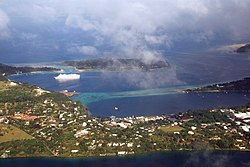
Port Vila (/ˈviːlə/ VEE-lə; French: Port-Vila [pɔʁ vila]), or simply Vila (Bislama: [viˈla]), is the capital of Vanuatu and its largest city. It is on the island of Efate, in Shefa Province.
The population was 49,034 as of the 2020 census. In 2020, the population of Port Vila formed 16.3% of the country's population.
Located on the east coast of the island of Efate, Port Vila is the economic and commercial centre of Vanuatu. The mayor is Jenny Regenvanu of the Land and Justice Party, the first woman to hold the position, elected in August 2024. Her deputy was Marie Louise Milne, of the Green Confederation, until the seat was vacated in January 2025.
Locally, the town is most commonly referred to simply as "Vila", whether in French or Bislama [viˈla] or in English /ˈviːlə/ VEE-lə (not like English "villa").
The name of the area is Efil in the native South Efate language and Ifira in neighbouring Mele-Fila language. Vila is a variant of these names. Ifira is a small island in Vila Harbour where many traditional landowners reside.
Melanesian people have occupied the Port Vila area for thousands of years. In the autumn of 2004, an archaeological expedition known as Teouma discovered a burial site of 25 tombs containing three dozen skeletons of members of the Lapita culture. Pieces of ceramics found at the site were dated to the 13th century BC.[citation needed]
Efate Island was charted in 1774 by James Cook, who named it Sandwich Island. Cook's expedition did not land but noted the presence of good harbours and land suitable for European settlement. In the late 19th century, when the islands were known as the New Hebrides, the British initially had the dominant European presence. However, by the 1890s, the economic balance had begun favouring the French, who established large plantations. French citizen Ferdinand Chevillard began buying and clearing land around Port Vila to be converted into the largest French plantation on the island. Instead, it was converted into the municipality of Franceville, which declared independence on 9 August 1889, though this only lasted until June of the following year.[citation needed]
After 1887, the territory was jointly administered by the French and the British. This was formalized in 1906 as an Anglo-French Condominium. During World War II, Port Vila was an American and Australian airbase.[citation needed]
Port Vila
Port Vila (/ˈviːlə/ VEE-lə; French: Port-Vila [pɔʁ vila]), or simply Vila (Bislama: [viˈla]), is the capital of Vanuatu and its largest city. It is on the island of Efate, in Shefa Province.
The population was 49,034 as of the 2020 census. In 2020, the population of Port Vila formed 16.3% of the country's population.
Located on the east coast of the island of Efate, Port Vila is the economic and commercial centre of Vanuatu. The mayor is Jenny Regenvanu of the Land and Justice Party, the first woman to hold the position, elected in August 2024. Her deputy was Marie Louise Milne, of the Green Confederation, until the seat was vacated in January 2025.
Locally, the town is most commonly referred to simply as "Vila", whether in French or Bislama [viˈla] or in English /ˈviːlə/ VEE-lə (not like English "villa").
The name of the area is Efil in the native South Efate language and Ifira in neighbouring Mele-Fila language. Vila is a variant of these names. Ifira is a small island in Vila Harbour where many traditional landowners reside.
Melanesian people have occupied the Port Vila area for thousands of years. In the autumn of 2004, an archaeological expedition known as Teouma discovered a burial site of 25 tombs containing three dozen skeletons of members of the Lapita culture. Pieces of ceramics found at the site were dated to the 13th century BC.[citation needed]
Efate Island was charted in 1774 by James Cook, who named it Sandwich Island. Cook's expedition did not land but noted the presence of good harbours and land suitable for European settlement. In the late 19th century, when the islands were known as the New Hebrides, the British initially had the dominant European presence. However, by the 1890s, the economic balance had begun favouring the French, who established large plantations. French citizen Ferdinand Chevillard began buying and clearing land around Port Vila to be converted into the largest French plantation on the island. Instead, it was converted into the municipality of Franceville, which declared independence on 9 August 1889, though this only lasted until June of the following year.[citation needed]
After 1887, the territory was jointly administered by the French and the British. This was formalized in 1906 as an Anglo-French Condominium. During World War II, Port Vila was an American and Australian airbase.[citation needed]
Recent media
Recent media