
Recent from talks
Port Whitby and Port Perry Railway
Knowledge base stats:
Talk channels stats:
Members stats:
Port Whitby and Port Perry Railway
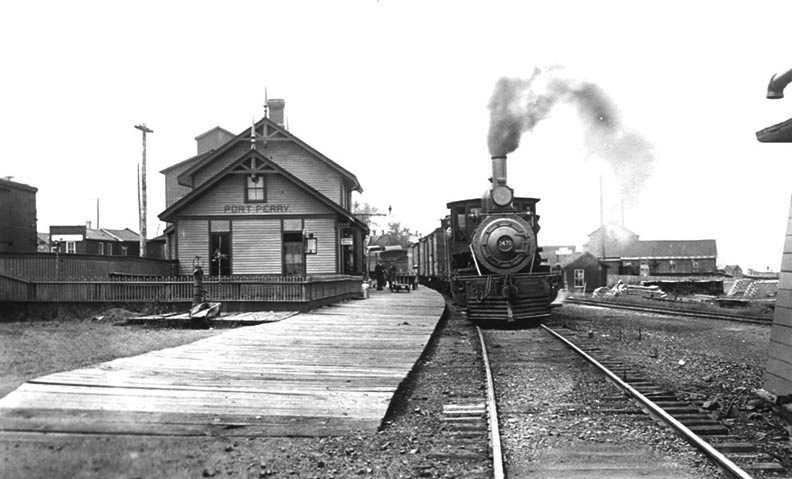
The Port Whitby and Port Perry Railway (PW&PP) was a railway running from Whitby to Port Perry, running north–south about 50 km east of Toronto. It was built to connect local grain and logging interests with the railway mainlines on the shores of Lake Ontario. It was later extended northeast to Lindsay, becoming the Whitby, Port Perry and Lindsay Railway (WPP&L).
The railway was never very successful, as the original engineering was considered sub-par and reliability was poor from the start. It earned the nickname "The Nip 'n Tuck", a euphemism for something considered unreliable. The last train ran in 1939, a specially commissioned passenger train, and the rails were pulled up in 1941 to feed wartime steel production.
Reach Township started filling out in the 1840s and developed a rivalry between three incorporated towns, Prince Albert, Port Perry and Manchester. The three towns were only a kilometer from each other, lying along a roughly east–west line at the southern tip of Lake Scugog. Rivalries between the towns were intense, and Peter Perry predicted that one day goats would eat grass off of Prince Albert's main street.
Simcoe Street, a graveled toll road, had recently been constructed through Prince Albert. By 1850, Prince Albert was the second largest grain-buying market in what was then known as "Canada West" (today's Ontario). Grain and timber, the major exports from the area to the north, were hauled to Prince Albert, ganged into larger loads, and then sent southward by horse team on Simcoe Street for shipment abroad.
In the 1850s Abraham Farewell, an early advocate of the development of Ontario County through the construction of gravel roads, predicted that unless a railway was built from Georgian Bay to Whitby, control of the inland grain and timber trade would be taken over by Toronto and Port Hope interests. There had been some talk of introducing the "Port Whitby & Port Huron Railway" to pre-empt this possibility, and although a charter was granted in April 1853, no money was forthcoming and nothing came of these early plans.
By the 1860s the need to connect to the newly forming mainlines along Lake Ontario had become more pressing. Plans for the Toronto and Nipissing Railway (T&N) that would connect Beaverton to the dockyards at the Gooderham & Worts distilleries in Toronto would cut off the customers to the west, while the Midland Railway to Port Hope would do the same to the east. These developments had the potential to make the entire Reach area a has-been economically.
Port Perry was ideally located to gather materials from a considerable area due to its lakeside location on Lake Scugog, which had connections to the Trent-Severn Waterway that offered easy access to large areas of northern Ontario. If a railway was built to the lakeshore, barges could carry produce to Port Perry and then be quickly trans-shipped southward. This would save considerable time compared to shipping by barge to the other access points in towns further northeast like Bobcaygeon or the terminus (at the time) in Peterborough. Lake Scugog was the southernmost point easily reachable from the Trent-Severn, cutting almost 100 kilometres (62 mi) off the route. Serious efforts to build a line to Port Perry started in 1867, led by the efforts of Joseph Bigelow and Thomas Paxton, men of some import in Port Perry.
Each of the towns took part in the decision on the exact route, which was uncontentious to the south but a matter of some concern within Reach. Adam Gordon, at one time a Canadian Member of Parliament, wanted the line to pass through Manchester, where he lived and was very active in local politics. Joshua Wright, a famed orator, wanted the line to pass near a tannery outside of Prince Albert. Bigelow and Paxton argued the case for Port Perry. A route was finally decided on, making all of the towns happy, running just south of Manchester and east of Prince Albert with the terminus on the shore of Lake Scugog in Port Perry.
Hub AI
Port Whitby and Port Perry Railway AI simulator
(@Port Whitby and Port Perry Railway_simulator)
Port Whitby and Port Perry Railway
The Port Whitby and Port Perry Railway (PW&PP) was a railway running from Whitby to Port Perry, running north–south about 50 km east of Toronto. It was built to connect local grain and logging interests with the railway mainlines on the shores of Lake Ontario. It was later extended northeast to Lindsay, becoming the Whitby, Port Perry and Lindsay Railway (WPP&L).
The railway was never very successful, as the original engineering was considered sub-par and reliability was poor from the start. It earned the nickname "The Nip 'n Tuck", a euphemism for something considered unreliable. The last train ran in 1939, a specially commissioned passenger train, and the rails were pulled up in 1941 to feed wartime steel production.
Reach Township started filling out in the 1840s and developed a rivalry between three incorporated towns, Prince Albert, Port Perry and Manchester. The three towns were only a kilometer from each other, lying along a roughly east–west line at the southern tip of Lake Scugog. Rivalries between the towns were intense, and Peter Perry predicted that one day goats would eat grass off of Prince Albert's main street.
Simcoe Street, a graveled toll road, had recently been constructed through Prince Albert. By 1850, Prince Albert was the second largest grain-buying market in what was then known as "Canada West" (today's Ontario). Grain and timber, the major exports from the area to the north, were hauled to Prince Albert, ganged into larger loads, and then sent southward by horse team on Simcoe Street for shipment abroad.
In the 1850s Abraham Farewell, an early advocate of the development of Ontario County through the construction of gravel roads, predicted that unless a railway was built from Georgian Bay to Whitby, control of the inland grain and timber trade would be taken over by Toronto and Port Hope interests. There had been some talk of introducing the "Port Whitby & Port Huron Railway" to pre-empt this possibility, and although a charter was granted in April 1853, no money was forthcoming and nothing came of these early plans.
By the 1860s the need to connect to the newly forming mainlines along Lake Ontario had become more pressing. Plans for the Toronto and Nipissing Railway (T&N) that would connect Beaverton to the dockyards at the Gooderham & Worts distilleries in Toronto would cut off the customers to the west, while the Midland Railway to Port Hope would do the same to the east. These developments had the potential to make the entire Reach area a has-been economically.
Port Perry was ideally located to gather materials from a considerable area due to its lakeside location on Lake Scugog, which had connections to the Trent-Severn Waterway that offered easy access to large areas of northern Ontario. If a railway was built to the lakeshore, barges could carry produce to Port Perry and then be quickly trans-shipped southward. This would save considerable time compared to shipping by barge to the other access points in towns further northeast like Bobcaygeon or the terminus (at the time) in Peterborough. Lake Scugog was the southernmost point easily reachable from the Trent-Severn, cutting almost 100 kilometres (62 mi) off the route. Serious efforts to build a line to Port Perry started in 1867, led by the efforts of Joseph Bigelow and Thomas Paxton, men of some import in Port Perry.
Each of the towns took part in the decision on the exact route, which was uncontentious to the south but a matter of some concern within Reach. Adam Gordon, at one time a Canadian Member of Parliament, wanted the line to pass through Manchester, where he lived and was very active in local politics. Joshua Wright, a famed orator, wanted the line to pass near a tannery outside of Prince Albert. Bigelow and Paxton argued the case for Port Perry. A route was finally decided on, making all of the towns happy, running just south of Manchester and east of Prince Albert with the terminus on the shore of Lake Scugog in Port Perry.
Recent media