



Community hub
Recent from talks
Knowledge base stats:
Talk channels stats:
Members stats:
Port of Hong Kong
The Port of Hong Kong located by the South China Sea, is a deepwater seaport dominated by trade in containerised manufactured products, and to a lesser extent raw materials and passengers. A key factor in the economic development of Hong Kong, the natural shelter and deep waters of Victoria Harbour provide ideal conditions for berthing and the handling of all types of vessels. It is one of the busiest ports in the world, in the three categories of shipping movements, cargo handled and passengers carried. This makes Hong Kong a Large-Port Metropolis.
The responsibility for administering the port is vested in the Director of Marine. The Port Operations Committee advises the director on all matters in regards to the efficient operations of the port, except those matters that are the responsibility of the Pilotage Advisory Committee and the Provisional Local Vessels Advisory Committee. The Hong Kong Maritime and Port Board (HKMPB) advises the Government on matters related to port planning and development and promoting Hong Kong as a regional hub port and a leading container port in the world as well as on measures to further develop Hong Kong's maritime industry and to promote Hong Kong's position as an international maritime centre. The HKMPB replaced (in April 2016) the former Hong Kong Maritime Industry Council and Hong Kong Port Development Council and is chaired by the Secretary for Transport and Housing, as they both were.
The Marine Department is responsible for ensuring that conditions exist to enable ships to enter the port, work their cargoes and leave as quickly and as safely as possible. It is concerned with many aspects of safety standards for all classes and types of vessels, from the largest oil-carrying tankers to the smallest passenger-carrying sampans. It also maintains aids to navigation and mooring buoys for seagoing ships, manages three cross-boundary ferry terminals and administers eight public cargo working areas.
Hong Kong is one of several hub ports serving the South-East and East Asia region, and is an economic gateway to mainland China. The port is part of the Maritime Silk Road that runs from the Chinese coast via the Suez Canal to the Mediterranean, there to the Upper Adriatic region of Trieste with its rail connections to Central and Eastern Europe.
Hong Kong set a record in its container throughput in 2007 by handling 23.9 million TEUs (20-foot equivalent units of containers), maintaining its status as the largest container port serving southern China and one of the busiest ports in the world. Some 456,000 vessels arrived in and departed from Hong Kong during the year, carrying 243 million tonnes of cargo and about 25 million passengers. The average turnaround time for container vessels in Hong Kong is about 10 hours. For conventional vessels working in mid-stream at buoys or anchorages, it is 42 and 52 hours respectively.
The port has been one of the busiest container ports in the world for many years, and at times the busiest. It was the world's busiest container port from 1987 to 1989, from 1992 to 1997, and from 1999 to 2004. The amount of container ships that went through Hong Kong's container port was 25,869 in 2016, with a net register tonnage of 386,853 tonnes in 2016.
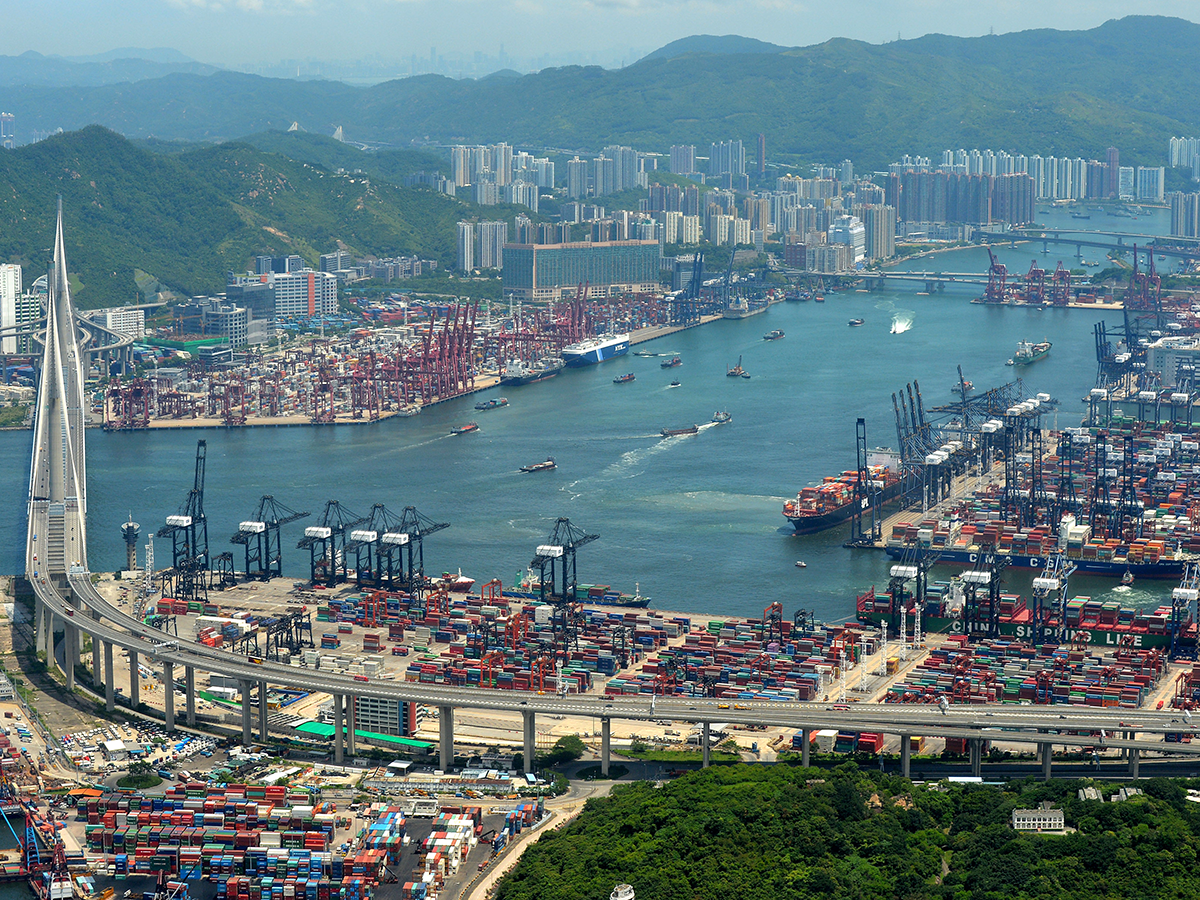
There are currently nine container terminals situated at Kwai Chung, Stonecutters Island and Tsing Yi (the last one completed in 2004). Substantial container throughput is handled by the River Trade Terminal at Tuen Mun and by mid-stream.
The Kwai Tsing Container Terminals (Kwai Chung Container Terminals until Container Terminal 9 was opened on Tsing Yi), located in the north-western part of the harbour, has nine container terminals with 24 berths of about 8,500 metres of frontage. It covers a total terminal area of about 2.7 km2 which includes container yards and container freight stations. The nine container terminals have a total handling capacity of over 18 million twenty-foot equivalent units (TEU).
Hub AI
Port of Hong Kong AI simulator
(@Port of Hong Kong_simulator)
Port of Hong Kong
The Port of Hong Kong located by the South China Sea, is a deepwater seaport dominated by trade in containerised manufactured products, and to a lesser extent raw materials and passengers. A key factor in the economic development of Hong Kong, the natural shelter and deep waters of Victoria Harbour provide ideal conditions for berthing and the handling of all types of vessels. It is one of the busiest ports in the world, in the three categories of shipping movements, cargo handled and passengers carried. This makes Hong Kong a Large-Port Metropolis.
The responsibility for administering the port is vested in the Director of Marine. The Port Operations Committee advises the director on all matters in regards to the efficient operations of the port, except those matters that are the responsibility of the Pilotage Advisory Committee and the Provisional Local Vessels Advisory Committee. The Hong Kong Maritime and Port Board (HKMPB) advises the Government on matters related to port planning and development and promoting Hong Kong as a regional hub port and a leading container port in the world as well as on measures to further develop Hong Kong's maritime industry and to promote Hong Kong's position as an international maritime centre. The HKMPB replaced (in April 2016) the former Hong Kong Maritime Industry Council and Hong Kong Port Development Council and is chaired by the Secretary for Transport and Housing, as they both were.
The Marine Department is responsible for ensuring that conditions exist to enable ships to enter the port, work their cargoes and leave as quickly and as safely as possible. It is concerned with many aspects of safety standards for all classes and types of vessels, from the largest oil-carrying tankers to the smallest passenger-carrying sampans. It also maintains aids to navigation and mooring buoys for seagoing ships, manages three cross-boundary ferry terminals and administers eight public cargo working areas.
Hong Kong is one of several hub ports serving the South-East and East Asia region, and is an economic gateway to mainland China. The port is part of the Maritime Silk Road that runs from the Chinese coast via the Suez Canal to the Mediterranean, there to the Upper Adriatic region of Trieste with its rail connections to Central and Eastern Europe.
Hong Kong set a record in its container throughput in 2007 by handling 23.9 million TEUs (20-foot equivalent units of containers), maintaining its status as the largest container port serving southern China and one of the busiest ports in the world. Some 456,000 vessels arrived in and departed from Hong Kong during the year, carrying 243 million tonnes of cargo and about 25 million passengers. The average turnaround time for container vessels in Hong Kong is about 10 hours. For conventional vessels working in mid-stream at buoys or anchorages, it is 42 and 52 hours respectively.
The port has been one of the busiest container ports in the world for many years, and at times the busiest. It was the world's busiest container port from 1987 to 1989, from 1992 to 1997, and from 1999 to 2004. The amount of container ships that went through Hong Kong's container port was 25,869 in 2016, with a net register tonnage of 386,853 tonnes in 2016.
There are currently nine container terminals situated at Kwai Chung, Stonecutters Island and Tsing Yi (the last one completed in 2004). Substantial container throughput is handled by the River Trade Terminal at Tuen Mun and by mid-stream.
The Kwai Tsing Container Terminals (Kwai Chung Container Terminals until Container Terminal 9 was opened on Tsing Yi), located in the north-western part of the harbour, has nine container terminals with 24 berths of about 8,500 metres of frontage. It covers a total terminal area of about 2.7 km2 which includes container yards and container freight stations. The nine container terminals have a total handling capacity of over 18 million twenty-foot equivalent units (TEU).