
Recent from talks
Portland International Jetport
Knowledge base stats:
Talk channels stats:
Members stats:
Portland International Jetport
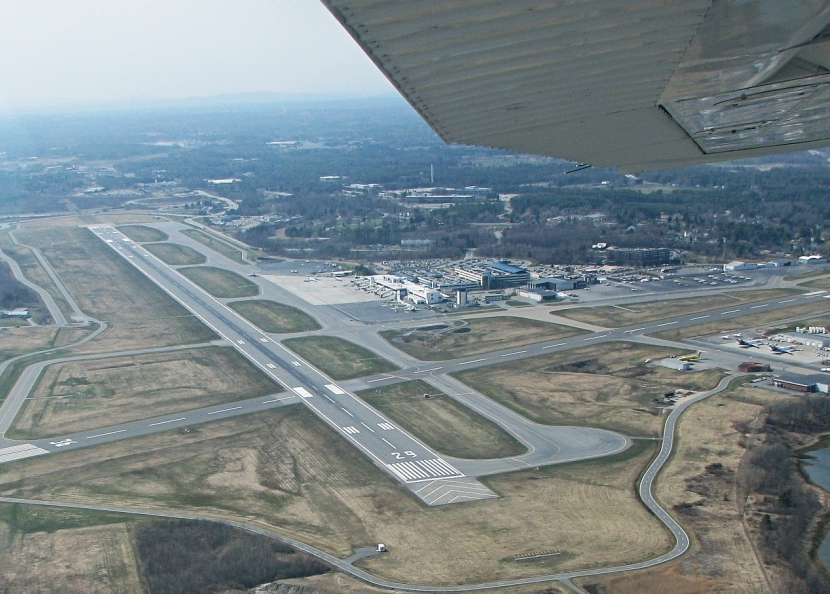
Portland International Jetport (IATA: PWM, ICAO: KPWM, FAA LID: PWM), locally known as the Jetport, is a public airport two miles (3 km) west of downtown Portland, Maine, United States. It is owned and operated by the City of Portland. A portion of the Jetport's property, including the main runway, is located within the neighboring city of South Portland. PWM covers 726 acres (293 ha) of land.
The airport is the busiest in the state. In 2024, the Jetport handled approximately 2.44 million passengers, setting a new annual record and continuing the growth trend that began when the airport first exceeded two million passengers in 2018.
The Jetport has benefited from service by low-cost carriers such as Southwest Airlines, JetBlue, and Breeze Airways, as well as Portland's increased popularity as a tourist destination. Multiple carriers have expanded service to the airport in recent years, with United Airlines adding seasonal service to Houston in 2025 and Avelo Airlines beginning service to New Haven, Connecticut. A survey conducted in June 2011 found PWM to be the most affordable airport in the region, and the third-most-affordable in New England.
In October 2011, PWM completed a $75 million renovation and expansion of its terminal to allow more airline service and more amenities for passengers. More recent infrastructure improvements include taxiway lighting upgrades completed in 2024 and federal funding received in 2020 for a 1,200 ft-long (370 m) taxiway connecting runways.
The airfield was founded in the late 1920s by Dr. Clifford "Kip" Strange, who needed space for his JN-4 "Jenny" Biplane. Known as Stroudwater Airport, the airport received its first commercial service on August 1, 1931, when Boston-Maine Airways began a flight from Portland to Boston. In 1937 the city of Portland purchased the airfield for $68,471 and changed its name to Portland-Westbrook Municipal Airport; this is the origin of its airport code, PWM. "Westbrook" referred to the location of the last directional light before the airport in the nearby city of Westbrook.
In January 1934, a statewide airport survey was conducted by Captain Harry M. Jones, of the Maine Emergency Relief Administration (MERA), a state division of the Federal New Deal public works programs launched in November 1933. MERA expended $816,376 across the state on labor in airport construction in the period April 1934 to July 1935. Two runways were constructed at Portland Municipal Airport by MERA, one north–south 2,400'x 100' gravel runway and one east–west 1,500'x 100' gravel runway. In the summer of 1935, the MERA aviation program had made possible the extension of the Boston-Portland-Augusta-Waterville-Bangor mail service to Bar Harbor, where an airport, Hancock County–Bar Harbor Airport, had been constructed by the MERA. The Portland town report of 1938 reported that the building of the runways and grading of the field were by WPA labor, and the city furnished part of the material. In 1940, the Works Progress Administration (WPA) built Portland's first real terminal, a brick structure that is now the general-aviation terminal.
According to Portland Town Reports, the WPA conducted two projects sponsored by the city:
The present airport started to take shape in the 1950s. The March 1951 chart shows runway 1 4260 ft long, runway 10 2900 ft, and runway 15 4010 ft. Runway 11/29 was built in 1957 and lengthened to 6,800 feet (2,073 m) in 1966. The current terminal opened in 1968, when jet flights began.
Hub AI
Portland International Jetport AI simulator
(@Portland International Jetport_simulator)
Portland International Jetport
Portland International Jetport (IATA: PWM, ICAO: KPWM, FAA LID: PWM), locally known as the Jetport, is a public airport two miles (3 km) west of downtown Portland, Maine, United States. It is owned and operated by the City of Portland. A portion of the Jetport's property, including the main runway, is located within the neighboring city of South Portland. PWM covers 726 acres (293 ha) of land.
The airport is the busiest in the state. In 2024, the Jetport handled approximately 2.44 million passengers, setting a new annual record and continuing the growth trend that began when the airport first exceeded two million passengers in 2018.
The Jetport has benefited from service by low-cost carriers such as Southwest Airlines, JetBlue, and Breeze Airways, as well as Portland's increased popularity as a tourist destination. Multiple carriers have expanded service to the airport in recent years, with United Airlines adding seasonal service to Houston in 2025 and Avelo Airlines beginning service to New Haven, Connecticut. A survey conducted in June 2011 found PWM to be the most affordable airport in the region, and the third-most-affordable in New England.
In October 2011, PWM completed a $75 million renovation and expansion of its terminal to allow more airline service and more amenities for passengers. More recent infrastructure improvements include taxiway lighting upgrades completed in 2024 and federal funding received in 2020 for a 1,200 ft-long (370 m) taxiway connecting runways.
The airfield was founded in the late 1920s by Dr. Clifford "Kip" Strange, who needed space for his JN-4 "Jenny" Biplane. Known as Stroudwater Airport, the airport received its first commercial service on August 1, 1931, when Boston-Maine Airways began a flight from Portland to Boston. In 1937 the city of Portland purchased the airfield for $68,471 and changed its name to Portland-Westbrook Municipal Airport; this is the origin of its airport code, PWM. "Westbrook" referred to the location of the last directional light before the airport in the nearby city of Westbrook.
In January 1934, a statewide airport survey was conducted by Captain Harry M. Jones, of the Maine Emergency Relief Administration (MERA), a state division of the Federal New Deal public works programs launched in November 1933. MERA expended $816,376 across the state on labor in airport construction in the period April 1934 to July 1935. Two runways were constructed at Portland Municipal Airport by MERA, one north–south 2,400'x 100' gravel runway and one east–west 1,500'x 100' gravel runway. In the summer of 1935, the MERA aviation program had made possible the extension of the Boston-Portland-Augusta-Waterville-Bangor mail service to Bar Harbor, where an airport, Hancock County–Bar Harbor Airport, had been constructed by the MERA. The Portland town report of 1938 reported that the building of the runways and grading of the field were by WPA labor, and the city furnished part of the material. In 1940, the Works Progress Administration (WPA) built Portland's first real terminal, a brick structure that is now the general-aviation terminal.
According to Portland Town Reports, the WPA conducted two projects sponsored by the city:
The present airport started to take shape in the 1950s. The March 1951 chart shows runway 1 4260 ft long, runway 10 2900 ft, and runway 15 4010 ft. Runway 11/29 was built in 1957 and lengthened to 6,800 feet (2,073 m) in 1966. The current terminal opened in 1968, when jet flights began.
Recent media