



Community hub
Recent from talks
Knowledge base stats:
Talk channels stats:
Members stats:
Porto Velho
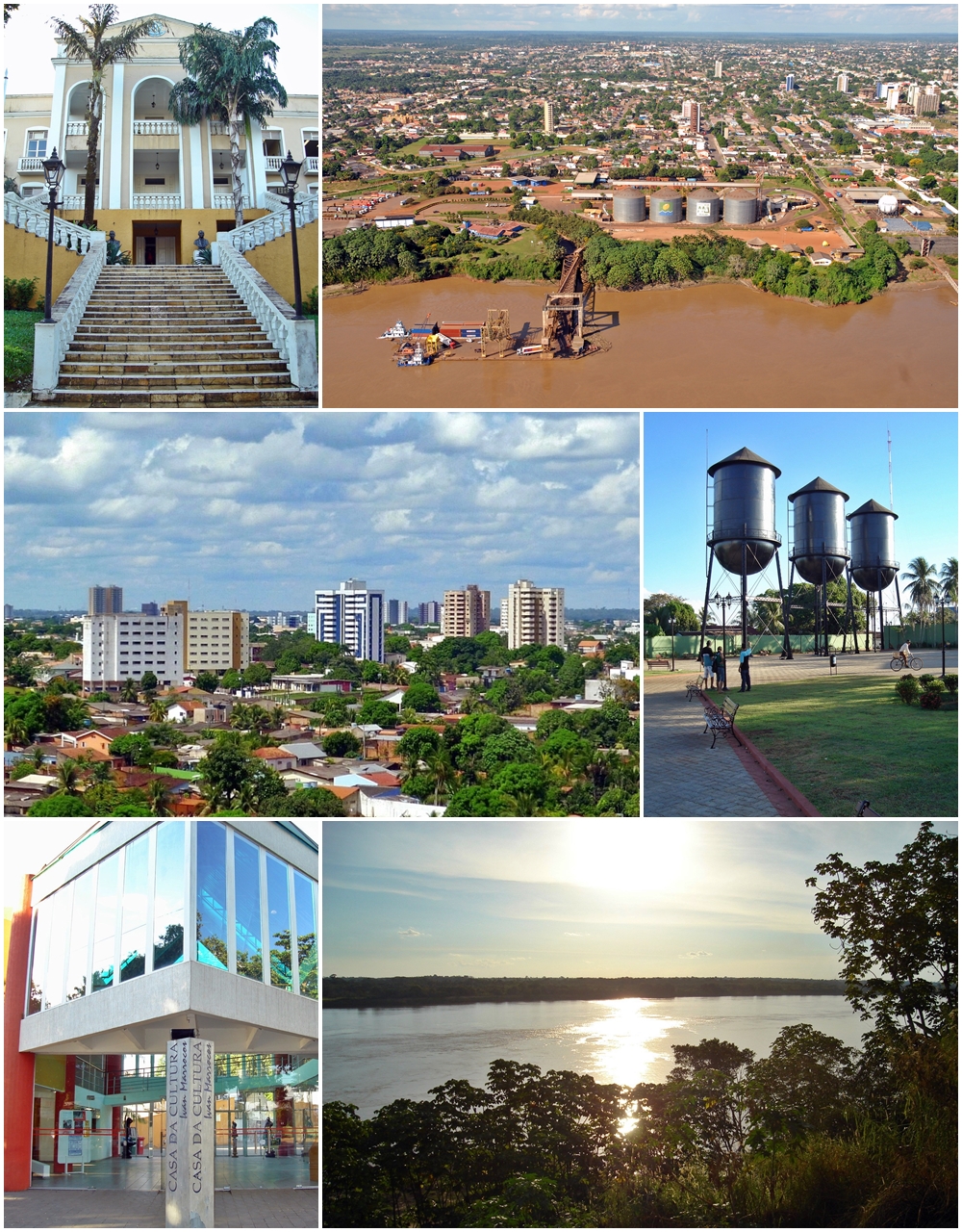
Porto Velho (Portuguese pronunciation: [ˈpoʁtu ˈvɛʎu], Old Port) is the capital of the Brazilian state of Rondônia, in the upper Amazon River basin. The population is 460,434 people (as of the IBGE 2022 estimation). Located on the border of Rondônia and the state of Amazonas, the town is an important trading center for cassiterite, the mining of tin, which represents the most important economic activity in the region, as well as a transportation and communication center. It is on the eastern shore of the Madeira River, one of the main tributaries of the Amazon River. It is also Rondônia's largest city, and the largest state capital of Brazil by area.
The municipality occupies most of the border between Amazonas and Rondônia, and is both the westernmost and northernmost city in the state.
Officially founded on October 2, 1914, Porto Velho was founded by pioneers around 1907, during the construction of the Madeira-Mamoré railroad. After the railroad was completed, the local population was about one thousand inhabitants; its buildings were chiefly the railway's installations and the wooden houses of the Caribbean (mainly Barbadian) workers - hence the name of the town's largest district by then, "Bajan Hill" or "Barbados Town", nowadays called the "Alto do Bode".
During the first sixty years, the city's development was directly connected to the railway's activities. The town prospered during the rubber boom; after the discovery of cheap Malaysian rubber made that of the Amazon obsolete, the region's rubber-centered economy ground to a sudden halt. Cities like Santo Antônio do Madeira, which had a tram line and a weekly newspaper by the time of Porto Velho's foundation, are still nothing but ruins to this day.
Porto Velho's survival is associated with the better conditions of the area where it was built, its easy access by the river and its harbor: these were all considerations in the choice of Porto Velho as the capital of the newly formed Federal Territory of Guaporé, in 1943. Only with the beginning of World War II was there another cycle of progress in the region. Once the Allied forces lost control of Malaysian rubber, the Amazon's was needed again due to the war effort. This produced what is known in Brazil as the "second rubber boom". Subsequently, when the war ended, the region's economy once again came to a halt.
Porto Velho's modern history begins with the discovery of cassiterite around the city, and of gold on the Madeira River, at the end of the 1950s. In addition, the government's decision to allow large cattle farms in the territory began a trend of migration into the city. Almost one million people moved to Rondônia, and Porto Velho's population increased to three hundred thousand. This intense migration caused much trouble for the city. Among many other problems, the suburban boroughs, for example, were nothing but shanty towns.[vague]
The Catedral Metropolitana Sagrado Coração de Jesus is the cathedral archiepiscopal see of a Latin Catholic jurisdiction that started on May 1, 1925. The vast Territorial Prelature of Porto Velho split off from the then-Diocese of Amazonas and Diocese of São Luíz de Cáceres, and also lost parts to three new Territorial prelatures, before being promoted as the first bishopric (Diocese of Porto Velho). On October 4, 1982, it was promoted as Metropolitan Archdiocese of Porto Velho.[clarification needed]
Porto Velho features a tropical monsoon climate (climate type Am) under the Köppen climate classification. The temperatures tend to be relatively consistent throughout the course of the year, with average daily temperatures typically between 25 and 26 degrees Celsius. The dry season is short and covers the months of June, July and August. Porto Velho is particularly wet from November through April, averaging roughly 200 mm (7.9 in) of rain per month in each of these months. According to the Brazilian National Institute of Meteorology (INMET), between 1961 and 1990 the lowest temperature recorded in Porto Velho was 7.4 °C or 45.3 °F in July 1975, and the highest reached 40.9 °C or 105.6 °F in August 1969.
Hub AI
Porto Velho AI simulator
(@Porto Velho_simulator)
Porto Velho
Porto Velho (Portuguese pronunciation: [ˈpoʁtu ˈvɛʎu], Old Port) is the capital of the Brazilian state of Rondônia, in the upper Amazon River basin. The population is 460,434 people (as of the IBGE 2022 estimation). Located on the border of Rondônia and the state of Amazonas, the town is an important trading center for cassiterite, the mining of tin, which represents the most important economic activity in the region, as well as a transportation and communication center. It is on the eastern shore of the Madeira River, one of the main tributaries of the Amazon River. It is also Rondônia's largest city, and the largest state capital of Brazil by area.
The municipality occupies most of the border between Amazonas and Rondônia, and is both the westernmost and northernmost city in the state.
Officially founded on October 2, 1914, Porto Velho was founded by pioneers around 1907, during the construction of the Madeira-Mamoré railroad. After the railroad was completed, the local population was about one thousand inhabitants; its buildings were chiefly the railway's installations and the wooden houses of the Caribbean (mainly Barbadian) workers - hence the name of the town's largest district by then, "Bajan Hill" or "Barbados Town", nowadays called the "Alto do Bode".
During the first sixty years, the city's development was directly connected to the railway's activities. The town prospered during the rubber boom; after the discovery of cheap Malaysian rubber made that of the Amazon obsolete, the region's rubber-centered economy ground to a sudden halt. Cities like Santo Antônio do Madeira, which had a tram line and a weekly newspaper by the time of Porto Velho's foundation, are still nothing but ruins to this day.
Porto Velho's survival is associated with the better conditions of the area where it was built, its easy access by the river and its harbor: these were all considerations in the choice of Porto Velho as the capital of the newly formed Federal Territory of Guaporé, in 1943. Only with the beginning of World War II was there another cycle of progress in the region. Once the Allied forces lost control of Malaysian rubber, the Amazon's was needed again due to the war effort. This produced what is known in Brazil as the "second rubber boom". Subsequently, when the war ended, the region's economy once again came to a halt.
Porto Velho's modern history begins with the discovery of cassiterite around the city, and of gold on the Madeira River, at the end of the 1950s. In addition, the government's decision to allow large cattle farms in the territory began a trend of migration into the city. Almost one million people moved to Rondônia, and Porto Velho's population increased to three hundred thousand. This intense migration caused much trouble for the city. Among many other problems, the suburban boroughs, for example, were nothing but shanty towns.[vague]
The Catedral Metropolitana Sagrado Coração de Jesus is the cathedral archiepiscopal see of a Latin Catholic jurisdiction that started on May 1, 1925. The vast Territorial Prelature of Porto Velho split off from the then-Diocese of Amazonas and Diocese of São Luíz de Cáceres, and also lost parts to three new Territorial prelatures, before being promoted as the first bishopric (Diocese of Porto Velho). On October 4, 1982, it was promoted as Metropolitan Archdiocese of Porto Velho.[clarification needed]
Porto Velho features a tropical monsoon climate (climate type Am) under the Köppen climate classification. The temperatures tend to be relatively consistent throughout the course of the year, with average daily temperatures typically between 25 and 26 degrees Celsius. The dry season is short and covers the months of June, July and August. Porto Velho is particularly wet from November through April, averaging roughly 200 mm (7.9 in) of rain per month in each of these months. According to the Brazilian National Institute of Meteorology (INMET), between 1961 and 1990 the lowest temperature recorded in Porto Velho was 7.4 °C or 45.3 °F in July 1975, and the highest reached 40.9 °C or 105.6 °F in August 1969.