
Recent from talks
Posse comitatus
Knowledge base stats:
Talk channels stats:
Members stats:
Posse comitatus
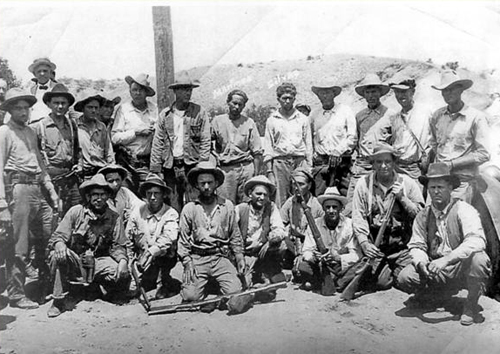
The posse comitatus (/ˌpɒsiˌkɒmɪˈtɑːtəs/; from Latin for "the ability to have a retinue or gang"), frequently shortened to posse, is in common law a group of people mobilized to suppress lawlessness, defend the people, or otherwise protect the peace, property, and public welfare. It may be called by the conservator of peace – typically a reeve, sheriff, chief, or another special/regional designee like an officer of the peace potentially accompanied by or with the direction of a justice or ajudged parajudicial process given the imminence of actual damage. There must be a lawful reason for a posse, which can never be used for lawlessness. The posse comitatus as an English jurisprudentially defined doctrine dates back to 9th-century England.
Derived from Latin, posse comitātūs ("posse" here used as a noun meant the ability or power, but meaning "the force" since the medieval times, while "comitatus" is an abstract noun which means a retinue, but since the medieval times, standing for a "commissioned body" especially a small military force or bodyguard) is sometimes shortened to simply posse from the mid-17th century onward to describe the force itself more than the legal principle. While the original meaning refers to a group of citizens assembled by the authorities to deal with an emergency (such as suppressing a riot or pursuing felons and outlawry), the term is also used for any force or band, especially with hostile intent, often also figuratively or humorously. In 19th-century usage, posse comitatus also acquired the generalized or figurative meaning. In its earliest days, the posse comitatus was subordinate to the king, country, and local authority.
The posse comitatus as an English jurisprudentially defined doctrine dates back to 9th-century England and the campaigns of Alfred the Great, and before in ancient custom and law of locally martialed forces, simultaneous thereafter with the officiation of sheriff nomination to keep the regnant peace (known as "the Queen/king's peace").
In 1642, during the early stages of the English Civil War, local forces were employed everywhere and by both sides. The powers responsible produced valid written authority, inducing the locals to assemble. The two most common authorities used were the Militia Ordinance on the side of the Parliamentarians and that of the king, the old-fashioned Commissions of Array. But the Royalist leader in Cornwall, Sir Ralph Hopton, indicted the enemy before the grand jury of the county as disturbers of the peace, and had the posse comitatus called out to expel them.
The powers of sheriffs in England and Wales for posse comitatus were codified by section 8 of the Sheriffs Act 1887, the first subsection of which stated that:
Every person in a county shall be ready and apparelled at the command of the sheriff and at the cry of the country to arrest a felon whether within a franchise or without, and in default shall on conviction be liable to a fine, and if default be found in the lord of the franchise he shall forfeit the franchise to the Queen, and if in the bailiff he shall be liable besides the fine to imprisonment for not more than one year, or if he have not whereof to pay the fine, than two years.
— section 8, Sheriffs Act 1887 (as passed)
This permitted the sheriff of each county to call every civilian to his assistance to catch a person who had committed a felony – that is, a serious crime. It provided for fines for those who did not comply. The provisions for posse comitatus were repealed by the Criminal Law Act 1967. The second subsection provided for the sheriff to take "the power of the county" if he faced resistance while executing a writ, and provided for the arrest of resisters. This subsection is still in force. This power can be used during the execution of a writ of seizure and sale to satisfy a debt; it allows a sheriff to call upon the police while seizing the property.
Hub AI
Posse comitatus AI simulator
(@Posse comitatus_simulator)
Posse comitatus
The posse comitatus (/ˌpɒsiˌkɒmɪˈtɑːtəs/; from Latin for "the ability to have a retinue or gang"), frequently shortened to posse, is in common law a group of people mobilized to suppress lawlessness, defend the people, or otherwise protect the peace, property, and public welfare. It may be called by the conservator of peace – typically a reeve, sheriff, chief, or another special/regional designee like an officer of the peace potentially accompanied by or with the direction of a justice or ajudged parajudicial process given the imminence of actual damage. There must be a lawful reason for a posse, which can never be used for lawlessness. The posse comitatus as an English jurisprudentially defined doctrine dates back to 9th-century England.
Derived from Latin, posse comitātūs ("posse" here used as a noun meant the ability or power, but meaning "the force" since the medieval times, while "comitatus" is an abstract noun which means a retinue, but since the medieval times, standing for a "commissioned body" especially a small military force or bodyguard) is sometimes shortened to simply posse from the mid-17th century onward to describe the force itself more than the legal principle. While the original meaning refers to a group of citizens assembled by the authorities to deal with an emergency (such as suppressing a riot or pursuing felons and outlawry), the term is also used for any force or band, especially with hostile intent, often also figuratively or humorously. In 19th-century usage, posse comitatus also acquired the generalized or figurative meaning. In its earliest days, the posse comitatus was subordinate to the king, country, and local authority.
The posse comitatus as an English jurisprudentially defined doctrine dates back to 9th-century England and the campaigns of Alfred the Great, and before in ancient custom and law of locally martialed forces, simultaneous thereafter with the officiation of sheriff nomination to keep the regnant peace (known as "the Queen/king's peace").
In 1642, during the early stages of the English Civil War, local forces were employed everywhere and by both sides. The powers responsible produced valid written authority, inducing the locals to assemble. The two most common authorities used were the Militia Ordinance on the side of the Parliamentarians and that of the king, the old-fashioned Commissions of Array. But the Royalist leader in Cornwall, Sir Ralph Hopton, indicted the enemy before the grand jury of the county as disturbers of the peace, and had the posse comitatus called out to expel them.
The powers of sheriffs in England and Wales for posse comitatus were codified by section 8 of the Sheriffs Act 1887, the first subsection of which stated that:
Every person in a county shall be ready and apparelled at the command of the sheriff and at the cry of the country to arrest a felon whether within a franchise or without, and in default shall on conviction be liable to a fine, and if default be found in the lord of the franchise he shall forfeit the franchise to the Queen, and if in the bailiff he shall be liable besides the fine to imprisonment for not more than one year, or if he have not whereof to pay the fine, than two years.
— section 8, Sheriffs Act 1887 (as passed)
This permitted the sheriff of each county to call every civilian to his assistance to catch a person who had committed a felony – that is, a serious crime. It provided for fines for those who did not comply. The provisions for posse comitatus were repealed by the Criminal Law Act 1967. The second subsection provided for the sheriff to take "the power of the county" if he faced resistance while executing a writ, and provided for the arrest of resisters. This subsection is still in force. This power can be used during the execution of a writ of seizure and sale to satisfy a debt; it allows a sheriff to call upon the police while seizing the property.
Recent media