Hubbry Logo
Posterior commissurePosterior commissureMain
Open search
Posterior commissure
Community hub
Posterior commissure
logo
8 pages, 0 posts
0 subscribers
Be the first to start a discussion here.
Posterior commissure
from Wikipedia
Posterior commissure
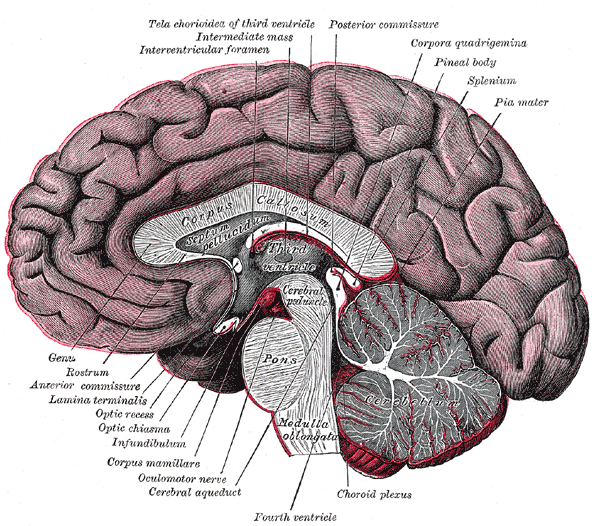
Sagittal cross-section of the human brain. The posterior commissure is labelled at center top.
The posterior commissure labelled on a human brain
Details
Part ofHuman brain
Identifiers
Latincommissura posterior
MeSHD066243
NeuroNames484
NeuroLex IDbirnlex_1026
TA98A14.1.08.416
TA25749
FMA62072
Anatomical terms of neuroanatomy

The posterior commissure (also known as the epithalamic commissure) is a rounded band of white fibers crossing the middle line on the dorsal aspect of the rostral end of the cerebral aqueduct. It is important in the bilateral pupillary light reflex.[citation needed] It constitutes part of the epithalamus.[1]

Its fibers acquire their medullary sheaths early, but their connections have not been definitively determined. Most of them have their origin in a nucleus, the nucleus of the posterior commissure (nucleus of Darkschewitsch), which lies in the periaqueductal grey at rostral end of the cerebral aqueduct, in front of the oculomotor nucleus. Some are thought to be derived from the posterior part of the thalamus and from the superior colliculus, whereas others are believed to be continued downward into the medial longitudinal fasciculus.

For the pupillary light reflex, the olivary pretectal nucleus innervates both Edinger-Westphal nuclei. To reach the contralateral Edinger-Westphal nucleus, the axons cross in the posterior commissure.

References

[edit]
[edit]
Revisions and contributorsEdit on WikipediaRead on Wikipedia
from Grokipedia
The posterior commissure (PC) is a small, transversely oriented bundle of fibers in the that decussates along the midline, serving as a commissural tract connecting homologous regions of the and , including the pretectal nuclei, superior colliculi, and thalamic structures. Located in the at the posterior wall of the third ventricle, it forms the inferior stalk or lamina of the and lies dorsal to the , just rostral to the superior colliculi and posterior to the mammillary bodies. This structure is surrounded by gray matter containing associated nuclei, such as those of Darkschewitsch and Cajal, and measures approximately 1-2 mm in width and 3-6 mm in length in human and mammalian brains. The posterior commissure plays a key role in coordinating bilateral visual and oculomotor functions, primarily by facilitating the consensual through interconnections between pretectal nuclei, which ensure synchronized pupil constriction in both eyes in response to light stimulation on one side. It also contributes to vertical gaze control, including upward eye movements, eyelid retraction, and the vestibulo-ocular reflex, via projections to the rostral interstitial nucleus of the (riMLF) and interstitial nucleus of Cajal (iNC). Fibers within the commissure originate from diverse sources, including the and thalamic intralaminar nuclei, while also linking to habenular nuclei and tectal regions, supporting integration of visual information across hemispheres. Clinically, lesions or compression of the posterior commissure—often due to pineal region tumors, , or infarcts—can lead to (dorsal midbrain syndrome), characterized by upward gaze palsy, convergence-retraction , light-near dissociation of pupils (pseudo-Argyll Robertson pupils), and sign (lid retraction). As an important neuroimaging landmark, the posterior commissure is used in defining the anterior commissure-posterior commissure (AC-PC) line for stereotactic procedures and , aiding in the precise localization of deep structures. Its early developmental formation underscores its evolutionary conservation in coordinating reflexive and orienting behaviors essential for survival.

Anatomy

Location

The posterior commissure is a transverse band of white matter that crosses the midline on the dorsal aspect of the rostral end of the cerebral aqueduct, serving as a key landmark at the junction between the diencephalon and mesencephalon. This structure lies within the epithalamus, where it forms the inferior lamina of the pineal stalk, contributing to the posterior wall of the third ventricle alongside the pineal gland and habenular commissure. Positioned near the nucleus of Darkschewitsch within the matter, the posterior commissure is situated immediately below the habenular commissure and rostral to the . These relations place it approximately at the level of the in the midbrain- junction, nearly surrounded by gray matter that includes several small associated nuclei.

Structure and connections

The posterior commissure consists primarily of decussating myelinated axons that form a compact, rounded band of white fibers, traversing the midline dorsal to the at the diencephalic-mesencephalic junction. These axons arise from multiple and diencephalic nuclei, including the nucleus of Darkschewitsch, the interstitial nucleus of Cajal, the , and various thalamic intralaminar and midline nuclei, contributing to its role as a key commissural pathway in the upper . The commissure's efferent projections extend contralaterally to several targets, such as the Edinger-Westphal nucleus, and the , enabling cross-midline integration of signals from pretectal and tectal regions. Additionally, it incorporates ascending and descending fibers from the and , including contributions from periaqueductal gray matter and habenular nuclei, which further link it to broader diencephalic networks. These interconnections primarily serve to coordinate bilateral pretectal activity through densely packed axonal bundles. In adults, the posterior commissure measures approximately 1-2 mm in width and spans about 3-6 mm in length along its rostrocaudal axis in mammalian . This configuration positions it as a distinct tract amid surrounding gray matter, with its fibers exhibiting a mix of thick and thin myelinated profiles for efficient across hemispheres.

Function

Role in pupillary light reflex

The posterior commissure enables bilateral pupillary constriction in the by serving as the primary site for axons originating from the olivary pretectal nucleus, allowing them to cross to the contralateral Edinger-Westphal nucleus. input travels via the optic tract to the , where neurons in the olivary pretectal nucleus receive this information and project efferents bilaterally, with approximately 50% decussating through the posterior commissure to form a subcortical that activates parasympathetic preganglionic neurons in both Edinger-Westphal nuclei. This pathway ensures the consensual , where illumination of one eye elicits constriction in both pupils due to the bilateral innervation facilitated by the commissure. Lesions affecting the posterior commissure disrupt this crossing, impairing the light-induced pupillary constriction while often sparing the near response, resulting in light-near dissociation. Such disruptions highlight the commissure's specific role in the afferent limb of the light reflex pathway, distinct from the accommodation-convergence response mediated by different circuits. The involvement of the posterior commissure in pathways was first described in relation to anatomy in early 20th-century studies, including experimental lesion work in animals that demonstrated partial crossing of reflex fibers. These findings built on pretectal connections detailed in foundational neuroanatomical mappings.

Role in vertical eye movements

The posterior commissure serves as a critical decussating pathway interconnecting the rostral interstitial nucleus of the medial longitudinal fasciculus (riMLF) and the interstitial nucleus of Cajal (INC), which are essential for generating vertical saccades and maintaining gaze holding in the vertical plane. These connections enable coordinated bilateral activation from the riMLF, where burst neurons drive torsional and vertical saccadic eye movements, while the INC integrates signals to stabilize eccentric gaze positions following saccades. Fibers originating in the midbrain tegmentum traverse the posterior commissure to facilitate these functions. Through its decussating fibers, the posterior commissure facilitates upward gaze and convergence by projecting to the contralateral oculomotor nuclei, specifically targeting motoneurons innervating the superior rectus and inferior oblique muscles. For upward saccades and pursuit, signals from the riMLF cross midline via the posterior commissure, ensuring symmetric activation of both eyes, whereas downward movements often bypass this structure ventrally. The posterior commissure also supports vergence movements, which involve disconjugate eye shifts to maintain binocular fusion on near targets, by integrating pathways that link vergence with accommodation and responses. Additionally, it contributes to vertical components of the vestibulo-ocular (VOR), stabilizing gaze during head rotations in the vertical plane through connections that modulate INC activity for compensatory eye movements. Experimental evidence from lesion studies in underscores the posterior commissure's specificity to vertical eye movements. In monkeys, targeted lesions of the posterior commissure resulted in impaired upward , postsaccadic drifts, and reduced VOR gain during vertical head rotations, without affecting horizontal saccades or pursuit, confirming its role in the vertical neural integrator. Similar bilateral lesions in other produced of upward and convergence-retraction , sparing horizontal movements entirely.

Development

Embryonic origins

The posterior commissure forms as one of the earliest decussating axonal tracts in the dorsal mesencephalon during embryogenesis, becoming detectable as early as approximately 6 weeks of (12 mm in ) and well-developed in embryos measuring 25–37 mm in , corresponding to approximately weeks 7–8 of . This tract emerges in the dorsocaudal portion of prosomere 1, at the junction of the and mesencephalon, where it crosses the midline just dorsal to the mesocoelic recess. Its initial fibers consist of coarse axons that establish the foundational decussation, paving the way for subsequent connections. The tract arises primarily from proliferating neurons in the pretectum, a derivative of the alar plate in the neural tube's most caudal diencephalic segment. These neurons, located in nuclei such as the interstitial nucleus of Cajal and the nucleus of Darkschewitsch, extend axons dorsally to cross the midline, with additional contributions from parvocellular pretectal populations. Axonal guidance to the midline is regulated by molecular cues, including Slit/Robo signaling, which provides repulsive interactions to ensure precise and prevent aberrant crossing. This structure exhibits strong evolutionary conservation across vertebrates, appearing as a fundamental component of early wiring that links bilateral visual and oculomotor processing circuits, from lampreys to mammals. Myelination of the posterior commissure initiates around 14 weeks of , with ventral fibers myelinating first.

Postnatal maturation

Following birth, the axons of the posterior commissure undergo progressive myelination, beginning in early infancy as part of the broader postnatal maturation process in the dorsal brainstem. This myelination enhances signal conduction efficiency to support roles in vertical gaze and pupillary responses. In preterm infants, myelination proceeds more slowly ex utero than , which can lead to immaturity in visual reflexes like the pupillary light response. Such delays can manifest as sluggish or absent reflexes in very preterm neonates.

Clinical significance

Parinaud's syndrome

, also known as dorsal midbrain syndrome, is a characterized by dysfunction in vertical and pupillary responses due to lesions affecting the dorsal , particularly those compressing or infiltrating the posterior commissure. This commissure serves as a key point for fibers involved in upward and light reflexes, rendering it vulnerable to space-occupying masses or inflammatory processes in the rostral and . The syndrome was first described in 1883 by French ophthalmologist Henri Parinaud, who identified cases of upward palsy and convergence paralysis in patients with pathology. The hallmark symptoms include paralysis of upward gaze, convergence-retraction elicited on attempted upgaze, and light-near dissociation of the pupils, where pupillary constriction occurs with near vision but not direct light stimulation. Additional features often encompass bilateral lid retraction, known as Collier's sign, along with , , and symptoms such as , , or . These manifestations arise from disruption of the supranuclear pathways for vertical eye movements and the pretectal , which cross at the posterior commissure. Common etiologies involve pineal region tumors, such as pineocytomas or germinomas, which account for a significant portion of cases in younger patients by exerting on the tectum. Other causes include from aqueductal obstruction, which may be reversible with prompt intervention; demyelinating diseases like ; and vascular events such as strokes or hemorrhages, more prevalent in older adults. Diagnosis relies on clinical examination revealing the classic triad of upgaze palsy, convergence-retraction nystagmus, and pupillary light-near dissociation, supplemented by (MRI) to confirm involvement and identify the underlying pathology. Further evaluation, such as analysis or tumor markers, may be pursued based on suspected .

Neuroimaging and lesions

High-resolution (MRI) sequences, such as T1- and T2-weighted imaging, visualize the posterior commissure as a distinct hypointense band in the dorsal , spanning the midline just posterior to the third ventricle and superior to the aqueduct of Sylvius. This appearance arises from the compact arrangement of myelinated fibers, providing contrast against surrounding gray matter and , particularly in 3T scanners with thin-slice acquisitions (e.g., 0.67 × 0.67 × 1.34 mm³ resolution). Such imaging is essential for stereotactic targeting in procedures like or tumor resection, where precise delineation of the commissure relative to the anterior commissure-posterior commissure (AC-PC) line ensures accurate coordinate mapping. Diffusion tensor imaging (DTI) further enhances assessment by mapping the orientation and integrity of posterior commissure fibers, revealing their decussating trajectories from the interstitial nucleus of Cajal and rostral interstitial nucleus of the toward the contralateral oculomotor complex. in DTI demonstrates these commissural pathways as coherent fiber bundles with high values, indicating preserved microstructural organization in healthy individuals, while disruptions manifest as reduced or fractional discontinuity in pathological states. This technique is particularly valuable for evaluating subtle alterations in the , aiding preoperative planning and postoperative monitoring of fiber integrity. Isolated lesions of the posterior commissure are rare due to its small size and midline location but can result from compressive effects, such as vertebrobasilar dolichoectasia, leading to selective bilateral without affecting downgaze or horizontal movements. More commonly, damage occurs as part of larger infarcts involving the paramedian branches of the posterior cerebral or basilar arteries, where infarction extends to adjacent structures like the riMLF, producing combined vertical gaze deficits alongside upgaze impairment. in these cases typically shows hyperintense signals on T2/FLAIR sequences within the dorsal , correlating with clinical selective upgaze limitations confirmed by oculocephalic testing. In therapeutic contexts, such as management of pineal region tumors, surgical and radiation approaches prioritize sparing the posterior commissure to maintain vertical gaze reflexes and pupillary responses. Supracerebellar-infratentorial or endoscopic transventricular trajectories allow maximal resection while avoiding direct injury to the commissure, with postoperative MRI verifying preserved fiber integrity via DTI to minimize oculomotor morbidity. Similarly, stereotactic targets tumor margins, delivering focused radiation doses (e.g., 12-18 Gy) that exclude the commissure.

References

Add your contribution
Related Hubs
User Avatar
No comments yet.