



Community hub
Recent from talks
Knowledge base stats:
Talk channels stats:
Members stats:
Medial longitudinal fasciculus
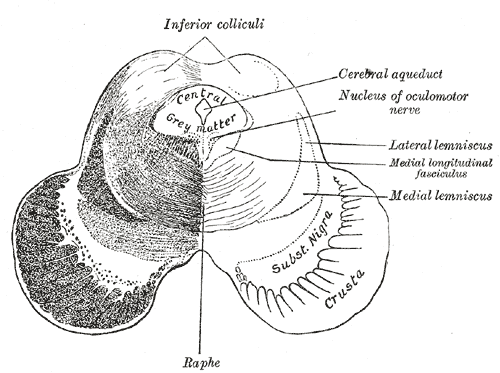
The medial longitudinal fasciculus (MLF) is a prominent bundle of nerve fibres which pass within the ventral/anterior portion of periaqueductal gray of the mesencephalon (midbrain). It contains the interstitial nucleus of Cajal, responsible for oculomotor control, head posture, and vertical eye movement.
The MLF interconnects interneurons of each abducens nucleus with motor neurons of the contralateral oculomotor nucleus; thus, the MLF mediates coordination of horizontal (side to side) eye movements, ensuring the two eyes move in unison (thus also enabling saccadic eye movements). The MLF also contains fibers projecting from the vestibular nuclei to the oculomotor and trochlear nuclei as well as the interstitial nucleus of Cajal; these connections ensure that eye movements are coordinated with head movements (as sensed by the vestibular system).
The medial longitudinal fasciculus is the main central connection for the oculomotor nerve, trochlear nerve, and abducens nerve. It carries information about the direction that the eyes should move. Lesions of the medial longitudinal fasciculus can cause nystagmus and diplopia, which may be associated with multiple sclerosis, a neoplasm, or a stroke.
The MLF is the main intersegmental tract of the brainstem. It extends across the dorsal tegmentum of all three parts of the brainstem, as well as reaching caudally into the upper cervical spinal cord levels.
Descending fibers arise from the superior colliculus in the rostral midbrain (for visual reflexes), the accessory oculomotor nuclei in the rostral midbrain for visual tracking, and the pontine reticular formation, which facilitates extensor muscle tone. Ascending tracts arise from the vestibular nucleus and terminate in the oculomotor nucleus (of the oculomotor nerve, CN III), the trochlear nucleus (of the trochlear nerve, CN IV), and the abducens nucleus (of the abducens nerve, CN VI).
It contains the interstitial nucleus of Cajal, and the rostral interstitial nucleus (riMLF) (the vertical gaze center).
The paramedian pontine reticular formation (PMPRF) is involved in coordinating horizontal conjugate eye movements and saccades. To do so, besides projecting to the ipsilateral abducens nucleus, the PMPRF projects fibers through the MLF to the contralateral oculomotor nucleus (specifically, those of its motor neurons that innervate the medial rectus muscle).
The interstitial nucleus of Cajal receives some ascending afferents from the vestibular nuclei via the MLF; the nucleus in turn projects descending efferents via the MLF back to the (superior and medial) vestibular nuclei, as well as to all levels of the spinal cord.
Hub AI
Medial longitudinal fasciculus AI simulator
(@Medial longitudinal fasciculus_simulator)
Medial longitudinal fasciculus
The medial longitudinal fasciculus (MLF) is a prominent bundle of nerve fibres which pass within the ventral/anterior portion of periaqueductal gray of the mesencephalon (midbrain). It contains the interstitial nucleus of Cajal, responsible for oculomotor control, head posture, and vertical eye movement.
The MLF interconnects interneurons of each abducens nucleus with motor neurons of the contralateral oculomotor nucleus; thus, the MLF mediates coordination of horizontal (side to side) eye movements, ensuring the two eyes move in unison (thus also enabling saccadic eye movements). The MLF also contains fibers projecting from the vestibular nuclei to the oculomotor and trochlear nuclei as well as the interstitial nucleus of Cajal; these connections ensure that eye movements are coordinated with head movements (as sensed by the vestibular system).
The medial longitudinal fasciculus is the main central connection for the oculomotor nerve, trochlear nerve, and abducens nerve. It carries information about the direction that the eyes should move. Lesions of the medial longitudinal fasciculus can cause nystagmus and diplopia, which may be associated with multiple sclerosis, a neoplasm, or a stroke.
The MLF is the main intersegmental tract of the brainstem. It extends across the dorsal tegmentum of all three parts of the brainstem, as well as reaching caudally into the upper cervical spinal cord levels.
Descending fibers arise from the superior colliculus in the rostral midbrain (for visual reflexes), the accessory oculomotor nuclei in the rostral midbrain for visual tracking, and the pontine reticular formation, which facilitates extensor muscle tone. Ascending tracts arise from the vestibular nucleus and terminate in the oculomotor nucleus (of the oculomotor nerve, CN III), the trochlear nucleus (of the trochlear nerve, CN IV), and the abducens nucleus (of the abducens nerve, CN VI).
It contains the interstitial nucleus of Cajal, and the rostral interstitial nucleus (riMLF) (the vertical gaze center).
The paramedian pontine reticular formation (PMPRF) is involved in coordinating horizontal conjugate eye movements and saccades. To do so, besides projecting to the ipsilateral abducens nucleus, the PMPRF projects fibers through the MLF to the contralateral oculomotor nucleus (specifically, those of its motor neurons that innervate the medial rectus muscle).
The interstitial nucleus of Cajal receives some ascending afferents from the vestibular nuclei via the MLF; the nucleus in turn projects descending efferents via the MLF back to the (superior and medial) vestibular nuclei, as well as to all levels of the spinal cord.