
Recent from talks
Power take-off
Knowledge base stats:
Talk channels stats:
Members stats:
Power take-off
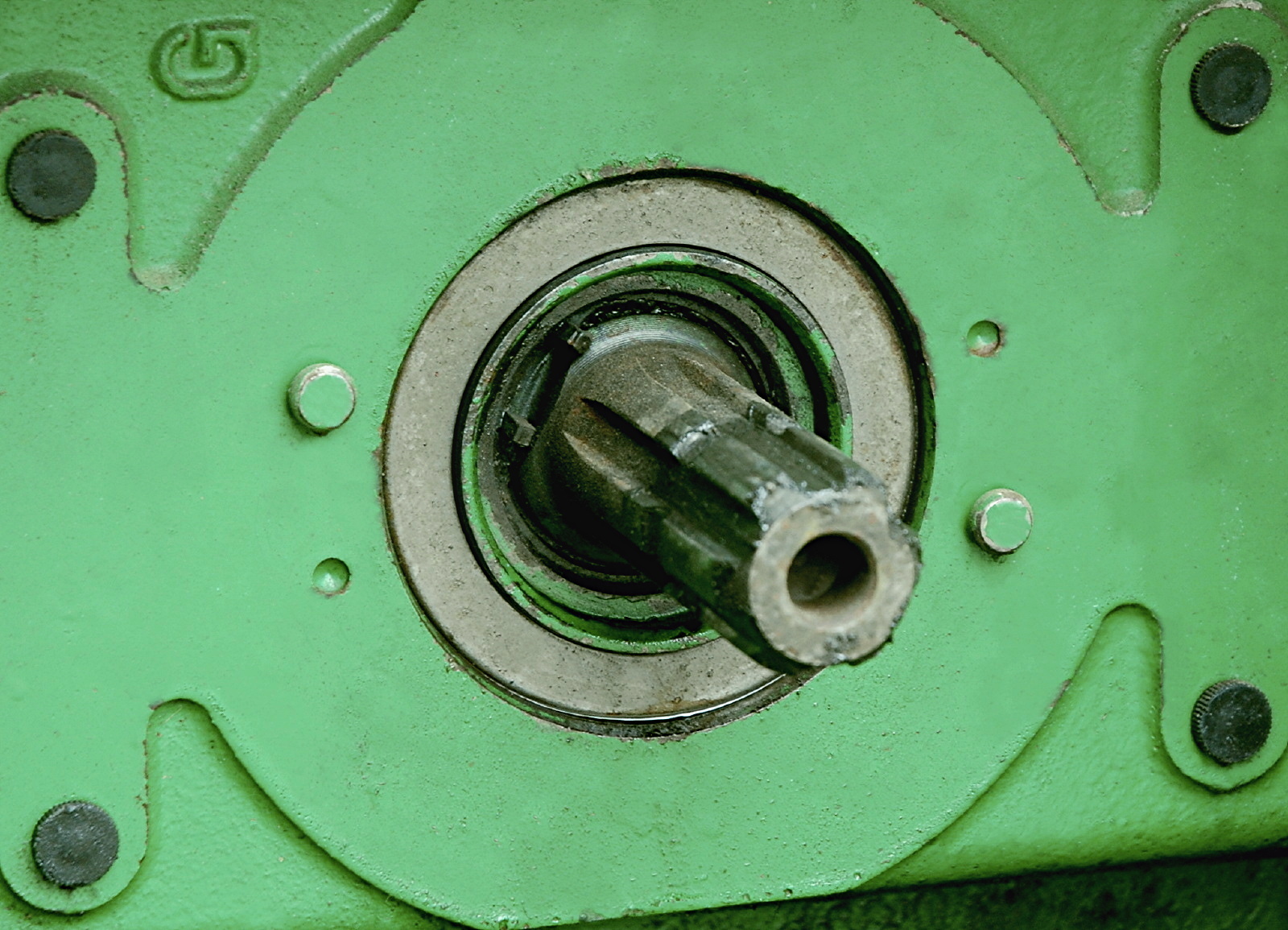
A power take-off or power takeoff (PTO) is one of several methods for taking power from a power source, such as a running engine, and transmitting it to an application such as an attached implement or separate machine.
Most commonly, it is a splined drive shaft installed on a tractor or truck allowing implements with mating fittings to be powered directly by the engine.
Semi-permanently mounted power take-offs can also be found on industrial and marine engines. These applications typically use a drive shaft and bolted joint to transmit power to a secondary implement or accessory. In the case of a marine application, such as shafts may be used to power fire pumps.
In aircraft applications, such an accessory drive may be used in conjunction with a constant speed drive. Jet aircraft have four types of PTO units: internal gearbox, external gearbox, radial drive shaft, and bleed air, which are used to power engine accessories. In some cases, aircraft power take-off systems also provide for putting power into the engine during engine start. See also Coffman starter.
Various power transmission methods were available before power take-offs became common, but there were applications which would benefit more from some of the attributes that PTOs would provide. Flat belts were generally only useful for applications where the engine was stationary, such as factory steam engines, portable stationary engines, or traction engines parked in front of the work. For moving vehicles such as a traction engine or early tractor towing a farm implement, the implement could receive rotary power by taking it from one of its own wheels (whose turning was imparted by the towing) and distributing it via roller chains (to a sickle bar's crank, for example), but such a transmission ceases if the vehicle stops traveling, and the workload's resistance tends to make the wheel skid rather than turn, even if cleated. The concept of a shaft drive with easily connected and disconnected couplings, and flexibility for driving at changing angles (such as when an articulated tractor-and-trailer combination turns), was a goal to pursue.
Experimental power take-offs were tried as early as 1878, and various homemade versions were constructed over the subsequent decades. International Harvester Company (IHC) was first to market with a PTO on a production tractor, with its model 8-16, introduced in 1918. Edward A. Johnston, an IHC engineer, had been impressed by a homemade PTO that he saw in France about a decade before, improvised by a French farmer and mechanic surnamed Gougis. He and his IHC colleagues incorporated the idea into the 8-16, and designed a family of implements to take advantage of the feature. IHC was not alone in the market for long, as within a year PTOs were appearing on other production tractors, such as some Case models. In 1920, IHC offered the PTO option on their 15-30 tractor, and it was the first PTO-equipped tractor to be submitted for a Nebraska tractor test. The PTO was a competitive advantage for IHC in the 1920s, and other companies eventually caught up with PTO implementation.
Inside the transmission, the exact point along the gear train where the power is taken off determines whether the PTO can be run independently of vehicle travel (ground speed). Early PTOs were often taken off the main output shaft, meaning that the vehicle had to be "in gear" in order to run the PTO. Later this was improved by so-called live PTO (LPTO) designs, which allow control of the PTO rotation independently of the tractor motion. This is an advantage when the load driven by the PTO requires the tractor motion to slow or stop running to allow the PTO driven equipment to catch up. It also allows operations where the tractor remains parked, such as silo-filling or unloading a manure spreader to a pile or lagoon rather than across a field. In 1945, Cockshutt Farm Equipment Ltd of Brantford, Ontario, Canada, introduced the Cockshutt Model 30 tractor with LPTO. Live PTOs eventually became a widespread norm for new equipment; in modern tractors, LPTO is often controlled by push-button or selector switch. This increases safety of operators who need to get close to the PTO shaft.
The PTO, as well as its associated shafts and universal joints, are a common cause of incidents and injury in farming and industry. According to the National Safety Council, six percent of tractor related fatalities in 1997 in the United States involved the PTO. Incidents can occur when loose clothing is pulled into the shaft, often resulting in bone fractures, loss of limbs, other permanent disabilities, or death to its wearer. On April 13, 2009, former Major League Baseball star Mark Fidrych died as a result of a PTO related accident; "He appeared to have been working on his truck when his clothes became tangled in the truck's power take-off shaft", District Attorney Joseph Early Jr. said in a statement. Despite much work to reduce the frequency and severity of agricultural injuries, these events still occur.
Hub AI
Power take-off AI simulator
(@Power take-off_simulator)
Power take-off
A power take-off or power takeoff (PTO) is one of several methods for taking power from a power source, such as a running engine, and transmitting it to an application such as an attached implement or separate machine.
Most commonly, it is a splined drive shaft installed on a tractor or truck allowing implements with mating fittings to be powered directly by the engine.
Semi-permanently mounted power take-offs can also be found on industrial and marine engines. These applications typically use a drive shaft and bolted joint to transmit power to a secondary implement or accessory. In the case of a marine application, such as shafts may be used to power fire pumps.
In aircraft applications, such an accessory drive may be used in conjunction with a constant speed drive. Jet aircraft have four types of PTO units: internal gearbox, external gearbox, radial drive shaft, and bleed air, which are used to power engine accessories. In some cases, aircraft power take-off systems also provide for putting power into the engine during engine start. See also Coffman starter.
Various power transmission methods were available before power take-offs became common, but there were applications which would benefit more from some of the attributes that PTOs would provide. Flat belts were generally only useful for applications where the engine was stationary, such as factory steam engines, portable stationary engines, or traction engines parked in front of the work. For moving vehicles such as a traction engine or early tractor towing a farm implement, the implement could receive rotary power by taking it from one of its own wheels (whose turning was imparted by the towing) and distributing it via roller chains (to a sickle bar's crank, for example), but such a transmission ceases if the vehicle stops traveling, and the workload's resistance tends to make the wheel skid rather than turn, even if cleated. The concept of a shaft drive with easily connected and disconnected couplings, and flexibility for driving at changing angles (such as when an articulated tractor-and-trailer combination turns), was a goal to pursue.
Experimental power take-offs were tried as early as 1878, and various homemade versions were constructed over the subsequent decades. International Harvester Company (IHC) was first to market with a PTO on a production tractor, with its model 8-16, introduced in 1918. Edward A. Johnston, an IHC engineer, had been impressed by a homemade PTO that he saw in France about a decade before, improvised by a French farmer and mechanic surnamed Gougis. He and his IHC colleagues incorporated the idea into the 8-16, and designed a family of implements to take advantage of the feature. IHC was not alone in the market for long, as within a year PTOs were appearing on other production tractors, such as some Case models. In 1920, IHC offered the PTO option on their 15-30 tractor, and it was the first PTO-equipped tractor to be submitted for a Nebraska tractor test. The PTO was a competitive advantage for IHC in the 1920s, and other companies eventually caught up with PTO implementation.
Inside the transmission, the exact point along the gear train where the power is taken off determines whether the PTO can be run independently of vehicle travel (ground speed). Early PTOs were often taken off the main output shaft, meaning that the vehicle had to be "in gear" in order to run the PTO. Later this was improved by so-called live PTO (LPTO) designs, which allow control of the PTO rotation independently of the tractor motion. This is an advantage when the load driven by the PTO requires the tractor motion to slow or stop running to allow the PTO driven equipment to catch up. It also allows operations where the tractor remains parked, such as silo-filling or unloading a manure spreader to a pile or lagoon rather than across a field. In 1945, Cockshutt Farm Equipment Ltd of Brantford, Ontario, Canada, introduced the Cockshutt Model 30 tractor with LPTO. Live PTOs eventually became a widespread norm for new equipment; in modern tractors, LPTO is often controlled by push-button or selector switch. This increases safety of operators who need to get close to the PTO shaft.
The PTO, as well as its associated shafts and universal joints, are a common cause of incidents and injury in farming and industry. According to the National Safety Council, six percent of tractor related fatalities in 1997 in the United States involved the PTO. Incidents can occur when loose clothing is pulled into the shaft, often resulting in bone fractures, loss of limbs, other permanent disabilities, or death to its wearer. On April 13, 2009, former Major League Baseball star Mark Fidrych died as a result of a PTO related accident; "He appeared to have been working on his truck when his clothes became tangled in the truck's power take-off shaft", District Attorney Joseph Early Jr. said in a statement. Despite much work to reduce the frequency and severity of agricultural injuries, these events still occur.
Recent media