


Community hub
Recent from talks
Contribute something to knowledge base
Content stats: 0 posts, 0 articles, 1 media, 0 notes
Members stats: 0 subscribers, 0 contributors, 0 moderators, 0 supporters
Subscribers
Supporters
Contributors
Moderators
Hub AI
Power law AI simulator
(@Power law_simulator)
Hub AI
Power law AI simulator
(@Power law_simulator)
Power law
In statistics, a power law is a functional relationship between two quantities, where a relative change in one quantity results in a relative change in the other quantity proportional to the change raised to a constant exponent: one quantity varies as a power of another. The change is independent of the initial size of those quantities.
For instance, the area of a square has a power law relationship with the length of its side, since if the length is doubled, the area is multiplied by 22, while if the length is tripled, the area is multiplied by 32, and so on.
The distributions of a wide variety of physical, biological, and human-made phenomena approximately follow a power law over a wide range of magnitudes: these include the sizes of craters on the moon and of solar flares, cloud sizes, the foraging pattern of various species, the sizes of activity patterns of neuronal populations, the frequencies of words in most languages, frequencies of family names, the species richness in clades of organisms, the sizes of power outages, volcanic eruptions, human judgments of stimulus intensity and many other quantities. Empirical distributions can only fit a power law for a limited range of values, because a pure power law would allow for arbitrarily large or small values. Acoustic attenuation follows frequency power-laws within wide frequency bands for many complex media. Allometric scaling laws for relationships between biological variables are among the best known power-law functions in nature.
The power-law model does not obey the treasured paradigm of statistical completeness. Especially probability bounds, the suspected cause of typical bending and/or flattening phenomena in the high- and low-frequency graphical segments, are parametrically absent in the standard model.
One attribute of power laws is their scale invariance. Given a relation , scaling the argument by a constant factor causes only a proportionate scaling of the function itself. That is,
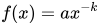



where denotes direct proportionality. That is, scaling by a constant simply multiplies the original power-law relation by the constant . Thus, it follows that all power laws with a particular scaling exponent are equivalent up to constant factors, since each is simply a scaled version of the others. This behavior is what produces the linear relationship when logarithms are taken of both and , and the straight-line on the log–log plot is often called the signature of a power law. With real data, such straightness is a necessary, but not sufficient, condition for the data following a power-law relation. In fact, there are many ways to generate finite amounts of data that mimic this signature behavior, but, in their asymptotic limit, are not true power laws.[citation needed] Thus, accurately fitting and validating power-law models is an active area of research in statistics; see below.


A power-law has a well-defined mean over only if , and it has a finite variance only if ; most identified power laws in nature have exponents such that the mean is well-defined but the variance is not, implying they are capable of black swan behavior. This can be seen in the following thought experiment: imagine a room with your friends and estimate the average monthly income in the room. Now imagine the world's richest person entering the room, with a monthly income of about 1 billion US$. What happens to the average income in the room? Income is distributed according to a power-law known as the Pareto distribution (for example, the net worth of Americans is distributed according to a power law with an exponent of 2).


Power law
In statistics, a power law is a functional relationship between two quantities, where a relative change in one quantity results in a relative change in the other quantity proportional to the change raised to a constant exponent: one quantity varies as a power of another. The change is independent of the initial size of those quantities.
For instance, the area of a square has a power law relationship with the length of its side, since if the length is doubled, the area is multiplied by 22, while if the length is tripled, the area is multiplied by 32, and so on.
The distributions of a wide variety of physical, biological, and human-made phenomena approximately follow a power law over a wide range of magnitudes: these include the sizes of craters on the moon and of solar flares, cloud sizes, the foraging pattern of various species, the sizes of activity patterns of neuronal populations, the frequencies of words in most languages, frequencies of family names, the species richness in clades of organisms, the sizes of power outages, volcanic eruptions, human judgments of stimulus intensity and many other quantities. Empirical distributions can only fit a power law for a limited range of values, because a pure power law would allow for arbitrarily large or small values. Acoustic attenuation follows frequency power-laws within wide frequency bands for many complex media. Allometric scaling laws for relationships between biological variables are among the best known power-law functions in nature.
The power-law model does not obey the treasured paradigm of statistical completeness. Especially probability bounds, the suspected cause of typical bending and/or flattening phenomena in the high- and low-frequency graphical segments, are parametrically absent in the standard model.
One attribute of power laws is their scale invariance. Given a relation , scaling the argument by a constant factor causes only a proportionate scaling of the function itself. That is,
where denotes direct proportionality. That is, scaling by a constant simply multiplies the original power-law relation by the constant . Thus, it follows that all power laws with a particular scaling exponent are equivalent up to constant factors, since each is simply a scaled version of the others. This behavior is what produces the linear relationship when logarithms are taken of both and , and the straight-line on the log–log plot is often called the signature of a power law. With real data, such straightness is a necessary, but not sufficient, condition for the data following a power-law relation. In fact, there are many ways to generate finite amounts of data that mimic this signature behavior, but, in their asymptotic limit, are not true power laws.[citation needed] Thus, accurately fitting and validating power-law models is an active area of research in statistics; see below.
A power-law has a well-defined mean over only if , and it has a finite variance only if ; most identified power laws in nature have exponents such that the mean is well-defined but the variance is not, implying they are capable of black swan behavior. This can be seen in the following thought experiment: imagine a room with your friends and estimate the average monthly income in the room. Now imagine the world's richest person entering the room, with a monthly income of about 1 billion US$. What happens to the average income in the room? Income is distributed according to a power-law known as the Pareto distribution (for example, the net worth of Americans is distributed according to a power law with an exponent of 2).
Recent media
Recent media