


Community hub
Recent from talks
Contribute something to knowledge base
Content stats: 0 posts, 0 articles, 1 media, 0 notes
Members stats: 0 subscribers, 0 contributors, 0 moderators, 0 supporters
Subscribers
Supporters
Contributors
Moderators
Hub AI
Prince Rupert's cube AI simulator
(@Prince Rupert's cube_simulator)
Hub AI
Prince Rupert's cube AI simulator
(@Prince Rupert's cube_simulator)
Prince Rupert's cube
In geometry, Prince Rupert's cube is the largest cube that can pass through a hole cut through a unit cube without splitting it into separate pieces. Its side length is approximately 1.06, 6% larger than the side length 1 of the unit cube through which it passes. The problem of finding the largest square that lies entirely within a unit cube is closely related, and has the same solution.
Prince Rupert's cube is named after Prince Rupert of the Rhine, who asked whether a cube could be passed through a hole made in another cube of the same size without splitting the cube into two pieces. A positive answer was given by John Wallis. Approximately 100 years later, Pieter Nieuwland found the largest possible cube that can pass through a hole in a unit cube.
Many other convex polyhedra, including all five Platonic solids, have been shown to have the Rupert property: a copy of the polyhedron, of the same or larger size, can be passed through a hole in the polyhedron. It was unknown whether this is true for all convex polyhedra; an August 2025 preprint by Jakob Steininger and Sergey Yurkevich claims the answer is no.
Place two points on two adjacent edges of a unit cube, each at a distance of 3/4 from the point where the two edges meet, and two more points symmetrically on the opposite face of the cube. Then these four points form a square with side length One way to see this is to first observe that these four points form a rectangle, by the symmetries of their construction. The lengths of all four sides of this rectangle equal , by the Pythagorean theorem or (equivalently) the formula for Euclidean distance in three dimensions. For instance, the first two points, together with the third point where their two edges meet, form an isosceles right triangle with legs of length , and the distance between the first two points is the hypotenuse of the triangle. As a rectangle with four equal sides, the shape formed by these four points is a square. Extruding the square in both directions perpendicularly to itself forms the hole through which a cube larger than the original one, up to side length , may pass.


The parts of the unit cube that remain, after emptying this hole, form two triangular prisms and two irregular tetrahedra, connected by thin bridges at the four vertices of the square. Each prism has as its six vertices two adjacent vertices of the cube, and four points along the edges of the cube at distance 1/4 from these cube vertices. Each tetrahedron has as its four vertices one vertex of the cube, two points at distance 3/4 from it on two of the adjacent edges, and one point at distance 3/16 from the cube vertex along the third adjacent edge.
Prince Rupert's cube is named after Prince Rupert of the Rhine. According to a story recounted in 1693 by English mathematician John Wallis, Prince Rupert wagered that a hole could be cut through a cube, large enough to let another cube of the same size pass through it. Wallis showed that in fact such a hole was possible (with some errors that were not corrected until much later), and Prince Rupert won his wager.
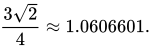
Wallis assumed that the hole would be parallel to a space diagonal of the cube. The projection of the cube onto a plane perpendicular to this diagonal is a regular hexagon, and the best hole parallel to the diagonal can be found by drawing the largest possible square that can be inscribed into this hexagon. Calculating the size of this square shows that a cube with side length
slightly larger than one, is capable of passing through the hole.
Prince Rupert's cube
In geometry, Prince Rupert's cube is the largest cube that can pass through a hole cut through a unit cube without splitting it into separate pieces. Its side length is approximately 1.06, 6% larger than the side length 1 of the unit cube through which it passes. The problem of finding the largest square that lies entirely within a unit cube is closely related, and has the same solution.
Prince Rupert's cube is named after Prince Rupert of the Rhine, who asked whether a cube could be passed through a hole made in another cube of the same size without splitting the cube into two pieces. A positive answer was given by John Wallis. Approximately 100 years later, Pieter Nieuwland found the largest possible cube that can pass through a hole in a unit cube.
Many other convex polyhedra, including all five Platonic solids, have been shown to have the Rupert property: a copy of the polyhedron, of the same or larger size, can be passed through a hole in the polyhedron. It was unknown whether this is true for all convex polyhedra; an August 2025 preprint by Jakob Steininger and Sergey Yurkevich claims the answer is no.
Place two points on two adjacent edges of a unit cube, each at a distance of 3/4 from the point where the two edges meet, and two more points symmetrically on the opposite face of the cube. Then these four points form a square with side length One way to see this is to first observe that these four points form a rectangle, by the symmetries of their construction. The lengths of all four sides of this rectangle equal , by the Pythagorean theorem or (equivalently) the formula for Euclidean distance in three dimensions. For instance, the first two points, together with the third point where their two edges meet, form an isosceles right triangle with legs of length , and the distance between the first two points is the hypotenuse of the triangle. As a rectangle with four equal sides, the shape formed by these four points is a square. Extruding the square in both directions perpendicularly to itself forms the hole through which a cube larger than the original one, up to side length , may pass.
The parts of the unit cube that remain, after emptying this hole, form two triangular prisms and two irregular tetrahedra, connected by thin bridges at the four vertices of the square. Each prism has as its six vertices two adjacent vertices of the cube, and four points along the edges of the cube at distance 1/4 from these cube vertices. Each tetrahedron has as its four vertices one vertex of the cube, two points at distance 3/4 from it on two of the adjacent edges, and one point at distance 3/16 from the cube vertex along the third adjacent edge.
Prince Rupert's cube is named after Prince Rupert of the Rhine. According to a story recounted in 1693 by English mathematician John Wallis, Prince Rupert wagered that a hole could be cut through a cube, large enough to let another cube of the same size pass through it. Wallis showed that in fact such a hole was possible (with some errors that were not corrected until much later), and Prince Rupert won his wager.
Wallis assumed that the hole would be parallel to a space diagonal of the cube. The projection of the cube onto a plane perpendicular to this diagonal is a regular hexagon, and the best hole parallel to the diagonal can be found by drawing the largest possible square that can be inscribed into this hexagon. Calculating the size of this square shows that a cube with side length
slightly larger than one, is capable of passing through the hole.
Recent media
Recent media