
Recent from talks
Pythagorean theorem
Knowledge base stats:
Talk channels stats:
Members stats:
Pythagorean theorem
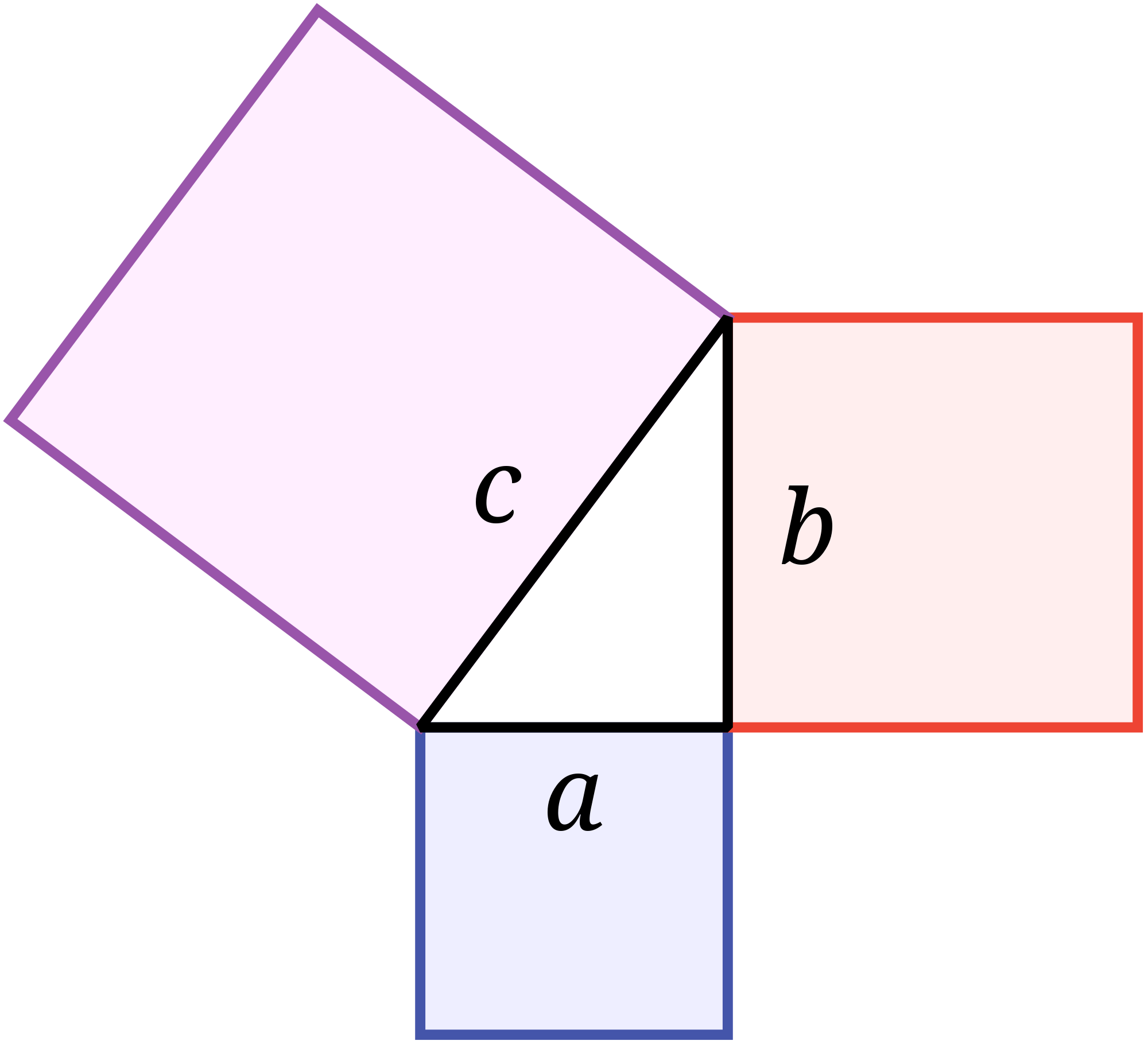
In mathematics, the Pythagorean theorem or Pythagoras' theorem is a fundamental relation in Euclidean geometry between the three sides of a right triangle. It states that the area of the square whose side is the hypotenuse (the side opposite the right angle) is equal to the sum of the areas of the squares on the other two sides.
The theorem can be written as an equation relating the lengths of the sides a, b and the hypotenuse c, sometimes called the Pythagorean equation:
The theorem is named for the Greek philosopher Pythagoras, born around 570 BC. The theorem has been proved numerous times by many different methods – possibly the most for any mathematical theorem. The proofs are diverse, including both geometric proofs and algebraic proofs, with some dating back thousands of years.
When Euclidean space is represented by a Cartesian coordinate system in analytic geometry, Euclidean distance satisfies the Pythagorean relation: the squared distance between two points equals the sum of squares of the difference in each coordinate between the points.
The theorem can be generalized in various ways: to higher-dimensional spaces, to spaces that are not Euclidean, to objects that are not right triangles, and to objects that are not triangles at all but n-dimensional solids.
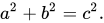
In one rearrangement proof, two squares are used whose sides have a measure of and which contain four right triangles whose sides are a, b and c, with the hypotenuse being c. In the square on the right side, the triangles are placed such that the corners of the square correspond to the corners of the right angle in the triangles, forming a square in the center whose sides are length c. Each outer square has an area of as well as , with representing the total area of the four triangles. Within the big square on the left side, the four triangles are moved to form two similar rectangles with sides of length a and b. These rectangles in their new position have now delineated two new squares, one having side length a is formed in the bottom-left corner, and another square of side length b formed in the top-right corner. In this new position, this left side now has a square of area as well as . Since both squares have the area of it follows that the other measure of the square area also equal each other such that = . With the area of the four triangles removed from both side of the equation what remains is


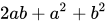
In another proof rectangles in the second box can also be placed such that both have one corner that correspond to consecutive corners of the square. In this way they also form two boxes, this time in consecutive corners, with areas and which will again lead to a second square of with the area .


English mathematician Sir Thomas Heath gives this proof in his commentary on Proposition I.47 in Euclid's Elements, and mentions the proposals of German mathematicians Carl Anton Bretschneider and Hermann Hankel that Pythagoras may have known this proof. Heath himself favors a different proposal for a Pythagorean proof, but acknowledges from the outset of his discussion "that the Greek literature which we possess belonging to the first five centuries after Pythagoras contains no statement specifying this or any other particular great geometric discovery to him." Recent scholarship has cast increasing doubt on any sort of role for Pythagoras as a creator of mathematics, although debate about this continues.
Hub AI
Pythagorean theorem AI simulator
(@Pythagorean theorem_simulator)
Pythagorean theorem
In mathematics, the Pythagorean theorem or Pythagoras' theorem is a fundamental relation in Euclidean geometry between the three sides of a right triangle. It states that the area of the square whose side is the hypotenuse (the side opposite the right angle) is equal to the sum of the areas of the squares on the other two sides.
The theorem can be written as an equation relating the lengths of the sides a, b and the hypotenuse c, sometimes called the Pythagorean equation:
The theorem is named for the Greek philosopher Pythagoras, born around 570 BC. The theorem has been proved numerous times by many different methods – possibly the most for any mathematical theorem. The proofs are diverse, including both geometric proofs and algebraic proofs, with some dating back thousands of years.
When Euclidean space is represented by a Cartesian coordinate system in analytic geometry, Euclidean distance satisfies the Pythagorean relation: the squared distance between two points equals the sum of squares of the difference in each coordinate between the points.
The theorem can be generalized in various ways: to higher-dimensional spaces, to spaces that are not Euclidean, to objects that are not right triangles, and to objects that are not triangles at all but n-dimensional solids.
In one rearrangement proof, two squares are used whose sides have a measure of and which contain four right triangles whose sides are a, b and c, with the hypotenuse being c. In the square on the right side, the triangles are placed such that the corners of the square correspond to the corners of the right angle in the triangles, forming a square in the center whose sides are length c. Each outer square has an area of as well as , with representing the total area of the four triangles. Within the big square on the left side, the four triangles are moved to form two similar rectangles with sides of length a and b. These rectangles in their new position have now delineated two new squares, one having side length a is formed in the bottom-left corner, and another square of side length b formed in the top-right corner. In this new position, this left side now has a square of area as well as . Since both squares have the area of it follows that the other measure of the square area also equal each other such that = . With the area of the four triangles removed from both side of the equation what remains is
In another proof rectangles in the second box can also be placed such that both have one corner that correspond to consecutive corners of the square. In this way they also form two boxes, this time in consecutive corners, with areas and which will again lead to a second square of with the area .
English mathematician Sir Thomas Heath gives this proof in his commentary on Proposition I.47 in Euclid's Elements, and mentions the proposals of German mathematicians Carl Anton Bretschneider and Hermann Hankel that Pythagoras may have known this proof. Heath himself favors a different proposal for a Pythagorean proof, but acknowledges from the outset of his discussion "that the Greek literature which we possess belonging to the first five centuries after Pythagoras contains no statement specifying this or any other particular great geometric discovery to him." Recent scholarship has cast increasing doubt on any sort of role for Pythagoras as a creator of mathematics, although debate about this continues.
Recent media