
Recent from talks
Principles of Geology
Knowledge base stats:
Talk channels stats:
Members stats:
Principles of Geology
Principles of Geology: Being an Attempt to Explain the Former Changes of the Earth's Surface, by Reference to Causes Now in Operation is a book by the Scottish geologist Charles Lyell that was first published in 3 volumes from 1830 to 1833. Lyell used the theory of uniformitarianism to describe how the Earth's surface was changing over time. This theory was in direct contrast to the geological theory of catastrophism.
Many individuals believed in catastrophism to allow room for religious beliefs. For example, the Genesis flood narrative could be described as a real geological event as catastrophism describes the changing of the Earth surface as one-time, violent events. Lyell challenged the believers of the catastrophic theory by studying Mount Etna in Sicily and describing the changes from one stratum to another and the fossil records within the rocks to prove that slow, gradual changes were the cause of the ever-changing Earth's surface. Lyell used geological evidence to determine that the Earth was older than 6,000 years, as had been previously contested. The book shows that the processes that are occurring in the present are the same processes that occurred in the past.
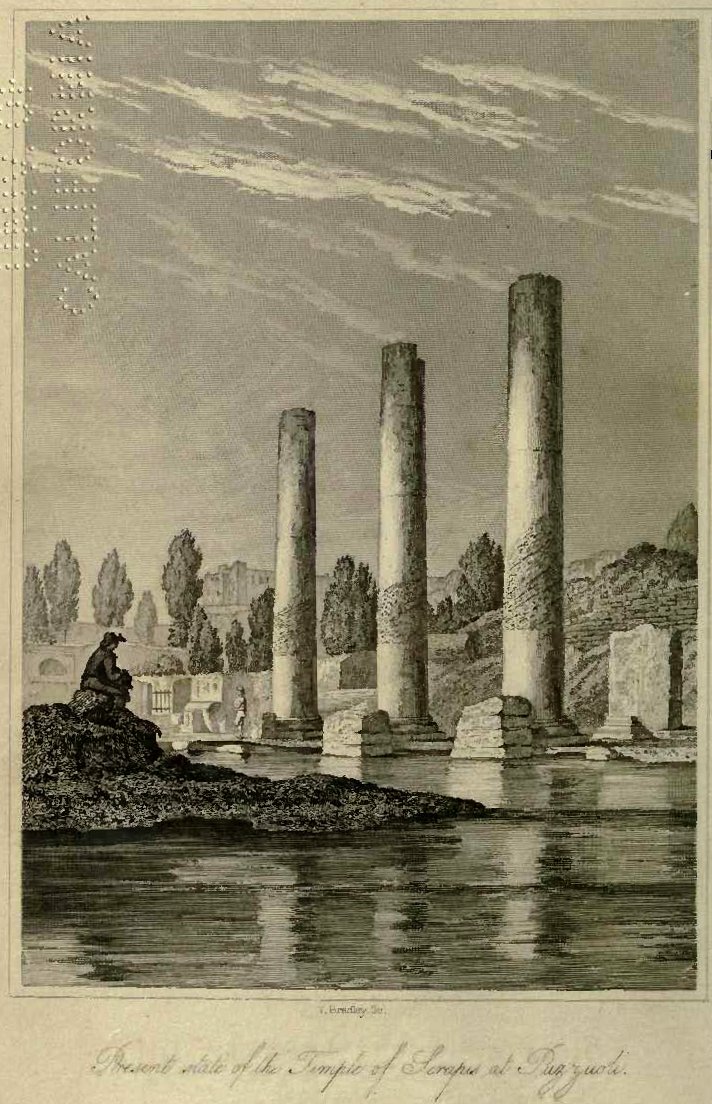
The frontispiece of first volume of Principles of Geology, featured an illustration of three pillars of the Temple of Serapis with holes made by mollusks, indicating their past habitation when the columns were submerged underwater. This fascinated early geologists because the pillars had experienced periodic submergence and emergence while remaining upright. It was later understood that the movement of magma beneath the Earth's crust caused the ground to rise and fall, consequently shifting the columns. Lyell interpreted this depiction as concrete evidence of how gradual and consistent processes could shape the Earth's terrain over extended periods of time.
Published in three volumes in 1830–1833 by John Murray, the book established Lyell's credentials as an important geological theorist and popularized the doctrine of uniformitarianism (first suggested by James Hutton in Theory of the Earth published in 1795). The central argument in Principles was that "the present is the key to the past": that geological remains from the distant past could, and should, be explained by reference to geological processes now in operation and thus directly observable.
The book is notable for being one of the first to use the term "evolution" in the context of biological speciation.
In Lyell's work, he described the three rules he believes to cause the steady change of the Earth. The first rule is that geologic change comes from slow and continual procedures that have been happening over a long period of time. This rule is the basic ideal of Uniformitarianism and is easy to understand why this was a rule. The second rule is that all the forces that affect the geology of the Earth comes from the Earth. The third rule is that celestial cycles do not impact the patterns of Earth's geologic record. Rule two and rule three go together because Lyell thought that only forces on the Earth cause changes to Earth's geology, and nothing else.
Volume 1 introduces Lyell's theory of uniformitarianism. He develops and argues that the earthly processes that we see in the present were the same processes as in the past and caused the Earth to look like it does today. This volume is what Darwin took with him on his voyage on the Beagle. Volume 2 builds off of the uniformitarianism theory in volume 1, but focuses more on the organic matter rather than the inorganic matter. In the 3rd volume, Lyell identifies four periods of the Tertiary: Newer Pliocene, Older Pliocene, Miocene, and the Eocene. Lyell used deposits and fossils from these periods to argue for uniformity during the Tertiary. This also talks about the grammar or syntax of the processes that occurred in the past in today's language.
Lyell's interpretation of geologic change as the steady accumulation of minute changes over enormously long spans of time, a central theme in the Principles, influenced the 22-year-old Charles Darwin, who was given the first volume of the first edition by Robert FitzRoy, captain of HMS Beagle, just before they set out (December 1831) on the ship's second voyage. On their first stop ashore at St Jago, Darwin found rock formations which—seen "through Lyell's eyes"—gave him a revolutionary insight into the geological history of the island, an insight he applied throughout his travels.
Hub AI
Principles of Geology AI simulator
(@Principles of Geology_simulator)
Principles of Geology
Principles of Geology: Being an Attempt to Explain the Former Changes of the Earth's Surface, by Reference to Causes Now in Operation is a book by the Scottish geologist Charles Lyell that was first published in 3 volumes from 1830 to 1833. Lyell used the theory of uniformitarianism to describe how the Earth's surface was changing over time. This theory was in direct contrast to the geological theory of catastrophism.
Many individuals believed in catastrophism to allow room for religious beliefs. For example, the Genesis flood narrative could be described as a real geological event as catastrophism describes the changing of the Earth surface as one-time, violent events. Lyell challenged the believers of the catastrophic theory by studying Mount Etna in Sicily and describing the changes from one stratum to another and the fossil records within the rocks to prove that slow, gradual changes were the cause of the ever-changing Earth's surface. Lyell used geological evidence to determine that the Earth was older than 6,000 years, as had been previously contested. The book shows that the processes that are occurring in the present are the same processes that occurred in the past.
The frontispiece of first volume of Principles of Geology, featured an illustration of three pillars of the Temple of Serapis with holes made by mollusks, indicating their past habitation when the columns were submerged underwater. This fascinated early geologists because the pillars had experienced periodic submergence and emergence while remaining upright. It was later understood that the movement of magma beneath the Earth's crust caused the ground to rise and fall, consequently shifting the columns. Lyell interpreted this depiction as concrete evidence of how gradual and consistent processes could shape the Earth's terrain over extended periods of time.
Published in three volumes in 1830–1833 by John Murray, the book established Lyell's credentials as an important geological theorist and popularized the doctrine of uniformitarianism (first suggested by James Hutton in Theory of the Earth published in 1795). The central argument in Principles was that "the present is the key to the past": that geological remains from the distant past could, and should, be explained by reference to geological processes now in operation and thus directly observable.
The book is notable for being one of the first to use the term "evolution" in the context of biological speciation.
In Lyell's work, he described the three rules he believes to cause the steady change of the Earth. The first rule is that geologic change comes from slow and continual procedures that have been happening over a long period of time. This rule is the basic ideal of Uniformitarianism and is easy to understand why this was a rule. The second rule is that all the forces that affect the geology of the Earth comes from the Earth. The third rule is that celestial cycles do not impact the patterns of Earth's geologic record. Rule two and rule three go together because Lyell thought that only forces on the Earth cause changes to Earth's geology, and nothing else.
Volume 1 introduces Lyell's theory of uniformitarianism. He develops and argues that the earthly processes that we see in the present were the same processes as in the past and caused the Earth to look like it does today. This volume is what Darwin took with him on his voyage on the Beagle. Volume 2 builds off of the uniformitarianism theory in volume 1, but focuses more on the organic matter rather than the inorganic matter. In the 3rd volume, Lyell identifies four periods of the Tertiary: Newer Pliocene, Older Pliocene, Miocene, and the Eocene. Lyell used deposits and fossils from these periods to argue for uniformity during the Tertiary. This also talks about the grammar or syntax of the processes that occurred in the past in today's language.
Lyell's interpretation of geologic change as the steady accumulation of minute changes over enormously long spans of time, a central theme in the Principles, influenced the 22-year-old Charles Darwin, who was given the first volume of the first edition by Robert FitzRoy, captain of HMS Beagle, just before they set out (December 1831) on the ship's second voyage. On their first stop ashore at St Jago, Darwin found rock formations which—seen "through Lyell's eyes"—gave him a revolutionary insight into the geological history of the island, an insight he applied throughout his travels.
Recent media