
Probability integral transform
View on WikipediaIn probability theory, the probability integral transform (also known as universality of the uniform) relates to the result that data values that are modeled as being random variables from any given continuous distribution can be converted to random variables having a standard uniform distribution.[1] This holds exactly provided that the distribution being used is the true distribution of the random variables; if the distribution is one fitted to the data, the result will hold approximately in large samples.
The result is sometimes modified or extended so that the result of the transformation is a standard distribution other than the uniform distribution, such as the exponential distribution.
The transform was introduced by Ronald Fisher in his 1932 edition of the book Statistical Methods for Research Workers.[2]
Applications
[edit]One use for the probability integral transform in statistical data analysis is to provide the basis for testing whether a set of observations can reasonably be modelled as arising from a specified distribution. Specifically, the probability integral transform is applied to construct an equivalent set of values, and a test is then made of whether a uniform distribution is appropriate for the constructed dataset. Examples of this are P–P plots and Kolmogorov–Smirnov tests.
A second use for the transformation is in the theory related to copulas which are a means of both defining and working with distributions for statistically dependent multivariate data. Here the problem of defining or manipulating a joint probability distribution for a set of random variables is simplified or reduced in apparent complexity by applying the probability integral transform to each of the components and then working with a joint distribution for which the marginal variables have uniform distributions.
A third use is based on applying the inverse of the probability integral transform to convert random variables from a uniform distribution to have a selected distribution: this is known as inverse transform sampling.
Statement
[edit]Suppose that a random variable has a continuous distribution for which the cumulative distribution function (CDF) is Then the random variable defined as


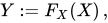
has a standard uniform distribution.[1][3]
Equivalently, if is the uniform measure on , the distribution of on is the pushforward measure .

![{\displaystyle [0,1]}](https://wikimedia.org/api/rest_v1/media/math/render/svg/738f7d23bb2d9642bab520020873cccbef49768d)


Proof
[edit]Given any random continuous variable , define . Given , if exists (i.e., if there exists a unique such that , then:

![{\displaystyle y\in [0,1]}](https://wikimedia.org/api/rest_v1/media/math/render/svg/75565b2f1c9aa708980c991de7726f71e1e8c556)


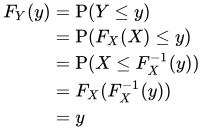
If does not exist, then it can be replaced in this proof by the function , where we define , , and for , with the same result that . Thus, is just the CDF of a random variable, so that has a uniform distribution on the interval .





Examples
[edit]For a first, illustrative example, let be a random variable with a standard normal distribution . Then its CDF is

![{\displaystyle \Phi (x)={\frac {1}{\sqrt {2\pi }}}\int _{-\infty }^{x}{\rm {e}}^{-t^{2}/2}\,{\rm {d}}t={\frac {1}{2}}{\Big [}\,1+\operatorname {erf} {\Big (}{\frac {x}{\sqrt {2}}}{\Big )}\,{\Big ]},\quad x\in \mathbb {R} ,\,}](https://wikimedia.org/api/rest_v1/media/math/render/svg/86014170f90fb7cd78b56360db29b3eaa4125070)
where is the error function. Then the new random variable defined by is uniformly distributed.


As second example, if has an exponential distribution with unit mean, then its CDF is

and the immediate result of the probability integral transform is that

has a uniform distribution. Moreover, by symmetry of the uniform distribution,
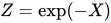
also has a uniform distribution.
See also
[edit]References
[edit]- ^ a b Dodge, Y. (2006) The Oxford Dictionary of Statistical Terms, Oxford University Press
- ^ David, F. N.; Johnson, N. L. (1948). "The Probability Integral Transformation When Parameters are Estimated from the Sample". Biometrika. 35 (1/2): 182. doi:10.2307/2332638. JSTOR 2332638.
- ^ Casella, George; Berger, Roger L. (2002). Statistical Inference (2nd ed.). Theorem 2.1.10, p.54.
Probability integral transform
View on GrokipediaIntroduction
Definition
The probability integral transform is a key technique in probability theory for standardizing continuous random variables by mapping them to a uniform scale using their cumulative distribution function (CDF). For a continuous random variable with CDF , the transformed variable follows a uniform distribution on the interval , denoted . This process enables the comparison and analysis of random variables drawn from different distributions as if they were on a common probabilistic footing, preserving essential distributional properties while simplifying computations.[1] The CDF of a random variable is defined as for , providing the probability that does not exceed . For continuous random variables, is a continuous, non-decreasing function with limits and , often strictly increasing over the support of . The probability integral transform exploits these properties of the CDF to yield , where the notation generically represents the CDF and the standard uniform distribution. This transform applies primarily to continuous distributions, where the continuity of the CDF ensures the uniformity of . It serves as a foundational tool in areas such as simulation and goodness-of-fit testing.[1]Historical Background
The probability integral transform was introduced by Ronald A. Fisher in the fourth edition of his influential book Statistical Methods for Research Workers, published in 1932, where it emerged as a tool within the broader framework of statistical inference and the theory of probability distributions. Fisher's work implicitly utilized the transform in discussions of variance and hypothesis testing, marking an early recognition of its utility in transforming random variables to facilitate statistical analysis. This introduction occurred amid Fisher's broader contributions to modern statistics at Rothamsted Experimental Station, where he developed foundational methods for experimental design and hypothesis testing. Early extensions and formalizations of the transform appeared in the statistical literature shortly thereafter, notably in the work of F. N. David and N. L. Johnson. In their 1948 paper published in Biometrika, they examined the behavior of the probability integral transform when distribution parameters are estimated from the sample rather than known a priori, deriving key distributional properties under these conditions. This analysis addressed practical challenges in goodness-of-fit testing and parameter estimation, solidifying the transform's role in applied statistics and influencing subsequent theoretical developments.[7] Following these foundational contributions, the probability integral transform evolved into a cornerstone of computational statistics in the post-1950s period, as digital computing enabled widespread simulation techniques and Monte Carlo methods. Its inverse form became essential for generating random variates from complex distributions, underpinning advancements in numerical integration and stochastic modeling across statistical practice.Mathematical Formulation
Statement
The probability integral transform theorem states that if is a continuous random variable with continuous cumulative distribution function (CDF) , then the random variable follows a standard uniform distribution on the interval .[1] This transformation maps the distribution of to the uniform distribution through application of its own CDF, leveraging the continuity of to ensure uniformity. If is strictly increasing, the transformation is bijective from the support of to . The continuity of is essential, as discontinuities would distort the uniformity of .Proof
The proof of the probability integral transform theorem relies on the continuity and non-decreasing nature of the cumulative distribution function (CDF) of the random variable . Assume has a continuous CDF , which is non-decreasing and right-continuous. To show that follows a uniform distribution on , compute the CDF of , denoted , for . Define the quantile function (generalized inverse CDF) asProperties
Uniform Distribution
A central consequence of the probability integral transform is that if has a continuous cumulative distribution function , then the transformed variable follows a standard uniform distribution on the interval . This result, established through probabilistic arguments involving the continuity and monotonicity of , ensures that is uniformly distributed irrespective of the underlying distribution of .[1][8] The uniformity of provides a powerful standardization mechanism for any continuous random variable, rendering the output distribution parameter-free and independent of the specific parameters governing . For the standard uniform distribution , the expected value is and the variance is . This standardization preserves independence: if multiple random variables are independent, their transforms remain independent uniforms. Consequently, it enables the straightforward generation of samples from diverse distributions by leveraging the uniform base.[9] Additionally, the transform maintains the relative ordering of data points because is strictly increasing, thereby mapping the order statistics of the sample directly to those of the corresponding uniform sample. This order-preserving property is valuable for ranking observations and comparing structures across heterogeneous distributions without altering their positional relationships.[10]Inverse Transform
The inverse probability integral transform, often referred to as the quantile transform, reverses the forward probability integral transform by generating random variables from a target distribution using uniform random variables as input. Specifically, if $ U $ is a random variable uniformly distributed on the interval (0,1), then the random variable $ X = F_X^{-1}(U) $ follows the cumulative distribution function $ F_X $ of the target distribution.[11] This construction relies on the quantile function $ F_X^{-1} $, defined as $ F_X^{-1}(u) = \inf { x \in \mathbb{R} : F_X(x) \geq u } $ for $ u \in (0,1) $, with the convention that the infimum over the empty set is $ +\infty $.[12] The quantile function possesses several key properties that ensure its utility in this transform. It is non-decreasing, reflecting the monotonicity of the underlying cumulative distribution function, and left-continuous at every point in its domain where it is finite.[12] These properties guarantee that $ F_X(F_X^{-1}(u)) \geq u $ for all $ u \in (0,1) $, with equality holding if $ F_X $ is continuous and strictly increasing.[12] For continuous distributions, the quantile function provides a precise inverse mapping, establishing a bidirectional correspondence with the forward transform that converts variables from the target distribution back to uniform and vice versa.[13] In practice, evaluating the quantile function $ X = F_X^{-1}(U) $ may involve computational challenges when closed-form expressions are unavailable for complex distributions. Numerical methods, such as root-finding algorithms, are then applied to approximate the infimum defining the quantile.[14] This approach maintains the theoretical guarantees of the transform while enabling its application in simulation and statistical inference.Generalizations
Discrete Distributions
For discrete random variables, the standard probability integral transform does not produce a uniform distribution on [0,1]. If is a discrete random variable with cumulative distribution function (CDF) , then satisfies for all , due to the discontinuous jumps in at the atoms of 's support; equality holds when is a possible value of (i.e., for some atom ) and is strict otherwise. Equality for all holds if and only if is continuous.[15] This limitation arises because the possible values of are confined to the partial sums of the probability mass function at the support points, resulting in a discrete distribution rather than a continuous uniform one. To overcome this, a randomized modification incorporates an auxiliary uniform random variable to "fill" the jumps in the CDF. The randomized probability integral transform is given byGeneral randomizing variable
The standard randomized PIT uses $ U \sim \text{Uniform}[0,1] $. More generally, let $ W $ be any random variable on [0,1] independent of $ X $, and defineMultivariate Extensions
The multivariate extension of the probability integral transform (PIT) applies to a random vector with joint cumulative distribution function (CDF) . Applying the univariate PIT to each marginal CDF yields the vector , where for . Each is uniformly distributed on , but the components of are generally dependent, reflecting the dependence structure in the original joint distribution.[17] This dependence is captured by the copula , defined as the joint CDF of :where denotes the quantile function (generalized inverse) of the -th marginal. The copula thus links the joint distribution to its marginals, isolating the dependence while preserving the marginal behaviors.[17][18] To achieve a full transformation to independent uniform random variables, the Rosenblatt transform extends the PIT through iterative conditioning. For the random vector , the transformed variables are defined sequentially as and, for ,
where is the conditional CDF of given the previous components. The resulting consists of independent uniforms on , enabling simulation and uniformity-based analyses in higher dimensions.[19] This extension assumes that the joint distribution is absolutely continuous (with continuous marginals and conditional distributions having densities) to ensure the uniqueness of the copula as established by Sklar's theorem. Sklar's theorem states that for any joint distribution with continuous marginals, there exists a unique copula on that couples the marginals to the joint CDF. Without continuity, the transform may not yield exact uniformity due to ties or discontinuities.[17][20]
Applications
Simulation Methods
The inverse transform sampling algorithm, a core application of the probability integral transform in simulation, generates random variates from a target distribution by leveraging uniform random numbers. For a continuous random variable with cumulative distribution function (CDF) , which is strictly increasing and thus invertible, the method proceeds as follows: generate , then set , where . This yields distributed according to , as the transformation ensures . The algorithm is particularly efficient when the inverse CDF has a closed-form expression, requiring only a single uniform variate and direct computation.[21][22] A primary advantage of inverse transform sampling is its exactness: the generated samples precisely match the target distribution without approximation bias, making it ideal for distributions where the inverse is readily available, such as the exponential or uniform cases. It also offers simplicity in implementation and preserves monotonicity, which is useful for generating ordered statistics or correlated variates by applying the transform to sorted uniforms. Computationally, it avoids the overhead of acceptance-rejection steps when the inverse is explicit, enabling fast generation in one dimension.[21][22] However, the method's limitations arise when the inverse CDF lacks a closed form or is computationally expensive to evaluate, as in the normal or gamma distributions, necessitating numerical inversion techniques like bisection or Newton-Raphson, which increase runtime and may introduce minor inaccuracies. For such complex cases, alternatives like rejection sampling—where proposals from a simpler distribution are accepted or rejected based on a bounding density—provide more practical efficiency, though at the cost of variable sample acceptance rates and potentially higher variance in generation time.[21][22] This approach has been a foundational technique in Monte Carlo simulation since the 1950s, emerging alongside early efforts to generate non-uniform variates for probabilistic modeling in physics and engineering.[22]Goodness-of-Fit Testing
The probability integral transform (PIT) provides a foundational method for goodness-of-fit testing by converting an observed sample from a hypothesized continuous distribution to a set of values that should follow a uniform distribution on [0,1] under the null hypothesis. Given an independent and identically distributed (i.i.d.) sample purportedly drawn from a distribution with cumulative distribution function (CDF) , the transformed values are for . If the null hypothesis holds—that the data indeed follow the specified distribution—then the are i.i.d. Uniform(0,1). This reduction to uniformity testing allows the application of standard tests designed for the uniform distribution to assess fit for arbitrary continuous distributions, thereby streamlining the evaluation process across diverse parametric families.[23] A common approach employs the Kolmogorov-Smirnov (KS) test on the transformed . The KS statistic measures the maximum deviation between the empirical CDF of the and the theoretical uniform CDF, given byPredictive Modeling and Forecast Evaluation
In predictive modeling and forecast evaluation, PIT residuals serve as a diagnostic tool to assess the calibration of probabilistic forecasts. For a predictive cumulative distribution function conditioned on covariates or past data, the PIT residual for an observed value is computed as , where represents the information available at time . Under a well-calibrated model, the sequence should behave like i.i.d. Uniform(0,1) draws. Deviations from uniformity, assessed via histograms, quantile-quantile (Q-Q) plots, or formal tests like the KS statistic, indicate model misspecification, such as under- or over-dispersion, or failure to capture dependencies. This application is widely used in econometrics, meteorology, and machine learning to validate density forecasts and improve predictive accuracy.[6]Copula Modeling
In copula modeling, the probability integral transform (PIT) serves as a foundational tool for separating the marginal distributions of multivariate data from their underlying dependence structure. By applying the PIT to each marginal cumulative distribution function (CDF) , the observed variables are transformed into uniform random variables on the interval . This transformation yields a joint vector of uniforms whose distribution is governed solely by the copula, allowing practitioners to fit and estimate the copula directly from the transformed data without interference from the specific forms of the marginals. This process is underpinned by Sklar's theorem, which establishes that for any multivariate CDF with continuous marginal CDFs , there exists a unique copula such thatExamples
Continuous Uniform Case
The probability integral transform applied to a continuous uniform random variable demonstrates a fixed-point property, where the transformation preserves uniformity but rescales the support to the standard interval. Consider a random variable following a uniform distribution on the interval , denoted , with . The cumulative distribution function (CDF) of is given byExponential Distribution
The exponential distribution is a continuous probability distribution commonly used to model the time between events in a Poisson process, characterized by a constant rate parameter . A random variable following an exponential distribution, denoted , has the cumulative distribution function (CDF) for , and otherwise.[30] Applying the probability integral transform to , the transformed variable follows a uniform distribution on , i.e., . This result holds because the exponential distribution is continuous and strictly increasing, satisfying the conditions of the probability integral transform theorem. The inverse transform, which maps a uniform random variable back to the exponential scale, is given by . This inverse is particularly useful for generating exponential random variables from uniform ones in simulation contexts.[27][31] To illustrate the uniformity of the transform, consider and a small set of simulated exponential values for (generated via the inverse method from uniform inputs for reproducibility). The corresponding values cluster between 0 and 1 without apparent bias, demonstrating the transform's effect. The table below shows five example pairs:| (simulated) | |
|---|---|
| 0.2231 | 0.2000 |
| 0.6931 | 0.5000 |
| 1.0986 | 0.6667 |
| 1.6094 | 0.8000 |
| 2.3026 | 0.9000 |