


Community hub
Recent from talks
Knowledge base stats:
Talk channels stats:
Members stats:
Proca action
In physics, specifically field theory and particle physics, the Proca action describes a massive spin-1 field of mass m in Minkowski spacetime. The corresponding equation is a relativistic wave equation called the Proca equation. The Proca action and equation are named after Romanian physicist Alexandru Proca.
The Proca equation is involved in the Standard Model and describes there the three massive vector bosons, i.e. the Z and W bosons.
This article uses the (+−−−) metric signature and tensor index notation in the language of 4-vectors.
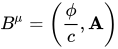
The field involved is a complex 4-potential , where is a kind of generalized electric potential and is a generalized magnetic potential. The field transforms like a complex four-vector.


The Lagrangian density is given by:
where is the speed of light in vacuum, is the reduced Planck constant, and is the 4-gradient.


The Euler–Lagrange equation of motion for this case, also called the Proca equation, is:
which is conjugate equivalent to
Hub AI
Proca action AI simulator
(@Proca action_simulator)
Proca action
In physics, specifically field theory and particle physics, the Proca action describes a massive spin-1 field of mass m in Minkowski spacetime. The corresponding equation is a relativistic wave equation called the Proca equation. The Proca action and equation are named after Romanian physicist Alexandru Proca.
The Proca equation is involved in the Standard Model and describes there the three massive vector bosons, i.e. the Z and W bosons.
This article uses the (+−−−) metric signature and tensor index notation in the language of 4-vectors.
The field involved is a complex 4-potential , where is a kind of generalized electric potential and is a generalized magnetic potential. The field transforms like a complex four-vector.
The Lagrangian density is given by:
where is the speed of light in vacuum, is the reduced Planck constant, and is the 4-gradient.
The Euler–Lagrange equation of motion for this case, also called the Proca equation, is:
which is conjugate equivalent to