


Community hub
Recent from talks
Contribute something
Nothing was collected or created yet.
Four-vector
View on Wikipedia
| Part of a series on |
| Spacetime |
|---|
 |


In special relativity, a four-vector (or 4-vector, sometimes Lorentz vector)[1] is an object with four components, which transform in a specific way under Lorentz transformations. Specifically, a four-vector is an element of a four-dimensional vector space considered as a representation space of the standard representation of the Lorentz group, the (1/2,1/2) representation. It differs from a Euclidean vector in how its magnitude is determined. The transformations that preserve this magnitude are the Lorentz transformations, which include spatial rotations and boosts (a change by a constant velocity to another inertial reference frame).[2]: ch1
Four-vectors describe, for instance, position xμ in spacetime modeled as Minkowski space, a particle's four-momentum pμ, the amplitude of the electromagnetic four-potential Aμ(x) at a point x in spacetime, and the elements of the subspace spanned by the gamma matrices inside the Dirac algebra.
The Lorentz group may be represented by 4×4 matrices Λ. The action of a Lorentz transformation on a general contravariant four-vector X (like the examples above), regarded as a column vector with Cartesian coordinates with respect to an inertial frame in the entries, is given by

(matrix multiplication) where the components of the primed object refer to the new frame. Related to the examples above that are given as contravariant vectors, there are also the corresponding covariant vectors xμ, pμ and Aμ(x). These transform according to the rule
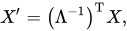
where T denotes the matrix transpose. This rule is different from the above rule. It corresponds to the dual representation of the standard representation. However, for the Lorentz group the dual of any representation is equivalent to the original representation. Thus the objects with covariant indices are four-vectors as well.
For an example of a well-behaved four-component object in special relativity that is not a four-vector, see bispinor. It is similarly defined, the difference being that the transformation rule under Lorentz transformations is given by a representation other than the standard representation. In this case, the rule reads X′ = Π(Λ)X, where Π(Λ) is a 4×4 matrix other than Λ. Similar remarks apply to objects with fewer or more components that are well-behaved under Lorentz transformations. These include scalars, spinors, tensors and spinor-tensors.
The article considers four-vectors in the context of special relativity. Although the concept of four-vectors also extends to general relativity, some of the results stated in this article require modification in general relativity.
In the standard configuration, where the primed frame has speed u along the positive x-axis, the transformation of four-vectors is: [3]
or depending on convention (viz. whether events are written (t,x,y,z) or (ct,x,y,z), respectively).


Notation
[edit]The notations in this article are: lowercase bold for three-dimensional vectors, hats for three-dimensional unit vectors, capital bold for four dimensional vectors (except for the four-gradient), and tensor index notation.
Four-vector algebra
[edit]Four-vectors in a real-valued basis
[edit]A four-vector A is a vector with a "timelike" component and three "spacelike" components, and can be written in various equivalent notations:[4]
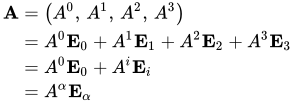
where Aα is the magnitude component and Eα is the basis vector component; note that both are necessary to make a vector, and that when Aα is seen alone, it refers strictly to the components of the vector.
The upper indices indicate contravariant components. Here the standard convention is that Latin indices take values for spatial components, so that i = 1, 2, 3, and Greek indices take values for space and time components, so α = 0, 1, 2, 3, used with the summation convention. The split between the time component and the spatial components is a useful one to make when determining contractions of one four vector with other tensor quantities, such as for calculating Lorentz invariants in inner products (examples are given below), or raising and lowering indices.
In special relativity, the spacelike basis E1, E2, E3 and components A1, A2, A3 are often Cartesian basis and components:

although, of course, any other basis and components may be used, such as spherical polar coordinates

or cylindrical polar coordinates,

or any other orthogonal coordinates, or even general curvilinear coordinates. Note the coordinate labels are always subscripted as labels and are not indices taking numerical values. In general relativity, local curvilinear coordinates in a local basis must be used. Geometrically, a four-vector can still be interpreted as an arrow, but in spacetime - not just space. In relativity, the arrows are drawn as part of Minkowski diagram (also called spacetime diagram). In this article, four-vectors will be referred to simply as vectors.
It is also customary to represent the bases by column vectors:
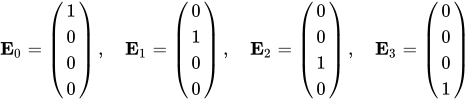
so that:
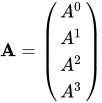
The relation between the covariant and contravariant coordinates is through the Minkowski metric tensor (referred to as the metric), η which raises and lowers indices as follows:
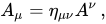
and in various equivalent notations the covariant components are:
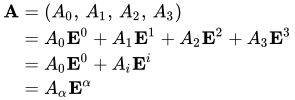
where the lowered index indicates it to be covariant. Often the metric is diagonal, as is the case for orthogonal coordinates (see line element), but not in general curvilinear coordinates.
The bases can be represented by row vectors:
so that:
![{\displaystyle {\begin{aligned}\mathbf {E} ^{0}&={\begin{pmatrix}1&0&0&0\end{pmatrix}}\,,&\mathbf {E} ^{1}&={\begin{pmatrix}0&1&0&0\end{pmatrix}}\,,\\[1ex]\mathbf {E} ^{2}&={\begin{pmatrix}0&0&1&0\end{pmatrix}}\,,&\mathbf {E} ^{3}&={\begin{pmatrix}0&0&0&1\end{pmatrix}},\end{aligned}}}](https://wikimedia.org/api/rest_v1/media/math/render/svg/abcc63ff1a2a74eaf2d7fab9f41dfa9e74698c2c)

The motivation for the above conventions are that the inner product is a scalar, see below for details.
Lorentz transformation
[edit]Given two inertial or rotated frames of reference, a four-vector is defined as a quantity which transforms according to the Lorentz transformation matrix Λ:

In index notation, the contravariant and covariant components transform according to, respectively: in which the matrix Λ has components Λμν in row μ and column ν, and the matrix (Λ−1)T has components Λμν in row μ and column ν.

For background on the nature of this transformation definition, see tensor. All four-vectors transform in the same way, and this can be generalized to four-dimensional relativistic tensors; see special relativity.
Pure rotations about an arbitrary axis
[edit]For two frames rotated by a fixed angle θ about an axis defined by the unit vector:

without any boosts, the matrix Λ has components given by:[5]

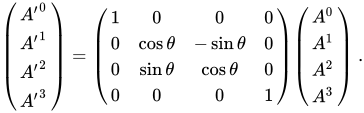
where δij is the Kronecker delta, and εijk is the three-dimensional Levi-Civita symbol. The spacelike components of four-vectors are rotated, while the timelike components remain unchanged.
For the case of rotations about the z-axis only, the spacelike part of the Lorentz matrix reduces to the rotation matrix about the z-axis:
Pure boosts in an arbitrary direction
[edit]
For two frames moving at constant relative three-velocity v (not four-velocity, see below), it is convenient to denote and define the relative velocity in units of c by:

Then without rotations, the matrix Λ has components given by:[6] where the Lorentz factor is defined by: and δij is the Kronecker delta. Contrary to the case for pure rotations, the spacelike and timelike components are mixed together under boosts.
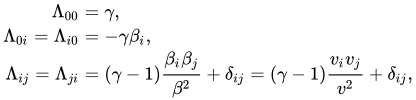
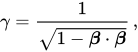
For the case of a boost in the x-direction only, the matrix reduces to;[7][8]
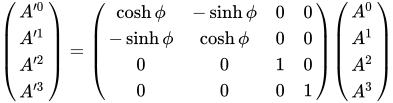
Where the rapidity ϕ expression has been used, written in terms of the hyperbolic functions:

This Lorentz matrix illustrates the boost to be a hyperbolic rotation in four dimensional spacetime, analogous to the circular rotation above in three-dimensional space.
Properties
[edit]Linearity
[edit]Four-vectors have the same linearity properties as Euclidean vectors in three dimensions. They can be added in the usual entrywise way: and similarly scalar multiplication by a scalar λ is defined entrywise by:


Then subtraction is the inverse operation of addition, defined entrywise by:

Minkowski tensor
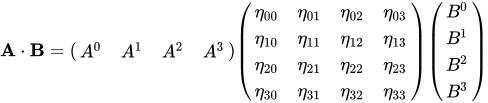
[edit]Applying the Minkowski tensor ημν to two four-vectors A and B, writing the result in dot product notation, we have, using Einstein notation:

in special relativity. The dot product of the basis vectors is the Minkowski metric, as opposed to the Kronecker delta as in Euclidean space. It is convenient to rewrite the definition in matrix form: in which case ημν above is the entry in row μ and column ν of the Minkowski metric as a square matrix. The Minkowski metric is not a Euclidean metric, because it is indefinite (see metric signature). A number of other expressions can be used because the metric tensor can raise and lower the components of A or B. For contra/co-variant components of A and co/contra-variant components of B, we have: so in the matrix notation: while for A and B each in covariant components: with a similar matrix expression to the above.

![{\displaystyle {\begin{aligned}\mathbf {A} \cdot \mathbf {B} &={\begin{pmatrix}A_{0}&A_{1}&A_{2}&A_{3}\end{pmatrix}}{\begin{pmatrix}B^{0}\\B^{1}\\B^{2}\\B^{3}\end{pmatrix}}\\[1ex]&={\begin{pmatrix}B_{0}&B_{1}&B_{2}&B_{3}\end{pmatrix}}{\begin{pmatrix}A^{0}\\A^{1}\\A^{2}\\A^{3}\end{pmatrix}}\end{aligned}}}](https://wikimedia.org/api/rest_v1/media/math/render/svg/94102cfb466ea382a720f78aa2bc64ea8935d0ed)

Applying the Minkowski tensor to a four-vector A with itself we get: which, depending on the case, may be considered the square, or its negative, of the length of the vector.

Following are two common choices for the metric tensor in the standard basis (essentially Cartesian coordinates). If orthogonal coordinates are used, there would be scale factors along the diagonal part of the spacelike part of the metric, while for general curvilinear coordinates the entire spacelike part of the metric would have components dependent on the curvilinear basis used.
Standard basis, (+−−−) signature
[edit]The (+−−−) metric signature is sometimes called the "mostly minus" convention, or the "west coast" convention.
In the (+−−−) metric signature, evaluating the summation over indices gives: while in matrix form:

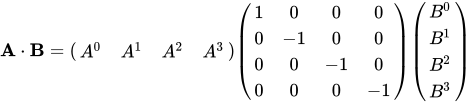
It is a recurring theme in special relativity to take the expression in one reference frame, where C is the value of the inner product in this frame, and: in another frame, in which C′ is the value of the inner product in this frame. Then since the inner product is an invariant, these must be equal: that is:



![{\displaystyle {\begin{aligned}C&=A^{0}B^{0}-A^{1}B^{1}-A^{2}B^{2}-A^{3}B^{3}\\[2pt]&={A'}^{0}{B'}^{0}-{A'}^{1}{B'}^{1}-{A'}^{2}{B'}^{2}-{A'}^{3}{B'}^{3}\end{aligned}}}](https://wikimedia.org/api/rest_v1/media/math/render/svg/3d8faee65a366f79be5049674ff58b6803b3b4ac)
Considering that physical quantities in relativity are four-vectors, this equation has the appearance of a "conservation law", but there is no "conservation" involved. The primary significance of the Minkowski inner product is that for any two four-vectors, its value is invariant for all observers; a change of coordinates does not result in a change in value of the inner product. The components of the four-vectors change from one frame to another; A and A′ are connected by a Lorentz transformation, and similarly for B and B′, although the inner products are the same in all frames. Nevertheless, this type of expression is exploited in relativistic calculations on a par with conservation laws, since the magnitudes of components can be determined without explicitly performing any Lorentz transformations. A particular example is with energy and momentum in the energy-momentum relation derived from the four-momentum vector (see also below).
In this signature we have:

With the signature (+−−−), four-vectors may be classified as either spacelike if , timelike if , and null vectors if .


Standard basis, (−+++) signature
[edit]The (-+++) metric signature is sometimes called the "east coast" convention.
Some authors define η with the opposite sign, in which case we have the (−+++) metric signature. Evaluating the summation with this signature:

while the matrix form is:
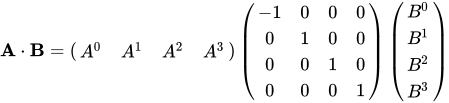
Note that in this case, in one frame:

while in another:

so that:
![{\displaystyle {\begin{aligned}-C&=-A^{0}B^{0}+A^{1}B^{1}+A^{2}B^{2}+A^{3}B^{3}\\[2pt]&=-{A'}^{0}{B'}^{0}+{A'}^{1}{B'}^{1}+{A'}^{2}{B'}^{2}+{A'}^{3}{B'}^{3}\end{aligned}}}](https://wikimedia.org/api/rest_v1/media/math/render/svg/e341c11738d92eccbd0118c015437559cfab380c)
which is equivalent to the above expression for C in terms of A and B. Either convention will work. With the Minkowski metric defined in the two ways above, the only difference between covariant and contravariant four-vector components are signs, therefore the signs depend on which sign convention is used.
We have:

With the signature (−+++), four-vectors may be classified as either spacelike if , timelike if , and null if .
Dual vectors
[edit]Applying the Minkowski tensor is often expressed as the effect of the dual vector of one vector on the other:

Here the Aνs are the components of the dual vector A* of A in the dual basis and called the covariant coordinates of A, while the original Aν components are called the contravariant coordinates.
Four-vector calculus
[edit]Derivatives and differentials
[edit]In special relativity (but not general relativity), the derivative of a four-vector with respect to a scalar λ (invariant) is itself a four-vector. It is also useful to take the differential of the four-vector, dA and divide it by the differential of the scalar, dλ:
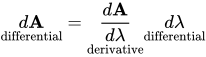
where the contravariant components are:

while the covariant components are:

In relativistic mechanics, one often takes the differential of a four-vector and divides by the differential in proper time (see below).
Fundamental four-vectors
[edit]Four-position
[edit]A point in Minkowski space is a time and spatial position, called an "event", or sometimes the position four-vector or four-position or 4-position, described in some reference frame by a set of four coordinates:

where r is the three-dimensional space position vector. If r is a function of coordinate time t in the same frame, i.e. r = r(t), this corresponds to a sequence of events as t varies. The definition R0 = ct ensures that all the coordinates have the same dimension (of length) and units (in the SI, meters).[9][10][11][12] These coordinates are the components of the position four-vector for the event.
The displacement four-vector is defined to be an "arrow" linking two events:

For the differential four-position on a world line we have, using a norm notation:

defining the differential line element ds and differential proper time increment dτ, but this "norm" is also:

so that:

When considering physical phenomena, differential equations arise naturally; however, when considering space and time derivatives of functions, it is unclear which reference frame these derivatives are taken with respect to. It is agreed that time derivatives are taken with respect to the proper time . As proper time is an invariant, this guarantees that the proper-time-derivative of any four-vector is itself a four-vector. It is then important to find a relation between this proper-time-derivative and another time derivative (using the coordinate time t of an inertial reference frame). This relation is provided by taking the above differential invariant spacetime interval, then dividing by (cdt)2 to obtain:


where u = dr/dt is the coordinate 3-velocity of an object measured in the same frame as the coordinates x, y, z, and coordinate time t, and
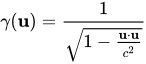
is the Lorentz factor. This provides a useful relation between the differentials in coordinate time and proper time:
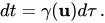
This relation can also be found from the time transformation in the Lorentz transformations.
Important four-vectors in relativity theory can be defined by applying this differential .

Four-gradient
[edit]Considering that partial derivatives are linear operators, one can form a four-gradient from the partial time derivative ∂/∂t and the spatial gradient ∇. Using the standard basis, in index and abbreviated notations, the contravariant components are:
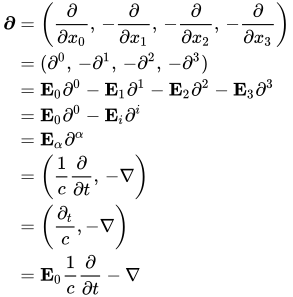
Note the basis vectors are placed in front of the components, to prevent confusion between taking the derivative of the basis vector, or simply indicating the partial derivative is a component of this four-vector. The covariant components are:
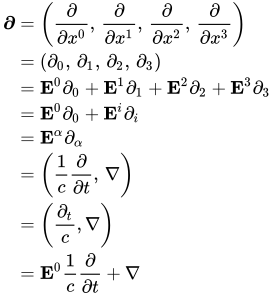
Since this is an operator, it doesn't have a "length", but evaluating the inner product of the operator with itself gives another operator:

called the D'Alembert operator.
Kinematics
[edit]Four-velocity
[edit]The four-velocity of a particle is defined by:

Geometrically, U is a normalized vector tangent to the world line of the particle. Using the differential of the four-position, the magnitude of the four-velocity can be obtained:

in short, the magnitude of the four-velocity for any object is always a fixed constant:

The norm is also:

so that:

which reduces to the definition of the Lorentz factor.
Units of four-velocity are m/s in SI and 1 in the geometrized unit system. Four-velocity is a contravariant vector.
Four-acceleration
[edit]The four-acceleration is given by:

where a = du/dt is the coordinate 3-acceleration. Since the magnitude of U is a constant, the four acceleration is orthogonal to the four velocity, i.e. the Minkowski inner product of the four-acceleration and the four-velocity is zero:

which is true for all world lines. The geometric meaning of four-acceleration is the curvature vector of the world line in Minkowski space.
Dynamics
[edit]Four-momentum
[edit]For a massive particle of rest mass (or invariant mass) m0, the four-momentum is given by:

where the total energy of the moving particle is:
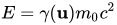
and the total relativistic momentum is:
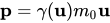
Taking the inner product of the four-momentum with itself:

and also:
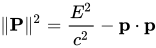
which leads to the energy–momentum relation:

This last relation is useful in relativistic mechanics, essential in relativistic quantum mechanics and relativistic quantum field theory, all with applications to particle physics.
Four-force
[edit]The four-force acting on a particle is defined analogously to the 3-force as the time derivative of 3-momentum in Newton's second law:

where P is the power transferred to move the particle, and f is the 3-force acting on the particle. For a particle of constant invariant mass m0, this is equivalent to

An invariant derived from the four-force is:

from the above result.
Thermodynamics
[edit]Four-heat flux
[edit]The four-heat flux vector field, is essentially similar to the 3d heat flux vector field q, in the local frame of the fluid:[13]

where T is absolute temperature and k is thermal conductivity.
Four-baryon number flux
[edit]The flux of baryons is:[14] where n is the number density of baryons in the local rest frame of the baryon fluid (positive values for baryons, negative for antibaryons), and U the four-velocity field (of the fluid) as above.

Four-entropy
[edit]The four-entropy vector is defined by:[15] where s is the entropy per baryon, and T the absolute temperature, in the local rest frame of the fluid.[16]

Electromagnetism
[edit]Examples of four-vectors in electromagnetism include the following.
Four-current
[edit]The electromagnetic four-current (or more correctly a four-current density)[17] is defined by formed from the current density j and charge density ρ.

Four-potential
[edit]The electromagnetic four-potential (or more correctly a four-EM vector potential) defined by formed from the vector potential a and the scalar potential ϕ.
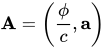
The four-potential is not uniquely determined, because it depends on a choice of gauge.
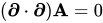
In the wave equation for the electromagnetic field:
- In vacuum,
- With a four-current source and using the Lorenz gauge condition ,


Waves
[edit]Four-frequency
[edit]A photonic plane wave can be described by the four-frequency, defined as

where ν is the frequency of the wave and is a unit vector in the travel direction of the wave. Now:


so the four-frequency of a photon is always a null vector.
Four-wavevector
[edit]The quantities reciprocal to time t and space r are the angular frequency ω and angular wave vector k, respectively. They form the components of the four-wavevector or wave four-vector:
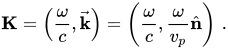
The wave four-vector has coherent derived unit of reciprocal meters in the SI.[18]
A wave packet of nearly monochromatic light can be described by:

The de Broglie relations then showed that four-wavevector applied to matter waves as well as to light waves: yielding and , where ħ is the Planck constant divided by 2π .



The square of the norm is: and by the de Broglie relation: we have the matter wave analogue of the energy–momentum relation:


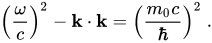
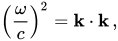
Note that for massless particles, in which case m0 = 0, we have: or ‖k‖ = ω/c . Note this is consistent with the above case; for photons with a 3-wavevector of modulus ω / c , in the direction of wave propagation defined by the unit vector

Quantum theory
[edit]Four-probability current
[edit]In quantum mechanics, the four-probability current or probability four-current is analogous to the electromagnetic four-current:[19] where ρ is the probability density function corresponding to the time component, and j is the probability current vector. In non-relativistic quantum mechanics, this current is always well defined because the expressions for density and current are positive definite and can admit a probability interpretation. In relativistic quantum mechanics and quantum field theory, it is not always possible to find a current, particularly when interactions are involved.

Replacing the energy by the energy operator and the momentum by the momentum operator in the four-momentum, one obtains the four-momentum operator, used in relativistic wave equations.
Four-spin
[edit]The four-spin of a particle is defined in the rest frame of a particle to be where s is the spin pseudovector. In quantum mechanics, not all three components of this vector are simultaneously measurable, only one component is. The timelike component is zero in the particle's rest frame, but not in any other frame. This component can be found from an appropriate Lorentz transformation.

The norm squared is the (negative of the) magnitude squared of the spin, and according to quantum mechanics we have

This value is observable and quantized, with s the spin quantum number (not the magnitude of the spin vector).
Other formulations
[edit]Four-vectors in the algebra of physical space
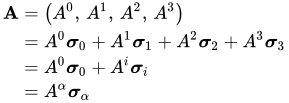
[edit]A four-vector A can also be defined in using the Pauli matrices as a basis, again in various equivalent notations:[20] or explicitly: and in this formulation, the four-vector is represented as a Hermitian matrix (the matrix transpose and complex conjugate of the matrix leaves it unchanged), rather than a real-valued column or row vector. The determinant of the matrix is the modulus of the four-vector, so the determinant is an invariant:

![{\displaystyle {\begin{aligned}|\mathbf {A} |&={\begin{vmatrix}A^{0}+A^{3}&A^{1}-iA^{2}\\A^{1}+iA^{2}&A^{0}-A^{3}\end{vmatrix}}\\[1ex]&=\left(A^{0}+A^{3}\right)\left(A^{0}-A^{3}\right)-\left(A^{1}-iA^{2}\right)\left(A^{1}+iA^{2}\right)\\[1ex]&=\left(A^{0}\right)^{2}-\left(A^{1}\right)^{2}-\left(A^{2}\right)^{2}-\left(A^{3}\right)^{2}\end{aligned}}}](https://wikimedia.org/api/rest_v1/media/math/render/svg/0eae567b8920aabd56af8500021c0703a00b4ad9)
This idea of using the Pauli matrices as basis vectors is employed in the algebra of physical space, an example of a Clifford algebra.
Four-vectors in spacetime algebra
[edit]In spacetime algebra, another example of Clifford algebra, the gamma matrices can also form a basis. (They are also called the Dirac matrices, owing to their appearance in the Dirac equation). There is more than one way to express the gamma matrices, detailed in that main article.
The Feynman slash notation is a shorthand for a four-vector A contracted with the gamma matrices:

The four-momentum contracted with the gamma matrices is an important case in relativistic quantum mechanics and relativistic quantum field theory. In the Dirac equation and other relativistic wave equations, terms of the form: appear, in which the energy E and momentum components (px, py, pz) are replaced by their respective operators.
![{\displaystyle {\begin{aligned}\mathbf {P} \!\!\!\!/=P_{\alpha }\gamma ^{\alpha }&=P_{0}\gamma ^{0}+P_{1}\gamma ^{1}+P_{2}\gamma ^{2}+P_{3}\gamma ^{3}\\[4pt]&={\dfrac {E}{c}}\gamma ^{0}-p_{x}\gamma ^{1}-p_{y}\gamma ^{2}-p_{z}\gamma ^{3}\\\end{aligned}}}](https://wikimedia.org/api/rest_v1/media/math/render/svg/f089c4155e7e8da899f3db0882a78472bf898933)
See also
[edit]- Basic introduction to the mathematics of curved spacetime
- Dust (relativity) for the number-flux four-vector
- Minkowski space
- Paravector
- Relativistic mechanics
- Wave vector
References
[edit]- ^ Rindler, W. Introduction to Special Relativity (2nd edn.) (1991) Clarendon Press Oxford ISBN 0-19-853952-5
- ^ Sibel Baskal; Young S Kim; Marilyn E Noz (1 November 2015). Physics of the Lorentz Group. Morgan & Claypool Publishers. ISBN 978-1-68174-062-1.
- ^ Idema, Timon. "The Force Four-Vector - Physics LibreTexts".
- ^ Relativity DeMystified, D. McMahon, Mc Graw Hill (BSA), 2006, ISBN 0-07-145545-0
- ^ C.B. Parker (1994). McGraw Hill Encyclopaedia of Physics (2nd ed.). McGraw Hill. p. 1333. ISBN 0-07-051400-3.
- ^ Gravitation, J.B. Wheeler, C. Misner, K.S. Thorne, W.H. Freeman & Co, 1973, ISAN 0-7167-0344-0
- ^ Dynamics and Relativity, J.R. Forshaw, B.G. Smith, Wiley, 2009, ISAN 978-0-470-01460-8
- ^ Relativity DeMystified, D. McMahon, Mc Graw Hill (ASB), 2006, ISAN 0-07-145545-0
- ^ "Details for IEV number 113-07-19: "position four-vector"". International Electrotechnical Vocabulary (in Japanese). Retrieved 2024-09-08.
- ^ Jean-Bernard Zuber & Claude Itzykson, Quantum Field Theory, pg 5, ISBN 0-07-032071-3
- ^ Charles W. Misner, Kip S. Thorne & John A. Wheeler,Gravitation, pg 51, ISBN 0-7167-0344-0
- ^ George Sterman, An Introduction to Quantum Field Theory, pg 4, ISBN 0-521-31132-2
- ^ Ali, Y. M.; Zhang, L. C. (2005). "Relativistic heat conduction". Int. J. Heat Mass Trans. 48 (12): 2397–2406. doi:10.1016/j.ijheatmasstransfer.2005.02.003.
- ^ J.A. Wheeler; C. Misner; K.S. Thorne (1973). Gravitation. W.H. Freeman & Co. pp. 558–559. ISBN 0-7167-0344-0.
- ^ J.A. Wheeler; C. Misner; K.S. Thorne (1973). Gravitation. W.H. Freeman & Co. p. 567. ISBN 0-7167-0344-0.
- ^ J.A. Wheeler; C. Misner; K.S. Thorne (1973). Gravitation. W.H. Freeman & Co. p. 558. ISBN 0-7167-0344-0.
- ^ Rindler, Wolfgang (1991). Introduction to Special Relativity (2nd ed.). Oxford Science Publications. pp. 103–107. ISBN 0-19-853952-5.
- ^ "Details for IEV number 113-07-57: "four-wave vector"". International Electrotechnical Vocabulary (in Japanese). Retrieved 2024-09-08.
- ^ Vladimir G. Ivancevic, Tijana T. Ivancevic (2008) Quantum leap: from Dirac and Feynman, across the universe, to human body and mind. World Scientific Publishing Company, ISBN 978-981-281-927-7, p. 41
- ^ J.A. Wheeler; C. Misner; K.S. Thorne (1973). Gravitation. W.H. Freeman & Co. pp. 1142–1143. ISBN 0-7167-0344-0.
- Rindler, W. Introduction to Special Relativity (2nd edn.) (1991) Clarendon Press Oxford ISBN 0-19-853952-5
Four-vector
View on GrokipediaMathematical Foundations
Notation and Components
In special relativity, a four-vector is defined as a rank-1 tensor possessing four components within Minkowski spacetime, which undergoes linear transformation under Lorentz transformations to preserve the spacetime structure. This concept was introduced by Hermann Minkowski in 1908 as a foundational element of his four-dimensional spacetime formalism, unifying space and time into a single geometric entity.[3] The standard notation for a four-vector employs Greek indices , where the contravariant form is written as and the covariant form as .[4] Repeated indices in expressions imply the Einstein summation convention, summing over from 0 to 3, which simplifies tensor algebra in relativistic contexts.[4] Minkowski spacetime admits two common metric signatures: (+, −, −, −) or (−, +, +, +), with the choice influencing the signs appearing in relativistic equations such as those for invariants and norms.[5] This article adopts the (+, −, −, −) signature for consistency, aligning with conventions prevalent in particle physics and many modern treatments.[5] The components of a four-vector consist of a time-like component , frequently expressed as (where is the speed of light) in applications involving energy or time coordinates, and space-like components corresponding to the spatial directions.Minkowski Metric
The Minkowski metric tensor, denoted , is the fundamental bilinear form that defines the geometry of flat four-dimensional spacetime in special relativity. It is a diagonal tensor with components in the mostly minus signature convention, where the indices correspond to the time and spatial coordinates, respectively.[3] In matrix form, it is expressed as with the inverse metric identical due to the diagonal structure.[6] An alternative signature is sometimes used, but the choice affects only the overall sign of invariants and not the physical predictions.[6] The metric tensor facilitates raising and lowering indices on four-vectors through contraction. For a contravariant four-vector , the covariant form is obtained as , while the reverse is .[6] This operation preserves the vector's transformation properties under Lorentz transformations. For the time component, , it yields since . For spatial components, , (no summation), so .[6] Thus, a four-vector with contravariant components has covariant components .[6] The invariant spacetime interval, a scalar quantity independent of the reference frame, is given by , where is the speed of light and .[3] This interval serves as the primary measure of separation between events in Minkowski spacetime, underpinning the causality structure of special relativity.[3] The norm of a four-vector, or its squared magnitude, is the invariant .[6] Four-vectors are classified based on the sign of this norm: timelike if (lying inside the light cone, connectable by slower-than-light paths), spacelike if (outside the light cone), or null (lightlike) if (on the light cone).[6] This classification determines the causal relationships possible between events associated with the vector.[6]Lorentz Transformations
In special relativity, the Lorentz transformation describes how four-vector components change between two inertial reference frames in relative motion, ensuring the preservation of the spacetime interval. A four-vector in one frame transforms to in another via the general linear relation , where is an element of the Lorentz group, a 4×4 matrix satisfying the orthogonality condition with respect to the Minkowski metric: .[7] This condition guarantees that the transformation leaves the metric tensor invariant, forming the foundation for the relativistic structure of spacetime.[8] A common subclass consists of Lorentz boosts, which account for relative motion without spatial rotation. For a boost along the x-axis with relative velocity , parameterized by and , the transformation matrix takes the explicit form: where the time and x-components mix hyperbolically, while y and z remain unchanged.[8] This matrix can be derived from the requirement that the speed of light remains constant in all frames, as originally formulated in the context of electromagnetic field transformations.[9] Lorentz transformations also include spatial rotations, which embed three-dimensional rotations into the four-dimensional spacetime framework without affecting the time component. For a rotation by angle about the z-axis, the matrix acts on the spatial components as a standard SO(3) rotation while leaving the zeroth component fixed: General rotations about arbitrary axes follow similarly, preserving the overall Lorentz group structure.[8] The composition of Lorentz transformations is non-trivial, particularly when combining boosts and rotations or non-collinear boosts. Boosts along the same direction commute and add linearly in rapidity, but successive boosts in different directions do not commute, resulting in an additional spatial rotation known as the Thomas rotation. This effect arises because the Lorentz group is non-abelian, and the composition of two non-parallel boosts equals a boost followed by a rotation , where is the Thomas rotation matrix depending on the velocities involved.[10] The Thomas rotation manifests in relativistic kinematics, such as the precession of a gyroscope in an accelerated frame.[8] The defining property of Lorentz transformations ensures the invariance of the four-vector norm, or more generally, the Minkowski inner product. For a four-vector , the transformed components satisfy , where the metric condition directly implies the equality via the property . This proof holds for the scalar product of any two four-vectors , confirming that physical quantities like proper time and rest mass remain frame-independent.[11]Algebraic Properties
Vector Addition and Scalar Multiplication
Four-vectors constitute a four-dimensional vector space over the real numbers , equipped with the standard operations of addition and scalar multiplication defined component-wise in a chosen inertial frame.[12] The addition of two four-vectors and is performed by summing their corresponding components: for . This component-wise addition ensures that the result inherits the Lorentz transformation properties of the original vectors, as the transformations themselves are linear.[13] Scalar multiplication by a real scalar scales each component uniformly: This operation, along with addition, satisfies the vector space axioms, including distributivity and associativity over the field .[13] The linearity of these operations with respect to Lorentz transformations follows directly from the linearity of the transformation matrix . If and are four-vectors, so that and in a boosted frame, then for any linear combination with , confirming that transforms as a four-vector.[12] These operations extend bilinearly to the formation of higher-rank tensors; specifically, the outer product of two four-vectors and yields the components of a contravariant rank-2 tensor , which transforms under Lorentz transformations via the product rule due to linearity in each index.[14]Inner Products and Norms
In Minkowski space with the metric signature , the inner product of two four-vectors and is defined as , where and denote the spatial parts of the vectors.[15] This bilinear form is symmetric, , and linear in each argument, but it is indefinite due to the metric's signature, distinguishing it from the positive-definite Euclidean dot product.[16] The norm squared of a four-vector is given by .[15] Four-vectors are classified based on the sign of this norm: timelike if , spacelike if , and null (or lightlike) if .[16] For a timelike four-vector, such as the four-velocity along a particle's worldline, the norm squared has the physical interpretation of relating to proper time; specifically, the proper time elapsed along a timelike path satisfies , where is an affine parameter, providing an invariant measure of duration independent of the observer's frame.[17] Two four-vectors and are orthogonal if their inner product vanishes, .[16] In special relativity, this orthogonality arises naturally in dynamics; for instance, the four-momentum (where is the rest mass and is the four-velocity) is orthogonal to the four-force , satisfying , which ensures the rest mass remains invariant along the particle's trajectory.[18] An analog of the Cauchy-Schwarz inequality in Minkowski space states that for certain pairs of four-vectors, but the indefinite metric introduces significant caveats: the inequality may reverse or fail depending on the vectors' causal types.[19] For example, when both and are timelike and point toward the same future light cone, the reverse inequality holds, reflecting the hyperbolic geometry of the space and the possibility of "angles" greater than 90 degrees in the timelike sector.[20]Invariance under Lorentz Transformations
In special relativity, the inner product of a four-vector with itself, denoted as , forms a Lorentz scalar that remains unchanged under Lorentz transformations. This invariance arises from the defining property of the Lorentz transformation matrix , which satisfies , where is the Minkowski metric; thus, transforming the components yields .[11][21] This scalar nature extends to the bilinearity of the inner product, ensuring that operations involving vector addition preserve invariance across frames. Specifically, for four-vectors , , and , the relation holds identically in any inertial frame, as each term is a Lorentz scalar.[22] The outer product of two four-vectors, , transforms as a rank-2 tensor under Lorentz transformations, with components . However, any contraction of this tensor, such as tracing over indices to form scalars like , yields an invariant quantity.[23] Physically, this invariance underpins key conserved quantities; for instance, the rest mass of a particle is defined via the invariant from its four-momentum , ensuring the mass is the same in all inertial frames.[24]Four-Vector Calculus
Four-Gradient Operator
The four-gradient operator serves as the cornerstone of differential operations in four-vector calculus within special relativity, enabling the construction of Lorentz-covariant expressions for gradients and divergences. It is defined in covariant form as , where are the contravariant coordinates in Minkowski spacetime with the metric signature . The contravariant four-gradient is then , ensuring proper transformation under Lorentz boosts and rotations.[25][26] The explicit components of the covariant four-gradient are for the time component and for the spatial components . This formulation incorporates the speed of light to maintain dimensional consistency and Lorentz invariance, with the contravariant components becoming and . These components reflect the structure of the Minkowski metric, where the raising and lowering of indices introduces sign flips for spatial parts.[27] When applied to a scalar field , the four-gradient operator yields the contravariant four-vector , whose components are . This construction ensures that transforms as a proper four-vector under Lorentz transformations, generalizing the three-dimensional gradient while preserving invariance properties essential for relativistic field theories.[2][28] For completeness in flat Minkowski spacetime, the components of the four-gradient in curvilinear coordinate systems are obtained via the chain rule: , where primed coordinates denote the new system; this maintains the operator's vectorial transformation properties without introducing curvature terms.[25]Differentials and Line Elements
In special relativity, the four-differential, or infinitesimal displacement four-vector, is defined as , where is the speed of light, is the coordinate time, and are spatial coordinates in an inertial frame.[29][30] This four-vector represents the tangent to a worldline at a point in Minkowski spacetime and transforms covariantly under Lorentz transformations.[31] The line element, which quantifies the invariant spacetime interval between nearby events, is given by , where is the Minkowski metric tensor.[29][31] Expanding this yields , distinguishing timelike (), spacelike (), and null () intervals based on the causal structure of spacetime.[30] For timelike paths, such as the worldline of a massive particle, the proper time along the curve is the invariant arc length parameter, computed as where is an arbitrary affine parameter (often taken as coordinate time for convenience).[29][31] This parametrization by proper time ensures that the four-velocity has constant norm , providing a Lorentz-invariant description of motion independent of the observer's frame.[30] In four-dimensional integrals over Minkowski spacetime, the volume element is , which is invariant under Lorentz transformations when combined with the metric determinant (unity in flat space).[31] This element is essential for formulating relativistic field theories, such as integrating Lagrangians or computing action functionals over spacetime volumes.[30]Covariant Derivatives
In general relativity, which generalizes the framework of special relativity to curved spacetimes, the covariant derivative extends the notion of differentiation for four-vectors to account for spacetime curvature. For a contravariant four-vector , the covariant derivative with respect to the coordinate is given by where are the Christoffel symbols (of the second kind), non-tensorial objects constructed from derivatives of the metric tensor .[32] These symbols quantify the variation of the coordinate basis vectors across spacetime points, ensuring that the covariant derivative transforms as a tensor.[33] In the flat Minkowski spacetime of special relativity, using inertial coordinates where the metric is constant, the Christoffel symbols vanish (), and the covariant derivative simplifies to the partial derivative , aligning with the four-gradient operator. This reduction highlights the covariant derivative as a natural generalization for handling four-vectors in non-flat geometries. The covariant derivative underpins parallel transport, the process of moving a four-vector along a curve while keeping it "parallel" to itself with respect to the spacetime connection; a vector is parallel transported if its covariant derivative along the curve is zero.[34] This concept leads directly to the geodesic equation, describing the worldline of a freely falling test particle as the curve of extremal proper length, expressed as where is the proper time and is the four-velocity; this equation enforces that the four-velocity is parallel transported along the geodesic.[34] The Levi-Civita connection, defined by the Christoffel symbols, is metric-compatible, satisfying , which guarantees that the metric tensor—and thus the inner products and norms of four-vectors—remains unchanged under parallel transport.[32] In the special relativistic limit, this condition holds trivially for the Minkowski metric , preserving the invariance properties of four-vectors under Lorentz transformations.[32]Kinematics
Four-Position
In special relativity, the four-position vector, often denoted , provides the coordinate description of an event in four-dimensional Minkowski spacetime. Its components are , where is the speed of light in vacuum, is the coordinate time measured in a given inertial frame, and are the spatial coordinates forming the three-dimensional position vector . This formulation combines time and space into a single geometric object, ensuring that physical laws remain invariant under Lorentz transformations.[1] For the trajectory of a massive particle, known as its worldline, the four-position is parametrized by the proper time , the time measured by a clock moving with the particle, yielding . Along a timelike worldline (where the particle's speed is less than ), the Minkowski inner product satisfies the normalization condition when measured from the spacetime origin, using the metric signature . This invariant quantity underscores the causal structure of spacetime, distinguishing timelike separations from spacelike or lightlike ones.[35][1] Under a Lorentz boost along the x-direction with relative velocity , the four-position components transform to preserve this invariance. Specifically, in the boosted frame, the components become , , , and , where and . These transformations mix time and space coordinates, reflecting the relativity of simultaneity and length contraction.[36] The four-position fully characterizes the worldline of a particle, with its tangent vector given by the four-velocity . This parametrization arises from integrating infinitesimal line elements along the path, connecting local spacetime intervals to the global position.[35]Four-Velocity
In special relativity, the four-velocity represents the instantaneous rate of change of a particle's position in four-dimensional spacetime with respect to its proper time, serving as the tangent vector to its worldline.[37] This proper time is the time measured by a clock moving with the particle, distinguishing it from coordinate time in any particular reference frame.[38] The four-velocity is formally defined as where is the four-position vector, with the speed of light, the coordinate time, and the three-position.[37] In an inertial frame where the particle has three-velocity , the components of the four-velocity are and , with the Lorentz factor , where .[37] These components connect the relativistic four-velocity directly to the familiar non-relativistic three-velocity, but scaled by to account for time dilation and length contraction effects.[37] The normalization condition for the four-velocity follows from the spacetime interval (line element) in Minkowski space. The proper time interval satisfies , where is the Minkowski metric.[39] Dividing by yields or , proving the invariant magnitude of the four-velocity is (in units where the norm is positive for timelike vectors).[39] This normalization ensures the four-velocity has constant length along the worldline, reflecting the universal speed limit and the timelike nature of massive particle trajectories.[37] As a four-vector, the four-velocity transforms under Lorentz transformations according to , where is the Lorentz transformation matrix.[37] The invariance of the metric tensor under such transformations guarantees that the norm remains in the new frame.[39] For a boost along the direction of relative motion between frames, the time and space components mix, altering the apparent direction of the four-velocity in spacetime while preserving its magnitude, consistent with the relativity of simultaneity and velocity addition.[37]Four-Acceleration
The four-acceleration of a particle in special relativity is defined as the covariant derivative of its four-velocity with respect to proper time , given by This four-vector quantifies the rate of change of the four-velocity along the particle's worldline.[40][41] A key property is its orthogonality to the four-velocity, satisfying , which follows from the constancy of the four-velocity's norm and holds in all inertial frames as a Lorentz invariant.[40][41][42] The norm of the four-acceleration is spacelike, expressed as (using the metric signature ), where is the magnitude of the proper acceleration, representing the acceleration measured by an observer comoving instantaneously with the particle.[41][42] This negative norm distinguishes it from the timelike four-velocity and underscores its role in describing changes transverse to the direction of motion. In the particle's instantaneous rest frame, where the four-velocity is and , the four-acceleration simplifies to and , with the spatial components directly giving the proper acceleration vector.[41][40] In a general inertial frame, the relationship between the proper acceleration components and the coordinate acceleration (decomposed into parts parallel and perpendicular to the three-velocity ) incorporates relativistic corrections: and , where .[43] These factors arise from the Lorentz transformation of acceleration to the instantaneous rest frame and highlight how relativistic effects amplify the proper acceleration relative to coordinate measurements, particularly for directions aligned with motion.[43] Physically, the four-acceleration characterizes the deviation of a particle's worldline from geodesic (inertial) motion in Minkowski spacetime, serving as the relativistic analogue of three-dimensional acceleration while preserving invariance under Lorentz transformations.[41] Its magnitude relates to the curvature of the worldline, with for the radius of curvature in cases of uniform proper acceleration.[42]Dynamics
Four-Momentum
The four-momentum represents the relativistic extension of classical momentum, incorporating both energy and three-momentum into a single four-vector that transforms covariantly under Lorentz transformations. It was first formulated as a four-vector in the context of special relativity by Hermann Minkowski in his 1908 lecture "Space and Time."[44] For a particle of rest mass , the four-momentum is defined as , where is the four-velocity of the particle.[45] In an inertial reference frame, the components of the four-momentum are given by for the time-like component and for the space-like components, where is the Lorentz factor and is the three-velocity. The time component relates directly to the total relativistic energy via . This structure unifies energy and momentum, with the four-velocity serving as .[45] The four-momentum possesses an invariant magnitude given by the Minkowski inner product (using the mostly minus signature), which yields the fundamental relation . This invariance holds across all inertial frames and connects the particle's rest mass to its observable energy and momentum.[46] In the particle's rest frame, where and , the four-momentum simplifies to .[45] For isolated systems, such as in particle collisions or decays, the total four-momentum is conserved, meaning the vector sum remains unchanged and Lorentz invariant before and after the interaction. This conservation law arises from the translational symmetry of spacetime in special relativity and underpins the analysis of relativistic processes.[46]Four-Force
The four-force is defined as the covariant derivative of the four-momentum with respect to proper time, , where is the four-momentum of a particle.[47] For a particle of constant rest mass , this is equivalent to , with denoting the four-acceleration.[48] Due to the invariance of the four-momentum magnitude , the four-force is orthogonal to the four-momentum, satisfying .[47] In the lab frame, the components of the four-force are expressed in terms of the relativistic three-force , where is the three-momentum. The time component is , and the spatial components are , with the Lorentz factor.[47][49] The time component relates to the rate of change of the particle's energy . Specifically, , where represents the power delivered by the three-force in the lab frame.[47][49] A key example arises when the proper acceleration is constant, corresponding to a four-force of constant magnitude in the particle's instantaneous rest frame. This leads to hyperbolic motion, described by the worldline equations and , where is the constant proper acceleration, satisfying the invariant .[47]Electromagnetic Applications
Four-Current
In relativistic electrodynamics, the four-current is a contravariant four-vector that unifies the charge density and the flow of charge into a single Lorentz-covariant object. It is defined in Minkowski space with the metric signature as , where is the charge density in the frame, is the speed of light, and is the three-dimensional current density vector.[50] This formulation ensures that the four-current transforms as a four-vector under Lorentz transformations, with the time component and the spatial components (for ).[2] Charge conservation, which in non-relativistic physics is expressed as the continuity equation , takes a manifestly covariant form in special relativity as the four-divergence .[51] This equation holds in all inertial frames without additional factors, reflecting the invariance of total charge under Lorentz boosts. Under a boost along the -direction with velocity , for example, the components mix such that the transformed charge density and current depend on both and through the Lorentz factor and the velocity, ensuring the four-divergence remains zero.[8] For a system of point-like charged particles, the four-current can be expressed microscopically as a sum over individual contributions: , where is the charge of the -th particle, the integral is over proper time , is the worldline of the particle, and is the four-velocity normalized such that .[52] This distribution satisfies the continuity equation locally, with the delta function concentrating the current along the particle trajectories, and the summation extends the expression to many-particle systems.Four-Potential
The electromagnetic four-potential is a four-vector field in special relativity that combines the scalar electric potential and the vector magnetic potential into a single entity, facilitating the covariant formulation of Maxwell's equations. It is defined in components as , where is the speed of light, using the metric signature . This four-vector transforms under Lorentz transformations to ensure the electromagnetic fields remain invariant across inertial frames.[53] The electromagnetic field strength tensor , which encapsulates the electric field and magnetic field , is expressed in terms of the four-potential as This antisymmetric tensor has components related to the fields via and (with the Levi-Civita symbol), yielding the standard expressions and . The four-potential thus provides a potential formulation from which the observable fields can be derived.[53][54] The four-potential exhibits gauge invariance, meaning physical predictions are unchanged under the transformation , where is an arbitrary smooth scalar function. To fix this freedom and simplify calculations, the Lorentz gauge condition is often imposed, which is Lorentz covariant and corresponds to in three-vector notation.[2][53][55] In the Lorentz gauge, the components of the four-potential satisfy the inhomogeneous wave equation where is the d'Alembertian operator, is the permeability of free space, and is the electromagnetic four-current density serving as the source term. This equation unifies the wave equations for and derived from Maxwell's equations, highlighting the propagation of electromagnetic potentials at the speed of light.[54][53]Wave and Quantum Applications
Four-Wavevector
The four-wavevector is a contravariant four-vector that describes the propagation of plane waves in the framework of special relativity. Its components are given by , where denotes the angular frequency, is the speed of light in vacuum, and is the three-wavevector with components and magnitude , corresponding to the wavenumber of the wave.[56] This formulation ensures that the four-wavevector transforms linearly under Lorentz transformations, preserving the relativistic structure of wave phenomena.[56] The phase of a plane wave is expressed as the invariant scalar , where is the four-position vector and the metric signature is , making unchanged between inertial frames.[56] For massless waves such as light in vacuum, the four-wavevector is light-like, satisfying the null condition , which yields the dispersion relation .[56] This relation connects the temporal and spatial aspects of the wave, reflecting the finite propagation speed dictated by relativity.[56] Lorentz transformations of the four-wavevector account for key relativistic effects in wave observation, including the Doppler shift in frequency and the aberration in direction. For a boost with velocity along the line of sight, the frequency in the transformed frame is , where and is the angle between and in the original frame; this formula derives from the covariant transformation of .[56] Aberration alters the apparent direction of , according to , where is the angle between and in the original frame, ensuring consistency with the boosted phase invariance.[57] In the context of wave-particle duality, the four-wavevector connects to quantum mechanics through the de Broglie relations, where for a particle's four-momentum , with and ; this four-vector form upholds Lorentz invariance for matter waves.[58]Four-Probability Current
In relativistic quantum mechanics, the four-probability current arises as a conserved four-vector associated with the Dirac equation, describing the density and flow of probability for spin-1/2 particles such as electrons. It is defined by the bilinear form , where is the four-component Dirac spinor field, is its Dirac adjoint, and () are the Dirac gamma matrices satisfying the Clifford algebra , with the Minkowski metric.[59] This expression was introduced in Paul Dirac's seminal 1928 paper, where the gamma matrices first appeared to ensure the relativistic invariance of the wave equation.[59] The Dirac equation (in natural units) implies the continuity equation through Noether's theorem applied to spacetime translations, guaranteeing the conservation of total probability over all space.[59] The time component represents the probability density, while the spatial components describe the probability flux, incorporating both orbital motion and spin contributions inherent to the relativistic spinor structure.[60] In the non-relativistic limit, where the particle's speed is much less than the speed of light (), the four-probability current reduces to familiar non-relativistic forms. The density becomes , where is the dominant large-component spinor approximating the non-relativistic wave function, and the flux simplifies to , recovering the standard probability current of the Schrödinger equation while neglecting higher-order relativistic corrections like the spin-orbit term.[61] This limit highlights the compatibility of the Dirac theory with non-relativistic quantum mechanics for low energies.[61] For a single-particle interpretation, the Dirac spinor is normalized such that the integral of the probability density over space equals unity: , ensuring the total probability remains conserved and interpretable as the likelihood of finding the particle.[60] This normalization is frame-dependent in the sense that Lorentz boosts mix density and flux, but the four-vector structure preserves the invariant volume integral along timelike hypersurfaces.[60] By construction, transforms as a contravariant four-vector under Lorentz transformations, , reflecting the relativistic covariance of the Dirac equation and ensuring that probability conservation holds in all inertial frames.[59] This property distinguishes it from non-relativistic currents, which lack such invariance. For charged particles, the electromagnetic four-current is analogous, given by (with for electrons), coupling the probability flow to the electromagnetic field in quantum electrodynamics.[60]Thermodynamic and Other Applications
Four-Heat Flux
In relativistic thermodynamics, the four-heat flux is a four-vector that describes the flow of internal (thermal) energy relative to the fluid's average motion, capturing heat conduction effects in dissipative processes. It is defined such that, in the local rest frame of the fluid (where the four-velocity ), the time component vanishes (), and the spatial components represent the energy flux due to temperature gradients across the fluid. Crucially, is orthogonal to the four-velocity, satisfying , ensuring no heat flow along the direction of bulk motion in the comoving frame. This orthogonality arises from the decomposition of the energy-momentum transport into convective and diffusive parts, as formulated in the Eckart frame for relativistic hydrodynamics.[62] The four-heat flux enters the stress-energy tensor of a relativistic fluid with dissipation, extending the ideal perfect-fluid form to include thermal conduction and viscosity. In the first-order approximation for a heat-conducting viscous fluid, the tensor takes the form where is the proper energy density, is the pressure, is the Minkowski metric (with signature ), and is the viscous stress tensor (symmetric, traceless, and orthogonal to ). The terms involving account for the energy-momentum exchange due to heat flow, with the positive signs reflecting the contribution to energy flux in this convention. This structure, originally proposed by Eckart, ensures conservation of energy and momentum while satisfying the second law of thermodynamics locally.[62] Under Lorentz boosts, the components of transform covariantly as a four-vector, leading to a mixing of its time and spatial parts that couples the pure heat flux to the convective enthalpy transport . For instance, boosting along the direction of flow introduces a non-zero time component in the new frame, effectively blending diffusive heat with the bulk enthalpy current. In the laboratory frame, the three-heat flux is obtained by projecting orthogonal to the observer's time direction, yielding the observed energy flow vector that includes both transformed conduction and relativistic corrections to the rest-frame flux. This transformation highlights the frame-dependence of heat as a dissipative process in special relativity.[63]Four-Entropy Flux
In relativistic hydrodynamics, the four-entropy flux describes the flow of entropy in a thermodynamic system, ensuring consistency with the principles of special relativity and thermodynamics. For an ideal fluid, it is defined as , where is the proper entropy density measured in the fluid's rest frame and is the four-velocity of the fluid element, satisfying in the mostly-minus metric convention with signature .[64] This form reflects the time-like nature of the entropy current, with the spatial components vanishing in the local rest frame. In the absence of dissipation, the conservation law holds, corresponding to isentropic evolution.[65] The second law of thermodynamics manifests in the relativistic context through the inequality for irreversible processes, quantifying the local production of entropy due to dissipative effects such as viscosity and heat conduction.[65] This ensures thermodynamic stability and positivity of entropy generation, a cornerstone derived from the entropy principle in second-order hydrodynamics. In the Eckart frame, which defines the fluid rest frame via the particle number current (with no diffusive contribution), the four-entropy flux relates to the heat flux in dissipative cases. Specifically, the non-equilibrium part of the entropy current includes a term , where is the temperature, such that ; here, is the heat flux obtained by projecting the stress-energy tensor orthogonal to using the spatial projector .[66] For ideal fluids, , simplifying the flux to the equilibrium form.[67] Under Lorentz boosts, the four-entropy flux transforms covariantly as a four-vector, aligning with the fluid's velocity. When boosting to a frame moving with velocity relative to the rest frame, the components become , , where is the Lorentz factor, preserving the time-like character and proper density .[64] This transformation underscores the relativistic invariance of thermodynamic relations in hydrodynamics.Alternative Formulations
In Geometric Algebra
In geometric algebra, four-vectors are represented as elements of the Clifford algebra , which models Minkowski spacetime with signature . The algebra is generated by an orthonormal basis , where is timelike with and (for ) are spacelike with . A general four-vector is expressed as , where summation over repeated indices is implied and the components are real scalars. The geometric product provides the inner product through its symmetric part: for two four-vectors and , the inner product is , which reproduces the Minkowski metric .[68] Lorentz transformations in this framework are implemented by rotors, which are even-grade elements of the algebra with magnitude 1. A spatial rotation by angle around a unit bivector axis (satisfying ) is given by the rotor , transforming a four-vector to , where is the reverse of . Similarly, a Lorentz boost with rapidity along a timelike bivector (satisfying ) uses the rotor , preserving the spacetime interval . These rotors belong to the spin group , offering a double cover of the proper Lorentz group and enabling coordinate-free computations.[69][68] The geometric algebra formulation unifies the treatment of vectors and higher-grade multivectors, such as bivectors, which represent oriented planes and simplify physical laws. For instance, the electromagnetic field strength is encoded as a single bivector , where and are the electric and magnetic field vectors, allowing Maxwell's equations to collapse into one geometric equation with the four-current as a vector. This contrasts with tensor notations by directly incorporating orientations and avoiding artificial distinctions between vector and pseudovector fields.[68] A key example is the four-velocity , defined as the derivative of the position four-vector with respect to proper time , so with (in units where ). The square follows directly from the inner product, yielding the Lorentz factor and ensuring invariance under Lorentz transformations via the rotor action. This representation highlights the geometric algebra's ability to treat relativistic kinematics intuitively without explicit metric tensors.[69][68]In Clifford Algebra
In the context of special relativity, the Clifford algebra provides a comprehensive algebraic framework for representing spacetime geometry, generated by basis elements () satisfying the anticommutation relations , where is the Minkowski metric with signature .[68] This algebra, also known as spacetime algebra, encompasses scalars, vectors, bivectors, trivectors, and the pseudoscalar, enabling a unified treatment of multivectors that encode both magnitude and orientation in four-dimensional Minkowski space.[68] Four-vectors in are expressed as linear combinations of the basis vectors, , where are scalar components corresponding to the contravariant coordinates in spacetime.[68] The geometric product of two four-vectors and decomposes into symmetric and antisymmetric parts: , where is the inner (scalar) product preserving the metric signature, and is the outer (bivector) product representing oriented area elements.[68] This product structure facilitates computations of rotations, boosts, and other Lorentz transformations within the algebra. The unit pseudoscalar squares to and commutes or anticommutes with even- or odd-grade elements, respectively, serving as a central element for duality operations in .[68] Duality maps a multivector to its Hodge dual , allowing interconversion between inner and outer products, such as for a vector and multivector , which is particularly useful for formulating electromagnetic fields and other bivector quantities in relativistic physics.[68] In quantum field theory, four-vectors in connect to spinors through the even subalgebra , where Dirac spinors are represented as even multivectors acted upon by four-vectors via the relation , linking to the Dirac equation in its standard matrix form.[68][70] This formulation embeds the Lorentz group representations naturally, with rotors transforming four-vectors as , where .[68]References
- https://en.wikisource.org/wiki/Translation:Space_and_Time