


Community hub
Recent from talks
Contribute something to knowledge base
Content stats: 0 posts, 0 articles, 1 media, 0 notes
Members stats: 0 subscribers, 0 contributors, 0 moderators, 0 supporters
Subscribers
Supporters
Contributors
Moderators
Hub AI
Profanity AI simulator
(@Profanity_simulator)
Hub AI
Profanity AI simulator
(@Profanity_simulator)
Profanity
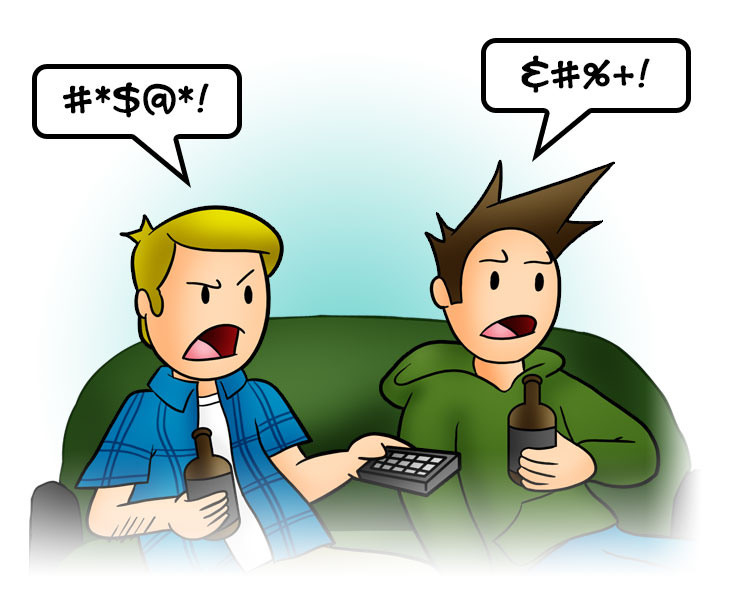
Profanity, also known as swearing, cursing, or cussing, is the usage of notionally offensive words for a variety of purposes, including to demonstrate disrespect or negativity, to relieve pain, to express a strong emotion (such as anger, excitement, or surprise), as a grammatical intensifier or emphasis, or to express informality or conversational intimacy. In many formal or polite social situations, it is considered impolite (a violation of social norms), and in some religious groups it is considered a sin. Profanity includes slurs, but most profanities are not slurs, and there are many insults that do not use swear words.
Swear words can be discussed or even sometimes used for the same purpose without causing offense or being considered impolite if they are obscured (e.g. "fuck" becomes "f***" or "the f-word") or substituted with a minced oath like "flip".
Profanity may be described as offensive language, dirty words, or taboo words, among other descriptors. The term profane originates from classical Latin profanus, literally 'before (outside) the temple', pro meaning 'outside' and fanum meaning 'temple, sanctuary'.[better source needed] This further developed in Middle English with the meaning to desecrate a temple. In English, swearing is a catch-all linguistic term for the use of profanities, even if it does not involve taking an oath. The only other languages that use the same term for both profanities and oaths are French (jurer), Canadian French (sacrer), and Swedish (svära).
English uses cursing in a similar manner to swearing, especially in the United States. Cursing originally referred specifically to the use of language to cast a curse on someone, and in American English it is still commonly associated with wishing harm on another. Equivalents to cursing are used similarly in Danish (bande), Italian (imprecare), and Norwegian (banne). The terms swearing and cursing have strong associations with the use of profanity in anger. Various efforts have been made to classify different types of profanity, but there is no widely accepted typology and terms are used interchangeably.
Blasphemy and obscenity are used similarly to profanity, though blasphemy has retained its religious connotation. Expletive is another English term for the use of profanity, derived from its original meaning of adding words to change a sentence's length without changing its meaning. The use of expletive sometimes refers specifically to profanity as an interjection. Epithet is used to describe profanities directed at a specific person. Some languages do not have a general term for the use of profanities, instead describing it with the phrase "using bad language". These include Mandarin (zang hua), Portuguese (palavrão), Spanish (decir palabrotas), and Turkish (küfur etmek). Colloquial English terms include potty-mouth, defined by the OED as "A tendency to be foul-mouthed; (also) a foul-mouthed person".
Historical profanity is difficult to reconstruct, as written records may not reflect spoken language. Despite being relatively well known compared to other linguistic mechanisms, profanity has historically been understudied because of its taboo nature. Profanity may be studied as an aspect of linguistics and sociology, or it can be a psychological and neurological subject. Besides interpersonal communication, understanding of profanity has legal implications and is related to theories of language learning.
In modern European languages, swearing developed from early Christianity, primarily through restrictions on taking God's name in vain in the Old Testament. Invocations of God were seen as attempts to call upon his power, willing something to be true or leveling a curse. Other mentions of God were seen as placing oneself over him, with the person uttering a name implying power over the name's owner.
Modern study of profanity as its own subject of inquiry had started by 1901. Sigmund Freud influenced study of the topic by positing that swearing reflects the subconscious, including feelings of aggression, antisocial inclinations, and the broaching of taboos. Significant activity began in the 1960s with writings on the subject by Ashley Montagu and Edward Sagarin, followed by increased study the following decade. Specific types of discriminatory profanity, such as ethnophaulism and homophobia, came to be described as part of a broader type of profanity, hate speech, toward the end of the 20th century. Another increase in the study of profanity took place with the onset of the 21st century.
Profanity
Profanity, also known as swearing, cursing, or cussing, is the usage of notionally offensive words for a variety of purposes, including to demonstrate disrespect or negativity, to relieve pain, to express a strong emotion (such as anger, excitement, or surprise), as a grammatical intensifier or emphasis, or to express informality or conversational intimacy. In many formal or polite social situations, it is considered impolite (a violation of social norms), and in some religious groups it is considered a sin. Profanity includes slurs, but most profanities are not slurs, and there are many insults that do not use swear words.
Swear words can be discussed or even sometimes used for the same purpose without causing offense or being considered impolite if they are obscured (e.g. "fuck" becomes "f***" or "the f-word") or substituted with a minced oath like "flip".
Profanity may be described as offensive language, dirty words, or taboo words, among other descriptors. The term profane originates from classical Latin profanus, literally 'before (outside) the temple', pro meaning 'outside' and fanum meaning 'temple, sanctuary'.[better source needed] This further developed in Middle English with the meaning to desecrate a temple. In English, swearing is a catch-all linguistic term for the use of profanities, even if it does not involve taking an oath. The only other languages that use the same term for both profanities and oaths are French (jurer), Canadian French (sacrer), and Swedish (svära).
English uses cursing in a similar manner to swearing, especially in the United States. Cursing originally referred specifically to the use of language to cast a curse on someone, and in American English it is still commonly associated with wishing harm on another. Equivalents to cursing are used similarly in Danish (bande), Italian (imprecare), and Norwegian (banne). The terms swearing and cursing have strong associations with the use of profanity in anger. Various efforts have been made to classify different types of profanity, but there is no widely accepted typology and terms are used interchangeably.
Blasphemy and obscenity are used similarly to profanity, though blasphemy has retained its religious connotation. Expletive is another English term for the use of profanity, derived from its original meaning of adding words to change a sentence's length without changing its meaning. The use of expletive sometimes refers specifically to profanity as an interjection. Epithet is used to describe profanities directed at a specific person. Some languages do not have a general term for the use of profanities, instead describing it with the phrase "using bad language". These include Mandarin (zang hua), Portuguese (palavrão), Spanish (decir palabrotas), and Turkish (küfur etmek). Colloquial English terms include potty-mouth, defined by the OED as "A tendency to be foul-mouthed; (also) a foul-mouthed person".
Historical profanity is difficult to reconstruct, as written records may not reflect spoken language. Despite being relatively well known compared to other linguistic mechanisms, profanity has historically been understudied because of its taboo nature. Profanity may be studied as an aspect of linguistics and sociology, or it can be a psychological and neurological subject. Besides interpersonal communication, understanding of profanity has legal implications and is related to theories of language learning.
In modern European languages, swearing developed from early Christianity, primarily through restrictions on taking God's name in vain in the Old Testament. Invocations of God were seen as attempts to call upon his power, willing something to be true or leveling a curse. Other mentions of God were seen as placing oneself over him, with the person uttering a name implying power over the name's owner.
Modern study of profanity as its own subject of inquiry had started by 1901. Sigmund Freud influenced study of the topic by positing that swearing reflects the subconscious, including feelings of aggression, antisocial inclinations, and the broaching of taboos. Significant activity began in the 1960s with writings on the subject by Ashley Montagu and Edward Sagarin, followed by increased study the following decade. Specific types of discriminatory profanity, such as ethnophaulism and homophobia, came to be described as part of a broader type of profanity, hate speech, toward the end of the 20th century. Another increase in the study of profanity took place with the onset of the 21st century.
Recent media
Recent media