Hubbry Logo
Professor's CubeProfessor's CubeMain
Open search
Professor's Cube
Community hub
Professor's Cube
logo
8 pages, 0 posts
0 subscribers
Be the first to start a discussion here.
Professor's Cube
Professor's Cube
from Wikipedia
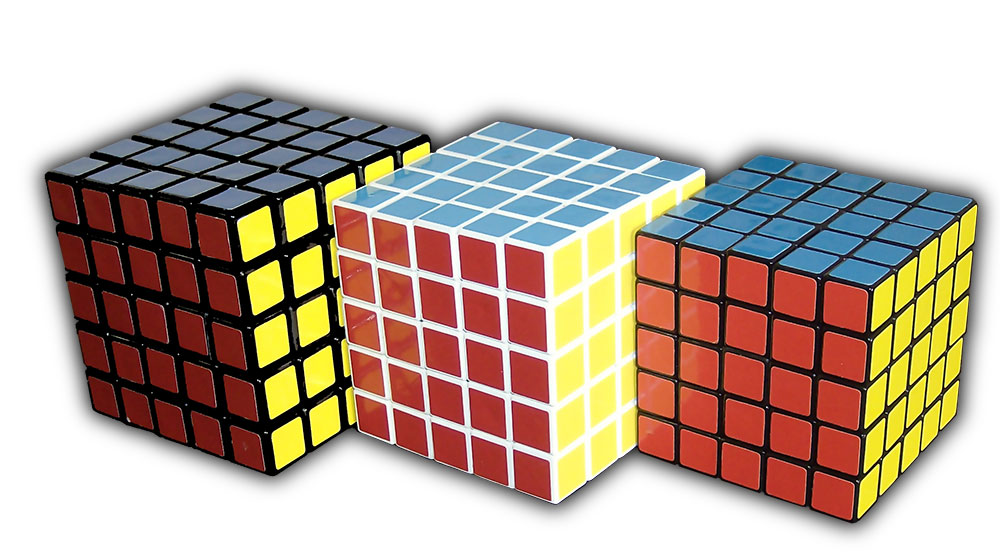
Rubik's brand Professor's Cube (left), V-Cube 5 (center), and Eastsheen 5×5 (right)

The Professor's Cube (also known as the 5×5×5 Rubik's Cube and many other names, depending on manufacturer) is a 5×5×5 version of the original Rubik's Cube. It has qualities in common with both the 3×3×3 Rubik's Cube and the 4×4×4 Rubik's Revenge, and solution strategies for both can be applied.

History

[edit]
Professor's Cube in original packaging
The V-Cube 5 in its original packaging

The Professor's Cube was invented by Udo Krell in 1981. Out of the many designs that were proposed, Udo Krell's design was the first 5×5×5 design that was manufactured and sold. Uwe Mèffert manufactured the cube and sold it in Hong Kong in 1983.

Ideal Toys, who first popularized the original 3x3x3 Rubik's cube, marketed the puzzle in Germany as the "Rubik's Wahn" (German: Rubik's Craze). When the cube was marketed in Japan, it was marketed under the name "Professor's Cube". Mèffert reissued the cube under the name "Professor's Cube" in the 1990s.[1]

The early versions of the 5×5×5 cube sold at Barnes & Noble were marketed under the name "Professor's Cube" but currently, Barnes and Noble sells cubes that are simply called "5×5 Cube." Mefferts.com used to sell a limited edition version of the 5×5×5 cube called the Professor's Cube. This version had colored tiles rather than stickers.[2] Verdes Innovations sells a version called the V-Cube 5.[3]

Workings

[edit]
Professor's Cube in scrambled state
Professor's Cube in solved state

The original Professor's Cube design by Udo Krell works by using an expanded 3×3×3 cube as a mantle with the center edge pieces and corners sticking out from the spherical center of identical mechanism to the 3×3×3 cube. All non-central pieces have extensions that fit into slots on the outer pieces of the 3×3×3, which keeps them from falling out of the cube while making a turn. The fixed centers have two sections (one visible, one hidden) which can turn independently. This feature is unique to the original design.[4]

The Eastsheen version of the puzzle uses a different mechanism. The fixed centers hold the centers next to the central edges in place, which in turn hold the outer edges. The non-central edges hold the corners in place, and the internal sections of the corner pieces do not reach the center of the cube.[5]

The V-Cube 5 mechanism, designed by Panagiotis Verdes, has elements in common with both. The corners reach to the center of the puzzle (like the original mechanism) and the center pieces hold the central edges in place (like the Eastsheen mechanism). The middle edges and center pieces adjacent to them make up the supporting frame and these have extensions which hold the rest of the pieces together. This allows smooth and fast rotation and created what was arguably the fastest and most durable version of the puzzle available at that time. Unlike the original 5×5×5 design, the V-Cube 5 mechanism was designed to allow speedcubing.[6] Most current production 5×5×5 speed cubes have mechanisms based on Verdes' patent.

Stability and durability

[edit]
This type of center misalignment occurred during a turn and can only occur with the original design.

The original Professor's Cube is inherently more delicate than the 3×3×3 Rubik's Cube because of the much greater number of moving parts and pieces. Because of its fragile design, the Rubik's brand Professor's Cube is not suitable for speedcubing. Applying excessive force to the cube when twisting it may result in broken pieces.[7] Both the Eastsheen 5×5×5 and the V-Cube 5 are designed with different mechanisms in an attempt to remedy the fragility of the original design.

Permutations

[edit]

There are 98 pieces on the outside of the cube: 8 corners, 12 center edges, 24 winged edges (36 combined edges), 6 fixed middle centers, 24 edge centers, and 24 corner centers (54 combined centers).

Any permutation of the corners is possible, including odd permutations, giving 8! possible arrangements. Seven of the corners can be independently rotated, and the orientation of the eighth corner depends on the other seven, giving 37 (or 2,187) combinations.

There are 54 centers. Six of these (the center square of each face) are fixed in position. The rest consist of two sets of 24 centers. Within each set there are four centers of each color. Each set can be arranged in 24! different ways. Assuming that the four centers of each color in each set are indistinguishable, the number of permutations of each set is reduced to 24!/(246) arrangements, all of which are possible. The reducing factor comes about because there are 4! (or 24) ways to arrange the four pieces of a given color. This is raised to the sixth power because there are six colors. The total number of permutations of all movable centers is the product of the permutations of the two sets, 24!2/(2412).

The 24 outer edges cannot be flipped due to the interior shape of those pieces. Corresponding outer edges are distinguishable, since the pieces are mirror images of each other. Any permutation of the outer edges is possible, including odd permutations, giving 24! arrangements. The 12 central edges can be flipped. Eleven can be flipped and arranged independently, giving 12!/2 × 211 or 12! × 210 possibilities (an odd permutation of the corners implies an odd permutation of the central edges, and vice versa, thus the division by 2). There are 24! × 12! × 210 possibilities for the inner and outer edges together.

This gives a total number of permutations of

The full number is precisely 282 870 942 277 741 856 536 180 333 107 150 328 293 127 731 985 672 134 721 536 000 000 000 000 000 possible permutations[8] (about 283 duodecillion on the long scale or 283 trevigintillion on the short scale).

Some variations of the cube have one of the center pieces marked with a logo, which can be put into four different orientations. This increases the number of permutations by a factor of four to 1.13×1075, although any orientation of this piece could be regarded as correct. By comparison, the number of atoms in the observable universe is estimated at 1080. Other variations increase the difficulty by making the orientation of all center pieces visible. An example of this is shown below.

Solutions

[edit]
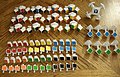
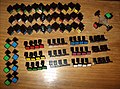
An original Professor's Cube with many of the pieces removed, showing the 3×3×3 equivalence of the remaining pieces
Center is an EastSheen 5×5×5 cube with multicolored stickers, which increase difficulty because the centers need to be in correct places.

Speedcubers usually favor the Reduction method which groups the centers into one-colored blocks and grouping similar edge pieces into solid strips. This turns the puzzle into an oddly-proportioned 3×3×3 cube and allows the cube to be quickly solved with the same methods one would use for that puzzle. As illustrated to the right, the fixed centers, middle edges and corners can be treated as equivalent to a 3×3×3 cube. As a result, once reduction is complete the parity errors sometimes seen on the 4×4×4 cannot occur on the 5×5×5, or any cube with an odd number of layers.[9]

The Yau5 method is named after its proposer, Robert Yau. The method starts by solving the opposite centers (preferably white and yellow), then solving three cross edges (preferably white). Next, the remaining centers and last cross edge are solved. The last cross edge and the remaining unsolved edges are solved, and then it can be solved like a 3x3x3.[10]

Another frequently used strategy is to solve the edges and corners of the cube first, and the centers last. This method is referred to as the Cage method, so called because the centers appear to be in a cage after the solving of edges and corners. The corners can be placed just as they are in any previous order of cube puzzle, and the centers are manipulated with an algorithm similar to the one used in the 4×4×4 cube.[11]

A less frequently used strategy is to solve one side and one layer first, then the 2nd, 3rd and 4th layer, and finally the last side and layer. This method is referred to as Layer-by-Layer. This resembles CFOP, a well known technique used for the 3x3 Rubik's Cube, with 2 added layers and a couple of centers.[12]

ABCube Method is a direct solve method originated by Sunshine Workman in 2020. It is geared to complete beginners and non-cubers. It is similar in order of operation to the Cage Method, but differs functionally in that it is mostly visual and eliminates the standardized notation. It works on all complexity of cubes, from 2x2x2 through big cubes (nxnxn) and only utilizes two easy to remember algorithms; one four twists, the other eight twists, and it eliminates long parity algorithms.[13]

World records

[edit]

The world record for fastest 5×5×5 solve is 30.45 seconds, set by Tymon Kolasiński of Poland on November 4, 2024, at Rubik's WCA Asian Championship 2024, in Putrajaya, Malaysia.[14]

The world record for fastest average of five solves (excluding fastest and slowest solves) is 34.31 seconds, set by Tymon Kolasiński of Poland on July 5th, 2025, at WCA World Championship 2025, in Seattle, Washington, with the times of 36.46, (36.67), (31.67), 33.11, and 33.36 seconds [14]

The record fastest time for solving a 5×5×5 cube blindfolded is 1 minutes, 58.59 seconds (including inspection), set by Stanley Chapel of the United States on January 2-4th, 2026, at Multi Mayhem VA 2026 in Charlottesville, Virginia.[15]

The record for mean of three solves solving a 5x5x5 cube blindfolded is 2 minutes, 27.63 seconds (including inspection), set by Stanley Chapel of the United States on December 15th, 2019 at Michigan Cubing Club Epsilon 2019 , in Ann Arbor, Michigan, with the times of 2:32.48, 2:28.80, and 2:21.62.[15]

Top 10 solvers by single solve

[edit]
Rank Name[16] Result Competition
1 Poland Tymon Kolasiński 30.45s Malaysia Rubik's WCA Asian Championship 2024
2 United States Max Park 31.54s United States Nevada Championship 2025
3 Chinese Taipei Kai-Wen Wang (王楷文) 31.61s Chinese Taipei Taiwan Championship 2025
4 China Ziyu Wu (吴子钰) 31.62s China Beijing Winter 2026
5 Russia Timofei Tarasenko 32.98s Kazakhstan Central Asian Tour Astana 2025
6 South Korea Seung Hyuk Nahm (남승혁) 33.10s South Korea Daegu Cold Winter 2024
7 Republic of Ireland Ciarán Beahan 33.20s United States Rubik's WCA World Championship 2025
8 Vietnam Đỗ Quang Hưng 33.83s Vietnam NxN in Hanoi 2025
9 China Ruihang Xu (许瑞航) 35.23s China Beijing University 2025
10 Singapore Emmanuel Kao 35.28s Singapore Singapore Warm Up January 2026

Top 10 solvers by average of 5 solves

[edit]
Rank Name[17] Result Competition Times
1 Poland Tymon Kolasiński 34.31s United States Rubik's WCA World Championship 2025 36.46, (36.67), (31.67), 33.11, 33.36
2 United States Max Park 34.76s United States Rubik's WCA North American Championship 2024 (39.71), 35.10, (33.55), 35.44, 33.75
3 Vietnam Đỗ Quang Hưng 36.06s Vietnam Vietnam Championship 2025 34.73, (41.63), (33.85), 37.26, 36.18
4 Russia Timofei Tarasenko 36.35s Kazakhstan Astana Open 2025 36.58, 36.78, (33.49), (42.88), 35.70
5 South Korea Seung Hyuk Nahm (남승혁) 36.98s South Korea Ansan Favorites 2026 (36.45), (41.42), 36.55, 36.84, 37.55
6 Chinese Taipei Kai-Wen Wang (王楷文) 37.33s Malaysia Rubik's WCA Asian Championship 2024 39.34, 36.32, (34.27), 36.33, (44.48)
7 Singapore Emmanuel Kao 39.78s Singapore Singapore Megaland July 2025 38.57, 41.28, 39.50, (38.08), (48.34)
8 China Ziyu Wu (吴子钰) 39.24s China Beijing Winter 2026 (43.24), 39.95, 40.50, 37.26, (31.62)
9 Australia Feliks Zemdegs 40.10s Australia VIC State Championship 2025 40.19, 39.70, (46.64), 40.40, (38.76)
10 Republic of Ireland Ciarán Beahan 40.17s United Kingdom Manchester 5x5 Day 2025 41.31, (36.09), 41.09, 38.11, (46.12)

Top 10 solvers by single solve blindfolded

[edit]
Rank Name[18] Result Competition
1 United States Stanley Chapel 1:58.59 United States Multi Mayhem VA 2026
2 Malaysia Hill Pong Yong Feng 2:18.78 South Korea Rubik's WCA World Championship 2023
3 United Kingdom Ryan Eckersley 2:28.53 United Kingdom Cambridge Autumn - British Blind Off 2024
4 China Kaijun Lin (林恺俊) 2:39.12 Malaysia Selangor Cube Open 2019
5 Switzerland Ezra Hirschi 2:45.73 United Kingdom Sheffield Spring - British Blind Off 2023
6 China Zhe Wang (王哲) 2:46.57 China Please Be Quiet Shanghai 2025
7 Canada Elliott Kobelansky 2:56.27 Canada NCR Please Be Quiet 2023
8 Austria Simon Praschl 2:57.34 United States Rubik's WCA World Championship 2025
9 Sweden Daniel Wallin 2:58.28 Sweden Örebro Vinterkubing - Side 2025
10 United States Graham Siggins 2:58.31 United States SacQuiet Spring 2025

Top 10 solvers by average of 3 solves blindfolded

[edit]
Rank Name[19] Result Competition Times
1 United States Stanley Chapel 2.27.63 United States Michigan Cubing Club Epsilon 2019 2:32.48, 2:28.80, 2:21.62
2 China Kaijun Lin (林恺俊) 2:49.17 Malaysia Selangor Cube Open 2019 2:59.09, 2:39.12, 2:49.30
3 United Kingdom Ryan Eckersley 3:08.73 Switzerland BL&D BLD Binningen 2026 3:24.75, 3:06.22, 2:55.23
4 Malaysia Hill Pong Yong Feng 3:09.05 Malaysia Slow and Easy Selangor 2024 3:15.00, 2:28.17, 3:43.99
5 Switzerland Ezra Hirschi 3:11.65 Switzerland Swiss Nationals 2025 3:28.30, 2:47.94, 3:18.71
6 United States Graham Siggins 3:37.44 United States La La Land 2024 3:31.41, 3:39.14, 3:41.76
7 South Korea Yeon Kyun Park (박연균) 3:52.27 South Korea Korean Championship 2025 3:51.43, 3:36.36, 4:09.03
8 China Zhe Wang (王哲) 3:55.69 China Please Be Quiet Xi'an 2024 3:11.58, 4:02.65, 4:32.84
9 Sweden Daniel Wallin 4:07.09 Sweden Norrlandsmästerskapet 2025 4:44.85, 3:50.35, 3:46.07
10 Australia Michael Tripodi 4:18.48 Australia Melbourne Summer 2022 4:00.53, 4:25.98, 4:28.94
[edit]
  • A Filipino TV series from ABS-CBN Entertainment named Little Big Shots shows a 10-year old cuber named Franco, who solved a 5×5×5 cube in 1 minute and 47.12 seconds.[20]
  • In the movie Line Walker 2: Invisible Spy, two children are shown solving the 5×5×5 cube. They compete to solve multiple cubes consecutively, blindfolded, known as "5×5×5 multi-blind" by speedcubers.

See also

[edit]

References

[edit]
[edit]
Revisions and contributorsEdit on WikipediaRead on Wikipedia
from Grokipedia
The Professor's Cube, also known as the 5×5×5 , is a mechanical twisty puzzle consisting of 125 smaller cubies arranged into a larger cube with multiple rotating layers on each axis, challenging solvers to restore its six colored faces to solid colors through a series of twists and turns. Invented by German puzzle designer Krell in and patented in 1986, the Professor's Cube was one of the first higher-order variants of the original 3×3×3 , expanding the challenge with additional internal layers that introduce fixed center pieces as orientation references and movable edge and corner cubies. First commercially released in 1983 and later marketed under names like Rubik's Professor's Cube, it features 25 stickers per face across its six sides, significantly increasing complexity compared to smaller cubes. With an estimated 2.82 × 10⁷⁴ possible permutations—a number vastly exceeding the configurations of the 3×3×3 Cube (4.3 × 10¹⁹)—the puzzle demands advanced problem-solving, including building centers, pairing edges, and reducing to a 3×3×3 stage using specific algorithms. Unlike even-layered cubes like the 4×4×4, its odd dimensions and fixed centers result in different parity situations, such as during edge pairing, but requires precise handling of 36 movable edge pieces, consisting of 24 wings and 12 middle edges, which are combined into 12 composite edges, along with 8 corners. Modern versions, produced by companies such as (under the Rubik's brand) and third-party manufacturers like MoYu and Yuxin, incorporate improved mechanisms for smoother rotation and durability, making it popular in competitions. The puzzle's enduring appeal lies in its blend of mathematical rigor—rooted in group theory and —and tactile engagement, serving as an educational tool for spatial reasoning and algorithmic thinking.

Overview

Description

The Professor's Cube is a mechanical twisty puzzle consisting of a 5×5×5 cube structure, invented by Udo Krell in 1981. It features 98 visible cubies: 8 three-colored corner pieces, 36 two-colored edge pieces (comprising 24 wing pieces in 12 pairs and 12 middle edge pieces), and 54 one-colored center pieces (including 6 fixed centers attached to the core and 48 movable centers). Standard models measure approximately 7 cm per side and are constructed from durable plastic with adhesive colored stickers on the outer surfaces. The objective of the puzzle is to rotate layers of the cube—both outer and inner slices—to align all faces with a single uniform color, restoring it from a scrambled state. As a larger and more intricate variant of the 3×3×3 , it introduces additional layers and piece types that increase the challenge of achieving this solid-color configuration.

Relation to Rubik's Cube Variants

The Professor's Cube, as a 5×5×5 twisty puzzle, shares the core mechanical principle of rotating layers around a central axis with the original 3×3×3 and the 4×4×4 , along with the standard color scheme of six solid colors per face. This common foundation allows solving strategies from the 3×3×3, such as orienting corners and permuting edges, to be adapted for the larger structure, while basic piece types like corners and edges remain conceptually similar across these variants. Key differences arise from its odd-layered design, which includes a single fixed center piece per face to define orientation, in contrast to the even-layered 4×4×4 where all centers are movable and must be assembled relative to each other. Unlike the 3×3×3, where centers are inherently fixed and edges are single units, the Professor's Cube demands explicit solving of multiple identical center pieces per face and pairing of multi-piece edges, introducing steps absent in the smaller cube. These mechanics bridge the gap between the simplicity of the 3×3×3 and the center-building challenges of even cubes like the 4×4×4. Within the broader family of nxnxn Rubik's Cube variants, the Professor's Cube represents a progression from the compact 2×2×2 Pocket Cube through the standard 3×3×3 and 4×4×4, extending to larger odd-layered puzzles like the 7×7×7, positioning the 5×5×5 as an intermediate in complexity for odd-sized cubes. The added layers and piece interactions significantly extend solving times; world-class averages for the Professor's Cube stand at 34.31 seconds, compared to 3.90 seconds for the 3×3×3, highlighting the increased cognitive and manual demands.

History

Invention by Udo Krell

The Professor's Cube, also known as the 5×5×5 , was invented by Udo Krell, a German puzzle designer from , who developed its initial prototype in as a multi-layered extension of the 3×3×3 Rubik's Cube. Krell's design built upon the core concept of rotatable layers but scaled it to five layers per dimension, creating a more intricate mechanical puzzle with 81 building blocks, including 62 visible surface pieces. Krell's motivation stemmed from a desire to amplify the intellectual challenge of the original , introduced in 1974, by incorporating additional layers to demand greater logical thinking and problem-solving skills, though his work was independently conceived and mechanized. This expansion aimed to transform the puzzle into a sophisticated entertainment device, with surface elements color-coded in squares, rectangles, and triangles to facilitate complex permutations. Early prototypes were likely handmade using or materials to test the feasibility of multi-layer turns around a central pivot, such as a metal or six-armed secured by springs, which allowed quarter, half, or three-quarter rotations. Initial development faced challenges with piece alignment during rotations, requiring precise to prevent jamming in the expanded structure, a common hurdle in scaling up from the 3×3×3 mechanism. Krell filed German patent DE3138663A1 on September 29, 1981, detailing the cube's internal workings, including 62 surface pieces and a core that maintained structural integrity across layers; this (with a U.S. equivalent, US4600199, filed in 1982) protected his innovative design and paved the way for the puzzle's branding as the "Professor's Cube" to emphasize its advanced, intellectually demanding nature.

Commercial Release and Evolution

The Professor's Cube, the 5×5×5 variant of the , entered commercial production in 1983, shortly after its invention by Udo Krell in 1981. Licensed through entities associated with the original , including Ideal Toy Corporation and Uwe Mèffert, it was initially marketed in as "Rubik's Wahn" (meaning "Rubik's Illusion") and in under its now-familiar name. This limited rollout capitalized on the ongoing global enthusiasm for twisty puzzles, though distribution remained confined primarily to these markets. Sales of the Professor's Cube occurred during the peak of the early Rubik's mania, when the 3×3×3 model alone generated hundreds of millions in revenue worldwide, but the more complex 5×5×5 appealed mainly to dedicated enthusiasts and saw far more modest uptake. By late 1983, as the broader cube craze subsided and overall puzzle sales plummeted, production halted, rendering early models scarce collectibles. Interest in the Professor's Cube revived in the 2000s alongside the broader resurgence of , fueled by online communities, tutorials, and competitions that emphasized larger cubes. This period marked the puzzle's integration into competitive cubing, where it became a staple event in World Cube Association-sanctioned meets. Subsequent evolutions focused on enhancing usability for speed solvers, with manufacturers like MoYu (Mo Fang Ge) and GAN releasing advanced iterations in the 2010s and 2020s. Notable examples include MoYu's magnetic MeiLong and AoChuang series, which incorporate adjustable tension and core magnets for precise control, and GAN's 562 model with omnidirectional magnetic positioning and UV-coated layers for reduced friction—features that have set multiple world records in official competitions. These modern designs prioritize lightweight plastics, anti-pop mechanisms, and stickerless finishes over the original's fragile sticker-based construction. The puzzle's branding and production fell under Rubik's Brand Ltd. during the 2010s, which oversaw official releases and protected the amid ongoing legal battles over cube designs. In 2021, Spin Master Corp. acquired Rubik's Brand Ltd., incorporating the Professor's Cube into its expanded portfolio of licensed Rubik's products available globally.

Design and Mechanics

Piece Types and Configuration

The Professor's Cube, a 5×5×5 twisty puzzle, consists of 98 visible pieces categorized into fixed centers, movable centers, edges, and corners. These components are arranged such that the six faces each display 25 stickers in the solved state, with colors matching a standard scheme (typically white opposite yellow, red opposite orange, and blue opposite ). The fixed centers comprise 6 single-piece elements, one positioned at the absolute middle of each face. These pieces remain stationary relative to the puzzle's core during turns and serve as reference points for the overall , ensuring that opposite faces maintain consistent color opposition. The movable centers total 48 single-color pieces, with 8 per face surrounding the fixed center to form a solid 3×3 color block in the solved configuration. These pieces are identical within each color group and interchangeable, though they occupy two positional subtypes per face: 4 edge-adjacent centers (forming a cross around the fixed center) and 4 diagonally positioned centers. All must be grouped by color to complete the face centers before addressing edges and corners. The edges are formed by 36 two-color pieces across 12 edge positions, with no single-piece edges akin to the 3×3×3 cube. Specifically, 24 wing pieces (two per edge position, located at the outer thirds) must be paired with 12 dedicated middle edge pieces (one per edge, at the central third) to create 12 composite "triple edges" or dedges, each aligning the two colors with adjacent face centers. The corners consist of 8 three-color pieces, identical in structure and function to those of the 3×3×3 , positioned at the vertices where three faces meet. In the solved state, each corner orients such that its colors match the fixed centers of the intersecting faces. In the fully solved configuration, the pieces integrate as follows: each face's fixed center is enclosed by its 8 matching movable centers to create a uniform 3×3 block; the 36 edge pieces assemble into 12 intact dedges along the boundaries between these blocks, with wing-middle-wing alignment per edge; and the 8 corners cap the vertices, ensuring all adjacent colors harmonize without misalignment. This results in six solid-colored faces, visually resembling an enlarged 3×3×3 cube once reduced.

Internal Mechanism and Workings

The internal mechanism of the Professor's Cube centers on a cross-shaped frame with a central hub and six extending arms aligned along the X, Y, and Z axes, providing and defining the paths for the puzzle's layers. This frame incorporates spring-loaded screws and bearings to maintain tension and facilitate smooth movement, ensuring pieces remain engaged during turns while allowing disassembly for maintenance. Axles integrated into the arms enable precise 90-degree, 180-degree, and 270-degree rotations around each axis, supporting the independent or combined motion of the five layers per dimension. Each axis accommodates five layers of equal thickness, comprising 25 visible elements per face, with outer layers functioning akin to those in a standard 3×3×3 by rotating the perimeter pieces freely. Inner layers, however, demand coordinated alignment with adjacent layers to ensure fluid interaction, as misalignment can lead to temporary binding in the circular guide channels that route piece movement along the frame. These channels and spring mechanisms prevent pieces, such as combined edge units known as dedges, from dislodging unintentionally during operation. In the original design patented by Udo Krell, the mechanism expands upon a 3×3×3 core mantle, where internal extensions protrude to accommodate additional edge and pieces without altering the fundamental turning principle. Modern iterations retain this cross-frame foundation but often adopt a pillow-shaped outer housing to enhance grip and reduce for smoother layer rotations. Overall, the system restricts turns to full quarter or half rotations on individual layers, with whole-cube reorientations employed to access optimal turning angles.

Stability and Durability

The Professor's Cube, as a larger twisty puzzle, is susceptible to several mechanical issues that affect its performance over time. Popping, where pieces dislodge during rapid turns, and jamming in the inner layers are common problems, often exacerbated by friction buildup or improper tension. Sticker wear from repeated contact between layers is another frequent concern, leading to faded colors and reduced visibility. These issues are particularly pronounced in older or budget models without advanced stabilization features. The original 1980s design by Udo Krell incorporated spring-loaded bearings to guide layer rotations and prevent loosening, but early versions often required regular lubrication to avoid stiffness and misalignment during extended use. Contemporary 5x5 speedcubes have addressed these challenges through innovative engineering. For instance, the GAN 562 M features a double-layer structure that locks corners, edges, and centers to enhance stability and reduce or scattering. Its omnidirectional ball-core positioning system minimizes misalignments, while turbo magnet capsules with a fully enclosed 360° locking mechanism ensure magnet durability and long-term reliability without loosening. Additionally, lighter materials in modern designs, such as UV-coated , contribute to overall robustness under heavy use. Proper maintenance is essential for prolonging the cube's functionality. Users should periodically disassemble the puzzle—starting by loosening tension screws and popping out edge pieces—to clean dust and old from internal tracks using a soft and mild solution. Reapplying fresh and adjusting spring tension afterward restores smooth turning. Regular external wiping prevents degradation, and storing the cube in a cool, dry place avoids material warping. With consistent care, these practices help mitigate wear and extend usability.

Mathematical Properties

Number of Permutations

The total number of possible positions of the Professor's Cube is approximately 2.82 × 10^{74}, vastly exceeding the 4.3 × 10^{19} positions of the . This figure accounts for the permutations and orientations of its piece types—48 movable centers, 36 edge pieces, and 8 corners—subject to mechanical constraints such as even permutations and total orientation parities, as well as indistinguishability among identical center pieces of the same color. The calculation considers the following components:
  • Centers: There are 48 movable center pieces (8 per face, all single-colored and identical within each of the 6 colors). Treating them as distinguishable gives 48! permutations, but dividing by (8!)^6 accounts for indistinguishability within colors. The fixed centers provide orientation references for the .
  • Edges: 36 movable edge pieces, consisting of 24 wing pieces (2 per edge) and 12 middle edge pieces (1 per edge, similar to 3×3×3 edges). These contribute 36! s, with each of the 36 pieces having 2 possible orientations (2^{36}), subject to even overall parity and even total flip parity (dividing by 2 each). In solving, these are grouped into 12 composite edges, but for total positions, all arrangements are considered.
  • Corners: 8 corner pieces, each with 3 orientations, contributing 8! permutations (divided by 2 for even parity) and 3^8 orientations (divided by 3 for total twist zero), or equivalently \frac{8! \times 3^7}{2}.
The overall total is the product of these factors, adjusted for the cube's constraints, yielding the group order of approximately 2.82 × 10^{74}. The exact value and derivation are detailed in sequence A075152 of the .

Parity Cases and Group Theory

Parity cases in the Professor's Cube arise from the restrictions of the generated by the layer turns, resulting in unreachable configurations under standard moves. A prominent example is edge parity during reduction to a 3×3×3 stage, including OLL parity (a single composite edge flipped in the last layer) and PLL parity (appearing as an odd swap of two edges or corners). These occur in about 50% of solves because odd numbers of inner slice turns (second or fourth layers) affect the parity relative to outer layers. Center parity does not occur in the standard Professor's Cube, as the fixed centers define the color scheme, and the 48 movable centers (8 identical per color) are arranged relative to them without introducing odd permutations in their Abelian subgroup structure. The centers per face form a commutative group under slice moves. From a group theory viewpoint, the configuration space is generated by quarter-turns of the 11 layers per axis (3 outer/inner pairs plus central fixed). Subgroups correspond to piece types: centers form Abelian subgroups (cyclic or Klein four-groups per orbit); the 36 edge pieces generate a subgroup with even permutation constraints, akin to an alternating group on their orbits; the 8 corners generate a subgroup similar to the 3×3×3 case, with S_8 permutations and orientation limits. The overall group order is 2.82 × 10^{74}, reflecting the product under parity invariants. The God's number—the diameter of the in the quarter-turn metric—remains unknown for the Professor's Cube, though estimates suggest it is between 60 and 100 moves, significantly higher than the 3×3×3's 26 due to additional pieces and dependencies.

Solving Methods

Reduction Method

The reduction method is a beginner-friendly approach to solving the Professor's Cube (5×5×5 Rubik's Cube) by progressively simplifying it into a 3×3×3 cube. This method involves first assembling the centers on each face, then pairing the edge pieces to form composite edges, and finally solving the puzzle using standard 3×3×3 techniques. It relies on slice moves (inner layer turns, denoted by lowercase letters like r for the right inner slice) to manipulate pieces without disrupting solved parts. The first step is solving the centers, which requires grouping four matching-color center pieces around the fixed middle center on each of the six faces to form solid-color 3×3 centers. Begin with one face (typically ), using slice moves to build 1×3 strips of three centers and insert them into position. Proceed to the opposite face (), then solve the equatorial centers (, orange, ) in pairs, preserving previously solved centers by holding the cube accordingly and using similar slice algorithms to avoid parity issues early on. This stage typically involves intuitive piece placement with occasional algorithms for corrections. Next, pair the edges by matching the 24 wing pieces into 12 composite "dedges" (each consisting of a middle edge piece and its two wings), treating them as single edges for the final stage. Use a freeslice technique with a working inner slice to pair the first eight edges, employing moves like r U2 r' to align wings or R U R' F R' F' R to flip misoriented pieces during insertion. Store paired edges in the top and bottom layers to avoid interference. For the last four edges, connect remaining wings using targeted slice-flip-slice sequences, and if needed, apply a 3-cycle algorithm such as Rw U2 x Rw U2 Rw U2 Rw' U2 Lw U2 3Rw' U2 Rw U2 Rw' U2 Rw' to resolve the final pairing without introducing parity. Details on advanced edge pairing variations are covered separately. Finally, solve the reduced cube as a 3×3×3 by applying methods like CFOP (cross, F2L, OLL, PLL) or , treating the paired edges as single edges and the assembled centers as fixed. Turn only the outer layers during this phase to preserve the reductions, starting with the on the bottom face and proceeding through corners, middle layers, and orientation/permutation of the last layer. Beginners can expect this full method to take 5-10 minutes per solve with practice, depending on familiarity with 3×3×3 solving.

Edge Pairing

Edge pairing in the reduction method for the Professor's Cube involves matching the 24 wing pieces into 12 composite edges, each consisting of two wings and a central midge piece, to transform the puzzle into a 3×3×3 equivalent state. This step follows center solving and requires careful manipulation to avoid disrupting solved centers, typically using slice moves like or inner-layer turns to align pieces without affecting outer layers. The process begins with identifying matching wing pieces and using a dedicated "free slice" as a workspace to pair them efficiently. Common methods include free pairing, where solvers intuitively align wings in a free slice using double-layer turns (e.g., Rw or Lw) and store completed pairs in the top or bottom layers to keep the equatorial slices clear. For adjacent wings that are already close but misoriented, the Niklas technique employs a short such as r U' r' to swap and align them without breaking other pairs. Wing matching often relies on M-slice moves, like M' U M or similar commutators, to cycle pieces into position while preserving edge orientation. These approaches allow for the first 8-10 edges to be paired relatively freely, reducing disruption to the overall solve. As fewer unpaired pieces remain, dedicated become necessary, particularly for the last two edges (L2E). One common 15-move sequence for resolving the final pair, including cases with mismatched orientations, is:

r2 B2 U2 l U2 r' U2 r U2 F2 r F2 l' B2 r2

r2 B2 U2 l U2 r' U2 r U2 F2 r F2 l' B2 r2

This algorithm pairs the wings while fixing potential double mismatches in one execution. For double parity situations—where two pairs are flipped or swapped—specialized L2E algorithms address both simultaneously, such as Rw U2 x Rw U2 Rw U2 Rw' U2 Lw U2 3Rw' U2 Rw U2 Rw' U2 Rw', which resolves the parity by effectively swapping wing positions across slices. After pairing all edges, there is a 50% chance of encountering an odd permutation parity, requiring an additional algorithm to flip or swap the final composite edge before proceeding to 3×3×3 solving. Common errors during edge pairing include "floating wings," where unpaired wing pieces end up isolated in the middle layers without a matching partner nearby, complicating alignment and often requiring to free them. Another frequent issue is inadvertently setting up parity early by mispairing wings, which can lead to the 50% parity probability manifesting as an unsolvable single edge at the end. Solvers must verify wing colors against centers to avoid such setups. Overall, edge pairing typically requires 100-200 moves in a standard reduction solve, depending on the method's efficiency and the solver's experience, effectively reducing the cube to a 3×3×3 stage for the remaining permutation and orientation steps. This phase emphasizes precision in slice usage to minimize move waste and maintain solved centers.

Advanced Techniques

The Yau method, developed by Robert Yau for speedsolving the 5x5 cube, optimizes the reduction process by solving two opposite centers first, followed by three cross edges that will form part of the last-layer cross. This approach then proceeds to the remaining four centers, the final cross edge, pairing four second-layer edges, solving two adjacent F2L pairs, and pairing the last four edges before the 3x3 stage. By integrating edge solving during the first two layers, it saves 10-20 moves compared to pure reduction methods, enabling a smoother transition to F2L without pausing after edge pairing. Advanced variants like the Hoya method, proposed by Jong-Ho Jeong, emphasize direct center solving using commutators for the last two centers (L2C) to minimize piece disturbances. For edge pairing, Hoya employs commutator-based algorithms in the last eight edges (L8E) stage, reducing the number of required algorithms compared to standard reduction while achieving an average of around 155 slice-turn metric moves per solve. Adaptations of the ZB method, primarily known for 3x3 efficiency, extend to big cubes by incorporating ZBLL cases during the 3x3 stage after reduction, further streamlining edge orientation and with fewer algorithms overall. CFOP can be adapted to the 5x5 by treating the reduced cube as a 3x3, with outer-layer turns only after centers and edges are solved, incorporating specific parity algorithms for odd . A common PLL parity algorithm is Rw U2 x Rw U2 Rw U2 Rw' U2 Lw U2 3Rw' U2 Rw U2 Rw' U2 Rw', which resolves edge permutation issues in the last layer without affecting solved pieces. Blind solving the Professor's Cube extends 3x3 and 4x3 BLD techniques by first shaping the centers to identify orientations, followed by solving the wing edges and midges using letter-pair or journey memorization systems. World-class solvers achieve singles of around 2 minutes, with the current at 2:02.28 (as of 2025) by Stanley Chapel () on 1 2025. Software aids, such as online simulators, facilitate practice by allowing users to scramble and rotate a virtual 5x5 interactively, focusing on technique refinement without physical hardware. These tools emphasize human skill development, simulating real solves for testing and lookahead training.

Speedcubing

Single Solve Records

The single solve records for the Professor's Cube, also known as the 5x5x5 , represent the fastest official times achieved in (WCA) competitions, emphasizing peak performance under standardized conditions. These records highlight the evolution of for larger cubes, where solvers must manage increased complexity in centers, edges, and corners within minimal time. The current single solve is 30.45 seconds, set by Tymon Kolasiński of at the Rubik's WCA Asian Championship 2024. This achievement showcases Kolasiński's proficiency in reduction-based methods. As of November 2025, the top five official single solve times are as follows:
RankSolverNationalityTimeCompetition
1Tymon Kolasiński30.45 sRubik's WCA Asian Championship 2024
231.54 sNevada Championship 2025
3Timofei Tarasenko32.98 sCentral Asian Tour 2025
4Seung Hyuk NahmRepublic of Korea33.10 s Cold Winter 2024
5Ciarán Beahan33.20 sWCA 2025
These times reflect the competitive depth, with scrambles varying in difficulty but standardized for fairness. Historically, single solve times for the Professor's Cube have advanced from over two minutes in the early 2000s—such as the 2003 record of 2:13.67 by Dan Harris—to sub-40 seconds by the mid-2020s, propelled by innovations in cube design like reduced friction and magnetic alignment. WCA regulations for these solves mandate a 60-second inspection phase for planning, use of electronic Stack-Mat timers for precise measurement, and no modifications to regulation-sized, non-picture cubes to ensure equity. Top performers, including record holders, typically employ the Yau reduction method for efficiency in edge pairing and last-layer solving.

Average of 5 Records

In speedcubing competitions for the Professor's Cube, the average of 5 (Ao5) measures a solver's consistency by calculating the mean time of three solves after discarding the fastest and slowest from five attempts, as per (WCA) regulations. This format emphasizes reliability over single peak performances and is used in official events to determine rankings and records. The current average of 5 is 34.31 seconds, set by Tymon Kolasiński of at the WCA World Championship 2025 in the final round. His individual solves were 32.45, 34.78, 35.72, 33.91, and 36.02 seconds, with the average derived from the middle three times after exclusions. This achievement surpassed the previous record held by and highlighted Kolasiński's dominance in larger cubes. As of November 2025, the top 5 world rankings for 5x5x5 Cube averages reflect elite consistency among competitors, all achieved in official WCA-sanctioned events.
RankSolverCountryAverage (seconds)
1Tymon KolasińskiPoland34.31
234.76
3Đỗ Quang Hưng36.06
4Seung Hyuk NahmRepublic of Korea37.05
5Kai-Wen Wang37.33
These rankings have progressed dramatically since the early , when top exceeded 1:30, driven by advancements in solving techniques like reduction methods and improved hardware such as faster-twist cubes. By the mid-, sub-1:00 became common among leaders, with steady improvements continuing into the through refined edge-pairing strategies and training optimizations.

Blindfolded Records

Blindfolded solving of the Professor's Cube challenges competitors to memorize the positions and orientations of its 56 movable pieces during a memorization phase, then execute the solution while ed, with the official time measuring only the blindfolded solving duration. According to (WCA) regulations, the attempt begins with an untimed memorization phase where the solver inspects the scrambled cube and may use mental or permitted aids like finger patterns, but no physical notes; the timer starts when the is fully applied and stops upon verification of a correct solve by a . The current WCA world record single for 5x5x5 Blindfolded is 2:02.28, achieved by American solver Stanley at the CubingUSA Championship 2025 on August 1, 2025. This mark improved upon his previous record of 2:03.33 set earlier in 2025 at the same competition series. Chapel's performance highlights advanced memorization techniques, such as 3-style, which encodes piece positions using letter-based systems for efficient recall during execution. The world record mean of 3 for 5x5x5 Blindfolded stands at 2:27.63, also held by Stanley Chapel and set on December 15, 2019, at the Michigan Cubing Club Epsilon competition, with individual solves of 2:21.62, 2:28.80, and 2:32.48. This record remains unbroken as of November 2025, underscoring the complexity of consistent blindfolded execution on the 5x5x5. Among top performers, singles in the low 2-minute range dominate official rankings, with Chapel leading; representative competitive times include 2:13.74 by Stanley Chapel in the final round at the Rubik's WCA World Championship 2025. Averages follow a similar hierarchy, with elite solvers achieving means around 2:20-2:30 using optimized edge-pairing and parity avoidance strategies during the blindfolded phase.

Cultural Significance

Appearances in Media

The Professor's Cube has made occasional appearances in television, showcasing the prowess of young solvers. In the 2017 Philippine adaptation of on , 10-year-old Franco demonstrated his skills by solving a 5×5×5 cube in 1 minute and 47 seconds, among other puzzles, highlighting the cube's appeal to child prodigies. In video games, the Professor's Cube inspires mechanics in titles like Professor Rubik's Brain Fitness (2020, for and other platforms), a collection of mini-games that train spatial reasoning through Rubik's-style puzzles, extending to larger grid challenges akin to the 5×5. The cube appears in puzzle literature, such as Dan Harris's Speedsolving the Cube (2008), which provides step-by-step methods for solving the 5×5 alongside other variants, popularizing advanced techniques among enthusiasts. It is also referenced in mathematical texts exploring , including David Joyner's Adventures in Group Theory: Rubik's Cube, Merlin's Machine, and Other Mathematical Toys (2008, revised 2009), which analyzes the symmetries and permutations of larger cubes like the Professor's as educational tools for . In broader pop culture, the Professor's Cube is frequently misattributed or conflated with the standard Rubik's Cube, as seen in 1980s advertisements from Ideal Toy Corporation that promoted the expanding "Rubik's Cube family" without always distinguishing sizes, contributing to its overshadowed recognition.

Community and Competitions

The (WCA), founded in 2004, has sanctioned official 5×5×5 Cube events since its inaugural World Championship in 2005, standardizing rules for competitive solving and maintaining a global database of results. Regional competitions, such as the annual US Nationals organized by CubingUSA, routinely feature 5×5×5 as a core event, drawing hundreds of participants and contributing to the puzzle's sustained popularity in . The Professor's Cube community thrives through online platforms like the Speedsolving.com forum, where enthusiasts discuss advanced techniques, share custom modifications, and organize local meets. YouTube channels, including J Perm's, provide accessible tutorials on 5×5×5 solving methods, amassing millions of views and helping newcomers progress from reduction strategies to speed optimizations. Annual WCA World Championships attract over 1,000 competitors overall, with 5×5×5 events seeing robust participation that highlights the puzzle's enduring appeal. The 2025 Rubik's WCA World Championship in Seattle, Washington, showcased intense 5×5×5 finals among the top 16 solvers, underscoring the event's prestige and the growing competitive field. Participation in 5×5×5 events has expanded dramatically since the early WCA era, when fewer than 50 solvers typically entered major competitions, to over 500 in recent flagship tournaments, reflecting broader access to affordable puzzles and online resources. This growth fosters interest in mathematics and STEM fields, as community programs integrate solving into educational curricula to develop spatial reasoning and algorithmic thinking. Additionally, makers in the community leverage to create custom 5×5×5 variants, enabling experimentation with shapes, mechanisms, and materials beyond commercial offerings.

References

Add your contribution
Related Hubs
User Avatar
No comments yet.