
Recent from talks
Project HARP
Knowledge base stats:
Talk channels stats:
Members stats:
Project HARP
13°04′38″N 59°28′32″W / 13.077306°N 59.475688°W
Project HARP, for high altitude research project, was a joint venture of the United States Department of Defense and Canada's Department of National Defence created with the goal of studying ballistics of re-entry vehicles and collecting upper atmospheric data for research. Unlike conventional space launching methods that rely on rockets, HARP instead used very large guns to fire projectiles into the atmosphere at extremely high speeds.
A 16-inch (41 cm) HARP gun operated by the U.S. Army's Ballistic Research Laboratory (now called the U.S. Army Research Laboratory) at Yuma Proving Ground currently holds the world record for the highest altitude that a gun-fired projectile has achieved: 180 kilometres (111.8 mi), well above the Kármán line conventionally marking the beginning of outer space.
Project HARP originated as the brainchild of Gerald Bull, a renowned but controversial ballistic engineer specializing in high-velocity guns and gun propulsion systems. In the mid-1950s, Bull was working on anti-ballistic missile (ABM) and intercontinental ballistic missile (ICBM) research at the Canadian Armaments and Research Development Establishment (CARDE) when he formulated the idea to launch satellites into orbit using an enormous cannon. Bull believed that a large supergun would be significantly more cost-effective at sending objects into space than a conventional rocket. Bull argued it would not need expensive rocket motors, firing a large gun wouldn't require the missile to throw away multiple rocket stages to break through the Earth's atmosphere to reach orbit. In theory, a sabot would protect the payload during firing and later fall away as the satellite inside emerges.
During the late 1950s, Bull conducted preliminary launch experiments at the CARDE (now known as Defence Research and Development Canada – Valcartier, or DRDC Valcartier) using guns as small as 76mm. These experiments soon caught the attention of the U.S. Army's Ballistic Research Laboratory and the U.S. Army's Chief of Army Research and Development, Lieutenant general Arthur Trudeau. At the time, aircraft engineers needed more information on the atmosphere's upper regions to design better jet planes. However, launching rockets into the air to collect data was generally considered costly and inefficient. The U.S. military, in particular, was especially in need of a low-cost launch system that could cover altitudes that conventional aircraft and weather balloons couldn't reach to support the development of new supersonic aircraft and missile systems. By late 1960, CARDE and the Ballistic Research Laboratory (BRL) conducted several feasibility studies surrounding small gun-launched probes' structural integrity. Around the same time, BRL developed a smooth-bore, 5-inch gun system at Aberdeen Proving Ground that successfully launched a probe to altitudes exceeding 220,000 feet.
In 1961, Bull resigned from CARDE and McGill University hired him as a professor. Working together with Donald Mordell, the university's Dean of Engineering, Bull moved forward with his space gun project and requested funding from various sources. He received a $200,000 loan from McGill University's board of governors. He was given a verbal promise for a $500,000 grant from the Canadian Department of Defence Production (CDDP), which was later reportedly denied due to bureaucratic opposition. In October 1961, Bull met with Charles Murphy, the head of the Ballistic Research Laboratory, to pitch his project for a supergun and was met with overwhelming support. The U.S. Army provided Bull with substantial financial backing and two 16-inch naval gun barrels complete with a land mount and surplus powder charges, a heavy-duty crane, and a $750,000 radar tracking system. Bull and Mordell officially announced the HARP project as a program under McGill University's Space Research Institute at a press conference in March 1962. HARP was presented as a research initiative dedicated to "developing low-orbital capacity for geodetic and atmospheric objectives". However, the project's long-term goal was to place satellites into orbit economically.
In 1962, Bull and Mordell established a McGill University research station on Barbados (then still a British colony and part of the West Indies Federation) as HARP's main base of operations for its 16-inch super gun. The site location was first suggested by Mordell, who believed that a launch site closer to the equator would allow the projectile to procure extra velocity from the Earth's rotation to reach higher altitudes. In addition, the site's close proximity to the Atlantic Ocean made for the safe impact of re-entry projectiles. As a result of McGill University's close connections with the island's Democratic Labour Party, Bull met with the Barbados Prime Minister Errol Barrow to arrange the construction of a firing site at Foul Bay, St. Philip. HARP reportedly received enthusiastic support from the Barbados government due to expectations that the island nation would become heavily involved in space exploration research.
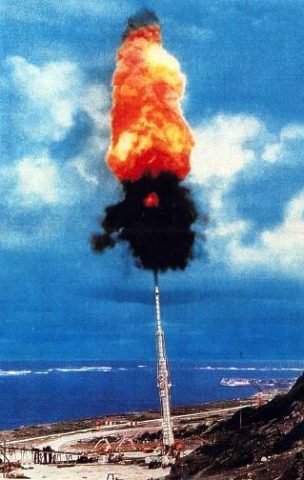
The installation of the 16-inch gun began at the newly established High Altitude Research Facility in April 1962. A gun pit was dug into the island's coral base, and a concrete emplacement was built on a plateau so that the gun barrel could stand vertically. The 16-inch naval gun barrels provided by the U.S. Army served as the barrels of the HARP gun. They had to be transported to the site on the U.S. Army landing ship, the Lieutenant Colonel John D. Page, with the U.S. Army Transportation Corps assistance, the U.S. Army Research Office, and the Office of the Chief of Research and Development. Hundreds of people from Barbados were employed to transport the two 140-ton gun tubes from the coast to the designated emplacement 21⁄2 miles from the beach using a temporary purpose-built railway. By late 1962, the HARP 16-inch gun was set up, and construction on workshops, storage buildings, radar installations, and other facilities neared completion. Around this time, the U.S. Army Research Office increased its financial support of the project to $250,000 per year. The first test shot from the 16-inch gun on Barbados was fired on January 20, 1963, marking the first time that a gun of this caliber was fired at a near-vertical angle. The 315 kg test slug reached an altitude of 3000 meters with a flight time of about 58 seconds at a launch velocity of 1,000 m/s before coming down a kilometer off-shore.
Hub AI
Project HARP AI simulator
(@Project HARP_simulator)
Project HARP
13°04′38″N 59°28′32″W / 13.077306°N 59.475688°W
Project HARP, for high altitude research project, was a joint venture of the United States Department of Defense and Canada's Department of National Defence created with the goal of studying ballistics of re-entry vehicles and collecting upper atmospheric data for research. Unlike conventional space launching methods that rely on rockets, HARP instead used very large guns to fire projectiles into the atmosphere at extremely high speeds.
A 16-inch (41 cm) HARP gun operated by the U.S. Army's Ballistic Research Laboratory (now called the U.S. Army Research Laboratory) at Yuma Proving Ground currently holds the world record for the highest altitude that a gun-fired projectile has achieved: 180 kilometres (111.8 mi), well above the Kármán line conventionally marking the beginning of outer space.
Project HARP originated as the brainchild of Gerald Bull, a renowned but controversial ballistic engineer specializing in high-velocity guns and gun propulsion systems. In the mid-1950s, Bull was working on anti-ballistic missile (ABM) and intercontinental ballistic missile (ICBM) research at the Canadian Armaments and Research Development Establishment (CARDE) when he formulated the idea to launch satellites into orbit using an enormous cannon. Bull believed that a large supergun would be significantly more cost-effective at sending objects into space than a conventional rocket. Bull argued it would not need expensive rocket motors, firing a large gun wouldn't require the missile to throw away multiple rocket stages to break through the Earth's atmosphere to reach orbit. In theory, a sabot would protect the payload during firing and later fall away as the satellite inside emerges.
During the late 1950s, Bull conducted preliminary launch experiments at the CARDE (now known as Defence Research and Development Canada – Valcartier, or DRDC Valcartier) using guns as small as 76mm. These experiments soon caught the attention of the U.S. Army's Ballistic Research Laboratory and the U.S. Army's Chief of Army Research and Development, Lieutenant general Arthur Trudeau. At the time, aircraft engineers needed more information on the atmosphere's upper regions to design better jet planes. However, launching rockets into the air to collect data was generally considered costly and inefficient. The U.S. military, in particular, was especially in need of a low-cost launch system that could cover altitudes that conventional aircraft and weather balloons couldn't reach to support the development of new supersonic aircraft and missile systems. By late 1960, CARDE and the Ballistic Research Laboratory (BRL) conducted several feasibility studies surrounding small gun-launched probes' structural integrity. Around the same time, BRL developed a smooth-bore, 5-inch gun system at Aberdeen Proving Ground that successfully launched a probe to altitudes exceeding 220,000 feet.
In 1961, Bull resigned from CARDE and McGill University hired him as a professor. Working together with Donald Mordell, the university's Dean of Engineering, Bull moved forward with his space gun project and requested funding from various sources. He received a $200,000 loan from McGill University's board of governors. He was given a verbal promise for a $500,000 grant from the Canadian Department of Defence Production (CDDP), which was later reportedly denied due to bureaucratic opposition. In October 1961, Bull met with Charles Murphy, the head of the Ballistic Research Laboratory, to pitch his project for a supergun and was met with overwhelming support. The U.S. Army provided Bull with substantial financial backing and two 16-inch naval gun barrels complete with a land mount and surplus powder charges, a heavy-duty crane, and a $750,000 radar tracking system. Bull and Mordell officially announced the HARP project as a program under McGill University's Space Research Institute at a press conference in March 1962. HARP was presented as a research initiative dedicated to "developing low-orbital capacity for geodetic and atmospheric objectives". However, the project's long-term goal was to place satellites into orbit economically.
In 1962, Bull and Mordell established a McGill University research station on Barbados (then still a British colony and part of the West Indies Federation) as HARP's main base of operations for its 16-inch super gun. The site location was first suggested by Mordell, who believed that a launch site closer to the equator would allow the projectile to procure extra velocity from the Earth's rotation to reach higher altitudes. In addition, the site's close proximity to the Atlantic Ocean made for the safe impact of re-entry projectiles. As a result of McGill University's close connections with the island's Democratic Labour Party, Bull met with the Barbados Prime Minister Errol Barrow to arrange the construction of a firing site at Foul Bay, St. Philip. HARP reportedly received enthusiastic support from the Barbados government due to expectations that the island nation would become heavily involved in space exploration research.
The installation of the 16-inch gun began at the newly established High Altitude Research Facility in April 1962. A gun pit was dug into the island's coral base, and a concrete emplacement was built on a plateau so that the gun barrel could stand vertically. The 16-inch naval gun barrels provided by the U.S. Army served as the barrels of the HARP gun. They had to be transported to the site on the U.S. Army landing ship, the Lieutenant Colonel John D. Page, with the U.S. Army Transportation Corps assistance, the U.S. Army Research Office, and the Office of the Chief of Research and Development. Hundreds of people from Barbados were employed to transport the two 140-ton gun tubes from the coast to the designated emplacement 21⁄2 miles from the beach using a temporary purpose-built railway. By late 1962, the HARP 16-inch gun was set up, and construction on workshops, storage buildings, radar installations, and other facilities neared completion. Around this time, the U.S. Army Research Office increased its financial support of the project to $250,000 per year. The first test shot from the 16-inch gun on Barbados was fired on January 20, 1963, marking the first time that a gun of this caliber was fired at a near-vertical angle. The 315 kg test slug reached an altitude of 3000 meters with a flight time of about 58 seconds at a launch velocity of 1,000 m/s before coming down a kilometer off-shore.
Recent media