



Recent from talks
Knowledge base stats:
Talk channels stats:
Members stats:
Propaganda for Japanese-American internment
Propaganda for Japanese-American internment is a form of propaganda created between 1941 and 1944 within the United States that focused on the relocation of Japanese Americans from the West Coast to internment camps during World War II. Several types of media were used to reach the American people such as motion pictures and newspaper articles. The significance of this propaganda was to project the relocation of Japanese Americans as matter of national security.
After the Japanese attack on Pearl Harbor on December 7, 1941, American attitudes towards people of Japanese ancestry indicated a strong sense of racism. This sentiment became further intensified by the media of the time, which played upon issues of racism on the West Coast, the social fear of the Japanese people, and citizen-influenced farming conflicts with the Japanese people. This, along with the attitude of the leaders of the Western Defense Command and the lack of perseverance by the Justice Department to protect the civil rights of Japanese Americans led to the successful relocation of both native and foreign born Japanese.
On February 19, 1942, President Franklin D. Roosevelt issued Executive Order 9066, which recognized specific strategic sites on the United States West Coast as off-limits to people of Japanese descent. This order gave members of the military the authority to remove Japanese people from the area if their presence there was deemed too close to the strategic installations. In April 1942, Exclusion Order 346 was issued to force the Japanese American citizens to live in assembly centers which were located in various open spaces such as fairgrounds and tracks. By the fall of 1942, the Japanese people had been evacuated out of the West Coast and into inland internment camps built by the United States government to hold over 80,000 evacuees. Propaganda in favor of Japanese-American internment was produced by both the government and local citizens through mediums such as movies and print.
The War Relocation Authority and Office of War Information produced multiple films about Japanese internment during World War 2. They were intended to form and shift public opinion of those living in the United States at the time.
A Challenge to Democracy (1944) is an 18-minute film created by the War Relocation Authority in collaboration with the Office of War Information and Office of Strategic Services. It is one of the most exhaustive films created by the United States about Japanese internment as well as the 442nd Infantry regiment. It is composed of footage from other propaganda films such as The Way Ahead (1943) and Go For Broke (1943).
A Challenge to Democracy depicts Japanese American internees who live in a camp that functions like a 'normal' community'. The camps are shown to have activities that would be found outside of the camps, such as sports, school, clubs, and other organizations. They also film internees who are working in agricultural fields, producing their own crops which are solely for the use of the internment camps. The narrator assures viewers that the internees are not disloyal to the United States, it is simply just a form of precaution that is being taken. The War Relocation Authority is said to have produced this film after multiple claims that they were being too 'soft' and 'coddling' the internees and using tax money to care for the internees while resources were scarce during the war.
Japanese Relocation (1942 film), a 9-minute film also by the U.S. Office of War Information, was the first documentary about Japanese American removal. The film implies that the West coast was in danger of becoming a war zone after Pearl Harbor and removal was for safety. It emphasized that this was done in a democratic, carefully planned manner, often showing internees happily cooperating. The footage of the camps implied that there was sense of order and command in the camps, with the high angles and panoramic views. Near the end of the film, it ensures viewers that internees will be able to leave after enemies had left the country. It also sends a message to the Axis countries asking that if any US prisoners are in their care, they hope they would be treated in the same 'democratic' ways.
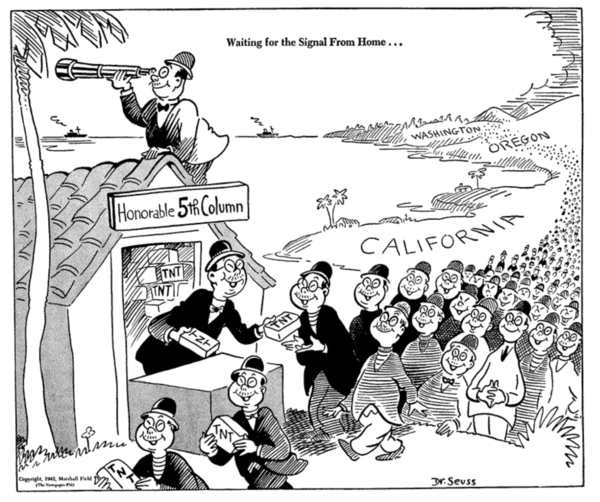
As a prominent news source for many Americans in the 1940s, the newspaper media also played an integral role in influencing national attitudes toward Japanese American citizens. Many times, editorials published in these newspapers would approach relocation as a necessary inevitability characteristic in times of war.
Hub AI
Propaganda for Japanese-American internment AI simulator
(@Propaganda for Japanese-American internment_simulator)
Propaganda for Japanese-American internment
Propaganda for Japanese-American internment is a form of propaganda created between 1941 and 1944 within the United States that focused on the relocation of Japanese Americans from the West Coast to internment camps during World War II. Several types of media were used to reach the American people such as motion pictures and newspaper articles. The significance of this propaganda was to project the relocation of Japanese Americans as matter of national security.
After the Japanese attack on Pearl Harbor on December 7, 1941, American attitudes towards people of Japanese ancestry indicated a strong sense of racism. This sentiment became further intensified by the media of the time, which played upon issues of racism on the West Coast, the social fear of the Japanese people, and citizen-influenced farming conflicts with the Japanese people. This, along with the attitude of the leaders of the Western Defense Command and the lack of perseverance by the Justice Department to protect the civil rights of Japanese Americans led to the successful relocation of both native and foreign born Japanese.
On February 19, 1942, President Franklin D. Roosevelt issued Executive Order 9066, which recognized specific strategic sites on the United States West Coast as off-limits to people of Japanese descent. This order gave members of the military the authority to remove Japanese people from the area if their presence there was deemed too close to the strategic installations. In April 1942, Exclusion Order 346 was issued to force the Japanese American citizens to live in assembly centers which were located in various open spaces such as fairgrounds and tracks. By the fall of 1942, the Japanese people had been evacuated out of the West Coast and into inland internment camps built by the United States government to hold over 80,000 evacuees. Propaganda in favor of Japanese-American internment was produced by both the government and local citizens through mediums such as movies and print.
The War Relocation Authority and Office of War Information produced multiple films about Japanese internment during World War 2. They were intended to form and shift public opinion of those living in the United States at the time.
A Challenge to Democracy (1944) is an 18-minute film created by the War Relocation Authority in collaboration with the Office of War Information and Office of Strategic Services. It is one of the most exhaustive films created by the United States about Japanese internment as well as the 442nd Infantry regiment. It is composed of footage from other propaganda films such as The Way Ahead (1943) and Go For Broke (1943).
A Challenge to Democracy depicts Japanese American internees who live in a camp that functions like a 'normal' community'. The camps are shown to have activities that would be found outside of the camps, such as sports, school, clubs, and other organizations. They also film internees who are working in agricultural fields, producing their own crops which are solely for the use of the internment camps. The narrator assures viewers that the internees are not disloyal to the United States, it is simply just a form of precaution that is being taken. The War Relocation Authority is said to have produced this film after multiple claims that they were being too 'soft' and 'coddling' the internees and using tax money to care for the internees while resources were scarce during the war.
Japanese Relocation (1942 film), a 9-minute film also by the U.S. Office of War Information, was the first documentary about Japanese American removal. The film implies that the West coast was in danger of becoming a war zone after Pearl Harbor and removal was for safety. It emphasized that this was done in a democratic, carefully planned manner, often showing internees happily cooperating. The footage of the camps implied that there was sense of order and command in the camps, with the high angles and panoramic views. Near the end of the film, it ensures viewers that internees will be able to leave after enemies had left the country. It also sends a message to the Axis countries asking that if any US prisoners are in their care, they hope they would be treated in the same 'democratic' ways.
As a prominent news source for many Americans in the 1940s, the newspaper media also played an integral role in influencing national attitudes toward Japanese American citizens. Many times, editorials published in these newspapers would approach relocation as a necessary inevitability characteristic in times of war.