Hubbry Logo
search
logo

Propensity probability

logo
Community Hub0 Subscribers
Read side by side
from Wikipedia

The propensity theory of probability is a probability interpretation in which the probability is thought of as a physical propensity, disposition, or tendency of a given type of situation to yield an outcome of a certain kind, or to yield a long-run relative frequency of such an outcome.[1]

Propensities are not relative frequencies, but purported causes of the observed stable relative frequencies. Propensities are invoked to explain why repeating a certain kind of experiment will generate a given outcome type at a persistent rate. Stable long-run frequencies are a manifestation of invariant single-case probabilities. Frequentists are unable to take this approach, since relative frequencies do not exist for single tosses of a coin, but only for large ensembles or collectives. These single-case probabilities are known as propensities or chances.

In addition to explaining the emergence of stable relative frequencies, the idea of propensity is motivated by the desire to make sense of single-case probability attributions in quantum mechanics, such as the probability of decay of a particular atom at a particular moment.

History

[edit]

A propensity theory of probability was given by Charles Sanders Peirce.[2][3][4][5]

Karl Popper

[edit]

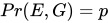
A later propensity theory was proposed[6] by philosopher Karl Popper, who had only slight acquaintance with the writings of Charles S. Peirce, however.[2][3] Popper noted that the outcome of a physical experiment is produced by a certain set of "generating conditions". When we repeat an experiment, as the saying goes, we really perform another experiment with a (more or less) similar set of generating conditions. To say that a set of generating conditions G has propensity p of producing the outcome E means that those exact conditions, if repeated indefinitely, would produce an outcome sequence in which E occurred with limiting relative frequency p. Thus the propensity p for E to occur depends upon G:. For Popper then, a deterministic experiment would have propensity 0 or 1 for each outcome, since those generating conditions would have the same outcome on each trial. In other words, non-trivial propensities (those that differ from 0 and 1) imply something less than determinism and yet still causal dependence on the generating conditions.
Recent work

[edit]

A number of other philosophers, including David Miller and Donald A. Gillies, have proposed propensity theories somewhat similar to Popper's, in that propensities are defined in terms of either long-run or infinitely long-run relative frequencies.

Other propensity theorists (e.g. Ronald Giere[7]) do not explicitly define propensities at all, but rather see propensity as defined by the theoretical role it plays in science. They argue, for example, that physical magnitudes such as electrical charge cannot be explicitly defined either, in terms of more basic things, but only in terms of what they do (such as attracting and repelling other electrical charges). In a similar way, propensity is whatever fills the various roles that physical probability plays in science.

Other theories have been offered by D. H. Mellor,[8] and Ian Hacking.[9]

Ballentine developed an axiomatic propensity theory[10] building on the work of Paul Humphreys.[11] They show that the causal nature of the condition in propensity conflicts with an axiom needed for Bayes' theorem.

Principal principle of David Lewis

[edit]

What roles does physical probability play in science? What are its properties? One central property of chance is that, when known, it constrains rational belief to take the same numerical value. David Lewis called this the principal principle,[12] The principle states:

  • The Principal Principle. Let C be any reasonable initial credence function. Let t be any time. Let x be any real number in the unit interval. Let X be the proposition that the chance, at time t, of A's holding equals x. Let E be any proposition compatible with X that is admissible at time t. Then C(AIXE) = x.

Thus, for example, suppose you are certain that a particular biased coin has propensity 0.32 to land heads every time it is tossed. What is then the correct credence? According to the Principal Principle, the correct credence is .32.

See also

[edit]

References

[edit]

Further reading

[edit]
[edit]
Revisions and contributorsEdit on WikipediaRead on Wikipedia
from Grokipedia
The propensity interpretation of probability, also known as propensity theory, is a philosophical account that defines probabilities as objective, physical dispositions or "propensities" inherent in the conditions or mechanisms that generate random events, analogous to forces in physics that incline outcomes toward certain possibilities with measurable "weights."[1] This view treats probability not as a subjective degree of belief or a mere statistical summary of past frequencies, but as a real, mind-independent property of the experimental setup or generating process, applicable to both repeatable trials and unique singular events.[1] Developed by Karl Popper, the theory was first articulated in his 1959 paper "The Propensity Interpretation of Probability," published in the British Journal for the Philosophy of Science, as a response to limitations in earlier interpretations like the classical (equiprobability) and frequentist approaches.[2] Popper argued that propensities provide a testable, objective basis for probability, where the probability value emerges from the relational properties of the physical situation, such as the design of a die or the configuration in a quantum experiment, and can be inferred from long-run relative frequencies without being reducible to them.[1] For instance, in the two-slit experiment in quantum mechanics, the propensity interpretation attributes the probabilistic interference pattern to the objective tendencies of the particle-emitting setup rather than observer ignorance or ensemble averages.[1] Distinguishing itself from frequentism—which restricts probabilities to limits in infinite sequences and struggles with one-off events—and subjectivism—which bases them on personal credences—the propensity theory enables single-case probabilities by locating them in the dispositional structure of the generating conditions, thus supporting realist explanations in fields like biology, statistics, and indeterministic physics.[3] Popper further elaborated this in his 1983 book Realism and the Aim of Science, emphasizing propensities' role in falsifiable scientific predictions and their compatibility with indeterminism, where outcomes remain unpredictable despite objective chances.[3] Despite its influence on objective interpretations of chance, the theory has prompted debates over the metaphysics of unobservable propensities and their precise axiomatic alignment with probability calculus.[3]

Definition and Basics

Core Concept

Propensity probability interprets probability as an objective, physical disposition or tendency inherent in a given situation or experimental setup to produce a particular outcome.[3] This dispositional property exists independently of any observer's beliefs or subjective credences, grounding probabilities in the physical characteristics of the system itself.[3] For instance, a fair six-sided die possesses an equal propensity of one-sixth to land on any specific face, such as the number three, due to its symmetrical construction and the mechanics of rolling.[3] Unlike frequency-based views that rely on observed relative frequencies in repeated trials, propensities generate objective probabilities directly from the setup's inherent tendencies, even in scenarios where repetitions are impossible or impractical.[3] This approach avoids dependence on empirical data aggregation, positing instead that the probability value reflects the strength of the physical disposition to yield the outcome.[3] A classic illustration is a biased coin, where physical asymmetry—such as uneven weight distribution—results in unequal propensities, say 0.6 for heads and 0.4 for tails, manifesting as an objective tendency in each toss.[3] The roots of this dispositional conception trace back to Charles Sanders Peirce, who in 1910 described probability as a "would-be" frequency arising from the habit-like disposition of a physical system, representing the frequency it would produce in an endless series of trials if allowed.[3] Peirce emphasized this as an objective property of the object or situation, analogous to a habit that governs its behavior under relevant conditions.[3] This idea was later formalized by Karl Popper in the mid-20th century.[3]

Types of Propensities

Long-run propensities represent the objective tendencies of a physical setup or mechanism to generate relative frequencies that converge to specific probability values over an indefinitely large number of repeated trials under identical conditions. These propensities are manifested in the limiting behavior of outcomes, providing a basis for interpreting probabilities as stable patterns in repeatable processes. For example, the long-run propensity of a well-balanced die to show each face with equal likelihood corresponds to a relative frequency approaching 1/6 for each outcome across countless rolls. Single-case propensities, by contrast, denote the intrinsic objective dispositions of a particular situation or entity to yield a certain outcome in a unique instance, irrespective of any series of repetitions.[4] These are physical properties akin to other measurable attributes, assigning objective chances to non-repeatable or singular events without invoking frequency limits. A classic illustration is the single-case propensity of an individual radioactive atom to decay within a specified timeframe, representing a definite objective probability for that isolated occurrence.[4] The fundamental distinction between these types centers on applicability: long-run propensities require the framework of repeatable conditions to reveal themselves through aggregate frequencies, while single-case propensities operate independently for irreplaceable or one-off scenarios. Ronald Giere advanced the view of single-case propensities as autonomous physical magnitudes, decoupled from frequency-based justifications, to ground objective probabilities in individual causal contexts.[4]

Philosophical Foundations

Objective Nature

Propensity probability qualifies as an objective interpretation because it locates probabilities in physical dispositions inherent to the world, independent of observers' beliefs or assumptions about symmetry.[https://plato.stanford.edu/entries/probability-interpret/] These dispositions represent tendencies or capacities of entities to produce certain outcomes under specified conditions, making probability a feature of reality rather than a subjective degree of confidence or a mere logical relation.[https://plato.stanford.edu/entries/probability-interpret/] In this framework, propensities are treated as real, dispositional properties of physical systems, analogous to fundamental attributes such as mass or electric charge, which exist objectively and can be investigated and measured through empirical scientific methods.[https://api.newton.ac.uk/website/v0/events/preprints/NI16052] For instance, the propensity of a die to land on a particular face arises from its physical structure and material properties, allowing probabilities to be calibrated against observed frequencies in repeated trials while retaining their status as intrinsic features.[https://www.sciencedirect.com/topics/mathematics/propensity-interpretation] A key advantage of this objective stance is its ability to assign meaningful probabilities to single events without relying on historical frequency data, addressing limitations in other interpretations.[https://plato.stanford.edu/entries/probability-interpret/] Consider the probability of rain tomorrow: under the propensity view, this is determined by the objective disposition of current atmospheric conditions to produce precipitation, providing a physical basis for the assessment even for a unique occurrence.[https://plato.stanford.edu/entries/probability-interpret/] Donald Gillies, in his analysis of probability theories, characterizes propensities as objective chances particularly suited to scientific contexts, where they function as measurable tendencies that underpin empirical predictions and explanations.[https://books.google.com/books/about/Philosophical_Theories_of_Probability.html?id=iBKGXi1GpNkC]

Relation to Physical Systems

In propensity theory, probabilities are understood as emerging from the causal structures inherent in physical systems, where the specific properties of the setup determine the likelihood of outcomes. For instance, the shape, material, and symmetry of a die influence the propensities for each face to land uppermost, creating weighted tendencies rather than uniform possibilities across all outcomes. These propensities arise not from abstract ideals but from the tangible interactions within the physical arrangement, such as gravitational forces, friction, and momentum during a roll. Unlike mere logical or metaphysical possibilities, which treat outcomes as equally conceivable without inherent bias, propensities represent objective, weighted dispositions that drive certain results more strongly than others in a given system. This distinction underscores that propensities are dynamic properties capable of influencing singular events while being empirically verifiable through repeated trials, distinguishing them from static notions of chance. In physical terms, these tendencies stem from the measurable causal mechanisms of the system, ensuring that probabilities reflect real-world asymmetries rather than idealized equality. Karl Popper formalized this view by arguing that propensities in repeatable experiments are intrinsic properties of the experimental arrangement itself, analogous to physical forces like gravitation that govern outcomes without being reducible to frequencies alone. He emphasized that such propensities characterize the disposition of the setup to produce specific results, testable through observed relative frequencies under controlled conditions. For example, in a gambling device like a biased roulette wheel, the propensities derive from mechanical imperfections—such as uneven weighting or surface irregularities—rather than presumed geometric symmetry, directly linking probability to the system's physical constitution.

Historical Development

Early Contributions

The early foundations of propensity probability trace back to Charles Sanders Peirce, who in 1910 articulated probability as a disposition or "would-be" frequency inherent in a generative setup, such as the tendency of a die to land on a particular face in repeated trials. Peirce likened this probability to a habit or real possibility within the object itself, which would manifest as a stable frequency if the experiment were repeated indefinitely, emphasizing its objective character independent of observer knowledge or finite observations. This conception positioned probability as a physical propensity rather than a purely abstract or subjective measure.[3] Building on this, other early objective views of probability incorporated influences from classical and logical interpretations, adapting their emphasis on structure and evidence to highlight dispositional aspects over strict logical deduction. The classical approach, pioneered by Pierre-Simon Laplace in the early 19th century, treated probabilities as objective ratios derived from equiprobable physical possibilities, such as in games of chance, thereby suggesting inherent tendencies in symmetric systems that foreshadowed propensities. Meanwhile, logical interpretations, advanced by figures like John Maynard Keynes in 1921, framed probability as an objective degree of partial support between evidence and propositions, incorporating dispositional elements by tying probabilities to evidential relations in real-world scenarios rather than ideal a priori symmetries. These strands contributed to an evolving objective ontology by shifting focus from formal logic to properties that could apply to empirical, repeatable processes.[3] These developments occurred amid 19th- and early 20th-century philosophical debates on the ontology of probability, intensified by the integration of probabilistic reasoning into emerging physical theories like statistical mechanics and early quantum concepts, which raised questions about whether probabilities denoted genuine objective features of natural systems or merely descriptive tools for uncertainty.[3] A key limitation of these early ideas was their insufficient separation from frequentist views, as dispositions were often explained through appeals to limiting relative frequencies in hypothetical infinite sequences, blurring the line between an intrinsic tendency and observable empirical regularities without addressing single-case applications distinctly.[3]

Karl Popper's Formulation

Karl Popper introduced the propensity interpretation of probability in his 1957 paper, where he proposed viewing probabilities as objective propensities inherent in physical systems, particularly in the context of quantum mechanics and repeatable experiments. In this formulation, probability measures the tendency or disposition of a generating mechanism—such as a quantum event or an experimental setup—to produce certain outcomes, rather than merely describing relative frequencies or subjective beliefs. This approach aimed to resolve issues in quantum theory by attributing objective indeterminism to propensities, allowing for non-deterministic yet physically real probabilities.[5] Popper further elaborated on this idea in his 1959 paper, emphasizing propensities as properties of the experimental arrangement that give rise to characteristic outcomes in repeated trials. Over time, his views evolved; by his 1990 work, he shifted focus from long-run frequencies to single-case propensities, treating them as objective physical realities akin to forces or masses—measurable dispositions that exist independently of actual repetitions or observers. This evolution underscored propensities as fundamental to understanding causality and indeterminism in the physical world.[6][7] A central argument in Popper's theory is that propensities provide a way to explain indeterminism objectively, without relying on subjective elements, as seen in examples like a random number generator with a propensity of 1/2 for producing an even number, which holds regardless of specific outcomes or frequencies observed. This avoids the pitfalls of subjective interpretations by grounding probability in the physical setup's inherent tendencies. Influenced by Popper's objective chances, David Lewis formulated the Principal Principle in 1980, stating that rational credences in a proposition should equal its objective chance (or propensity) when that chance is known.[8][9]

Post-Popper Developments

Following Karl Popper's initial formulation of propensity theory, subsequent philosophers refined and expanded the framework, particularly emphasizing its applicability to scientific practice and unique events. Ronald Giere, in his 1973 analysis, advocated for single-case propensities as objective probabilities that function as measurable physical magnitudes within scientific hypotheses.[4] Giere argued that these propensities represent dispositional properties of physical systems, allowing for the attribution of probabilities to individual events in empirical contexts, such as statistical inference in experimental sciences.[10] This approach positioned single-case propensities as testable components of theories, bridging the gap between abstract probability and concrete physical dispositions.[11] Donald Gillies further developed these ideas by distinguishing between long-run and single-case propensity theories, proposing the former as a more robust objective interpretation for repeatable experimental conditions.[12] In his 2000 work, Gillies outlined how long-run propensities align with frequency data in controlled settings, while single-case versions, though challenging, could apply to non-repeatable events such as historical singularities—like the probability of a specific war's outcome or a unique geological event—by treating them as manifestations of underlying causal structures. Building on this in 2016, Gillies integrated propensity theory with causal models in medical contexts, arguing that probabilities in multi-factorial disease scenarios derive from propensities inherent in causal mechanisms, enabling predictions for singular clinical cases without relying on long-run frequencies.[13] This distinction addressed limitations in applying propensities to irreproducible phenomena, emphasizing their role in explanatory rather than purely predictive frameworks.[14] Modern refinements have increasingly linked propensities to causal capacities, particularly in efforts to resolve paradoxes arising in conditional probability assignments. For instance, attempts to address Humphreys' paradox—which challenges the standard probability calculus under causal interpretations by highlighting asymmetries in conditional propensities—have proposed viewing propensities as capacities for causation rather than mere dispositions. This integration posits that propensities embody the potential of causal factors to produce outcomes, allowing conditional probabilities to be derived from underlying causal graphs without violating axioms. Such views, advanced in causal modeling literature, reinforce propensity theory's objectivity while accommodating complex, non-independent causal interactions.[15] As of the 2020s, propensity theory continues to play a central role in philosophy of science debates, particularly regarding objective interpretations of probability in indeterministic systems. Recent discussions highlight its strengths in unifying single-case and long-run approaches for scientific realism, though challenges persist in formalizing propensities for quantum and cosmological contexts without empirical overreach.[3] For example, in 2021, Lorenzo Lorenzetti refined propensity accounts to better accommodate probabilities in the Ghirardi–Rimini–Weber (GRW) collapse models of quantum mechanics.[16] Ongoing work emphasizes propensities' compatibility with Bayesian methods in causal inference, positioning the theory as a viable alternative to frequentist and subjective views amid evolving statistical practices.

Formal Aspects

Long-run Propensity Theory

The long-run propensity theory interprets probability as an objective physical tendency inherent in a repeatable experimental setup or stochastic mechanism, which disposes it to produce outcomes with relative frequencies that converge to the assigned probability values over many trials. In this view, a propensity is not merely a description of observed frequencies but a causal disposition of the setup that generates those frequencies in the long run. For instance, if a setup has a propensity of $ p $ for outcome $ A $, then the probability $ P(A) = p $ is understood as the limit $ \lim_{n \to \infty} \frac{n_A}{n} = p $, where $ n $ is the number of trials and $ n_A $ is the number of occurrences of $ A $, with the propensity being the underlying cause of this convergence.[3] Mathematically, long-run propensities satisfy the Kolmogorov axioms of probability—non-negativity, normalization, and finite additivity—because they approximate the limiting relative frequencies, which themselves obey these axioms under suitable conditions of repeatability and stability. Formally, the probability of a hypothesis $ H $ given a setup $ S $ is defined as $ P(H) = $ propensity of $ S $ to produce $ H $ in repeated trials, where the propensity magnitude is calibrated by the asymptotic frequency it induces. This foundation ensures that probabilities are both objective properties of the mechanism and empirically testable through repeated experimentation. Donald Gillies formalized long-run propensities in 2000 as dispositions of stochastic mechanisms operating under stable conditions, where the probability measure reflects the mechanism's tendency to yield specific long-run frequency distributions across possible outcomes. In Gillies' account, such propensities apply to systems like random number generators or physical processes with inherent randomness, provided the conditions remain invariant across trials, allowing the frequency limit to serve as a measure of the propensity's strength. This theory's key advantage lies in bridging objective probability—rooted in the physical properties of the setup—with empirical verification, as the long-run frequencies provide a practical means to estimate and confirm the propensity without relying solely on theoretical postulation.[3] As a complement to single-case propensities, long-run theory emphasizes repeatable scenarios amenable to frequency data.

Single-case Propensity Theory

The single-case propensity theory interprets probability as an objective physical propensity or tendency inherent in a specific situation to produce a particular outcome on a unique occasion, without presupposing any repeatability or long-run frequency.[2] This approach assigns objective chances to irreducible singular events, such as the propensity of a particular electron in a given experimental setup to be detected at a specific position xx.[1] Unlike frequency-based views, it treats these propensities as dispositional properties of the physical conditions generating the event, making probability a real feature of the world independent of observer knowledge or repeated trials.[17] In formal terms, propensities under this theory can be conceptualized as magnitudes or vectors within the state space of the physical system, representing directional tendencies akin to forces that govern outcomes.[18] Karl Popper, in his later formulation, described propensities as "weighted possibilities"—more than mere logical possibilities but actual tendencies embedded in the structure of physical reality, unconstrained by frequency limits and applicable to any concrete situation.[19] This vectorial or magnitudinal representation allows propensities to capture the asymmetric, causal push toward certain results in non-repeatable scenarios, emphasizing their role as objective measures of potentiality in the world's state spaces.[8] Mathematically, the strength of a propensity is denoted as P(os)P(o|s), where oo is the outcome and ss is the generating situation, satisfying the standard Kolmogorov axioms independently of empirical frequencies: additivity for mutually exclusive outcomes (P(o1o2s)=P(o1s)+P(o2s)P(o_1 \cup o_2 | s) = P(o_1 | s) + P(o_2 | s)) and normalization (0P(os)10 \leq P(o|s) \leq 1, with P(os)=1\sum P(o|s) = 1 over all possible oo).[1] A key challenge in the single-case theory lies in measuring these propensities, as unique events cannot be directly repeated; instead, assessment relies on hypothetical repeatable analogs that replicate the causal structure of the situation or on detailed causal analysis of the underlying physical conditions.[17] The long-run propensity theory emerges as a special case when the situation permits actual repetition.[1]

Comparisons with Other Interpretations

Versus Frequentist Interpretation

The frequentist interpretation of probability defines it as the limiting relative frequency of an event in an infinite sequence of repeated trials under identical conditions.[3] This view, associated with early proponents like John Venn, treats probability as an empirical property derived directly from observable or hypothetical long-run frequencies, applicable only to repeatable processes where such sequences can be conceptualized.[20] In contrast, the propensity interpretation, as formulated by Karl Popper, conceives of probability as an objective, physical disposition or tendency inherent in the experimental setup or situation to yield a particular outcome, which in turn generates the observed frequencies.[1] The key difference lies in the explanatory direction: frequentism equates probability with the frequency itself, offering a descriptive account, whereas propensity theory reverses this by positing propensities as the underlying causal mechanisms that explain why frequencies stabilize at certain values, providing a metaphysical foundation for probability as a real property of the world.[3] For instance, in the case of a fair six-sided die, the frequentist assigns a probability of 1/6 to each face based on the expected long-run relative frequency in repeated rolls, but the propensity view attributes this probability to the die's symmetric physical structure, which disposes it to produce outcomes with equal likelihood, thereby causing the frequency to approach 1/6.[1] A significant advantage of the propensity interpretation over frequentism is its ability to assign meaningful probabilities to non-repeatable or single-case events, where long-run frequencies are undefined or inapplicable.[3] Frequentism falters in such scenarios, as it requires an infinite reference class of similar trials that may not exist for unique events like a specific historical occurrence or the decay of a particular radioactive atom.[3] Propensity theory addresses this limitation by locating probability in the dispositional properties of the individual situation, allowing for objective probabilities in quantum mechanics or one-off experiments without reliance on hypothetical repetitions.[12] This extension makes propensity particularly useful for scientific contexts involving irreducible chance in isolated systems.

Versus Subjective Interpretation

In the subjective interpretation of probability, probabilities are understood as degrees of belief held by rational agents, which can be updated through conditionalization in accordance with Bayes' theorem.[21] This view, advanced by thinkers such as Frank Ramsey and Bruno de Finetti, treats probability as a personal credence calibrated to coherence conditions, such as those avoiding Dutch books, rather than as an inherent feature of the world.[21] Propensity theory, by contrast, posits probabilities as objective, mind-independent physical dispositions or tendencies inherent in generative conditions, such as the setup of a die toss or a quantum system, independent of any observer's beliefs.[1] This marks a fundamental objective-subjective divide: propensities exist as real properties of the situation, not as subjective calibrations to personal credences, directly challenging de Finetti's emphasis on coherence as the sole normative constraint for probabilities.[1] Proponents of propensity theory critique the subjective approach for failing to account for objective chances in natural phenomena, where probabilities persist regardless of human belief; for instance, the propensity of a radium atom to decay within a given timeframe—approximately 0.0004 in one year—represents an intrinsic physical tendency unaffected by an observer's degree of confidence.[1] In quantum mechanics, events like electron spin measurements exhibit such propensities as objective features of the system, which the subjective view cannot fully capture without anchoring to external realities beyond mere belief.[1] David Lewis's Principal Principle provides a bridge between these interpretations, stipulating that rational credences in a proposition should align with the objective propensity (or chance) of that proposition when known, thereby constraining subjective beliefs to reflect mind-independent probabilities for epistemic rationality.[9] This principle underscores how propensity theory demands that subjective probabilities defer to objective chances, rather than treating them as fully autonomous.[9]

Applications and Implications

In Quantum Mechanics

In the propensity interpretation of quantum mechanics, probabilities associated with measurement outcomes are understood as objective physical tendencies or dispositions inherent in the quantum system, rather than mere statistical frequencies or subjective beliefs. For instance, the probability of detecting a particle at a specific location is viewed as a propensity of the wave function to produce that outcome upon interaction with a measuring device, such as a detector screen. This approach explains wave function collapse not as a mysterious or observer-induced process, but as the realization of these propensities when the system interacts with an external apparatus, yielding definite results from an underlying indeterministic tendency.[22] Karl Popper originally motivated the propensity theory in 1957 to provide an objective resolution to quantum indeterminism, arguing that quantum events exhibit real, physical propensities that avoid the subjectivism of Copenhagen interpretations while accommodating the theory's probabilistic nature. By treating probabilities as dispositions of the physical setup—such as the quantum state interacting with a measurement context—Popper's framework posits that indeterminism arises from these objective tendencies, allowing for singular, non-repeatable events like individual particle detections without invoking hidden variables or ensemble limits. This formulation aligns quantum mechanics with a realist, indeterministic worldview, where propensities ground the theory's predictions empirically.[5][23] In modern applications, propensity theory extends to quantum field theory, where propensities model transition probabilities for particle interactions and decays without relying on subjective elements. For example, in propensiton quantum theory, quantum fields are composed of propensitons—probabilistic entities whose dispositions determine transition rates during inelastic processes, such as particle creation or scattering, with probabilities derived from asymptotic states of the field. This objective propensity basis supports the Born rule, interpreting the squared modulus of the wave function amplitude, $ P = |\psi|^2 $, as the strength of the physical tendency for a specific outcome, providing a dispositional foundation for quantum probabilities that is independent of observer knowledge.[24][25]

In Classical Physics and Statistics

In classical physics, propensity interpretations attribute objective probabilities to physical mechanisms that introduce indeterminism through biases or imperfections in repeatable setups. For instance, a coin that is unevenly weighted possesses a propensity to land heads with a probability greater than 1/2, reflecting the causal influence of its physical structure on outcomes over many trials.[3] Similarly, a roulette wheel tilted due to manufacturing flaws exhibits propensities for certain numbers or colors that deviate from uniform distribution, grounding the probability in the wheel's dispositional properties rather than subjective beliefs or mere observed frequencies.[3] These examples illustrate how propensities provide a realist account of probability in macroscopic systems, where outcomes are determined yet appear probabilistic due to initial conditions or environmental factors.[1] In statistics, objective propensities justify hypothesis testing by interpreting probabilities as inherent tendencies of causal mechanisms within defined reference classes. For example, the efficacy of a drug can be understood as its propensity to produce a cure in patients sharing relevant characteristics, such as age or condition, allowing statistical tests to evaluate whether observed frequencies align with the mechanism's disposition.[26] This approach resolves issues in causal inference, like Simpson's paradox, by specifying repeatable conditions under which the propensity manifests, thereby supporting rigorous empirical validation of scientific claims.[26] This application underscores how propensities enhance scientific realism by ascribing probabilities directly to underlying causal structures, bridging deterministic laws with observed stochastic behavior in classical domains.[3]

Criticisms and Responses

Key Objections

One major objection to propensity theory is that propensities are inherently vague and metaphysical, representing unobservable dispositions or physical properties whose nature remains unclear and difficult to specify beyond mere labeling. Critics contend that invoking "propensities" adds little explanatory power, as it fails to delineate what these entities are independently of the probabilities they purportedly generate, rendering the theory susceptible to charges of obscurity akin to invoking dormant virtues without empirical grounding.[27] A related criticism concerns the testability of propensities, particularly in single-case interpretations, where propensities cannot be directly measured or falsified without recourse to long-run frequencies; critics argue this renders single-case propensities untestable and thus metaphysical rather than scientifically verifiable, while some proponents favor long-run variants to ensure empirical testability. This issue undermines the theory's empirical foundation, as single-case propensities resist experimental confirmation or refutation in isolation from repeatable trials.[28] Humphreys' paradox highlights a formal problem, arguing that propensity accounts fail to satisfy key probability axioms, such as additivity, due to causal interdependencies; for instance, in scenarios involving conditional propensities like the emission of electrons from a metal surface under specific lighting, the joint propensities do not align with standard conditional probabilities, especially for inverse relations, thereby violating the Kolmogorov axioms. This paradox suggests that propensities, as causal tendencies, cannot consistently function as probabilities without ad hoc adjustments.[27] Finally, propensity theory risks circularity by defining propensities in terms of the very probabilities they are meant to explain, presupposing probabilistic outcomes to ground the dispositions without providing an independent foundation for the axioms or their application. This definitional loop fails to offer a reductive analysis, merely relabeling existing concepts and begging the question of what justifies the probabilistic structure.[27]

Defenses and Refinements

Proponents of propensity theory have countered charges of vagueness by likening propensities to other scientific unobservables, such as forces in physics, which cannot be directly observed but are postulated and inferred from their measurable effects on observable phenomena.[4] Concerns regarding the testability of single-case propensities, particularly their applicability to unique events without repeatable trials, have been addressed through appeals to hypothetical long-run frequencies or causal modeling frameworks that allow indirect validation of propensity claims in non-repeatable contexts.[3] To resolve paradoxes arising in non-causal propensity accounts, such as Humphreys' paradox where joint propensities fail to exhibit additivity, advocates have developed causal variants of the theory; these incorporate independence assumptions between causal factors to refine the definition of joint propensities, ensuring compliance with the axioms of probability.[27] In modern developments, the propensity interpretation has been refined by distinguishing between frequency-linked variants, which tie propensities to limiting relative frequencies in repeatable conditions, and purely dispositional variants, which emphasize intrinsic tendencies independent of any reference class or long-run behavior.[29]

References

User Avatar
No comments yet.