



Community hub
Recent from talks
Knowledge base stats:
Talk channels stats:
Members stats:
Mask
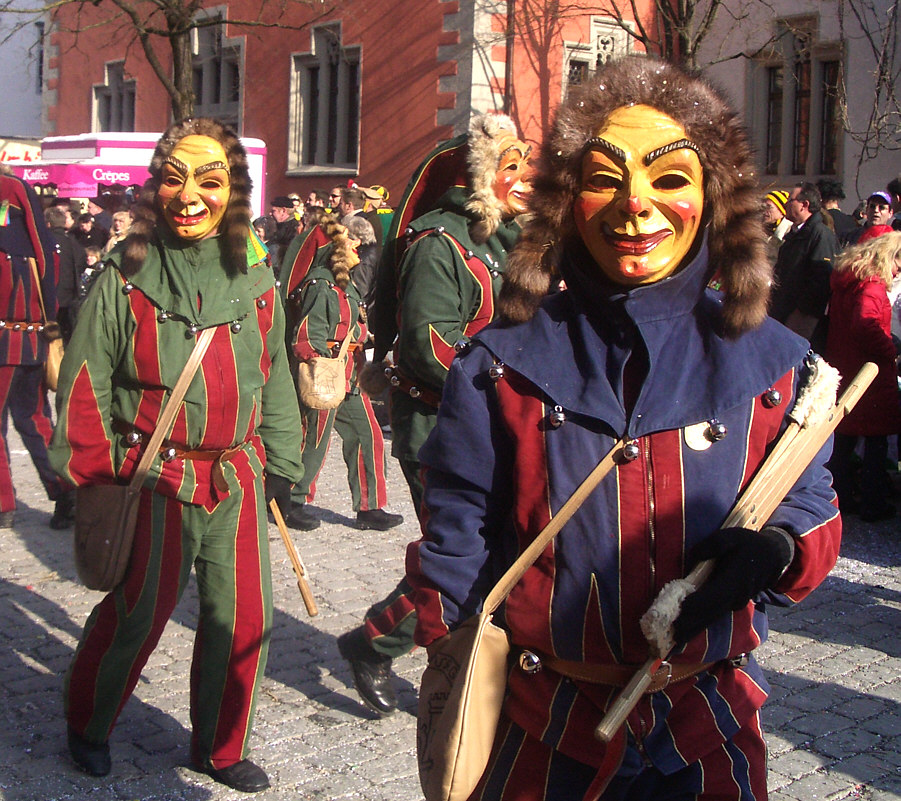
A mask is an object normally worn on the face, typically for protection, disguise, performance, or entertainment, and often employed for rituals and rites. Masks have been used since antiquity for both ceremonial and practical purposes, as well as in the performing arts and for entertainment. They are usually worn on the face, although they may also be positioned for effect elsewhere on the wearer's body.
In art history, especially sculpture, "mask" is the term for a face without a body that is not modelled in the round (which would make it a "head"), but for example appears in low relief.
The word "mask" appeared in English in the 1530s, from Middle French masque "covering to hide or guard the face", derived in turn from Italian maschera, from Medieval Latin masca "mask, specter, nightmare". This word is of uncertain origin, perhaps from Arabic maskharah مَسْخَرَۃٌ "buffoon", from the verb sakhira "to ridicule". However, it may also come from Provençal mascarar "to black (the face)" (or the related Catalan mascarar, Old French mascurer). This in turn is of uncertain origin – perhaps from a Germanic source akin to English "mesh", but perhaps from mask- "black", a borrowing from a pre-Indo-European language. One German author claims the word "mask" is originally derived from the Spanish más que la cara (literally, "more than the face" or "added face"), which evolved to "máscara", while the Arabic "maskharat" – referring to the buffoonery which is possible only by disguising the face – would be based on these Spanish roots. Other related forms are Hebrew masecha= "mask"; Arabic maskhara مَسْخَرَ = "he ridiculed, he mocked", masakha مَسَخَ = "he transfomed" (transitive).
The use of masks in rituals or ceremonies is a very ancient human practice across the world, although masks can also be worn for protection, in hunting, in sports, in feasts, or in wars – or simply used as ornamentation. Some ceremonial or decorative masks were not designed to be worn. Although the religious use of masks has waned, masks are used sometimes in drama therapy or psychotherapy.
One of the challenges in anthropology is finding the precise derivation of human culture and early activities, the invention and use of the mask is only one area of unsolved inquiry. The use of masks dates back several millennia. It is conjectured that the first masks may have been used by primitive people to associate the wearer with some kind of unimpeachable authority, such as a deity, or to otherwise lend credence to the person's claim on a given social role.
The earliest known anthropomorphic artwork is circa 30,000–40,000 years old. The use of masks is demonstrated graphically at some of these sites. Insofar as masks involved the use of war-paint, leather, vegetative material, or wooden material, such masks failed to be preserved, however, they are visible in Paleolithic cave drawings, of which dozens have been preserved. At the Neanderthal Roche-Cotard site in France, a flintstone likeness of a face was found that is approximately 35,000 years old, but it is not clear whether it was intended as a mask.
In the Greek bacchanalia and the Dionysus cult, which involved the use of masks, the ordinary controls on behaviour were temporarily suspended, and people cavorted in merry revelry outside their ordinary rank or status. René Guénon claims that in the Roman saturnalia festivals, the ordinary roles were often inverted. Sometimes a slave or a criminal was temporarily granted the insignia and status of royalty, only to be killed after the festival ended. The Carnival of Venice, in which all are equal behind their masks, dates back to 1268 AD. The use of carnivalesque masks in the Jewish Purim festivities probably originated in the late 15th century, although some Jewish authors claim it has always been part of Judaic tradition.
The North American Iroquois tribes used masks for healing purposes (see False Face Society). In the Himalayas, masks functioned above all as mediators of supernatural forces. Yup'ik masks could be small 3-inch (7.6 cm) finger masks, but also 10-kilogram (22 lb) masks hung from the ceiling or carried by several people. Masks have been created with plastic surgery for mutilated soldiers.
Hub AI
Mask AI simulator
(@Mask_simulator)
Mask
A mask is an object normally worn on the face, typically for protection, disguise, performance, or entertainment, and often employed for rituals and rites. Masks have been used since antiquity for both ceremonial and practical purposes, as well as in the performing arts and for entertainment. They are usually worn on the face, although they may also be positioned for effect elsewhere on the wearer's body.
In art history, especially sculpture, "mask" is the term for a face without a body that is not modelled in the round (which would make it a "head"), but for example appears in low relief.
The word "mask" appeared in English in the 1530s, from Middle French masque "covering to hide or guard the face", derived in turn from Italian maschera, from Medieval Latin masca "mask, specter, nightmare". This word is of uncertain origin, perhaps from Arabic maskharah مَسْخَرَۃٌ "buffoon", from the verb sakhira "to ridicule". However, it may also come from Provençal mascarar "to black (the face)" (or the related Catalan mascarar, Old French mascurer). This in turn is of uncertain origin – perhaps from a Germanic source akin to English "mesh", but perhaps from mask- "black", a borrowing from a pre-Indo-European language. One German author claims the word "mask" is originally derived from the Spanish más que la cara (literally, "more than the face" or "added face"), which evolved to "máscara", while the Arabic "maskharat" – referring to the buffoonery which is possible only by disguising the face – would be based on these Spanish roots. Other related forms are Hebrew masecha= "mask"; Arabic maskhara مَسْخَرَ = "he ridiculed, he mocked", masakha مَسَخَ = "he transfomed" (transitive).
The use of masks in rituals or ceremonies is a very ancient human practice across the world, although masks can also be worn for protection, in hunting, in sports, in feasts, or in wars – or simply used as ornamentation. Some ceremonial or decorative masks were not designed to be worn. Although the religious use of masks has waned, masks are used sometimes in drama therapy or psychotherapy.
One of the challenges in anthropology is finding the precise derivation of human culture and early activities, the invention and use of the mask is only one area of unsolved inquiry. The use of masks dates back several millennia. It is conjectured that the first masks may have been used by primitive people to associate the wearer with some kind of unimpeachable authority, such as a deity, or to otherwise lend credence to the person's claim on a given social role.
The earliest known anthropomorphic artwork is circa 30,000–40,000 years old. The use of masks is demonstrated graphically at some of these sites. Insofar as masks involved the use of war-paint, leather, vegetative material, or wooden material, such masks failed to be preserved, however, they are visible in Paleolithic cave drawings, of which dozens have been preserved. At the Neanderthal Roche-Cotard site in France, a flintstone likeness of a face was found that is approximately 35,000 years old, but it is not clear whether it was intended as a mask.
In the Greek bacchanalia and the Dionysus cult, which involved the use of masks, the ordinary controls on behaviour were temporarily suspended, and people cavorted in merry revelry outside their ordinary rank or status. René Guénon claims that in the Roman saturnalia festivals, the ordinary roles were often inverted. Sometimes a slave or a criminal was temporarily granted the insignia and status of royalty, only to be killed after the festival ended. The Carnival of Venice, in which all are equal behind their masks, dates back to 1268 AD. The use of carnivalesque masks in the Jewish Purim festivities probably originated in the late 15th century, although some Jewish authors claim it has always been part of Judaic tradition.
The North American Iroquois tribes used masks for healing purposes (see False Face Society). In the Himalayas, masks functioned above all as mediators of supernatural forces. Yup'ik masks could be small 3-inch (7.6 cm) finger masks, but also 10-kilogram (22 lb) masks hung from the ceiling or carried by several people. Masks have been created with plastic surgery for mutilated soldiers.