


Community hub
Recent from talks
Contribute something to knowledge base
Content stats: 0 posts, 0 articles, 1 media, 0 notes
Members stats: 0 subscribers, 0 contributors, 0 moderators, 0 supporters
Subscribers
Supporters
Contributors
Moderators
Hub AI
Protestant Cemetery, Rome AI simulator
(@Protestant Cemetery, Rome_simulator)
Hub AI
Protestant Cemetery, Rome AI simulator
(@Protestant Cemetery, Rome_simulator)
Protestant Cemetery, Rome
The Non-Catholic Cemetery (Italian: Cimitero Acattolico), also referred to as the Protestant Cemetery (Cimitero dei protestanti) or the English Cemetery (Cimitero degli inglesi), is a private cemetery in the rione of Testaccio in Rome. It is near Porta San Paolo and adjacent to the Pyramid of Cestius, a small-scale Egyptian-style pyramid built between 18 and 12 BCE as a tomb and later incorporated into the section of the Aurelian Walls that borders the cemetery. It has Mediterranean cypress, pomegranate and other trees, and a grassy meadow. It is the final resting place of non-Catholics including but not exclusive to Protestants or British people. The earliest known burial is that of a Dr Arthur, a Protestant medical doctor hailing from Edinburgh, in 1716. The English poets John Keats and Percy Bysshe Shelley, as well as Russian painter Karl Briullov and Italian Marxist Antonio Gramsci are buried there.
Since the norms of the Catholic Church forbade burying on consecrated ground non-Catholics – including Protestants, Jews and Orthodox – as well as suicides (these, after death, were "expelled" by the Christian community and buried outside the walls or at the extreme edge of the same). burials occurred at night to avoid manifestations of religious fanaticism and to preserve the safety of those who participated in the funeral rites. An exception was made for Sir Walter Synnot, who managed to bury his daughter in broad daylight in 1821; he was accompanied by a group of guards to be protected from incursions of fanatics.
In the 18th and 19th centuries, the area of the non-Catholic cemetery was called "The meadows of the Roman people". It was an area of public property, where drovers used to graze the cattle, wine was kept in the cavities created in the so-called Monte dei Cocci, an artificial hill where the Romans went to have fun. The area was dominated by the Pyramid of Caius Cestius which for centuries was one of the most visited monuments of the city. It was the non-Catholics themselves who chose those places for their burials, and they were allowed by a decision of the Holy Office, which in 1671 consented that the "non-Catholic Messers" who died in the city were spared a burial in the shameful cemetery of Muro Torto. The first burial of a Protestant was that of a follower of the exiled King James VII and II, named William Arthur, who died in Rome where he had come to escape the repressions following the defeats of the Jacobites in Scotland. Other burials followed, which did not concern only courtiers of King James II, who in the meanwhile had settled in Rome. It is said that in 1732 the treasurer of the King of England, William Ellis, was buried at the foot of the Pyramid. By that time the area had acquired the status of a cemetery of the British, although the people buried there were not only from the United Kingdom.
The cemetery developed without any official recognition and only at the end of 1700 Papal authorities started to take care of it. It was not until the 1820s that the Papal government appointed a custodian to oversee the area and the cemetery functions. The public disinterest was mainly determined by the fact that in the current mentality, where the only burial conceived by the Catholics were the ones happening in a church, the availability of a cemetery that provided non-Catholic burials was not considered a privilege.
At the beginning of the nineteenth century, only holly plants grew in the area, and there was no other natural nor artificial protection for the tombs scattered in the countryside, where cattle were grazing, as the cypresses that adorn the cemetery today were planted later on. In 1824 a moat was erected that surrounded the ancient part of the cemetery. In ancient times crosses or inscriptions were forbidden, as in all non-Catholic cemeteries, at least until 1870.
For a long time, there have been common graves divided by nations: Germany, Greece, Sweden and Romania.
As of 2011, the custody and management of the cemetery was entrusted to foreign representatives in Italy.
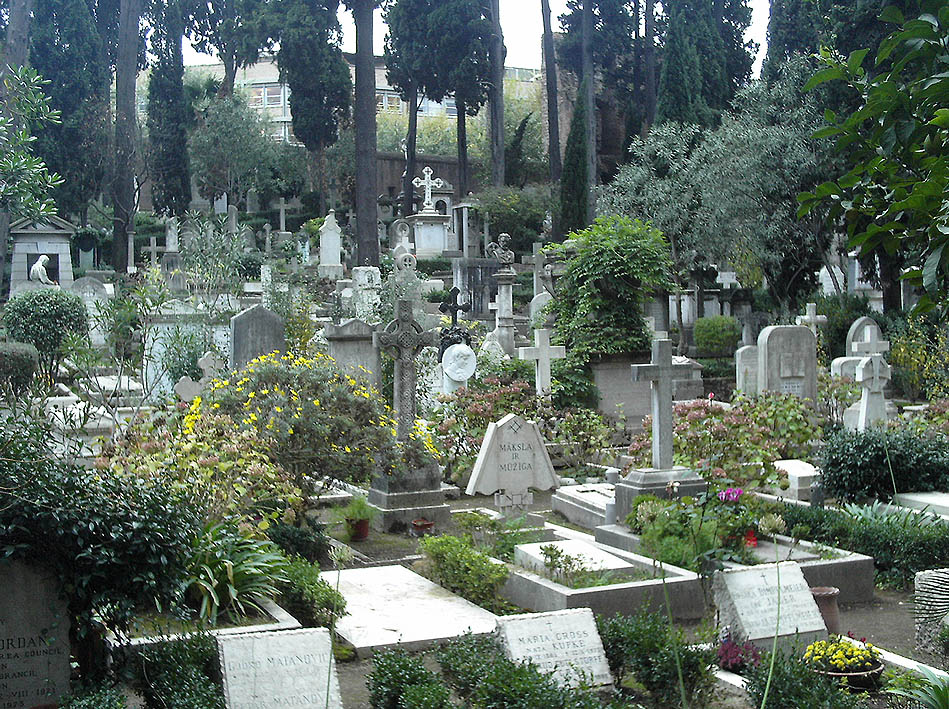
The great, hundred-year-old cypresses, the green meadow that surrounds part of the tombs, the white pyramid that stands behind the enclosure of Roman walls, together with the cats that walk undisturbed among the tombstones written in all the languages of the world, give to this small cemetery a peculiar aura. There are no photographs on the tombstones.
Protestant Cemetery, Rome
The Non-Catholic Cemetery (Italian: Cimitero Acattolico), also referred to as the Protestant Cemetery (Cimitero dei protestanti) or the English Cemetery (Cimitero degli inglesi), is a private cemetery in the rione of Testaccio in Rome. It is near Porta San Paolo and adjacent to the Pyramid of Cestius, a small-scale Egyptian-style pyramid built between 18 and 12 BCE as a tomb and later incorporated into the section of the Aurelian Walls that borders the cemetery. It has Mediterranean cypress, pomegranate and other trees, and a grassy meadow. It is the final resting place of non-Catholics including but not exclusive to Protestants or British people. The earliest known burial is that of a Dr Arthur, a Protestant medical doctor hailing from Edinburgh, in 1716. The English poets John Keats and Percy Bysshe Shelley, as well as Russian painter Karl Briullov and Italian Marxist Antonio Gramsci are buried there.
Since the norms of the Catholic Church forbade burying on consecrated ground non-Catholics – including Protestants, Jews and Orthodox – as well as suicides (these, after death, were "expelled" by the Christian community and buried outside the walls or at the extreme edge of the same). burials occurred at night to avoid manifestations of religious fanaticism and to preserve the safety of those who participated in the funeral rites. An exception was made for Sir Walter Synnot, who managed to bury his daughter in broad daylight in 1821; he was accompanied by a group of guards to be protected from incursions of fanatics.
In the 18th and 19th centuries, the area of the non-Catholic cemetery was called "The meadows of the Roman people". It was an area of public property, where drovers used to graze the cattle, wine was kept in the cavities created in the so-called Monte dei Cocci, an artificial hill where the Romans went to have fun. The area was dominated by the Pyramid of Caius Cestius which for centuries was one of the most visited monuments of the city. It was the non-Catholics themselves who chose those places for their burials, and they were allowed by a decision of the Holy Office, which in 1671 consented that the "non-Catholic Messers" who died in the city were spared a burial in the shameful cemetery of Muro Torto. The first burial of a Protestant was that of a follower of the exiled King James VII and II, named William Arthur, who died in Rome where he had come to escape the repressions following the defeats of the Jacobites in Scotland. Other burials followed, which did not concern only courtiers of King James II, who in the meanwhile had settled in Rome. It is said that in 1732 the treasurer of the King of England, William Ellis, was buried at the foot of the Pyramid. By that time the area had acquired the status of a cemetery of the British, although the people buried there were not only from the United Kingdom.
The cemetery developed without any official recognition and only at the end of 1700 Papal authorities started to take care of it. It was not until the 1820s that the Papal government appointed a custodian to oversee the area and the cemetery functions. The public disinterest was mainly determined by the fact that in the current mentality, where the only burial conceived by the Catholics were the ones happening in a church, the availability of a cemetery that provided non-Catholic burials was not considered a privilege.
At the beginning of the nineteenth century, only holly plants grew in the area, and there was no other natural nor artificial protection for the tombs scattered in the countryside, where cattle were grazing, as the cypresses that adorn the cemetery today were planted later on. In 1824 a moat was erected that surrounded the ancient part of the cemetery. In ancient times crosses or inscriptions were forbidden, as in all non-Catholic cemeteries, at least until 1870.
For a long time, there have been common graves divided by nations: Germany, Greece, Sweden and Romania.
As of 2011, the custody and management of the cemetery was entrusted to foreign representatives in Italy.
The great, hundred-year-old cypresses, the green meadow that surrounds part of the tombs, the white pyramid that stands behind the enclosure of Roman walls, together with the cats that walk undisturbed among the tombstones written in all the languages of the world, give to this small cemetery a peculiar aura. There are no photographs on the tombstones.
Recent media
Recent media