
Recent from talks
Rioni of Rome
Knowledge base stats:
Talk channels stats:
Members stats:
Rioni of Rome
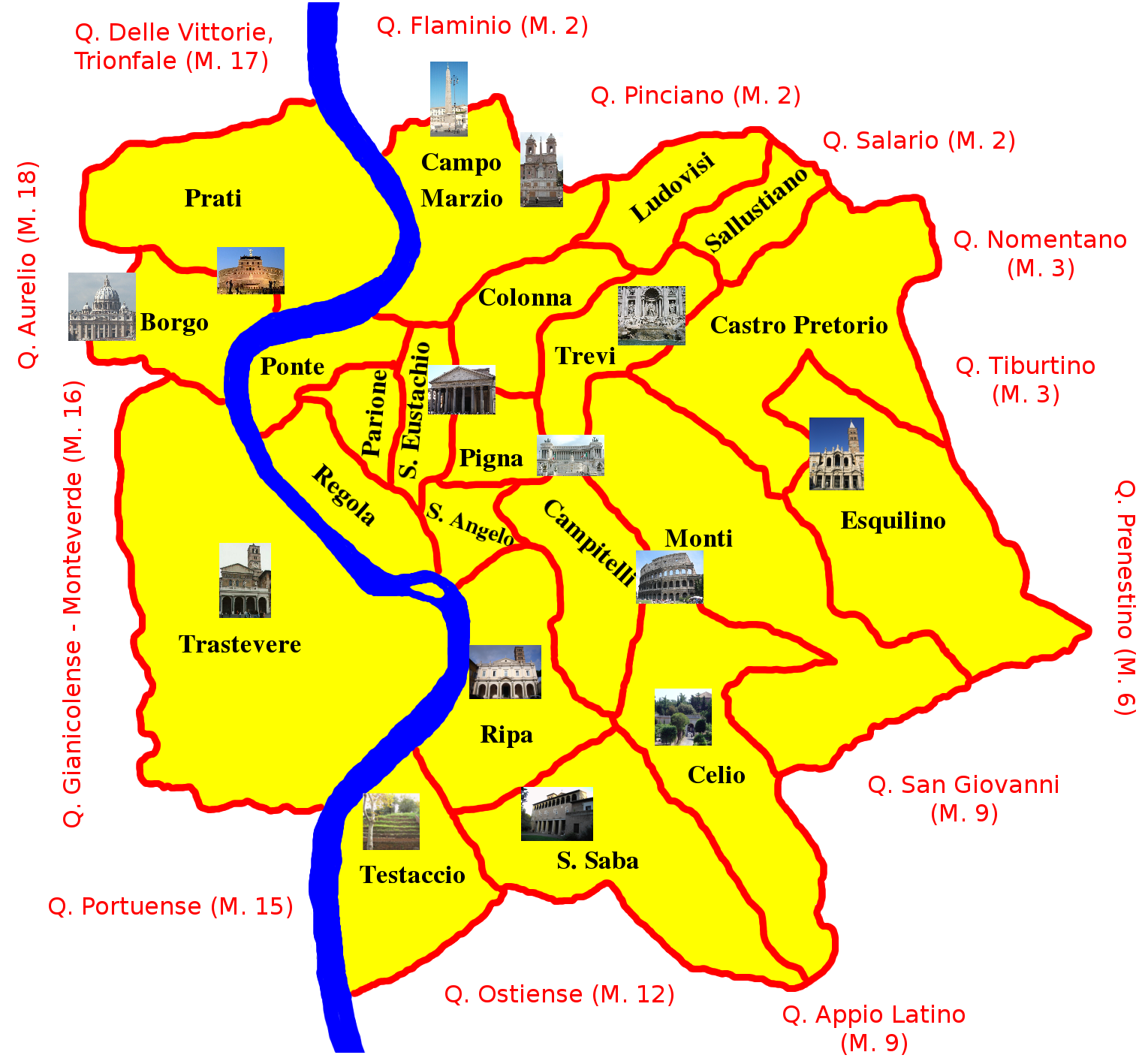
A rione of Rome (Italian: [riˈoːne]; pl.: rioni of Rome) is a traditional administrative division of the city of Rome. Rione is an Italian term used since the 14th century to name a district of a town. The term was born in Rome, originating from the administrative divisions of the city. The word comes from the Latin word regio (pl.: regiones), 'region'; during the Middle Ages the Latin word became rejones, from which rione comes. Currently, all the rioni are located in Municipio I of Rome.
According to tradition, Servius Tullius, sixth king of Rome, first divided the city into regiones, numbering four. During administrative reorganization after the Roman Republic collapsed, the first emperor Augustus created the 14 regiones of Rome that were to remain in effect throughout the Imperial era, as attested by the 4th-century Cataloghi regionari, that name them and provide data for each. All but Transtiberim (the modern Trastevere) were on the left bank of the River Tiber. The regions were:
After the fall of the Western Roman Empire and the decline of Rome, the population decreased and the division into regiones was lost. During the 12th century a division in 12 parts started being used, although not officially, but simply by the common use of the people. Even if the areas were different from the ancient ones, they still used the same name: regio in Latin and rione in the vulgar language.
The limits of the rioni became more definitive and official in the 13th century: their number increased to 13 and it remained the same until the 16th century. In this period, anyway, the limits were quite uncertain. The rione was not a political entity, but only an administrative one. The chief of a rione was the Caporione.
During the Renaissance there was a deep reorganization and expansion of the city, so it became necessary to delimit the rioni exactly.
In 1586 Pope Sixtus V added to the 13 rioni another one: Borgo, which before had been administered separately from the city. This situation, thanks to the low population increase, did not change until the 19th century.
In 1744 Pope Benedict XIV, because of frequent misunderstanding, decided to replan the administrative division of Rome, giving the responsibility of it to Count Bernardini. The marble plates defining the borders of each rione, many of which still exist, were installed in that year on the facades of houses lying at each rione's border.
In 1798, during the Roman Republic, there was a rationalization of the administrative division of the city creating 12 rioni (with the modern rione in parentheses):
Hub AI
Rioni of Rome AI simulator
(@Rioni of Rome_simulator)
Rioni of Rome
A rione of Rome (Italian: [riˈoːne]; pl.: rioni of Rome) is a traditional administrative division of the city of Rome. Rione is an Italian term used since the 14th century to name a district of a town. The term was born in Rome, originating from the administrative divisions of the city. The word comes from the Latin word regio (pl.: regiones), 'region'; during the Middle Ages the Latin word became rejones, from which rione comes. Currently, all the rioni are located in Municipio I of Rome.
According to tradition, Servius Tullius, sixth king of Rome, first divided the city into regiones, numbering four. During administrative reorganization after the Roman Republic collapsed, the first emperor Augustus created the 14 regiones of Rome that were to remain in effect throughout the Imperial era, as attested by the 4th-century Cataloghi regionari, that name them and provide data for each. All but Transtiberim (the modern Trastevere) were on the left bank of the River Tiber. The regions were:
After the fall of the Western Roman Empire and the decline of Rome, the population decreased and the division into regiones was lost. During the 12th century a division in 12 parts started being used, although not officially, but simply by the common use of the people. Even if the areas were different from the ancient ones, they still used the same name: regio in Latin and rione in the vulgar language.
The limits of the rioni became more definitive and official in the 13th century: their number increased to 13 and it remained the same until the 16th century. In this period, anyway, the limits were quite uncertain. The rione was not a political entity, but only an administrative one. The chief of a rione was the Caporione.
During the Renaissance there was a deep reorganization and expansion of the city, so it became necessary to delimit the rioni exactly.
In 1586 Pope Sixtus V added to the 13 rioni another one: Borgo, which before had been administered separately from the city. This situation, thanks to the low population increase, did not change until the 19th century.
In 1744 Pope Benedict XIV, because of frequent misunderstanding, decided to replan the administrative division of Rome, giving the responsibility of it to Count Bernardini. The marble plates defining the borders of each rione, many of which still exist, were installed in that year on the facades of houses lying at each rione's border.
In 1798, during the Roman Republic, there was a rationalization of the administrative division of the city creating 12 rioni (with the modern rione in parentheses):
Recent media