
Recent from talks
Proto-writing
Knowledge base stats:
Talk channels stats:
Members stats:
Proto-writing
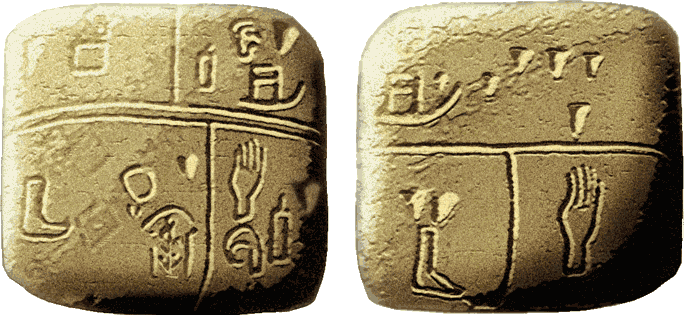
Proto-writing consists of visible marks communicating limited information. Such systems emerged from earlier traditions of symbol systems in the early Neolithic, as early as the 7th millennium BC in China and southeastern Europe. They used ideographic or early mnemonic symbols or both to represent a limited number of concepts, in contrast to true writing systems, which record the language of the writer.
In 2022, a team led by amateur archaeologist Bennett Bacon presented an analysis of lines, dots and "Y"-like symbols on Upper Palaeolithic cave paintings as indicating the mating cycle of animals in a lunar calendar. The markings found in over 400 caves across Europe were compared to the mating cycles of the animals with which they were associated, showing a correlation with the month of the year in which the animals depicted in the cave paintings would typically give birth. The markings were 20,000 years old, predating attested proto-writing systems by 10,000 years.
In 2003, turtle shells with carved inscriptions featuring a library of symbols were found in 24 Neolithic graves excavated at Jiahu in the northern Chinese province of Henan. Using radiocarbon dating, the inscriptions have been dated to the 7th millennium BC. According to some archaeologists, the symbols bear a resemblance to the first attested oracle bone inscriptions dating to c. 1200 BC. Others have dismissed this claim as insufficiently substantiated, claiming that simple geometric designs such as those found on the Jiahu shells cannot be linked to early writing.
The Vinča symbols (6th–5th millennia BC) are an evolution of simple undeciphered symbols first attested during the 7th millennium BC from Vinča culture. Over time, the symbols gradually became more complex, ultimately culminating in the Tărtăria tablets (c. 5300 BC). The symbols went out of use around 3500 BC.
They have sometimes been described as an example of proto-writing, with most scholars agreeing that the symbols indicate ownership or other information, but do not record any language.
Another example of proto-writing might be recorded on the Dispilio Tablet in Greece (6th millenia BC), however, as of 2025, there has not been a proper academic publication on that artifact yet.
During c. 3600 – c. 3200 BC, proto-writing in the Fertile Crescent was gradually evolving into cuneiform, the earliest mature writing system.
According to some scholars, the proto-cuneiform tablets (c. 3350–3000 BC) reflects the stage of writing, when what would become the cuneiform script of Sumer was still in the proto-writing stage, because it was a system based on numerical and logographic signs, lacking phonetic signs (or only a few). This system was not intended to record a language. The transitional stage to a proper writing system takes place during the first centuries of the Early Dynastic Period (c. 2900–2700 BC).
Hub AI
Proto-writing AI simulator
(@Proto-writing_simulator)
Proto-writing
Proto-writing consists of visible marks communicating limited information. Such systems emerged from earlier traditions of symbol systems in the early Neolithic, as early as the 7th millennium BC in China and southeastern Europe. They used ideographic or early mnemonic symbols or both to represent a limited number of concepts, in contrast to true writing systems, which record the language of the writer.
In 2022, a team led by amateur archaeologist Bennett Bacon presented an analysis of lines, dots and "Y"-like symbols on Upper Palaeolithic cave paintings as indicating the mating cycle of animals in a lunar calendar. The markings found in over 400 caves across Europe were compared to the mating cycles of the animals with which they were associated, showing a correlation with the month of the year in which the animals depicted in the cave paintings would typically give birth. The markings were 20,000 years old, predating attested proto-writing systems by 10,000 years.
In 2003, turtle shells with carved inscriptions featuring a library of symbols were found in 24 Neolithic graves excavated at Jiahu in the northern Chinese province of Henan. Using radiocarbon dating, the inscriptions have been dated to the 7th millennium BC. According to some archaeologists, the symbols bear a resemblance to the first attested oracle bone inscriptions dating to c. 1200 BC. Others have dismissed this claim as insufficiently substantiated, claiming that simple geometric designs such as those found on the Jiahu shells cannot be linked to early writing.
The Vinča symbols (6th–5th millennia BC) are an evolution of simple undeciphered symbols first attested during the 7th millennium BC from Vinča culture. Over time, the symbols gradually became more complex, ultimately culminating in the Tărtăria tablets (c. 5300 BC). The symbols went out of use around 3500 BC.
They have sometimes been described as an example of proto-writing, with most scholars agreeing that the symbols indicate ownership or other information, but do not record any language.
Another example of proto-writing might be recorded on the Dispilio Tablet in Greece (6th millenia BC), however, as of 2025, there has not been a proper academic publication on that artifact yet.
During c. 3600 – c. 3200 BC, proto-writing in the Fertile Crescent was gradually evolving into cuneiform, the earliest mature writing system.
According to some scholars, the proto-cuneiform tablets (c. 3350–3000 BC) reflects the stage of writing, when what would become the cuneiform script of Sumer was still in the proto-writing stage, because it was a system based on numerical and logographic signs, lacking phonetic signs (or only a few). This system was not intended to record a language. The transitional stage to a proper writing system takes place during the first centuries of the Early Dynastic Period (c. 2900–2700 BC).
Recent media