
Recent from talks
Prunus lusitanica
Knowledge base stats:
Talk channels stats:
Members stats:
Prunus lusitanica
Prunus lusitanica, the Portuguese laurel cherry or Portugal laurel, is a species of flowering plant in the rose family Rosaceae, native to the Iberian Peninsula, Morocco, the Macaronesian archipelagos, and the French Basque Country.
The split between the subspecies (subsp. azorica, hixa, and lusitanica) is dated around the Pliocene.
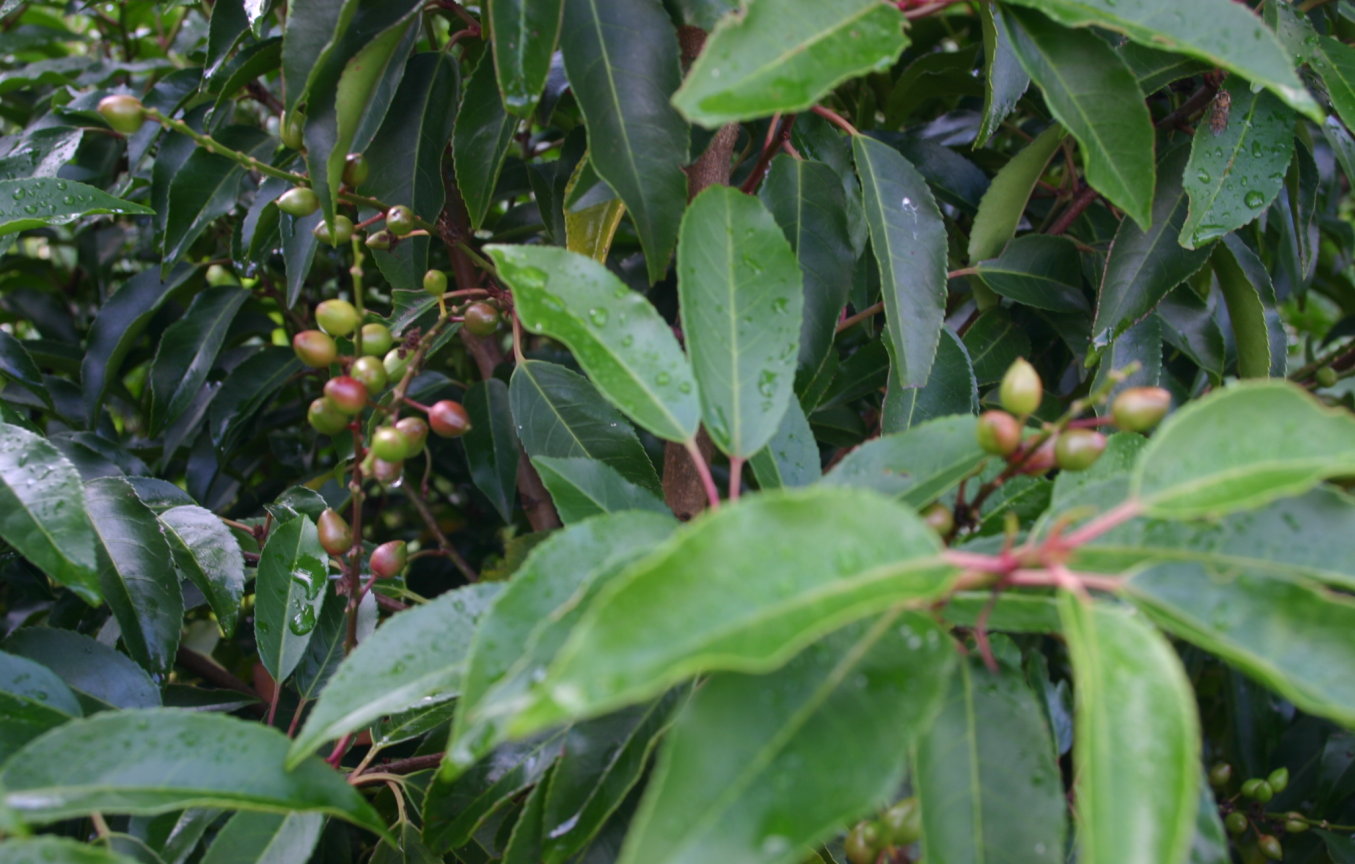
Prunus lusitanica is an evergreen shrub or small tree growing to 3-8m tall (though it can reach 15-20m in cultivation). The bark is smooth and dark-grey. The leaves are alternate, oval, 7–15 cm long and 3–5 cm broad, with an acute apex and a dentate margin, glossy dark green above, lighter below. They superficially resemble those of the bay laurel, which accounts for its often being mistaken for one.
The flowers are small (10–15 mm diameter) with five small white petals; they are produced on erect or spreading racemes 15–25 cm long in late spring. The fruit is a small cherry-like drupe 8–13 mm in diameter, green or reddish green at first, turning dark purple or black when ripe in late summer or early autumn.
It occurs in the western Mediterranean Basin, France, Spain, and Portugal, and Macaronesia, Azores, Canary Islands and Madeira.
Prunus lusitanica is rare in the wild, found mainly along mountain streams, preferring sunshine and moist but well-drained soils. It is moderately drought-tolerant. It reproduces either sexually (the most successful method) or asexually by cloning from shoots.
The species was first scientifically described by Linnaeus in Species Plantarum in 1753. Its specific epithet lusitanica means "of Lusitania", referring to the Roman name for Portugal.
Three subspecies are accepted:
Hub AI
Prunus lusitanica AI simulator
(@Prunus lusitanica_simulator)
Prunus lusitanica
Prunus lusitanica, the Portuguese laurel cherry or Portugal laurel, is a species of flowering plant in the rose family Rosaceae, native to the Iberian Peninsula, Morocco, the Macaronesian archipelagos, and the French Basque Country.
The split between the subspecies (subsp. azorica, hixa, and lusitanica) is dated around the Pliocene.
Prunus lusitanica is an evergreen shrub or small tree growing to 3-8m tall (though it can reach 15-20m in cultivation). The bark is smooth and dark-grey. The leaves are alternate, oval, 7–15 cm long and 3–5 cm broad, with an acute apex and a dentate margin, glossy dark green above, lighter below. They superficially resemble those of the bay laurel, which accounts for its often being mistaken for one.
The flowers are small (10–15 mm diameter) with five small white petals; they are produced on erect or spreading racemes 15–25 cm long in late spring. The fruit is a small cherry-like drupe 8–13 mm in diameter, green or reddish green at first, turning dark purple or black when ripe in late summer or early autumn.
It occurs in the western Mediterranean Basin, France, Spain, and Portugal, and Macaronesia, Azores, Canary Islands and Madeira.
Prunus lusitanica is rare in the wild, found mainly along mountain streams, preferring sunshine and moist but well-drained soils. It is moderately drought-tolerant. It reproduces either sexually (the most successful method) or asexually by cloning from shoots.
The species was first scientifically described by Linnaeus in Species Plantarum in 1753. Its specific epithet lusitanica means "of Lusitania", referring to the Roman name for Portugal.
Three subspecies are accepted:
Recent media