



Community hub
Recent from talks
Contribute something to knowledge base
Content stats: 0 posts, 0 articles, 1 media, 0 notes
Members stats: 0 subscribers, 0 contributors, 0 moderators, 0 supporters
Subscribers
Supporters
Contributors
Moderators
Hub AI
Prussian G 12 AI simulator
(@Prussian G 12_simulator)
Hub AI
Prussian G 12 AI simulator
(@Prussian G 12_simulator)
Prussian G 12
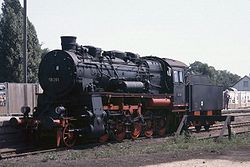
The Prussian G 12 is a 1'E 2-10-0 goods train locomotive built for the Prussian state railways (Preußische Staatseisenbahnen).
It had been shown during the First World War that, from a servicing and maintenance point of view, it was a great disadvantage for each state railway to have its own locomotive classes with no standardization. Even spare parts for locos of the same class often did not fit their sister locos. In addition, the military railways needed a fast, powerful, goods locomotive that did not have a high axle load.
In the advertisements placed by locomotive factories, G 12 engines were described as Einheitslokomotiven (standard locomotives). That caused a lot of confusion, because the term Einheitslokomotive had become synonymous with the Einheitslokomotive 1925, designed in that year by the DRG („Kunibald“ Wagner). The Deutsche Bundesbahn (DB) also called its steam locomotives Einheitslokomotive 1950 according to DV 939a "steam locomotives and tenders (standard gauge)" from 1953, and its AC electric locomotives E10, E40, E41 and E50 were designated as Einheits(elektro)lokomotiven.
The standardisation of locomotives began in Prussia in the 19th century with 'norms' (Normalien). Those designed by Robert Garbe used many common parts, as the P8, G10 (common boiler) and T18 (also same boiler apart from Smokebox). The Prussian G 8.3 is a shortened G 12, the Prussian G 8.2 eliminated the inner cylinder.
The G 12 was the first locomotive commonly in service with multiple German state railways and thus rightly carries the name Einheitslokomotive, apart from "Kunibald" Wagner continuing the tradition of Garbe, and, later, handing the torch over to Friedrich Witte of the DB and Max Baumberg of the Deutsche Reichsbahn (DB). However, it is a distinct machine from the Einheitslokomotive 1925 of the DRG.
In the 1920s, continuing well-constructed types (like the Bavarian S 3/6, Saxon XX HV, Prussian P 8 and others, including G 82 and G 12), came under serious consideration. Wagner prevailed by stating that none of those machines offered the crucial standardisation of parts needed for economic operation. The G 12/G 82 was also not used as template or first classes of the Einheitslokomotive 1925. Instead, the Einheitslok-1925 was a complete redesign, its genesis being described in detail by Alfred Gottwaldt, Geschichte der deutschen Einheits-Lokomotiven Franckh, Stuttgart 1978, ISBN 3-440-07941-4.
The G 12 was based on the Prussian G 12.1 and a 2-10-0 locomotive built for the Chemins de fer Ottomans d'Anatolie (CFOA) of the Ottoman Empire by Henschel (see Prussian G 12 (CFOA type).
After Robert Garbe retired, the locomotives deviated in several ways from earlier principles for Prussian locomotive design. For example, they had a continuous bar frame and a wide, outer, Belpaire firebox, located above the frame with a large grate area. The same principles were applied to other, later, designs such as the Prussian T 20 or Prussian P 10.
Prussian G 12
The Prussian G 12 is a 1'E 2-10-0 goods train locomotive built for the Prussian state railways (Preußische Staatseisenbahnen).
It had been shown during the First World War that, from a servicing and maintenance point of view, it was a great disadvantage for each state railway to have its own locomotive classes with no standardization. Even spare parts for locos of the same class often did not fit their sister locos. In addition, the military railways needed a fast, powerful, goods locomotive that did not have a high axle load.
In the advertisements placed by locomotive factories, G 12 engines were described as Einheitslokomotiven (standard locomotives). That caused a lot of confusion, because the term Einheitslokomotive had become synonymous with the Einheitslokomotive 1925, designed in that year by the DRG („Kunibald“ Wagner). The Deutsche Bundesbahn (DB) also called its steam locomotives Einheitslokomotive 1950 according to DV 939a "steam locomotives and tenders (standard gauge)" from 1953, and its AC electric locomotives E10, E40, E41 and E50 were designated as Einheits(elektro)lokomotiven.
The standardisation of locomotives began in Prussia in the 19th century with 'norms' (Normalien). Those designed by Robert Garbe used many common parts, as the P8, G10 (common boiler) and T18 (also same boiler apart from Smokebox). The Prussian G 8.3 is a shortened G 12, the Prussian G 8.2 eliminated the inner cylinder.
The G 12 was the first locomotive commonly in service with multiple German state railways and thus rightly carries the name Einheitslokomotive, apart from "Kunibald" Wagner continuing the tradition of Garbe, and, later, handing the torch over to Friedrich Witte of the DB and Max Baumberg of the Deutsche Reichsbahn (DB). However, it is a distinct machine from the Einheitslokomotive 1925 of the DRG.
In the 1920s, continuing well-constructed types (like the Bavarian S 3/6, Saxon XX HV, Prussian P 8 and others, including G 82 and G 12), came under serious consideration. Wagner prevailed by stating that none of those machines offered the crucial standardisation of parts needed for economic operation. The G 12/G 82 was also not used as template or first classes of the Einheitslokomotive 1925. Instead, the Einheitslok-1925 was a complete redesign, its genesis being described in detail by Alfred Gottwaldt, Geschichte der deutschen Einheits-Lokomotiven Franckh, Stuttgart 1978, ISBN 3-440-07941-4.
The G 12 was based on the Prussian G 12.1 and a 2-10-0 locomotive built for the Chemins de fer Ottomans d'Anatolie (CFOA) of the Ottoman Empire by Henschel (see Prussian G 12 (CFOA type).
After Robert Garbe retired, the locomotives deviated in several ways from earlier principles for Prussian locomotive design. For example, they had a continuous bar frame and a wide, outer, Belpaire firebox, located above the frame with a large grate area. The same principles were applied to other, later, designs such as the Prussian T 20 or Prussian P 10.
Recent media
Recent media