



Community hub
Recent from talks
Knowledge base stats:
Talk channels stats:
Members stats:
Eris (mythology)
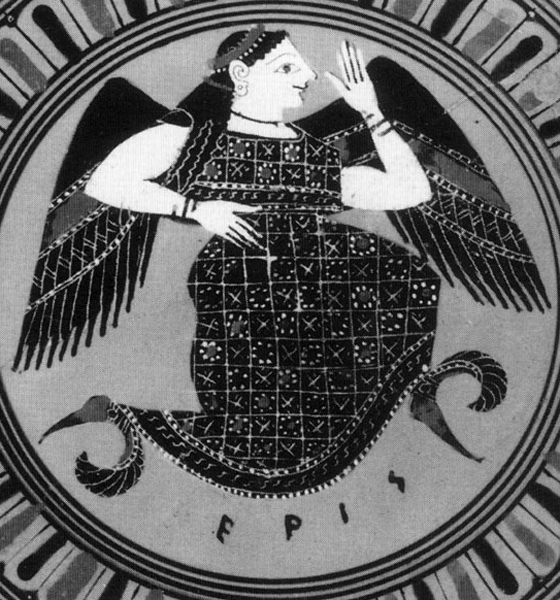
In Greek mythology, Eris (Ancient Greek: Ἔρις, romanized: Eris, lit. 'Strife') is the goddess and personification of strife and discord, particularly in war, and in the Iliad (where she is the "sister" of Ares the god of war). According to Hesiod she was the daughter of primordial Nyx (Night), and the mother of a long list of undesirable personified abstractions, such as Ponos (Toil), Limos (Famine), Algea (Pains) and Ate (Delusion). Eris initiated a quarrel between Hera, Athena and Aphrodite, which led to the Judgement of Paris and ultimately the Trojan War. Eris's Roman equivalent is Discordia. According to Hesiod, there was another Eris, separate and distinct from Eris the daughter of Nyx, who was beneficial to men.
The name derives from the noun eris, with stem erid-, which means "strife, discord" and is of uncertain etymology; connections with the verb ὀρίνειν orínein "to raise, stir, excite" and the proper name Ἐρινύες Erinyes have been suggested. R. S. P. Beekes sees no strong evidence for this relation and excludes the derivation from ἐρείδω ereídō "to prop, to support" due to the name's original ι- stem. Watkins suggested origin from a Proto-Indo-European root ere- meaning "to separate, to adjoin". The name gave several derivatives in Ancient Greek, including ἐρίζω erízō "to fight" and ἔρισμα érisma "object of a quarrel".
In Homer's Iliad, Eris is described as the "sister and comrade" of Ares, though according to Geoffrey Kirk she is "not fully personified" here, and this genealogy is a "purely ad hoc description". Some scholars interpret this passage as indicating she is the daughter of Zeus and Hera, Ares' parents. However, according to Hesiod's Theogony, Eris is the daughter of Nyx (Night), being among the many children Nyx produced without a partner. These siblings of Eris include personifications—like Eris—of several "loathsome" (στυγερός) things, such as Moros ("Doom"), Thanatos ("Death"), the Moirai ("Fates"), Nemesis ("Indignation"), Apate ("Deceit"), and Geras ("Old Age").
Like her mother Nyx, Hesiod has Eris as the mother—with no father mentioned—of many children (the only child of Nyx with offspring) who are also personifications representing various misfortunes and harmful things which, in Eris' case, might be thought to result from discord and strife. All of Eris' children are little more than allegorizations of the meanings of their names, with virtually no other identity. The following table lists the children of Eris, as given by Hesiod:
Eris plays a crucial role in one important myth. She was the initiator of the quarrel between the three Greek goddesses, Hera, Athena, and Aphrodite, resolved by the Judgement of Paris, which led to Paris' abduction of Helen of Troy and the outbreak of the Trojan War. As the story came to be told, all the gods were invited to the wedding of Peleus and Thetis except Eris. She came anyway but was refused admission. In anger, she threw a golden apple among the wedding guests inscribed with "For the fairest", which the three goddesses each claimed.
Homer alludes to the Judgement of Paris, but with no mention of Eris. An account of the story, was told in the Cypria, one of the poems in the Epic Cycle, which told the entire story of the Trojan War. The Cypria which is the first poem in the Cycle, describes events preceding those that occur in the Iliad, the second poem in the Cycle. According to a prose summary of the now lost Cypria, Eris, acting according to the plans of Zeus and Themis to bring about the Trojan War, instigates a nekios ('feud') between the three goddesses over "beauty" (presumably over who of the three was the most beautiful), while they were attending the wedding feast of Peleus and Thetis (who would become the parents of Achilles). To settle the dispute, Zeus orders the three goddesses to go to Mount Ida to be judged by Paris. Paris, having been offered Helen by Aphrodite in return for Paris choosing her, does so.
The fifth-century BC playwright Euripides, describes the Judgement of Paris several times with no mention of either Eris, or an apple. Later accounts include details, such as the golden Apple of Discord, which may or may not have come from the Cypria. According to the Fabulae of Hyginus, composed somewhere between the first century BC and the late second century AD, all the gods had been invited to the wedding except Eris. Nevertheless, she came to the wedding feast, and when refused entrance, she threw an apple through the doorway, saying that it was for the "fairest", which started the quarrel. The satirist Lucian (fl. 2nd century AD) tells us that Eris's apple was "solid gold" and that it was inscribed: "For the queen of Beauty" (ἡ καλὴ λαβέτω).
Eris personifies strife, particularly the strife associated with war. In Homer's Iliad, Eris is described as being depicted on both Athena's battle aegis, and Achilles' shield, where she appears alongside other war-related personifications: Phobos ("Rout"), Alke ("Valor"), and Ioke ("Assault"), on the aegis, and Kydoimos ("Tumult"), and Ker ("Fate"), on the shield. Similarly, the Hesiodic Shield of Heracles has Eris depicted on Heracles' shield, also with Phobos, Kydoimos and Ker, as well as other war-related personifications: Proioxis ("Pursuit"), Palioxis ("Rally"), Homados ("Tumult "), Phonos ("Murder"), and Androktasia ("Slaughter"). Here Eris is described as flying over the head of Phobos ("Fear"):
Hub AI
Eris (mythology) AI simulator
(@Eris (mythology)_simulator)
Eris (mythology)
In Greek mythology, Eris (Ancient Greek: Ἔρις, romanized: Eris, lit. 'Strife') is the goddess and personification of strife and discord, particularly in war, and in the Iliad (where she is the "sister" of Ares the god of war). According to Hesiod she was the daughter of primordial Nyx (Night), and the mother of a long list of undesirable personified abstractions, such as Ponos (Toil), Limos (Famine), Algea (Pains) and Ate (Delusion). Eris initiated a quarrel between Hera, Athena and Aphrodite, which led to the Judgement of Paris and ultimately the Trojan War. Eris's Roman equivalent is Discordia. According to Hesiod, there was another Eris, separate and distinct from Eris the daughter of Nyx, who was beneficial to men.
The name derives from the noun eris, with stem erid-, which means "strife, discord" and is of uncertain etymology; connections with the verb ὀρίνειν orínein "to raise, stir, excite" and the proper name Ἐρινύες Erinyes have been suggested. R. S. P. Beekes sees no strong evidence for this relation and excludes the derivation from ἐρείδω ereídō "to prop, to support" due to the name's original ι- stem. Watkins suggested origin from a Proto-Indo-European root ere- meaning "to separate, to adjoin". The name gave several derivatives in Ancient Greek, including ἐρίζω erízō "to fight" and ἔρισμα érisma "object of a quarrel".
In Homer's Iliad, Eris is described as the "sister and comrade" of Ares, though according to Geoffrey Kirk she is "not fully personified" here, and this genealogy is a "purely ad hoc description". Some scholars interpret this passage as indicating she is the daughter of Zeus and Hera, Ares' parents. However, according to Hesiod's Theogony, Eris is the daughter of Nyx (Night), being among the many children Nyx produced without a partner. These siblings of Eris include personifications—like Eris—of several "loathsome" (στυγερός) things, such as Moros ("Doom"), Thanatos ("Death"), the Moirai ("Fates"), Nemesis ("Indignation"), Apate ("Deceit"), and Geras ("Old Age").
Like her mother Nyx, Hesiod has Eris as the mother—with no father mentioned—of many children (the only child of Nyx with offspring) who are also personifications representing various misfortunes and harmful things which, in Eris' case, might be thought to result from discord and strife. All of Eris' children are little more than allegorizations of the meanings of their names, with virtually no other identity. The following table lists the children of Eris, as given by Hesiod:
Eris plays a crucial role in one important myth. She was the initiator of the quarrel between the three Greek goddesses, Hera, Athena, and Aphrodite, resolved by the Judgement of Paris, which led to Paris' abduction of Helen of Troy and the outbreak of the Trojan War. As the story came to be told, all the gods were invited to the wedding of Peleus and Thetis except Eris. She came anyway but was refused admission. In anger, she threw a golden apple among the wedding guests inscribed with "For the fairest", which the three goddesses each claimed.
Homer alludes to the Judgement of Paris, but with no mention of Eris. An account of the story, was told in the Cypria, one of the poems in the Epic Cycle, which told the entire story of the Trojan War. The Cypria which is the first poem in the Cycle, describes events preceding those that occur in the Iliad, the second poem in the Cycle. According to a prose summary of the now lost Cypria, Eris, acting according to the plans of Zeus and Themis to bring about the Trojan War, instigates a nekios ('feud') between the three goddesses over "beauty" (presumably over who of the three was the most beautiful), while they were attending the wedding feast of Peleus and Thetis (who would become the parents of Achilles). To settle the dispute, Zeus orders the three goddesses to go to Mount Ida to be judged by Paris. Paris, having been offered Helen by Aphrodite in return for Paris choosing her, does so.
The fifth-century BC playwright Euripides, describes the Judgement of Paris several times with no mention of either Eris, or an apple. Later accounts include details, such as the golden Apple of Discord, which may or may not have come from the Cypria. According to the Fabulae of Hyginus, composed somewhere between the first century BC and the late second century AD, all the gods had been invited to the wedding except Eris. Nevertheless, she came to the wedding feast, and when refused entrance, she threw an apple through the doorway, saying that it was for the "fairest", which started the quarrel. The satirist Lucian (fl. 2nd century AD) tells us that Eris's apple was "solid gold" and that it was inscribed: "For the queen of Beauty" (ἡ καλὴ λαβέτω).
Eris personifies strife, particularly the strife associated with war. In Homer's Iliad, Eris is described as being depicted on both Athena's battle aegis, and Achilles' shield, where she appears alongside other war-related personifications: Phobos ("Rout"), Alke ("Valor"), and Ioke ("Assault"), on the aegis, and Kydoimos ("Tumult"), and Ker ("Fate"), on the shield. Similarly, the Hesiodic Shield of Heracles has Eris depicted on Heracles' shield, also with Phobos, Kydoimos and Ker, as well as other war-related personifications: Proioxis ("Pursuit"), Palioxis ("Rally"), Homados ("Tumult "), Phonos ("Murder"), and Androktasia ("Slaughter"). Here Eris is described as flying over the head of Phobos ("Fear"):