


Community hub
Recent from talks
Contribute something
Nothing was collected or created yet.
Geras
View on Wikipedia| Geras | |
|---|---|
Personification of Old age | |
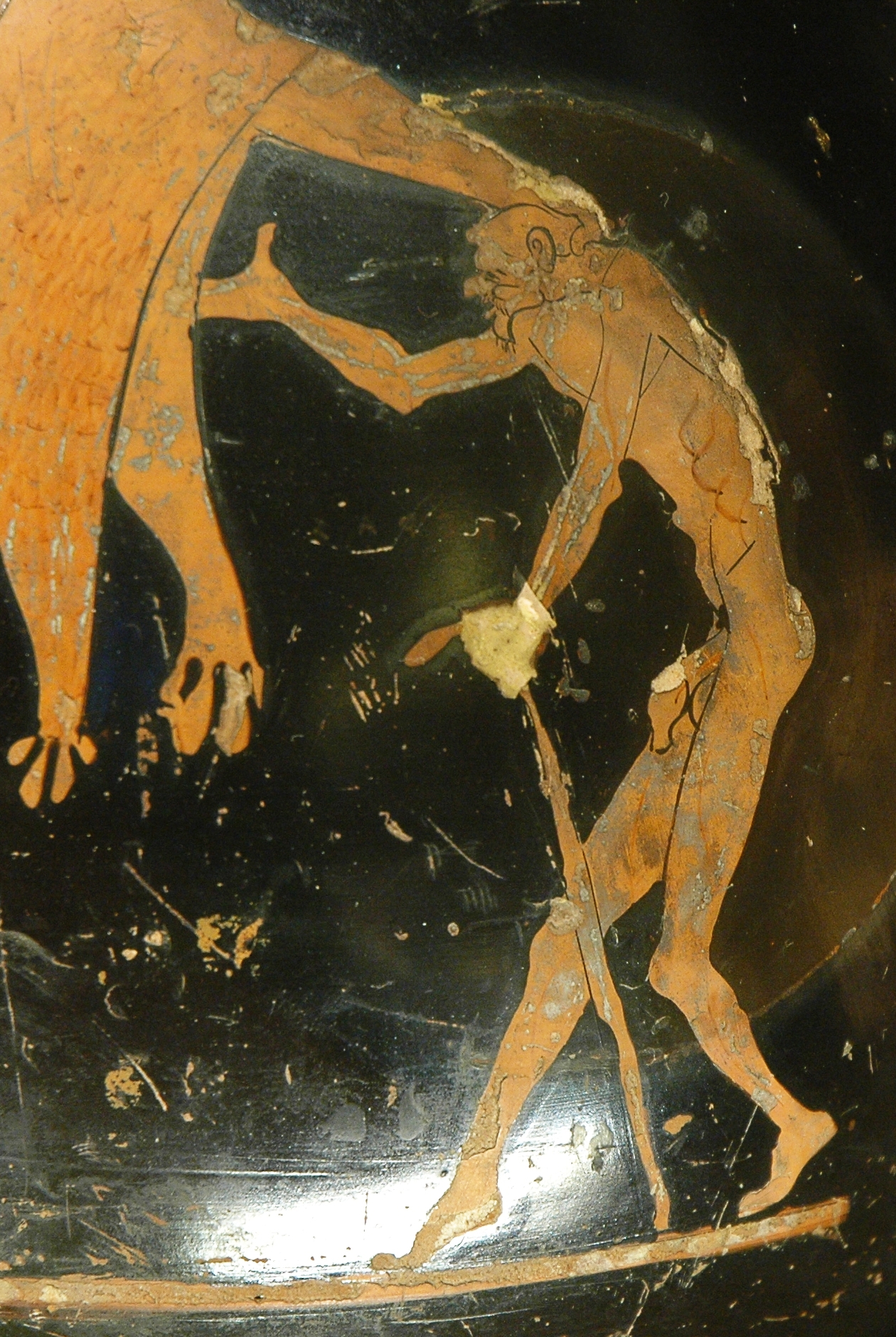
 Geras, detail of an Attic red-figure pelike, c. 480–470 BC, Louvre | |
| Abode | Erebus |
| Parents | Nyx alone or Erebus and Nyx |
In Greek mythology, Geras (Ancient Greek: Γῆρας, romanized: Gêras, lit. 'old age') is the god of old age. He was typically depicted as a tiny, shriveled old man. Gēras's opposite was Hebe, the goddess of youth. In Latin, he is referred to as Senectus.[1] He is known primarily from vase depictions that show him with the hero Heracles; the mythic story that inspired these depictions has been lost. Otherwise, Geras has a very limited role in both religion and mythology.
Etymology
[edit]The Greek word γῆρας (gĕras) means "old age" or in some other literature "dead skin" or "slough of a snake"; this word is the root of English words such as "geriatric" and "progeria".[2]
Mythology
[edit]According to Hesiod, Geras is one of the many sons and daughters that the night goddess Nyx produced on her own parthenogenetically.[3] However, later authors Hyginus and Cicero both add Erebus, Nyx's consort, as the father.[4][5]
In the myth of Tithonus, the mortal prince received immortality, but not agelessness, from the gods so when old age came to him he kept aging and shrinking but never dying. In the end his divine lover Eos turned Tithonus into a cicada.[6] In several ancient Greek vases Geras is depicted fighting Heracles, although no relevant written myth survives. Geras is presented as an old, wrinkled bald man begging for mercy.[7]
Philostratus claimed that the people of Gadeira set up altars to Geras and Thanatos.[8]
Function
[edit]Geras as embodied in humans represented a virtue: the more gēras a man acquired, the more kleos (fame) and arete (excellence and courage) he was considered to have. In ancient Greek literature, the related word géras (γέρας) can also carry the meaning of influence, authority or power; especially that derived from fame, good looks and strength claimed through success in battle or contest. Such uses of this meaning can be found in Homer's Odyssey, throughout which there is an evident concern from the various kings about the géras they will pass to their sons through their names.[9] The concern is significant because kings at this time (such as Odysseus) are believed to have ruled by common assent in recognition of their powerful influence, rather than hereditarily.[10][11]
Geras could refer to the treasure that was awarded during battles in Ancient Greece. After a battle, the victorious power would collect the captured gold, treasure, and other valuable artefacts. It would then be divided between the victors according to their timê or honour; the greater the honour, the greater the level of Geras that would be gained.
In Homer's Iliad, Agamemnon and Achilles fall out over a dispute of the return Chryses' daughter and taking Briseis in exchange (Book 1); Achilles sees Agamemnon taking his Gera as an affront to his pride and honour. Similarly, in many Hellenic cultures, it is customary to take the armour of a defeated enemy, a form of Gera, such as in Book 16 with Hector and Patroclus fighting over the body of Cebriones, son of Priam - King of Troy.
See also
[edit]

- Cumaean Sibyl
- Geras, Mortal Kombat character
- Elli, Norse personification of old age
- Gerascophobia
Notes
[edit]- ^ Brill's New Pauly, s.v. Geras.
- ^ "Definition of GERIATRIC". Merriam-webster.com. Retrieved 16 December 2021.
- ^ Hesiod, Theogony 225
- ^ Hyginus, Fabulae Preface
- ^ Cicero, De Natura Deorum 3.17
- ^ Homeric Hymn to Aphrodite 218 ff; Scholia on the Odyssey 5.1 Archived 2023-01-03 at the Wayback Machine
- ^ Williams, Mark E., M.D (June 22, 2016). The Art and Science of Aging Well: A Physician's Guide to a Healthy Body. University of North Carolina Press. p. 137. ISBN 9781469627403.
{{cite book}}: CS1 maint: multiple names: authors list (link) - ^ Philostratus, Life of Apollonius of Tyana 5.4
- ^ "The Internet Classics Archive | The Odyssey by Homer". classics.mit.edu. Retrieved 2019-07-04.
- ^ For an example of this, see Homer, The Odyssey, 24.33-34
- ^ Thomas, C. G. (1966). "The Roots of Homeric Kingship". Historia: Zeitschrift für Alte Geschichte. 15 (4): 387–407. ISSN 0018-2311. JSTOR 4434948.
References
[edit]- Brill’s New Pauly: Encyclopaedia of the Ancient World. Antiquity, Volume 5, Equ-Has, editors: Hubert Cancik, Helmuth Schneider, Brill, 2004. ISBN 978-90-04-12268-0. Online version at Brill.
- Gaius Julius Hyginus, Fabulae from The Myths of Hyginus translated and edited by Mary Grant. University of Kansas Publications in Humanistic Studies. Online version at the Topos Text Project.
- Hesiod, Theogony from The Homeric Hymns and Homerica with an English Translation by Hugh G. Evelyn-White, Cambridge, MA., Harvard University Press; London, William Heinemann Ltd. 1914. Online version at the Perseus Digital Library. Greek text available from the same website.
- Marcus Tullius Cicero, Nature of the Gods from the Treatises of M.T. Cicero translated by Charles Duke Yonge (1812-1891), Bohn edition of 1878. Online version at the Topos Text Project.
- Marcus Tullius Cicero, De Natura Deorum. O. Plasberg. Leipzig. Teubner. 1917. Latin text available at the Perseus Digital Library.
Further reading
[edit]- Preisshofen, Felix, Untersuchungen zur Darstellung des Greisenalters in der frühgriechischen Dichtung, Franz Steiner, 1977. ISBN 9783515020022.
External links
[edit] Media related to Geras at Wikimedia Commons

Geras
View on GrokipediaName and Etymology
Origin of the Name
The name of the primordial deity Geras derives directly from the Ancient Greek noun γῆρας (gêras), which translates to "old age" or "senility," serving as its personification in mythological contexts. This term encapsulates the inevitable decline associated with advanced years, often evoking frailty and the passage of time in early Greek literature. Additionally, γῆρας carries a positive connotation of "honor," "prize," or "prestige," particularly the respect or reward earned through age, excellence, or heroic deeds, as seen in Homeric epics where it denotes prizes in contests or the status of elders.[4] In ancient texts, γῆρας frequently denotes the aging process itself as a natural or burdensome condition. For instance, Homer employs it in the Iliad (22.60) in the genitive form γήραος to describe the state of old age afflicting mortals, while in the Odyssey (7.214), the accusative γῆρας highlights the infirmity of senescence. Herodotus uses it similarly in Histories (3.99) to discuss those who reach advanced age among certain tribes, underscoring its role as a descriptor of life's later stages.[5] These usages reflect a broader cultural view of old age as both a chronological milestone and a symbol of human vulnerability. Beyond its primary sense, γῆρας carries connotations of physical decay, including "dead skin" or the "slough of a snake," as evidenced in Nicander of Colophon's Theriaca (31), where it metaphorically links shedding to deterioration.[6] This secondary meaning reinforces themes of renewal amid entropy, though it remains tied to the core idea of aging's transformative wear. The word's etymological roots trace to Proto-Indo-European \ǵērh₂-s, a derivative of \ǵerh₂- ("to grow old"), connecting it to cognates like Sanskrit jarā ("old age").[4]Linguistic Connections
The Greek term underlying Geras, γῆρας ("old age"), derives from the Proto-Indo-European root *ǵerh₂-, meaning "to grow old," which connects to broader concepts of aging, maturity, and decay across Indo-European languages. This root appears in cognates such as Sanskrit jarā́ ("old age" or "decay") and the verbal form jarati ("grows old" or "decays"), as well as Avestan zarəṇt- ("old" or "aged"). In Germanic languages, related forms include Old Norse gorr ("hoary" or "aged," implying decay), illustrating how the root evolved to encompass both the passage of time and physical deterioration.[7] In Latin, the equivalent concept of old age was rendered as senectus, from senex ("old man") and ultimately the distinct Proto-Indo-European root *sén- ("old"), functioning as a partial linguistic parallel to γῆρας despite the etymological divergence. This term facilitated the adaptation of Greek mythological ideas into Roman culture, where the personification of old age was named Senectus, directly corresponding to Geras. The use of senectus in classical texts, such as Cicero's writings on aging, underscores its role in conveying similar notions of frailty and advanced years.[8][1] The legacy of γῆρας persists in modern English through medical terminology derived directly from Greek roots. "Geriatric," introduced in 1909, merges γῆρας with ἰατρός ("physician") to denote the branch of medicine focused on elderly care, reflecting the ancient association with physical decline. Similarly, "progeria," coined in 1904 for syndromes causing accelerated aging, combines πρό ("before" or "premature") with γῆρας, as seen in Hutchinson-Gilford progeria syndrome. These derivatives demonstrate the term's transition from mythological and philosophical contexts to scientific nomenclature.[9][10]Mythological Identity
Parentage and Family
In Greek mythology, Geras, the personification of old age, is primarily depicted as a child of Nyx, the primordial goddess of night, born parthenogenetically without a father. This genealogy is outlined in Hesiod's Theogony (lines 211–225), where Nyx independently produces a series of daimones representing abstract and often malevolent forces, including Geras as "hateful Old Age" in line 225.[11] Alternative accounts from later Roman authors attribute a father to Geras, identifying Erebus, the primordial god of darkness and Nyx's consort, as his parent alongside Nyx. Hyginus, in the Preface to his Fabulae, lists Geras (as Senectus, or Old Age) among the offspring of Night and Erebus, emphasizing their role in the cosmic genealogy emerging from Chaos.[12] Similarly, Cicero in De Natura Deorum 3.17 describes Senectus as born from Nox (Night) and Erebus, incorporating this pairing into a broader discussion of divine progeny.[13] As a member of Nyx's brood, Geras shares kinship with a host of siblings who embody nocturnal and destructive abstractions, underscoring the family's thematic unity as personifications of inevitable cosmic forces. These include Moros (Doom), the Keres (Violent Deaths), Thanatos (Peaceful Death), Hypnos (Sleep), the Oneiroi (Dreams), Momos (Blame), Oizys (Misery), the Hesperides (Evening), the Moirai (Fates), Nemesis (Retribution), Apate (Deceit), Philotes (Affection), and Eris (Strife), all detailed in Hesiod's Theogony (lines 211–232).[11] This extensive sibling group highlights Geras's place within a pantheon of daimones that govern the darker aspects of existence, from mortality to discord.Nature as a Primordial Deity
In Greek mythology, Geras embodies the abstract concept of old age as a primordial daimon, or personified spirit, rather than a fully anthropomorphic deity with personal agency or narratives of intervention. As one of the offspring of Nyx, the goddess of night, Geras is classified among the daimones—supernatural entities representing natural or cosmic forces—distinct from the more active and humanoid Olympian gods.[14] This positioning aligns him with other Nyx-born entities like Thanatos (death) and Hypnos (sleep), emphasizing his role as an inevitable aspect of existence rather than a figure of worship or emulation.[1] Unlike the dynamic Olympians, who engage in myths of creation, conflict, and benevolence, Geras personifies a passive and inexorable force of decline, often portrayed with a malevolent undertone due to the suffering and frailty it imposes on mortals. Ancient sources depict old age under Geras's influence as "ruthless" and "hated," a cosmic inevitability that spares no one, not even the gods themselves, underscoring its universal dread and lack of mercy.[15] This contrasts sharply with youthful deities like Hebe, who symbolize vitality and renewal, highlighting Geras's embodiment of entropy and the mortal cycle's somber end.[1] Evidence of cult worship for Geras is exceedingly rare, reflecting his abstract and fearsome nature, which deterred widespread veneration. The only attested instance occurs in the ancient city of Gadeira (modern Cádiz, Spain), where inhabitants, noted for their intense religiosity, erected an altar to Geras alongside one for death and composed hymns in honor of Thanatos—practices unique among known Greek-influenced cults.[16] This localized observance, as described by Philostratus, underscores Geras's marginal role in ritual life, confined to acknowledgment of life's inexorable decline rather than celebratory devotion.Role in Greek Mythology
Associations with Other Figures
In Greek mythology, Geras is prominently paired with the hero Heracles, embodying the latter's symbolic victory over the debilitations of aging. Ancient Attic red-figure vase paintings from the fifth century BCE depict Heracles striking Geras with his club, portrayed as a withered, emaciated old man recoiling from the blow, underscoring the hero's superhuman vigor and eventual apotheosis beyond mortal decline.[1] This motif, though primarily visual rather than literary, illustrates Heracles' role in conquering daimonic forces, with Geras representing the inevitable frailty that even demigods momentarily defy.[17] Geras forms a stark opposition to Hebe, the goddess of youth and cupbearer to the Olympians, encapsulating the cyclical progression from vigor to senescence in the human lifespan. As the daimon of old age, Geras counterbalances Hebe's restorative powers, which granted rejuvenation to figures like her husband Heracles upon his ascension to Olympus, thereby highlighting the complementary yet antagonistic forces governing life's temporal stages.[1][18] The myth of Tithonus exemplifies the torment of perpetual geras, where the Trojan prince received immortality from Zeus at Eos's behest but lacked eternal youth, resulting in ceaseless physical decay. This narrative, detailed in the Homeric Hymn to Aphrodite, evokes Geras's domain by portraying old age as an unending affliction divorced from death, reinforcing the daimon's role in tales of mortality's harsh boundaries.Symbolic Representations
In Greek mythology, Geras embodies the dual symbolism of old age, reflecting both revered longevity and inevitable decline within the heroic worldview. Positively, gēras represents the accumulation of kleos (fame), aretē (excellence), and timē (honor), as extended years enable greater heroic achievements and social standing, allowing elders like Nestor to wield authority through past exploits.[19] This association underscores old age as a marker of earned prestige in the Homeric tradition, where survival to maturity signifies success in the pursuit of glory.[20] Conversely, Geras symbolizes the negative facets of physical frailty, decay, and burdensome weakness, often depicted as a malevolent force spawned by Nyx that afflicts mortals with sorrowful senescence.[1] In epic contexts, this aspect portrays old age as a curse that diminishes vitality and heroic potential, contrasting sharply with the valor of youth.[19] In the Homeric epics, the term géras extends beyond chronological age to denote authority, battle spoils, and social influence, as seen in the Iliad where it signifies prizes of honor distributed among warriors to affirm status and communal respect.[21] Similarly, in the Odyssey, géras evokes the elder's portion of influence and resources, linking longevity to advisory roles and inherited prestige rather than mere years lived.[20] This multifaceted usage highlights Geras's role in encapsulating the Greek ideal of a life cycle where age confers both wisdom and weariness.Cultural and Artistic Significance
Literary References
Beyond Hesiod, direct personifications of Geras remain sparse in Greek literature, with the concept of gēras (old age) appearing more frequently as an abstract force evoking mortality and legacy in epic poetry. In Homer's Iliad, gēras denotes both the physical frailty of aging—feared by warriors like Achilles, who laments the prospect of returning home "a maimed king, useless, my limbs conquered by grievous old age" (9.416–419)—and a metaphorical "prize" of honor (timē), as when Agamemnon seizes Briseis as Achilles' geras (1.113–184), underscoring themes of impermanence and heroic striving against decay. These usages in the Iliad and related epics highlight old age not as a deity but as a looming antithesis to youthful valor and undying fame (kleos), reinforcing human vulnerability without anthropomorphic elaboration.[22]Visual Depictions
In ancient Greek art, Geras, the personification of old age, is consistently portrayed as a diminutive, emaciated elderly man with bald or thinning hair, deeply wrinkled skin, a stooped posture, and often exaggerated features of physical decay such as a shrunken jaw and lean limbs; he frequently appears nude or clad in ragged drapery to emphasize frailty and vulnerability.[1] This iconography underscores the unwelcome aspects of senescence, contrasting sharply with ideals of youth and vigor prevalent in Greek visual culture.[23] A prominent example is found on an Attic red-figure pelike attributed to the Geras Painter, dated circa 480–470 BC and housed in the Louvre Museum (inventory G234), where Geras is depicted in a dynamic confrontation with Heracles.[24] In the scene on side A, the hero, clad in his lion-skin and wielding a club, strikes or pursues the fleeing Geras, who grasps a walking stick for support and turns in a gesture of supplication; this portrayal highlights the mythic association between Heracles's enduring strength and the inexorable advance of age, with Geras rendered as a tiny, wrinkled figure with prominent, oversized genitals symbolizing diminished vitality.[17] The reverse features Poseidon, but the primary side focuses on this allegorical struggle. Other depictions of Geras are scarce, limited mostly to vase paintings in mythological contexts, such as a red-figure neck-amphora in the British Museum (1772,0320.423), dated 480–460 BC and attributed to the Charmides Painter, showing Heracles seizing and driving off Geras, who is characterized by rough, disheveled hair, a short pointed beard, deep-set eyes, and a skeletal frame.[25] No major sculptures of Geras exist, and the absence of dedicated temples or sanctuaries reflects his marginal role in cult practices, with representations confined to symbolic rather than devotional art.[23]References
- https://en.wiktionary.org/wiki/Reconstruction:Proto-Indo-European/%25C7%25B5erh%25E2%2582%2582-
- https://en.wiktionary.org/wiki/senectus