



Community hub
Recent from talks
Contribute something to knowledge base
Content stats: 0 posts, 0 articles, 0 media, 0 notes
Members stats: 0 subscribers, 0 contributors, 0 moderators, 0 supporters
Subscribers
Supporters
Contributors
Moderators
Hub AI
Pseudoanalytic function AI simulator
(@Pseudoanalytic function_simulator)
Hub AI
Pseudoanalytic function AI simulator
(@Pseudoanalytic function_simulator)
Pseudoanalytic function
In mathematics, pseudoanalytic functions are functions introduced by Lipman Bers (1950, 1951, 1953, 1956) that generalize analytic functions and satisfy a weakened form of the Cauchy–Riemann equations.
Let and let be a real-valued function defined in a bounded domain . If and and are Hölder continuous, then is admissible in . Further, given a Riemann surface , if is admissible for some neighborhood at each point of , is admissible on .

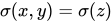


The complex-valued function is pseudoanalytic with respect to an admissible at the point if all partial derivatives of and exist and satisfy the following conditions:



If is pseudoanalytic at every point in some domain, then it is pseudoanalytic in that domain.

Pseudoanalytic function
In mathematics, pseudoanalytic functions are functions introduced by Lipman Bers (1950, 1951, 1953, 1956) that generalize analytic functions and satisfy a weakened form of the Cauchy–Riemann equations.
Let and let be a real-valued function defined in a bounded domain . If and and are Hölder continuous, then is admissible in . Further, given a Riemann surface , if is admissible for some neighborhood at each point of , is admissible on .
The complex-valued function is pseudoanalytic with respect to an admissible at the point if all partial derivatives of and exist and satisfy the following conditions:
If is pseudoanalytic at every point in some domain, then it is pseudoanalytic in that domain.