Hubbry Logo
Analytic functionAnalytic functionMain
Open search
Analytic function
Community hub
Analytic function
logo
8 pages, 0 posts
0 subscribers
Be the first to start a discussion here.
Contribute something
Analytic function
Analytic function
from Wikipedia

In mathematics, an analytic function is a function that is locally given by a convergent power series. There exist both real analytic functions and complex analytic functions. Functions of each type are infinitely differentiable, but complex analytic functions exhibit properties that do not generally hold for real analytic functions.

A function is analytic if and only if for every in its domain, its Taylor series about converges to the function in some neighborhood of . This is stronger than merely being infinitely differentiable at , and therefore having a well-defined Taylor series; the Fabius function provides an example of a function that is infinitely differentiable but not analytic.

Definitions

[edit]

Formally, a function is real analytic on an open set in the real line if for any one can write

in which the coefficients are real numbers and the series is convergent to for in a neighborhood of .

Alternatively, a real analytic function is an infinitely differentiable function such that the Taylor series at any point in its domain
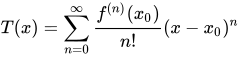
converges to for in a neighborhood of pointwise.[a] The set of all real analytic functions on a given set is often denoted by , or just by if the domain is understood.

A function defined on some subset of the real line is said to be real analytic at a point if there is a neighborhood of on which is real analytic.

The definition of a complex analytic function is obtained by replacing, in the definitions above, "real" with "complex" and "real line" with "complex plane". A function is complex analytic if and only if it is holomorphic i.e. it is complex differentiable. For this reason the terms "holomorphic" and "analytic" are often used interchangeably for such functions.[1]

In complex analysis, a function is called analytic in an open set "U" if it is (complex) differentiable at each point in "U" and its complex derivative is continuous on "U".[2]

Examples

[edit]

Typical examples of analytic functions are

Typical examples of functions that are not analytic are

  • The absolute value function when defined on the set of real numbers or complex numbers is not everywhere analytic because it is not differentiable at 0.
  • Piecewise defined functions (functions given by different formulae in different regions) are typically not analytic where the pieces meet.
  • The complex conjugate function z → z* is not complex analytic, although its restriction to the real line is the identity function and therefore real analytic, and it is real analytic as a function from to .
  • Other non-analytic smooth functions, and in particular any smooth function with compact support, i.e. , cannot be analytic on .[3]

Alternative characterizations

[edit]

The following conditions are equivalent:

  1. is real analytic on an open set .
  2. There is a complex analytic extension of to an open set which contains .
  3. is smooth and for every compact set there exists a constant such that for every and every non-negative integer the following bound holds[4]

Complex analytic functions are exactly equivalent to holomorphic functions, and are thus much more easily characterized.

For the case of an analytic function with several variables (see below), the real analyticity can be characterized using the Fourier–Bros–Iagolnitzer transform.

In the multivariable case, real analytic functions satisfy a direct generalization of the third characterization.[5] Let be an open set, and let . Then is real analytic on if and only if and for every compact there exists a constant such that for every multi-index the following bound holds[6]

Properties of analytic functions

[edit]
  • The sums, products, and compositions of analytic functions are analytic.
  • The reciprocal of an analytic function that is nowhere zero is analytic, as is the inverse of an invertible analytic function whose derivative is nowhere zero. (See also the Lagrange inversion theorem.)
  • Any analytic function is smooth, that is, infinitely differentiable. The converse is not true for real functions; in fact, in a certain sense, the real analytic functions are sparse compared to all real infinitely differentiable functions. For the complex numbers, the converse does hold, and in fact any function differentiable once on an open set is analytic on that set (see "analyticity and differentiability" below).
  • For any open set , the set A(Ω) of all analytic functions is a Fréchet space with respect to the uniform convergence on compact sets. The fact that uniform limits on compact sets of analytic functions are analytic is an easy consequence of Morera's theorem. The set of all bounded analytic functions with the supremum norm is a Banach space.

A polynomial cannot be zero at too many points unless it is the zero polynomial (more precisely, the number of zeros is at most the degree of the polynomial). A similar but weaker statement holds for analytic functions. If the set of zeros of an analytic function ƒ has an accumulation point inside its domain, then ƒ is zero everywhere on the connected component containing the accumulation point. In other words, if (rn) is a sequence of distinct numbers such that ƒ(rn) = 0 for all n and this sequence converges to a point r in the domain of D, then ƒ is identically zero on the connected component of D containing r. This is known as the identity theorem.

Also, if all the derivatives of an analytic function at a point are zero, the function is constant on the corresponding connected component.

These statements imply that while analytic functions do have more degrees of freedom than polynomials, they are still quite rigid.

Analyticity and differentiability

[edit]

As noted above, any analytic function (real or complex) is infinitely differentiable (also known as smooth, or ). (Note that this differentiability is in the sense of real variables; compare complex derivatives below.) There exist smooth real functions that are not analytic: see non-analytic smooth function. In fact there are many such functions.

The situation is quite different when one considers complex analytic functions and complex derivatives. It can be proved that any complex function differentiable (in the complex sense) in an open set is analytic. Consequently, in complex analysis, the term analytic function is synonymous with holomorphic function.

Real versus complex analytic functions

[edit]

Real and complex analytic functions have important differences (one could notice that even from their different relationship with differentiability). Analyticity of complex functions is a more restrictive property, as it has more restrictive necessary conditions and complex analytic functions have more structure than their real-line counterparts.[7]

According to Liouville's theorem, any bounded complex analytic function defined on the whole complex plane is constant. The corresponding statement for real analytic functions, with the complex plane replaced by the real line, is clearly false; this is illustrated by

Also, if a complex analytic function is defined in an open ball around a point x0, its power series expansion at x0 is convergent in the whole open ball (holomorphic functions are analytic). This statement for real analytic functions (with open ball meaning an open interval of the real line rather than an open disk of the complex plane) is not true in general; the function of the example above gives an example for x0 = 0 and a ball of radius exceeding 1, since the power series 1 − x2 + x4x6... diverges for |x| ≥ 1.

Any real analytic function on some open set on the real line can be extended to a complex analytic function on some open set of the complex plane. However, not every real analytic function defined on the whole real line can be extended to a complex function defined on the whole complex plane. The function f(x) defined in the paragraph above is a counterexample, as it is not defined for x = ±i. This explains why the Taylor series of f(x) diverges for |x| > 1, i.e., the radius of convergence is 1 because the complexified function has a pole at distance 1 from the evaluation point 0 and no further poles within the open disc of radius 1 around the evaluation point.

Analytic functions of several variables

[edit]

One can define analytic functions in several variables by means of power series in those variables (see power series). Analytic functions of several variables have some of the same properties as analytic functions of one variable. However, especially for complex analytic functions, new and interesting phenomena show up in 2 or more complex dimensions:

  • Zero sets of complex analytic functions in more than one variable are never discrete. This can be proved by Hartogs's extension theorem.
  • Domains of holomorphy for single-valued functions consist of arbitrary (connected) open sets. In several complex variables, however, only some connected open sets are domains of holomorphy. The characterization of domains of holomorphy leads to the notion of pseudoconvexity.

See also

[edit]

Notes

[edit]

References

[edit]
[edit]
Revisions and contributorsEdit on WikipediaRead on Wikipedia
from Grokipedia
In complex analysis, an analytic function is a function f:DCf: D \to \mathbb{C}, where DD is an open subset of the , that is complex differentiable at every point in DD. These functions, equivalently known as holomorphic functions, can be locally expressed as convergent around any point in their domain. A key characterization is that if f(z)=u(x,y)+iv(x,y)f(z) = u(x,y) + iv(x,y) with z=x+iyz = x + iy, then uu and vv satisfy the Cauchy-Riemann equations ux=vy\frac{\partial u}{\partial x} = \frac{\partial v}{\partial y} and uy=vx\frac{\partial u}{\partial y} = -\frac{\partial v}{\partial x}. Analytic functions exhibit strong regularity properties: they are infinitely differentiable in their domain, and differentiation can be performed term by term within the radius of convergence of their power series expansions. This contrasts sharply with real-variable functions, where differentiability does not imply higher-order differentiability or power series representability. Fundamental theorems underpin their behavior, such as , which states that if ff is analytic in a simply connected domain DD and γ\gamma is a closed contour in DD, then γf(z)dz=0\int_\gamma f(z) \, dz = 0. further allows expressing ff at interior points via contour integrals: f(a)=12πiγf(z)zadzf(a) = \frac{1}{2\pi i} \int_\gamma \frac{f(z)}{z - a} \, dz for aa inside γ\gamma. Notable consequences include the , which asserts that a non-constant analytic function on a bounded domain attains its maximum modulus on the boundary, and , implying that bounded entire functions (analytic on the whole plane) are constant. Analytic functions also have harmonic real and imaginary parts, satisfying . The concept extends to several complex variables, where analyticity requires differentiability in each variable separately, leading to Hartogs's theorem on extending holomorphic functions across compact sets. Applications span physics (e.g., , ) and engineering, leveraging tools like residue calculus for evaluating real integrals.

Historical Development

Origins in Complex Analysis

The concept of analytic functions in traces its origins to the , when mathematicians began to explore functions of complex variables in a formal manner without a fully rigorous framework for differentiability. Jean le Rond , in his 1746 work on the , demonstrated that algebraic operations, including roots and powers, could be consistently applied to complex numbers, treating them as entities amenable to analysis similar to real numbers. Leonhard Euler extended this approach significantly, investigating series expansions and logarithmic functions for complex arguments; for instance, in his 1751 publication on complex logarithms, he manipulated analytic expressions involving imaginary quantities to derive trigonometric identities, laying informal groundwork for representations in the . Augustin-Louis Cauchy advanced the field in the 1820s through his pioneering work on complex integration, which provided a pathway to understanding derivatives via integrals without relying on explicit pointwise differentiability. In his 1825 memoir "Mémoire sur les intégrales définies prises entre des limites imaginaires," Cauchy established the integral theorem for closed contours and derived a formula expressing the value of a function (and its derivatives) inside a contour solely in terms of its boundary values, a result that implicitly characterized the smoothness of functions analytic in a domain. This integral-based perspective shifted focus from algebraic manipulation to geometric and analytic properties, forming the core of modern complex analysis. Bernhard Riemann revolutionized the study of complex functions in the 1850s by introducing Riemann surfaces to handle multi-valued functions systematically. In his 1851 doctoral thesis at the , Riemann conceptualized these surfaces as multi-sheeted coverings of the , allowing multi-valued functions like the or logarithm to be represented as single-valued analytic mappings on a branched surface, thus resolving singularities and branch points through topological means. This geometric innovation emphasized the global structure of analytic functions, influencing subsequent developments in function theory. Karl Weierstrass, in the latter half of the , provided rigorous constructions of independent of integration, using infinite products to demonstrate their existence and properties. During his lectures in around 1860–1870 and in his 1876 publication on the theory of analytic functions, Weierstrass showed that any entire function could be expressed as a Weierstrass product over its zeros, combined with an exponential factor, thereby proving the density of such functions without invoking Cauchy's integral methods and establishing as a key analytic tool.

Key Contributions

Augustin-Louis Cauchy laid the foundations for the modern theory of analytic functions in his 1825 memoir "Mémoire sur les intégrales définies prises entre des limites imaginaires," where he introduced the concept of contour integrals and demonstrated how they could be used to establish key properties of analytic functions, such as the integral representation that underpins later developments like the . Although the full , which computes contour integrals via sums of residues at singularities within a closed curve, was formalized in his subsequent works around 1825–1831, Cauchy's 1825 contributions emphasized the role of these integrals in proving differentiability and other intrinsic properties of functions analytic in a domain. In 1851, advanced the geometric understanding of analytic functions through his doctoral dissertation "Grundlagen für eine allgemeine Theorie der Functionen einer veränderlichen complexen Grösse," in which he stated the , proving the existence of a from any simply connected domain in the (not the entire plane) onto the unit disk. This , relying on the Dirichlet principle for minimizing energy integrals, highlighted the conformal invariance of analytic functions and provided a powerful tool for classifying Riemann surfaces and studying domain mappings. Karl Weierstrass contributed significantly to the theory in the 1870s through his development of elliptic function theory, constructing doubly periodic meromorphic functions via infinite products and series, which offered an arithmetic foundation for understanding analytic functions on compact Riemann surfaces. His work on elliptic functions, detailed in lectures and publications from the 1860s onward, paved the way for the concept of uniformization by showing how such functions could parameterize algebraic curves, influencing later proofs of the uniformization theorem that every simply connected Riemann surface is conformally equivalent to the disk, plane, or sphere. Weierstrass also pioneered rigorous power series methods, establishing uniform convergence criteria essential for representing analytic functions locally as power series. Émile Picard extended the study of singularities in the 1880s with theorems characterizing the behavior of analytic functions near , building on Weierstrass's results to show that such functions assume every complex value, except possibly one, infinitely often in any punctured neighborhood of the singularity. His great , proved in 1913 but rooted in these earlier investigations, strengthened this by affirming that near an essential singularity, the function takes all finite values except at most one infinitely many times, with the exceptional value possibly omitted entirely in some cases. In the , Kiyoshi Oka bridged single-variable analytic function theory to multivariable extensions through his work on several complex variables in the 1930s and 1940s, resolving the Levi problem by proving that pseudoconvex domains are domains of holomorphy, thus generalizing analyticity to higher dimensions. Oka's sheaf-theoretic approach and solutions to Cousin problems established foundational results for coherent sheaves of holomorphic functions, influencing the modern theory of complex manifolds.

Core Concepts

Definition

In complex analysis, an analytic function is a function f:DCf: D \to \mathbb{C} that is complex differentiable at every point in an open domain DCD \subset \mathbb{C}. This means that for each z0Dz_0 \in D, there exists a neighborhood around z0z_0 where the derivative is defined, emphasizing the local nature of differentiability. The complex derivative at a point zz is given by f(z)=limh0f(z+h)f(z)h,f'(z) = \lim_{h \to 0} \frac{f(z + h) - f(z)}{h}, where hCh \in \mathbb{C} approaches 0, and the limit must exist and be independent of the direction (or path) in which hh approaches 0. In modern usage, the terms "analytic" and "holomorphic" are equivalent, both describing functions satisfying this condition on an . The domain DD must be an open subset of the complex plane C\mathbb{C} to ensure that every point has a surrounding disk within DD, allowing the limit to be evaluated locally. This requirement distinguishes analytic functions from those merely differentiable at isolated points, as analyticity demands differentiability throughout a region. The existence of the complex in a neighborhood implies that the real and imaginary parts of ff satisfy the Cauchy-Riemann equations; conversely, satisfaction of the Cauchy-Riemann equations with continuous partial derivatives ensures analyticity. Functions that are analytic on the entire complex plane C\mathbb{C} are termed entire functions; examples include polynomials and the , which exhibit this global analyticity.

Examples

Analytic functions abound in , with many familiar forms from extending naturally to the . Polynomials provide the simplest examples; any p(z)=anzn++a1z+a0p(z) = a_n z^n + \cdots + a_1 z + a_0, where the coefficients aka_k are complex constants, is entire, meaning it is analytic everywhere in the . This follows from their finite representation, which converges uniformly on the entire plane. The , defined by its exp(z)=n=0znn!\exp(z) = \sum_{n=0}^\infty \frac{z^n}{n!}, converges everywhere and thus is entire. Similarly, the sine and cosine extend to the complex domain via or exponential definitions, such as sin(z)=exp(iz)exp(iz)2i\sin(z) = \frac{\exp(iz) - \exp(-iz)}{2i} and cos(z)=exp(iz)+exp(iz)2\cos(z) = \frac{\exp(iz) + \exp(-iz)}{2}; both are entire functions. These satisfy the Cauchy-Riemann equations, confirming their analyticity. Rational functions, quotients of polynomials like f(z)=p(z)q(z)f(z) = \frac{p(z)}{q(z)} where qq is not identically zero, are analytic on the complex plane except at the poles, which are the zeros of q(z)q(z). For instance, f(z)=1zf(z) = \frac{1}{z} is analytic everywhere except at z=0z = 0, where it has a simple pole. To distinguish analyticity from mere differentiability, consider non-analytic examples. The complex conjugate f(z)=zˉf(z) = \bar{z} fails the Cauchy-Riemann equations everywhere and is nowhere differentiable in the complex sense. In contrast, g(z)=z2=zzˉ=x2+y2g(z) = |z|^2 = z \bar{z} = x^2 + y^2 (with z=x+iyz = x + iy) is complex differentiable at the origin, where g(0)=0g'(0) = 0, but it is not analytic there because the Cauchy-Riemann equations hold only at that isolated point, not in any neighborhood. These cases highlight that complex differentiability at a point does not imply analyticity without satisfaction in a disk around it.

Characterizations

Cauchy-Riemann Equations

The Cauchy-Riemann equations express the condition for a complex-valued function to be complex differentiable in terms of its real and imaginary parts as functions of real variables. Consider a function f(z)=u(x,y)+iv(x,y)f(z) = u(x, y) + i v(x, y), where z=x+iyz = x + i y with x,yRx, y \in \mathbb{R} and u,v:R2Ru, v: \mathbb{R}^2 \to \mathbb{R}. The function ff is complex differentiable at z0=x0+iy0z_0 = x_0 + i y_0 if the partial derivatives ux(x0,y0)\frac{\partial u}{\partial x}(x_0, y_0), uy(x0,y0)\frac{\partial u}{\partial y}(x_0, y_0), vx(x0,y0)\frac{\partial v}{\partial x}(x_0, y_0), and vy(x0,y0)\frac{\partial v}{\partial y}(x_0, y_0) exist and satisfy the equations ux(x0,y0)=vy(x0,y0),uy(x0,y0)=vx(x0,y0).\frac{\partial u}{\partial x}(x_0, y_0) = \frac{\partial v}{\partial y}(x_0, y_0), \quad \frac{\partial u}{\partial y}(x_0, y_0) = -\frac{\partial v}{\partial x}(x_0, y_0). These equations are necessary for the existence of the complex derivative f(z0)=limzz0f(z)f(z0)zz0f'(z_0) = \lim_{z \to z_0} \frac{f(z) - f(z_0)}{z - z_0}. To derive the equations, the limit defining f(z0)f'(z_0) must be independent of the path of approach to z0z_0. Approaching along the real axis with increment h=Δxh = \Delta x (real), the difference quotient becomes ΔuΔx+iΔvΔx\frac{\Delta u}{\Delta x} + i \frac{\Delta v}{\Delta x}, which approaches ux(x0,y0)+ivx(x0,y0)\frac{\partial u}{\partial x}(x_0, y_0) + i \frac{\partial v}{\partial x}(x_0, y_0) as Δx0\Delta x \to 0. Approaching along the imaginary axis with h=iΔyh = i \Delta y, the quotient is ΔuiΔy+iΔviΔy=iΔuΔy+ΔvΔy\frac{\Delta u}{i \Delta y} + i \frac{\Delta v}{i \Delta y} = -i \frac{\Delta u}{\Delta y} + \frac{\Delta v}{\Delta y}, approaching iuy(x0,y0)+vy(x0,y0)-i \frac{\partial u}{\partial y}(x_0, y_0) + \frac{\partial v}{\partial y}(x_0, y_0) as Δy0\Delta y \to 0. Equating the real parts gives ux(x0,y0)=vy(x0,y0)\frac{\partial u}{\partial x}(x_0, y_0) = \frac{\partial v}{\partial y}(x_0, y_0), and equating the imaginary parts yields vx(x0,y0)=uy(x0,y0)\frac{\partial v}{\partial x}(x_0, y_0) = -\frac{\partial u}{\partial y}(x_0, y_0). For sufficiency, if the four partial derivatives exist and are continuous in a neighborhood of z0z_0 and satisfy the Cauchy-Riemann equations at z0z_0, then ff is complex differentiable at z0z_0. More generally, if the partials are continuous throughout an open domain DCD \subset \mathbb{C} and the equations hold everywhere in DD, then ff is differentiable (hence analytic) at every point in DD. An equivalent form of the Cauchy-Riemann equations arises in polar coordinates, where z=reiθz = r e^{i \theta} with r>0r > 0 and θR\theta \in \mathbb{R}, and f(z)=u(r,θ)+iv(r,θ)f(z) = u(r, \theta) + i v(r, \theta). The equations become ur=1rvθ,vr=1ruθ.\frac{\partial u}{\partial r} = \frac{1}{r} \frac{\partial v}{\partial \theta}, \quad \frac{\partial v}{\partial r} = -\frac{1}{r} \frac{\partial u}{\partial \theta}. This polar version is obtained via the chain rule, relating the polar partials to the Cartesian ones through x=rcosθx = r \cos \theta and y=rsinθy = r \sin \theta. For example, the f(z)=ezf(z) = e^z satisfies both the Cartesian and polar forms of the Cauchy-Riemann equations wherever it is defined.

Power Series Representation

A fundamental characterization of analytic functions is their local representation by . Specifically, if ff is analytic at a point z0z_0 in the , then there exists a radius R>0R > 0 such that ff can be expressed as a f(z)=n=0f(n)(z0)n!(zz0)nf(z) = \sum_{n=0}^{\infty} \frac{f^{(n)}(z_0)}{n!} (z - z_0)^n which converges to f(z)f(z) for all zz in the open disk zz0<R|z - z_0| < R. The radius RR is determined by the distance from z0z_0 to the nearest singularity of ff, ensuring uniform convergence on compact subsets within the disk. This representation arises from Cauchy's integral formula, which provides an explicit expression for the Taylor coefficients. For n0n \geq 0, the coefficient is given by f(n)(z0)n!=12πiCf(ζ)(ζz0)n+1dζ,\frac{f^{(n)}(z_0)}{n!} = \frac{1}{2\pi i} \oint_C \frac{f(\zeta)}{(\zeta - z_0)^{n+1}} \, d\zeta, where CC is a positively oriented simple closed contour enclosing z0z_0 and lying within the domain of analyticity of ff. Substituting these coefficients into the series yields the power series expansion, and the convergence follows from estimates on the growth of the derivatives via Cauchy's estimates. This derivation confirms that the series equals f(z)f(z) inside the disk of convergence. The power series representation is both necessary and sufficient for analyticity: a function is analytic in a domain if and only if it is representable by a convergent power series in every sufficiently small disk within that domain. Conversely, any power series n=0an(zz0)n\sum_{n=0}^{\infty} a_n (z - z_0)^n with positive radius of convergence defines an analytic function inside its disk of convergence, as term-by-term differentiation yields the derivatives, establishing holomorphicity. For functions analytic in an annulus or punctured disk around an isolated singularity, the Taylor series generalizes to a Laurent series n=an(zz0)n\sum_{n=-\infty}^{\infty} a_n (z - z_0)^n, which converges in the region r<zz0<Rr < |z - z_0| < R and captures the behavior near the singularity through negative powers. The principal part (negative indices) distinguishes types of isolated singularities, such as removable, poles, or essential singularities.

Properties

Infinite Differentiability and Uniqueness

One fundamental property of analytic functions is their infinite differentiability. If a function ff is analytic in a domain DCD \subseteq \mathbb{C}, then ff is infinitely differentiable at every point in DD, meaning all higher-order derivatives f(n)f^{(n)} exist and are continuous in DD. Moreover, each derivative f(n)f^{(n)} is itself analytic in DD. This smoothness arises from the local power series representation of ff, where term-by-term differentiation yields convergent series for the derivatives within the disk of convergence, or alternatively from repeated application of the Cauchy-Riemann equations, which ensure the existence of higher derivatives through inductive satisfaction of the equations. Unlike real-variable functions, where infinite differentiability does not imply analyticity, complex analyticity enforces this global smoothness property. The identity theorem underscores the uniqueness of analytic functions in connected domains. Specifically, if two functions ff and gg are analytic in a connected domain DD and agree on a subset SDS \subseteq D that has a limit point in DD, then fgf \equiv g throughout DD. A proof sketch relies on the uniqueness of power series expansions: at any point z0Dz_0 \in D, the coefficients of the local power series for ff and gg are determined by integrals or derivatives matching on SS, hence identical series; by connectedness of DD, this equality propagates across the domain via overlapping disks. This theorem highlights the rigid structure of analytic functions, where local agreement implies global identity, contrasting with smoother real functions that may coincide locally without being identical globally. This uniqueness extends to analytic continuation, allowing a function defined and analytic in a subdomain to be uniquely extended along paths in the larger domain while avoiding singularities. If an analytic function ff is defined in a simply connected region and can be continued along a path γ\gamma to a larger domain, any such continuation is unique, as differing continuations would violate the identity theorem on overlapping regions. The process preserves analyticity, with the extended function remaining infinitely differentiable and satisfying the same local properties.

Liouville's Theorem

Liouville's theorem asserts that if ff is an entire function—that is, analytic everywhere on the complex plane C\mathbb{C}—and bounded, meaning there exists some M>0M > 0 such that f(z)M|f(z)| \leq M for all zCz \in \mathbb{C}, then ff must be constant. To prove this, fix any point z0Cz_0 \in \mathbb{C} and consider Cauchy's estimate for the derivatives: for any r>0r > 0, f(n)(z0)n!Mrn,|f^{(n)}(z_0)| \leq \frac{n! \, M}{r^n}, where the estimate arises from the Cauchy integral formula applied to a disk of radius rr centered at z0z_0. For n1n \geq 1, letting rr \to \infty yields f(n)(z0)0|f^{(n)}(z_0)| \leq 0, so f(n)(z0)=0f^{(n)}(z_0) = 0. Thus, the Taylor series of ff around z0z_0 has only the constant term, implying ff is constant everywhere. A direct corollary is that no non-constant entire function can be bounded on C\mathbb{C}; for example, any non-constant , being entire, must be unbounded as z|z| \to \infty. This underscores the rigid global behavior imposed by analyticity on the entire plane. The theorem extends briefly to periodic entire functions: if ff is entire and periodic with period τ0\tau \neq 0 (so f(z+τ)=f(z)f(z + \tau) = f(z) for all zz) and bounded, then ff must be constant, as boundedness on one fundamental strip implies boundedness everywhere by periodicity.

Maximum Modulus Principle

The maximum modulus principle asserts that if ff is analytic in a bounded domain DCD \subset \mathbb{C} and continuous on the closed set D\overline{D}, then the supremum of f(z)|f(z)| for zDz \in \overline{D} is attained on the boundary D\partial D. Moreover, if f(z0)=maxzDf(z)|f(z_0)| = \max_{z \in \overline{D}} |f(z)| for some z0z_0 in the interior of DD, then ff is constant throughout DD. To prove the interior maximum implication, suppose f(z0)=M|f(z_0)| = M for some interior point z0Dz_0 \in D and that ff is not constant. Without loss of generality, assume f(z0)=Mf(z_0) = M (by rotating via by eiargf(z0)e^{-i\arg f(z_0)}). Since ff is analytic, yields the mean value property: for a small disk B(z0,r)DB(z_0, r) \subset D, f(z0)=12π02πf(z0+reiθ)dθ.f(z_0) = \frac{1}{2\pi} \int_0^{2\pi} f(z_0 + r e^{i\theta}) \, d\theta. Taking moduli gives M=f(z0)12π02πf(z0+reiθ)dθM,M = |f(z_0)| \leq \frac{1}{2\pi} \int_0^{2\pi} |f(z_0 + r e^{i\theta})| \, d\theta \leq M, with equality only if f(z0+reiθ)=M|f(z_0 + r e^{i\theta})| = M for almost all θ\theta, implying ff is constant on the circle B(z0,r)\partial B(z_0, r) by the strict convexity of the modulus. By and connectedness of DD, ff must be constant in DD, a contradiction. For the boundary version, compactness of D\overline{D} ensures a maximum exists; if not on D\partial D, it occurs interiorly, forcing constancy. A corollary is the minimum modulus principle: if ff is analytic and non-vanishing in DD, continuous on D\overline{D}, then the infimum of f(z)|f(z)| on D\overline{D} is attained on D\partial D, unless ff is constant. This follows by applying the maximum modulus principle to 1/f1/f, which is analytic in DD since ff has no zeros. The principle has applications to uniqueness: if two functions ff and gg are analytic in DD and continuous on D\overline{D} with f=gf = g on D\partial D, then fgf \equiv g in DD, as fg|f - g| attains its maximum (zero) on the boundary, implying fg0f - g \equiv 0. This is a local version of Liouville's theorem, which follows similarly for the entire plane C\mathbb{C}.

Comparisons

Analyticity and Differentiability

In , a function f:DCf: D \to \mathbb{C}, where DCD \subset \mathbb{C} is a domain, is said to be complex differentiable at a point z0Dz_0 \in D if the limit f(z0)=limh0f(z0+h)f(z0)hf'(z_0) = \lim_{h \to 0} \frac{f(z_0 + h) - f(z_0)}{h} exists, with the limit taken over complex increments hCh \in \mathbb{C}. This condition is stricter than real differentiability, as it requires the to approach the same value regardless of the direction of approach in the . In contrast, a function is analytic (or holomorphic) in an UCU \subset \mathbb{C} if it is complex differentiable at every point in UU. Analyticity thus demands differentiability throughout an entire neighborhood, not merely at isolated points, and this uniform behavior leads to powerful global properties. For instance, non-analytic functions may satisfy the Cauchy-Riemann equations at a single point but fail them nearby, preventing broader differentiability. A classic example of a function that is complex differentiable at a point but nowhere analytic is f(z)=z2=zzˉf(z) = |z|^2 = z \bar{z} for zCz \in \mathbb{C}, with f(0)=0f(0) = 0. At z=0z = 0, the difference quotient simplifies to h2h=hˉ\frac{|h|^2}{h} = \bar{h}, which approaches 0 as h0h \to 0, so f(0)=0f'(0) = 0. However, for any z00z_0 \neq 0, the limit limh0z0+h2z02h=limh02Re(z0ˉh)+h2h\lim_{h \to 0} \frac{|z_0 + h|^2 - |z_0|^2}{h} = \lim_{h \to 0} \frac{2 \operatorname{Re}(\bar{z_0} h) + |h|^2}{h} depends on the direction of hh and does not exist, so ff is not differentiable at any nonzero point and hence not analytic in any open disk containing 0. Continuous functions that are nowhere complex differentiable also exist, providing a complex analog to the real-variable Weierstrass function, which is continuous everywhere but differentiable nowhere on R\mathbb{R}. A simple example is the complex conjugate f(z)=zˉf(z) = \bar{z}, which is continuous on all of C\mathbb{C} but fails to be complex differentiable at any point, as the difference quotient z0+hˉz0ˉh=hˉh\frac{\bar{z_0 + h} - \bar{z_0}}{h} = \frac{\bar{h}}{h} oscillates and has no limit unless hh approaches along the real axis specifically. More pathological constructions, such as certain lacunary series or functions built via the Baire category theorem adapted to the complex plane, yield continuous functions nowhere complex differentiable, underscoring that complex differentiability is a rare property among continuous functions. The key implication of isolated differentiability is that it does not confer the structural benefits of analyticity, such as representation by a convergent in a neighborhood or infinite complex differentiability. Only when differentiability holds throughout an does the function admit a expansion around each point, with all higher s existing and the series converging to the function locally. Thus, functions differentiable merely at isolated points lack these expansive analytic properties and remain "locally pathological" despite the pointwise .

Real versus Complex Analytic Functions

A real analytic function is a function f:RRf: \mathbb{R} \to \mathbb{R} that is infinitely differentiable and equals its in some neighborhood of every point in its domain. This means that for each point aa in the domain, there exists a n=0cn(xa)n\sum_{n=0}^{\infty} c_n (x - a)^n with real coefficients that converges to f(x)f(x) on an open interval around aa. Classic examples include polynomials, the exp(x)\exp(x), and the cosine function cos(x)\cos(x), all of which have that converge to the function everywhere on the real line. In contrast, the function defined by f(x)=e1/x2f(x) = e^{-1/x^2} for x>0x > 0 and f(x)=0f(x) = 0 for x0x \leq 0 is infinitely differentiable (smooth) at every point, including at x=0x = 0 where all derivatives vanish, but it is not real analytic at x=0x = 0 because its there is identically zero, which does not equal f(x)f(x) in any neighborhood. Complex analytic functions, also known as , are defined on open subsets of the and satisfy the Cauchy-Riemann equations, leading to local representations with complex coefficients. When restricted to the real line within their domain, complex analytic functions are always real analytic, as their expansions yield real analytic behavior on real subsets. However, the converse does not hold: while a real analytic function on the real line always extends locally to a in some complex neighborhood of each point, it may not admit a holomorphic extension to the entire . For instance, the function f(x)=11+x2f(x) = \frac{1}{1 + x^2} is real analytic everywhere on R\mathbb{R}, with a convergent at every real point, but any attempt to extend it holomorphically encounters poles at x=±ix = \pm i in the , preventing a global holomorphic extension. This one-way implication highlights a key rigidity in complex analytic functions compared to their real counterparts. Real analytic functions can exhibit "natural boundaries" along the real line where they remain analytic but cannot be extended holomorphically without nearby singularities in the , as seen in the example above where the poles at ±i\pm i act as barriers. In , such singularities enforce strict constraints, ensuring that analyticity propagates more rigidly across the plane, whereas real analytic functions allow greater flexibility without such enforced complex obstructions.

Extensions

Several Complex Variables

In several complex variables, the notion of analyticity generalizes to functions f:UCnCf: U \subset \mathbb{C}^n \to \mathbb{C}, where n2n \geq 2, defined on an UU. Such a function is called holomorphic if it is complex differentiable with respect to each variable zjz_j separately, holding the others fixed, at every point in UU. Equivalently, in terms of , ff is holomorphic if fzˉj=0\frac{\partial f}{\partial \bar{z}_j} = 0 for each j=1,,nj = 1, \dots, n, which extends the multivariable Cauchy-Riemann equations from the single-variable case. This condition ensures that ff is infinitely differentiable and satisfies the necessary partial differential relations for complex differentiability in Cn\mathbb{C}^n. Holomorphic functions in several variables admit local representations as , analogous to the Taylor expansion in one variable, but adapted to multiple dimensions. Specifically, around any point a=(a1,,an)Ua = (a_1, \dots, a_n) \in U, ff can be expanded as f(z)=αNncα(za)α,f(z) = \sum_{\alpha \in \mathbb{N}^n} c_\alpha (z - a)^\alpha, where α=(α1,,αn)\alpha = (\alpha_1, \dots, \alpha_n) is a multi-index, zα=z1α1znαnz^\alpha = z_1^{\alpha_1} \cdots z_n^{\alpha_n}, and the series converges uniformly on compact subsets of polydisks centered at aa. These polydisks, defined as {zCn:zjaj<rj}\{ z \in \mathbb{C}^n : |z_j - a_j| < r_j \} for radii rj>0r_j > 0, serve as natural domains for such expansions, highlighting how convergence in multiple variables depends on the product structure of Cn\mathbb{C}^n. Unlike in one variable, where the determines a disk, the multivariable series may converge in more complex Reinhardt domains but still locally in polydisks. A key distinction from the single-variable theory arises in analytic continuation: holomorphic functions in Cn\mathbb{C}^n for n2n \geq 2 exhibit greater flexibility. Hartogs' theorem states that if KUK \subset U is compact and UKU \setminus K is connected, then any holomorphic function on UKU \setminus K extends holomorphically to all of UU, allowing extension across compact sets with holes— a phenomenon impossible in one variable due to potential essential singularities. This less rigid continuation underscores the higher dimensionality's role in removing isolated singularities. Domains of holomorphy further illustrate these properties, characterizing maximal regions for holomorphic extensions. A domain UCnU \subset \mathbb{C}^n is a domain of holomorphy if there exists a holomorphic function on UU that cannot be extended holomorphically to any larger open set containing UU. Such domains coincide precisely with pseudoconvex domains, where pseudoconvexity is defined via the existence of a plurisubharmonic exhaustion function or, for smooth boundaries, nonnegative Levi form on the boundary. In pseudoconvex domains, holomorphic functions achieve their full extent without extendability, providing the natural settings for the theory in multiple variables.

Applications

Analytic functions play a pivotal role in physics through conformal mappings, which are analytic except at isolated poles and preserve angles, enabling the transformation of complex domains while maintaining harmonic properties essential for physical potentials. In , the Joukowski transform, a specific conformal mapping given by zz+1zz \mapsto z + \frac{1}{z}, models the flow around by mapping the flow past a to that around an airfoil shape, facilitating the design of streamlined bodies in . In , leverages the fact that the real part of an analytic function is harmonic, allowing the electrostatic potential to be represented as the real part of a complex potential whose imaginary part serves as its , thus simplifying the solution of in two dimensions. In engineering applications, analytic functions underpin via the , which extends the and represents discrete signals as expansions in the , enabling analysis of system stability and through pole-zero configurations on the unit circle. In , entire functions—analytic everywhere in the —arise in stability analysis of systems with time delays, where quasi-polynomials model the characteristic equations, and criteria like generalized Kharitonov theorems assess Hurwitz stability by ensuring all lie in the left half-plane. Beyond engineering, analytic functions are central to other mathematical domains; in , the , initially defined as a for (s)>1\Re(s) > 1, undergoes to a on the entire with a single pole at s=1s=1, enabling the study of prime distribution via its non-trivial zeros. In complex dynamics, iterations of analytic maps, such as quadratic polynomials fc(z)=z2+cf_c(z) = z^2 + c, generate Julia sets as the boundaries of the sets of points with bounded orbits, revealing structures that classify dynamical behavior and connectivity in the . Recent developments since 2000 highlight the role of analytic functions in , particularly through holomorphic bundles in , where vector bundles over Calabi-Yau manifolds support the computation of Yukawa couplings as integrals of bundle-valued forms, bridging geometry and particle physics in heterotic compactifications.

References

Add your contribution
Related Hubs
Contribute something
User Avatar
No comments yet.
