



Community hub
Recent from talks
Contribute something to knowledge base
Content stats: 0 posts, 0 articles, 1 media, 0 notes
Members stats: 0 subscribers, 0 contributors, 0 moderators, 0 supporters
Subscribers
Supporters
Contributors
Moderators
Hub AI
Pseudoscorpion AI simulator
(@Pseudoscorpion_simulator)
Hub AI
Pseudoscorpion AI simulator
(@Pseudoscorpion_simulator)
Pseudoscorpion
Pseudoscorpions, also known as false scorpions or book scorpions, are small, scorpion-like arachnids belonging to the order Pseudoscorpiones, also known as Pseudoscorpionida or Chelonethida.
Pseudoscorpions are generally beneficial to humans because they prey on clothes moth larvae, carpet beetle larvae, booklice, ants, mites, and small flies. They are common in many environments, but they are rarely noticed due to their small size. When people see pseudoscorpions, especially indoors, they often mistake them for ticks or small spiders. Pseudoscorpions often carry out phoresis, a form of commensalism in which one organism uses another for the purpose of transport.
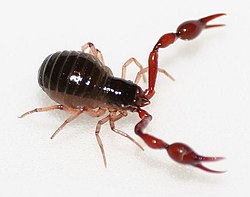
Pseudoscorpions, of the class Arachnida, are small arachnids with a flat, pear-shaped body, and pincer-like pedipalps that resemble those of scorpions. They usually range from 2 to 8 mm (0.08 to 0.31 in) in length. The largest known species is Garypus titanius of Ascension Island at up to 12 mm (0.5 in). Range is generally smaller at an average of 3 mm (0.1 in).
A pseudoscorpion has eight legs with five to seven segments each; the number of fused segments is used to distinguish families and genera. They have two very long pedipalps with palpal chelae (pincers), which strongly resemble the pincers found on a scorpion. The pedipalps generally consist of an immobile "hand" and mobile "finger", the latter controlled by an adductor muscle. Members of the clade Iocheirata, which contains the majority of pseudoscorpions, are venomous, with a venom gland and duct usually located in the mobile finger; the venom is used to immobilize the pseudoscorpion's prey. During digestion, pseudoscorpions exude a mildly corrosive fluid over the prey, then ingest the liquefied remains. In all known cases, this is medically insignificant to humans.
The abdomen, referred to as the opisthosoma, is made up of 12 segments, each protected by sclerotized plates (called tergites above and sternites below). The abdomen is short and rounded at the rear, rather than extending into a segmented tail and stinger like true scorpions. The color of the body can be yellowish tan to dark brown, with the paired claws often a contrasting color. They may have two, four, or no eyes.
Pseudoscorpions spin silk from a gland in their jaws to make disk-shaped cocoons for mating, molting, or waiting out cold weather, but they do not have book lungs like true scorpions and the Tetrapulmonata. Instead, they breathe exclusively through tracheae, which open laterally through two pairs of spiracles on the posterior margins of the sternites of abdominal segments 3 and 4.
The male produces a spermatophore, which is attached to the substrate and is picked up by the female. Members of the Cheliferoidea (Atemnidae, Cheliferidae, Chernetidae, and Withiidae) have an elaborate mating dance, which ends with the male navigating the female over his spermatophore. In Cheliferidae, the male also uses his forelegs to open the female genital operculum, and after she has mounted the packet of sperm, assisting the spermatophore's entry by pushing it into her genital opening. Females in species that possess a spermatheca (sperm-storing organ) can store the sperm for a long period of time before fertilizing the eggs, but species without the organ fertilize their eggs shortly after mating. The female carries the fertilized eggs in a brood pouch attached to her abdomen.
Between two and 50 young are hatched in a single brood, with more than one brood per year possible. The young go through three molts called the protonymph, deutonymph, and tritonymph. The developing embryo and the protonymph, which remain attached to the mother, are nourished by a ‘milk’ produced by her ovary. Many species molt in a small, silken igloo that protects them from enemies during this vulnerable period.
Pseudoscorpion
Pseudoscorpions, also known as false scorpions or book scorpions, are small, scorpion-like arachnids belonging to the order Pseudoscorpiones, also known as Pseudoscorpionida or Chelonethida.
Pseudoscorpions are generally beneficial to humans because they prey on clothes moth larvae, carpet beetle larvae, booklice, ants, mites, and small flies. They are common in many environments, but they are rarely noticed due to their small size. When people see pseudoscorpions, especially indoors, they often mistake them for ticks or small spiders. Pseudoscorpions often carry out phoresis, a form of commensalism in which one organism uses another for the purpose of transport.
Pseudoscorpions, of the class Arachnida, are small arachnids with a flat, pear-shaped body, and pincer-like pedipalps that resemble those of scorpions. They usually range from 2 to 8 mm (0.08 to 0.31 in) in length. The largest known species is Garypus titanius of Ascension Island at up to 12 mm (0.5 in). Range is generally smaller at an average of 3 mm (0.1 in).
A pseudoscorpion has eight legs with five to seven segments each; the number of fused segments is used to distinguish families and genera. They have two very long pedipalps with palpal chelae (pincers), which strongly resemble the pincers found on a scorpion. The pedipalps generally consist of an immobile "hand" and mobile "finger", the latter controlled by an adductor muscle. Members of the clade Iocheirata, which contains the majority of pseudoscorpions, are venomous, with a venom gland and duct usually located in the mobile finger; the venom is used to immobilize the pseudoscorpion's prey. During digestion, pseudoscorpions exude a mildly corrosive fluid over the prey, then ingest the liquefied remains. In all known cases, this is medically insignificant to humans.
The abdomen, referred to as the opisthosoma, is made up of 12 segments, each protected by sclerotized plates (called tergites above and sternites below). The abdomen is short and rounded at the rear, rather than extending into a segmented tail and stinger like true scorpions. The color of the body can be yellowish tan to dark brown, with the paired claws often a contrasting color. They may have two, four, or no eyes.
Pseudoscorpions spin silk from a gland in their jaws to make disk-shaped cocoons for mating, molting, or waiting out cold weather, but they do not have book lungs like true scorpions and the Tetrapulmonata. Instead, they breathe exclusively through tracheae, which open laterally through two pairs of spiracles on the posterior margins of the sternites of abdominal segments 3 and 4.
The male produces a spermatophore, which is attached to the substrate and is picked up by the female. Members of the Cheliferoidea (Atemnidae, Cheliferidae, Chernetidae, and Withiidae) have an elaborate mating dance, which ends with the male navigating the female over his spermatophore. In Cheliferidae, the male also uses his forelegs to open the female genital operculum, and after she has mounted the packet of sperm, assisting the spermatophore's entry by pushing it into her genital opening. Females in species that possess a spermatheca (sperm-storing organ) can store the sperm for a long period of time before fertilizing the eggs, but species without the organ fertilize their eggs shortly after mating. The female carries the fertilized eggs in a brood pouch attached to her abdomen.
Between two and 50 young are hatched in a single brood, with more than one brood per year possible. The young go through three molts called the protonymph, deutonymph, and tritonymph. The developing embryo and the protonymph, which remain attached to the mother, are nourished by a ‘milk’ produced by her ovary. Many species molt in a small, silken igloo that protects them from enemies during this vulnerable period.
Recent media
Recent media