


Community hub
Recent from talks
Contribute something
Nothing was collected or created yet.
| Tick | |
|---|---|

| |
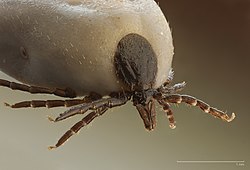
| Ixodes ricinus, a hard tick, engorged | |
Scientific classification 
| |
| Kingdom: | Animalia |
| Phylum: | Arthropoda |
| Subphylum: | Chelicerata |
| Class: | Arachnida |
| Superorder: | Parasitiformes |
| Order: | Ixodida |
| Superfamily: | Ixodoidea Leach, 1815 |
| Families | |
| |
| Diversity | |
| 37 genera, about 980 species | |
Ticks are parasitic arachnids of the order Ixodida. They are part of the mite superorder Parasitiformes. Adult ticks are approximately 3 to 5 mm in length depending on age, sex, and species, but can become larger when engorged. Ticks are external parasites, living by feeding on the blood of mammals, birds, and sometimes reptiles and amphibians. The timing of the origin of ticks is uncertain, though the oldest known tick fossils are around 100 million years old, and come from the Cretaceous period. Ticks are widely distributed around the world, especially in warm, humid climates.
Ticks belong to two major families: the Ixodidae, or hard ticks, and the Argasidae, or soft ticks. Nuttalliella, a genus of tick from southern Africa, is the only living member of the family Nuttalliellidae, which represents the most primitive living lineage of ticks. Adults have ovoid/pear-shaped bodies (idiosomas) which become engorged with blood when they feed, and eight legs. Their cephalothorax and abdomen are completely fused. In addition to having a hard shield on their dorsal surfaces, known as the scutum, hard ticks have a beak-like structure at the front containing the mouthparts, whereas soft ticks have their mouthparts on the underside of their bodies. Ticks locate potential hosts by sensing odor, body heat, moisture, and/or vibrations in the environment.[1]
Ticks have four stages to their life cycle, namely egg, larva, nymph, and adult. Ticks belonging to the Ixodidae family undergo either a one-host, two-host, or three-host life cycle.[2] Argasid ticks have up to seven nymphal stages (instars), each one requiring blood ingestion, and as such, Argasid ticks undergo a multihost life cycle. Because of their hematophagous (blood-ingesting) diets, ticks act as vectors of many serious diseases that affect humans and other animals.
Biology
[edit]Taxonomy and phylogeny
[edit]
| |||||||||||||||||||||
| Relationships among members of the Parasitiformes, after Klompen, 2010:[3] |
| |||||||||||||||
| Relationships of living and extinct tick families, after Chitimia-Dobler et al. (2022); Chitimia-Dobler et al. (2024).[4][5] |
Ticks belong to the Parasitiformes, a distinctive group of mites that are separate from the main group of mites, the Acariformes. Whether the two groups are more closely related to each other than to other arachnids is uncertain, and studies often resolve them as not closely related.[6] Within the Parasitiformes, ticks are most closely related to the Holothyrida, a small group of free living scavengers with 32 described species confined to the landmasses that formed the supercontinent Gondwana.[7] The phylogeny of the Ixodida within the Acari is shown in the cladogram, based on a 2014 maximum parsimony study of amino acid sequences of 12 mitochondrial proteins. The Argasidae appear monophyletic in this study.
Ticks belong to four different families. The majority of tick species belong to the two families: Ixodidae (hard ticks) and Argasidae (soft ticks). The third living family is Nuttalliellidae, named for the bacteriologist George Nuttall. It comprises a single extant species, Nuttalliella namaqua,[8][9] and as such is a monotypic taxon. Nuttalliella namaqua is found in southern Africa ranging from Tanzania to Namibia and South Africa.[8][10] There is one extinct family, Khimairidae, represented by the fossil species Khimaira fossus, currently regarded as the last common ancestral lineage of the Argasidae and Ixodidae.[11]
Discovery and examination of fossilised ticks have driven understanding of basal Ixodida lineages and the evolutionary history of contemporary taxa. Tick paleobiota have been discovered from the end of the Early Cretaceous onwards, most commonly in amber. The discovery of an argasid bird tick in Late Cretaceous New Jersey amber (Turonian ~94–90 Ma) in 2001 was the first mesozoic record of Parasitiformes.[12] Burmese amber (Cenomanian ~99 Ma) has produced the oldest fossil records, helping to resolve the Khimairidae and Nuttalliellidae through the discovery of extinct Khimaira, Deinocroton, Legionaris and Nuttalliella species,[13] as well as identifying ancient species of the living ixodid genera Amblyomma, Ixodes, Haemaphysalis, Bothriocroton and Archaeocroton.[14][7][11][15] Tick paleobiota is also known from late Albian amber, (~105 Ma) as well as Baltic (~56–34 Ma) and Dominican amber (~40-20 Ma).[14][16] Phylogenetic analysis suggests that the last common ancestor of all living ticks likely lived around 195 Ma in the Southern Hemisphere, in what was then Gondwana,[7] although other models put the origin of the Ixodida at closer to ~270 Ma.[17]
Almost all contemporary taxa fall into one of the two major tick families. The Ixodidae contain 750 species over 18 genera, characterised by a scutum or hard shield. The Argasidae contain about 220 species over 15 genera.[18] Argasid species have no scutum, and the capitulum (mouth and feeding parts) is concealed beneath the body.[19][20]
Anatomy and physiology
[edit]
Ticks, like mites, belong to the subclass Acari that lack their primary somatic segmentation of the abdomen (or opisthosoma), rather these parasitic arachnids present a subsequent fusion of the abdomen with the cephalothorax (or prosoma).[21] The tagmata typical of other Chelicerata have developed into the gnathosoma (head), which is retractable and contains the mouthparts, and idiosoma (body), which contains the legs, digestive tract, and reproductive organs.[22] The gnathosoma is a feeding structure with mouthparts adapted for piercing skin and sucking blood; it is the front of the head and contains neither the brain nor the eyes.[21] Features of the gnathosoma include two palps, two chelicerae, and hypostome. The hypostome acts as stabilizer and helps to anchor the tick's mouthparts to the host.[23] The chelicerae are specialized appendages used for cutting and piercing into the host's skin while palps are leglike appendages that are sensory in function.
The ventral side of the idiosoma bears sclerites, and the gonopore is located between the fourth pair of legs. In the absence of segmentation, the positioning of the eyes, limbs, and gonopore on the idiosoma provide the only locational guidance.[21]
Larval ticks hatch with six legs, acquiring the other two after a blood meal and molting into the nymph stage.[24] In the nymphal and adult stages, ticks have eight legs, each of which has seven segments and is tipped with a pair of claws. The legs are sometimes ornamented and usually bear sensory or tactile hairs.[25] In addition to being used for locomotion, the tarsus of leg I contains a unique sensory structure, Haller's organ, which can detect odors and chemicals emanating from the host, as well as sensing changes in temperature and air currents.[26][27][28] Ticks can also use Haller's organs to perceive infrared light emanating from a host.[29] When stationary, their legs remain tightly folded against the body.[26][27]
Ticks are extremely resilient animals. They can survive in a near vacuum for as long as half an hour.[30] Their slow metabolism during their dormant periods enables them to go prolonged durations between meals.[31] Even after 18 weeks of starvation, they can endure repeated two-day bouts of dehydration followed by rehydration, but their survivability against dehydration drops rapidly after 36 weeks of starvation.[32] To keep from dehydrating, ticks hide in humid spots on the forest floor[33] or absorb water from subsaturated air by secreting hygroscopic fluid produced by the salivary glands onto the external mouthparts and then reingesting the water-enriched fluid.[34]
Ticks can withstand temperatures just above −18 °C (0 °F) for more than two hours and can survive temperatures between −7 and −2 °C (20 and 29 °F) for at least two weeks. Ticks have even been found in Antarctica, where they feed on penguins.[35]
Most ticks are plain brown or reddish brown. However, the scuta of some species are decorated with white patterns.[36]
Ixodidae
[edit]In nymphs and adults, the capitulum is prominent and projects forwards from the body. The eyes are close to the sides of the scutum and the large spiracles are located just behind the coxae of the fourth pair of legs.[19] The hard protective scutellum, a characteristic of this family, covers nearly the whole dorsal surface in males, but is restricted to a small, shield-like structure behind the capitulum in females and nymphs.[37] When an ixodid attaches to a host the bite is typically painless and generally goes unnoticed. They remain in place until they engorge and are ready to molt; this process may take days or weeks. Some species drop off the host to molt in a safe place, whereas others remain on the same host and only drop off once they are ready to lay their eggs.[38]

Argasidae
[edit]The body of a soft tick is pear-shaped or oval with a rounded anterior portion. The mouthparts cannot be seen from above, as they are on the ventral surface. A centrally positioned dorsal plate with ridges projecting slightly above the surrounding surface, but with no decoration is often present. Soft ticks possess a leathery cuticle as well. A pattern of small, circular depressions expose where muscles are attached to the interior of the integument. The eyes are on the sides of the body, the spiracles open between legs 3 and 4, and males and females only differ in the structure of the genital pore.[39]
Nuttalliellidae
[edit]Nuttalliellidae can be distinguished from both ixodid and argasid ticks by a combination of a projecting gnathosoma and a soft leathery skin. Other distinguishing characteristics include the position of the stigmata, the lack of setae, the strongly corrugated integument, and the form of the fenestrated plates.[40][41] Nuttalliellidae genera are grouped together with reference to the character of the pseudoscutum and hypostome, but especially the 'ball-and-socket-like' leg joints.[13]
Diet and feeding
[edit]
Ticks are ectoparasites and most species consume blood to satisfy all of their nutritional requirements. They are obligate hematophages, and require blood to survive and move from one stage of life to another. Ticks can fast for long periods of time, but eventually die if unable to find a host.[42] Hematophagy evolved independently at least six times in arthropods living during the late Cretaceous; in ticks it is thought to have evolved 120 million years ago through adaptation to blood-feeding.[12][43] This behavior evolved independently within the separate tick families as well, with differing host-tick interactions driving the evolutionary change.[12]
Some ticks attach to their host rapidly, while others wander around searching for thinner skin, such as that in the ears of mammals. Depending on the species and life stage, preparing to feed can take from ten minutes to two hours. On locating a suitable feeding spot, the tick grasps the host's skin and cuts into the surface.[42] It extracts blood by cutting a hole in the host's epidermis, into which it inserts its hypostome and prevents the blood from clotting by excreting an anticoagulant or platelet aggregation inhibitor.[44][43]
Ticks find their hosts by detecting an animals' breath and body odors, sensing body heat, moisture, or vibrations.[45] A common misconception about ticks is they jump onto their host; however, they are incapable of jumping, although static electricity from their hosts has been shown to be capable of pulling the tick over distances several times their own body length.[46] Many tick species, particularly Ixodidae, lie in wait in a position known as "questing". While questing, ticks cling to leaves and grasses by their third and fourth pairs of legs. They hold the first pair of legs outstretched, waiting to grasp and climb on to any passing host. Tick questing heights tend to be correlated with the size of the desired host; nymphs and small species tend to quest close to the ground, where they may encounter small mammalian or bird hosts; adults climb higher into the vegetation, where larger hosts may be encountered. Some species are hunters and lurk near places where hosts may rest. Upon receiving an olfactory stimulus or other environmental indication, they crawl or run across the intervening surface.[45]
Other ticks, mainly the Argasidae, are nidicolous, finding hosts in their nests, burrows, or caves. They use the same stimuli as non-nidicolous species to identify hosts, with body heat and odors often being the main factors.[45] Many of them feed primarily on birds, though some Ornithodoros species, for example, feed on small mammals. Both groups of soft tick feed rapidly, typically biting painfully and drinking their fill within minutes. Unlike the Ixodidae that have no fixed dwelling place except on the host, they live in sand, in crevices near animal dens or nests, or in human dwellings, where they come out nightly to attack roosting birds or emerge when they detect carbon dioxide in the breath of their hosts.[47] While all species are haematophagous at some point in their lifecycle, a few argasid taxa, such as Antricola delacruzi, only take blood-meals as larvae, subsisting in the nymphal and adult stages by consuming guano.[48][49]
Ixodidae remain in place until they are completely engorged. Their weight may increase by 200 to 600 times compared to their prefeeding weight. To accommodate this expansion, cell division takes place to facilitate enlargement of the cuticle.[50] In the Argasidae, the tick's cuticle stretches to accommodate the fluid ingested, but does not grow new cells, with the weight of the tick increasing five- to tenfold over the unfed state. The tick then drops off the host and typically remains in the nest or burrow until its host returns to provide its next meal.[39]
Tick saliva contains about 1,500 to 3,000 proteins, depending on the tick species. The proteins with anti-inflammatory properties, called evasins, allow ticks to feed for eight to ten days without being perceived by the host animal. Researchers are studying these evasins with the goal of developing drugs to neutralise the chemokines that cause myocarditis, heart attack, and stroke.[51] The saliva of ticks also contains anticoagulant and antiplatelet proteins (integrin inhibitors), to stop the blood from coagulating while they suck.[52]

Most ticks do not use any other food source than vertebrate blood and therefore ingest high levels of protein, iron and salt, but few carbohydrates, lipids or vitamins.[53] Ticks' genomes have evolved large repertoires of genes related to this nutritional challenge, but they themselves cannot synthesize the essential vitamins that are lacking in blood meal. To overcome these nutritional deficiencies, ticks have evolved obligate interactions with nutritional endosymbionts.[53] The first appearance of ticks and their later diversification were largely conditioned by this nutritional endosymbiosis lasting for millions of years. The most common of these nutritional endosymbionts belong to the Coxiella and Francisella bacterial genera.[54][55] These intracellular symbiotic microorganisms are specifically associated with ticks and use transovarial transmission to ensure their persistence.[56][57][58] Although Coxiella and Francisella endosymbionts are distantly related bacteria, they have converged towards an analogous B vitamin-based nutritional mutualism with ticks.[53] Their experimental elimination typically results in decreased tick survival, molting, fecundity and egg viability, as well as in physical abnormalities, which all are fully restored with an oral supplement of B vitamins.[57][59][60] The genome sequencing of Coxiella and Francisella endosymbionts confirmed that they consistently produce three B vitamin types, biotin (vitamin B7), riboflavin (B2) and folate (B9).[57][59][61] As they are required for tick life cycle, these obligate endosymbionts are present in all individuals of the tick species they infect, at least at early stages of development since they may be secondarily lost in males during nymphal development.[55][57][58] Since Coxiella and Francisella endosymbionts are closely related to pathogens, there is a substantial risk of misidentification between endosymbionts and pathogens, leading to an overestimation of infection risks associated with ticks.[62][63]
Range and habitat
[edit]Tick species are widely distributed around the world.[64] They tend to flourish more in warm, humid climates, because they require a certain amount of moisture in the air to undergo metamorphosis, and low temperatures inhibit their development of eggs to larvae.[65] The occurrence of ticks and tick-borne illnesses in humans is increasing.[66] Tick populations are spreading into new areas, due in part to the warming temperatures of climate change.[67][68]
Tick parasitism is widely distributed among host taxa, including marsupial and placental mammals, birds, reptiles (snakes, iguanas, and lizards), and amphibians.[69] Ticks of domestic animals cause considerable harm to livestock through pathogenic transmission, causing anemia through blood loss, and damaging wool and hides.[70] The Tropical Bont tick wreaks havoc on livestock and wildlife in Africa, the Caribbean, and several other countries through the spread of disease, specifically heartwater disease.[71] The spinose ear tick has a worldwide distribution, the young feed inside the ears of cattle and various wildlife.[72]
A habitat preferred by ticks is the interface where a lawn meets the forest,[73] or more generally, the ecotone, which is unmaintained transitional edge habitat between woodlands and open areas. Therefore, one tick management strategy is to remove leaf litter, brush, and weeds at the edge of the woods.[74] Ticks like shady, moist leaf litter with an overstory of trees or shrubs and, in the spring, they deposit their eggs into such places allowing larvae to emerge in the fall and crawl into low-lying vegetation. The 3 meter boundary closest to the lawn's edge are a tick migration zone, where 82% of tick nymphs in lawns are found.[75]
Ecology
[edit]In general, ticks are found wherever their host species occur. Migrating birds carry ticks with them on through their migrations; a study of migratory birds passing through Egypt discovered more than half the bird species examined were carrying ticks. It was also observed the tick species varied depending on the season of migration, in this study it is spring and autumn migrations, this is thought to occur due to the seasonal periodicities of the different species.[76]
For an ecosystem to support ticks, it must satisfy two requirements; the population density of host species in the area must be great enough and it must be humid enough for ticks to remain hydrated.[22] Due to their role in transmitting Lyme disease, Ixodid ticks, particularly the North American I. scapularis, have been studied using geographic information systems to develop predictive models for ideal tick habitats. According to these studies, certain features of a given microclimate – such as sandy soil, hardwood trees, rivers, and the presence of deer – were determined to be good predictors of dense tick populations.[47]
Mites and nematodes feed on ticks, which are also a minor nutritional resource for birds. More importantly, ticks act as a disease vector and behave as the primary hosts of many different pathogens such as spirochaetes. Ticks carry various debilitating diseases therefore, ticks may assist in controlling animal populations and preventing overgrazing.[77]
Ticks can transmit an array of infectious diseases that affect humans and other animals.[78] Ticks that carry zoonotic pathogens often tend to have a wide host range. The infective agents can be present not only in the adult tick, but also in the eggs produced plentifully by the females. Many tick species have extended their ranges as a result of the movements of people, domesticated pets, and livestock. With increasing participation in outdoor activities such as wilderness hikes, more people and their dogs may find themselves exposed to ticks.[79]
Life cycle
[edit]

All three tick families ticks have four life cycle stages: egg, larva, nymph, and adult.[80]
Ixodidae
[edit]Ixodidae ticks have three different life cycles. Depending on the species, Ixodids can either possess a one-host life cycle, two-host life cycle, or three-host life cycle.
One-host ticks
[edit]In one-host ticks the tick remains on the host through the larval, nymphal, and adult stages, only to leave the host to lay eggs. Eggs laid in the environment hatch into larvae, which immediately seek out a host in which to attach and feed. Fed larvae molt into unfed nymphs that remain on the host. After engorging on the host's blood, the nymphs molt into sexually mature adults that remain on the host in order to feed and mate. Once a female is both fed and ready to lay eggs, only then does she leave the host in search of a suitable area to deposit her eggs. Ticks that follow this life cycle are called one-host ticks. The winter tick Dermacentor albipictus and the cattle tick Rhipicephalus microplus are examples of one-host ticks.[81]
Two-host ticks
[edit]The life cycle of a two-host tick often spans two years.[2] During fall the pregnant female tick will drop off her second host and lay her eggs. The eggs hatch during winter, the following spring the larvae emerge and attach to their first host. Newly hatched larvae attach to a host in order to obtain a blood meal. They remain on the host then develop into nymphs. Once engorged, they drop off the host and find a safe area in the natural environment in which to molt into adults, this typically occurs during the winter. Both male and female adults seek out a host on which to attach, which may be the same body that served as host during their early development but is often a larger mammal. Once attached, they feed and mate. Gravid females drop from the host to oviposit in the environment. Ticks that complete their life cycle in this manner are called two-host ticks, like Hyalomma anatolicum excavatum.[81]
Three-host ticks
[edit]Most ixodid ticks require three hosts, and their life cycles typically span three years. The female tick drops off its host, often in the fall, and lays thousands of eggs.[2] The larvae hatch in the winter and emerge in the spring. When the larvae emerge, they attach and feed primarily on small mammals and birds. During the summer the larvae become engorged and drop off the first host to molt and become nymphs, this often occurs during the fall. The following spring the nymphs emerge and seek out another host, often a small rodent. The nymphs become engorged and drop off the host in the fall to molt and become adults. The following spring the adult ticks emerge and seek out a larger host, often a large mammal such as cattle or even humans. Females will mate on their third host. Female adults then engorge on blood and prepare to drop off to lay her eggs on the ground, while males feed very little and remain on the host in order to continue mating with other females.[47][81]
Argasidae
[edit]Argasid ticks, unlike ixodid ticks, may go through up to seven nymphal stages (instars), requiring a meal of blood each time.[82] Often, egg laying and mating occurs detached from the host in a safe environment.[2] The eggs hatch and the larvae feed on a nearby host for anywhere from a few hours to several days, this depends on the species of tick. After they feed the larvae drop and molt into their first nymphal instars, then the nymph seeks out and feeds on its second host, often this is the same as the first host, within an hour. This process occurs repeatedly and until the last nymphal instar occurs, thus allowing the tick to molt into an adult. Once an adult these ticks feed rapidly and periodically their entire life cycle. In some species an adult female may lay eggs after each feeding. Their life cycles range from months to years. The adult female argasid tick can lay a few hundred to over a thousand eggs over the course of her lifetime. Both male and female adults feed on blood, and they mate off the host. During feeding, any excess fluid is excreted by the coxal glands, a process that is unique to argasid ticks.[47]
Nuttalliellidae
[edit]Nuttalliellidae is an elusive monotypic family of tick, that is, possesses a single species, Nuttalliella namaqua. There is little to nothing known about the life cycle and feeding habits of N. namaqua but it is speculated this species of tick has multiple different hosts.[83]
Relationship with humans
[edit]Tick-borne disease
[edit]
Ticks can transmit many kinds of pathogens, such as bacteria, viruses, and protozoa, that infect ticks' hosts.[84] A tick can harbor more than one type of pathogen, making diagnosis more difficult.[67] Species of the bacterial genus Rickettsia are responsible for typhus, rickettsialpox, boutonneuse fever, African tick bite fever, Rocky Mountain spotted fever, Flinders Island spotted fever, and Queensland tick typhus (Australian tick typhus).[85] Other tick-borne diseases include Lyme disease and Q fever,[86] Colorado tick fever, Crimean–Congo hemorrhagic fever, tularemia, tick-borne relapsing fever, babesiosis, ehrlichiosis, Bourbon virus, and tick-borne meningoencephalitis, as well as bovine anaplasmosis and the Heartland virus.[87] In the United States, Lyme disease is the most commonly reported vector-borne disease in the country.[88]
Some species, notably the Australian paralysis tick, are also intrinsically venomous and can cause tick paralysis. Eggs can become infected with pathogens inside a female tick's ovaries, in which case the larval ticks are infectious immediately at hatching, before feeding on their first host.[82] Tropical bont ticks transmit the heartwater, which can be particularly devastating in cattle.[72] The ticks carried by migratory birds act as reservoirs and vectors of foreign infectious diseases. In the Egyptian migratory bird study, over 20 strains of pathogenic viruses were detected within the tick sample from autumn.[76]
Not all ticks in an infective area are infected with transmittable pathogens, and both attachment of the tick and a long feeding session are necessary for diseases to be transmitted.[79] Consequently, tick bites often do not lead to infection, especially if the ticks are removed within 36 hours.[89] Adult ticks can be removed with fine-tipped tweezers or proprietary tick removal tools, before then disinfecting the wound.[90][91] In Australia and New Zealand, where tick-borne infections are less common than tick reactions, the Australasian Society of Clinical Immunology and Allergy recommends seeking medical assistance or killing ticks in-situ by freezing and then leaving them to fall out to prevent allergic/anaphylactic reactions.[92][93] Professor Sheryl van Nunen, whose research in 2007 identified tick-induced mammalian meat allergy, famously said "tweezers are tick squeezers",[94][95] referring to the tick toxins squeezed into people attempting to remove ticks with tweezers. Ticks can be disposed of by flushing them down the toilet, placing them in a container of soapy water or alcohol, or sticking them to tape that can then be folded over and thrown away.[24][90]
Bifenthrin and permethrin, both pyrethroids, are sometimes used as tick-control measures, although they have the disadvantage of being carcinogenic and able to attack the nervous systems of other species besides ticks. Those who walk through tick-infested areas can make it harder for ticks to latch onto them by tucking their trousers into boots made of smooth rubber, which ticks have trouble climbing.[96][97]
Research since 2008 has documented red-meat allergies (mammalian meat allergy and Alpha-gal allergy) in the US due to lone star tick bites. The range of the problem has been expanding with the range of the tick.[67] Other species of ticks are known for being responsible for meat allergies in other countries, including Sweden, Germany, and Australia.[98]
Many tick-transmitted viruses, such as Crimean–Congo hemorrhagic fever virus, Kyasanur Forest disease virus, Alkhumra hemorrhagic fever virus, and Omsk hemorrhagic fever virus, are classified as dangerous enough to require biosafety level 4 precautions in laboratory environments. This includes five levels of containment, viz., storage vials within humidified desiccators, within environmental chambers, within a tick suite, within a BSL4 laboratory. Precautions such as glove boxes, sticky pads, Vaseline barriers, safety suits, gloves, sticky tape, silicone vacuum grease, sticky trap paste, and micro mesh are used to safely contain ticks and prevent them from escaping.[99]
Population control measures
[edit]
With the possible exception of widespread DDT use in the Soviet Union, attempts to limit the population or distribution of disease-causing ticks have been quite unsuccessful.[100] The parasitoid encyrtid wasp Ixodiphagus hookeri has been investigated for its potential to control tick populations. It lays its eggs in ticks;[101][a] the hatching wasps kill their hosts.[102]
Predators and competitors of tick hosts can indirectly reduce the density of infected nymphs, thereby lowering tick-borne disease risk by lowering the density and/or tick burden of reservoir-competent hosts. A study in the Netherlands found that the number of larval ticks on bank voles and wood mice was lower at sites with significant red fox (Vulpes vulpes) and stone marten (Martes foina) activity.[103]
This supports the results of a study from the northeastern United States, in which the incidence of Lyme borreliosis was negatively correlated with the density of red fox, possibly because foxes decrease the density of white-footed mice (Peromyscus leucopus), the most important reservoir-competent host for Borrelia burgdorferi.[103][104]
Another natural form of control for ticks is the helmeted guineafowl, a bird species that consumes mass quantities of ticks.[105] Opossums groom themselves, swallowing many ticks; they are net destroyers of ticks, killing around ninety percent of the ticks that attempt to feed on them.[106] More generally, high animal diversity has a strongly protective effect against tick-borne disease.[75]
Topical tick medicines may be toxic to animals and humans. The synthetic pyrethroid insecticide phenothrin in combination with the hormone analogue methoprene was a popular topical flea and tick therapy for felines. Phenothrin kills adult ticks, while methoprene kills eggs. Some cat products were withdrawn in the US due to adverse reactions,[107] and others are known to cause adverse reactions.[citation needed]
In the arts
[edit]In 2020, the world's first monument to a tick was erected in the Russian city of Ufa on a stone base from the Ural Mountains with the inscription: "Same as you I also want to live".[108][better source needed]
The Tick is a parody superhero created by cartoonist Ben Edlund in 1986.
See also
[edit]
Notes
[edit]References
[edit]- ^ "How ticks spread disease". Centers for Disease Control and Prevention. 21 September 2020. Retrieved 29 November 2020.
- ^ a b c d "Ticks". CDC - DPDx. 23 January 2019. Retrieved 29 November 2020.
- ^ Klompen H (30 June 2010). "Holothyrids and ticks: new insights from larval morphology and DNA sequencing, with the description of a new species of Diplothyrus (Parasitiformes: Neothyridae)". Acarologia. 50 (2): 269–285. doi:10.1051/acarologia/20101970. ISSN 0044-586X. S2CID 55284869.
- ^ Chitimia-Dobler L, Mans BJ, Handschuh S, Dunlop JA (May 2022). "A remarkable assemblage of ticks from mid-Cretaceous Burmese amber". Parasitology. 149 (6): 820–830. doi:10.1017/S0031182022000269. ISSN 0031-1820. PMC 10090602. PMID 35241194.
- ^ Chitimia-Dobler L, Handschuh S, Dunlop JA, Pienaar R, Mans BJ (August 2024). "Nuttalliellidae in Burmese amber: implications for tick evolution". Parasitology. 151 (9): 891–907. doi:10.1017/S0031182024000477. ISSN 0031-1820. PMC 11770530. PMID 38623697.
- ^ Giribet G (March 2018). "Current views on chelicerate phylogeny—A tribute to Peter Weygoldt". Zoologischer Anzeiger. 273: 7–13. Bibcode:2018ZooAn.273....7G. doi:10.1016/j.jcz.2018.01.004. S2CID 90344977.
- ^ a b c Beati L, Klompen H (7 January 2019). "Phylogeography of Ticks (Acari: Ixodida)". Annual Review of Entomology. 64 (1): 379–397. doi:10.1146/annurev-ento-020117-043027. ISSN 0066-4170. PMID 30354695. S2CID 53023797.
- ^ a b Guglielmone et al. (2010)
- ^ Goddard (2008): p. 80
- ^ Keirans et al. (1976)
- ^ a b Chitimia-Dobler L, Mans BJ, Handschuh S, Dunlop JA (n.d.). "A remarkable assemblage of ticks from mid-Cretaceous Burmese amber". Parasitology. 149 (6): 820–830. doi:10.1017/S0031182022000269. ISSN 0031-1820. PMC 10090602. PMID 35241194. S2CID 247227499.
- ^ a b c Klompen H, Grimaldi D (2001). "First Mesozoic Record of a Parasitiform Mite: a Larval Argasid Tick in Cretaceous Amber (Acari: Ixodida: Argasidae)" (PDF). Annals of the Entomological Society of America. 94 (1): 10–15. doi:10.1603/0013-8746(2001)094[0010:FMROAP]2.0.CO;2.
- ^ a b Chitimia-Dobler L, Handschuh S, Dunlop JA, Pienaar R, Mans BJ (16 April 2024). "Nuttalliellidae in Burmese amber: implications for tick evolution". Parasitology. 151 (9): 891–907. doi:10.1017/S0031182024000477. ISSN 0031-1820. PMC 11770530. PMID 38623697.
- ^ a b Peñalver E, Arillo A, Delclòs X, Peris D, Grimaldi DA, Anderson SR, et al. (December 2017). "Ticks parasitised feathered dinosaurs as revealed by Cretaceous amber assemblages". Nature Communications. 8 (1) 1924. Bibcode:2017NatCo...8.1924P. doi:10.1038/s41467-017-01550-z. PMC 5727220. PMID 29233973.
- ^ Chitimia-Dobler L, Dunlop JA, Pfeffer T, Würzinger F, Handschuh S, Mans BJ (February 2023). "Hard ticks in Burmese amber with Australasian affinities". Parasitology. 150 (2): 157–171. doi:10.1017/S0031182022001585. ISSN 0031-1820. PMC 10090639. PMID 36341553.
- ^ Dunlop JA, Apanaskevich DA, Lehmann J, Hoffmann R, Fusseis F, Ehlke M, et al. (October 2016). "Microtomography of the Baltic amber tick Ixodes succineus reveals affinities with the modern Asian disease vector Ixodes ovatus". BMC Evolutionary Biology. 16 (1) 203. Bibcode:2016BMCEE..16..203D. doi:10.1186/s12862-016-0777-y. PMC 5057450. PMID 27724841.
- ^ Mans BJ, Featherston J, Kvas M, Pillay KA, de Klerk DG, Pienaar R, et al. (1 January 2019). "Argasid and ixodid systematics: Implications for soft tick evolution and systematics, with a new argasid species list". Ticks and Tick-borne Diseases. 10 (1): 219–240. doi:10.1016/j.ttbdis.2018.09.010. ISSN 1877-959X. PMID 30309738.
- ^ Mans BJ, Kelava S, Pienaar R, Featherston J, de Castro MH, Quetglas J, et al. (1 July 2021). "Nuclear (18S-28S rRNA) and mitochondrial genome markers of Carios (Carios) vespertilionis (Argasidae) support Carios Latreille, 1796 as a lineage embedded in the Ornithodorinae: re-classification of the Carios sensu Klompen and Oliver (1993) clade into its respective subgenera". Ticks and Tick-borne Diseases. 12 (4) 101688. doi:10.1016/j.ttbdis.2021.101688. ISSN 1877-959X. PMID 33652332.
- ^ a b Molyneux (1993) p. 6
- ^ Gu XB, Liu GH, Song HQ, Liu TY, Yang GY, Zhu XQ (July 2014). "The complete mitochondrial genome of the scab mite Psoroptes cuniculi (Arthropoda: Arachnida) provides insights into Acari phylogeny". Parasites & Vectors. 7 340. doi:10.1186/1756-3305-7-340. PMC 4223567. PMID 25052180.
- ^ a b c Ruppert EE, Fox RS, Barnes RD (2004). Invertebrate Zoology (7th ed.). Cengage Learning. pp. 590–595. ISBN 978-81-315-0104-7.
- ^ a b Wall & Shearer (2001): p. 55
- ^ Richter D, Matuschka FR, Spielman A, Mahadevan L (December 2013). "How ticks get under your skin: insertion mechanics of the feeding apparatus of Ixodes ricinus ticks". Proceedings. Biological Sciences. 280 (1773) 20131758. doi:10.1098/rspb.2013.1758. ISSN 0962-8452. PMC 3826218. PMID 24174106.
- ^ a b "Common Ticks". Illinois Department of Public Health. Retrieved 11 April 2014.
- ^ "Soft ticks". CVBD: Companion Vector-Borne Diseases. Retrieved 6 December 2016.
- ^ a b Sonenshine (2005): p. 14[permanent dead link]
- ^ a b Nicholson et al. (2009): p. 486
- ^ For Haller's organ, see also: Mehlhorn (2008): p. 582.
- ^ Mitchell RD, Zhu J, Carr AL, Dhammi A, Cave G, Sonenshine DE, et al. (August 2017). "Infrared light detection by the haller's organ of adult american dog ticks, Dermacentor variabilis (Ixodida: Ixodidae)". Ticks and Tick-Borne Diseases. 8 (5): 764–771. doi:10.1016/j.ttbdis.2017.06.001. PMC 5588665. PMID 28647127.
- ^ Yonge (15 March 2012). "Stuffed in a vacuum and bombarded by electrons, a tick waves hello". Discover. Archived from the original on 1 May 2019. Retrieved 1 May 2019.
- ^ Miller M (20 November 2018). "UC study: Hungry ticks work harder to find you". UC Cincinnati.
- ^ Rosendale AJ, Dunlevy ME, Fieler AM, Farrow DW, Davies B, Benoit JB (August 2017). "Dehydration and starvation yield energetic consequences that affect survival of the American dog tick". Journal of Insect Physiology. 101: 39–46. Bibcode:2017JInsP.101...39R. doi:10.1016/j.jinsphys.2017.06.012. PMID 28648807.
- ^ Zimmer C (30 April 2013). "The Rise of the Tick". Outside.
- ^ Gray JS, Kahl O, Lane RS, Levin ML, Tsao JI (July 2016). "Diapause in ticks of the medically important Ixodes ricinus species complex". Ticks and Tick-Borne Diseases. 7 (5): 992–1003. doi:10.1016/j.ttbdis.2016.05.006. PMC 5659180. PMID 27263092.
- ^ "Ticks are even tougher and nastier than you thought". Science Daily. 25 September 2017.
- ^ Sirois M (2015). Laboratory Procedures for Veterinary Technicians. St. Louis, MO: Elsevier. ISBN 978-0-323-16930-1.
- ^ Walker JB, Keirans JE, Horak IG (2005). The Genus Rhipicephalus (Acari, Ixodidae): A Guide to the Brown Ticks of the World. Cambridge University Press. p. 39. ISBN 978-1-316-58374-6.
- ^ Salman MD, Tarrés-Call J, Estrada-Peña A (2013). Ticks and Tick-borne Diseases: Geographical Distribution and Control Strategies in the Euro-Asia Region. CABI. pp. 6–12. ISBN 978-1-84593-853-6.
- ^ a b "Soft ticks". CVBD: Companion Vector-Borne Diseases. Archived from the original on 24 January 2019. Retrieved 6 December 2016.
- ^ Roshdy et al. (1983)
- ^ Brouwers L (30 August 2011). "Long Lost Relative of Ticks Pops Up Again". Scientific American. Retrieved 4 December 2016.
- ^ a b "Life cycle of Hard Ticks that Spread Disease". Centers for Disease Control and Prevention. Retrieved 22 June 2013.
- ^ a b Mans BJ, Louw AI, Neitz AW (October 2002). "Evolution of hematophagy in ticks: common origins for blood coagulation and platelet aggregation inhibitors from soft ticks of the genus Ornithodoros". Molecular Biology and Evolution. 19 (10): 1695–705. doi:10.1093/oxfordjournals.molbev.a003992. ISSN 1537-1719. PMID 12270896.
- ^ Goddard (2008): p. 82
- ^ a b c "Host seeking". CVBD: Companion Vector-Borne Diseases. Retrieved 8 December 2016.
- ^ Static electricity passively attracts ticks onto hosts
- ^ a b c d Allan (2001)
- ^ Francischetti IM, Sa-Nunes A, Mans BJ, Santos IM, Ribeiro JM Front Biosci. 2009 Jan 1; 14():2051-88.
- ^ Estrada-Peña A, Venzal JM, Kocan KM, Tramuta C, Tomassone L, de la Fuente J, et al. (2008). "Observations on Antricola Ticks: Small Nymphs Feed on Mammalian Hosts and Have a Salivary Gland Structure Similar to Ixodid Ticks". Journal of Parasitology. 94 (4): 953–955. doi:10.1645/GE-1371.1. ISSN 0022-3395. PMID 18576742.
- ^ "Hard ticks". CVBD: Companion Vector-Borne Diseases. Retrieved 6 December 2016.
- ^ University of Oxford (27 June 2017). "From bug to drug—tick saliva could be key to treating heart disease". Phys.org.
- ^ van den Kerkhof DL, van der Meijden PE, Hackeng TM, Dijkgraaf I (25 March 2021). "Exogenous Integrin αIIbβ3 Inhibitors Revisited: Past, Present and Future Applications". International Journal of Molecular Sciences. 22 (7): 3366. doi:10.3390/ijms22073366. ISSN 1422-0067. PMC 8036306. PMID 33806083.
- ^ a b c Duron O, Gottlieb Y (October 2020). "Convergence of Nutritional Symbioses in Obligate Blood Feeders" (PDF). Trends in Parasitology. 36 (10): 816–825. doi:10.1016/j.pt.2020.07.007. PMID 32811753. S2CID 221181791.
- ^ Binetruy F, Buysse M, Lejarre Q, Barosi R, Villa M, Rahola N, et al. (March 2020). "Microbial community structure reveals instability of nutritional symbiosis during the evolutionary radiation of Amblyomma ticks" (PDF). Molecular Ecology. 29 (5): 1016–1029. Bibcode:2020MolEc..29.1016B. doi:10.1111/mec.15373. PMID 32034827. S2CID 211065648.
- ^ a b Duron O, Binetruy F, Noël V, Cremaschi J, McCoy KD, Arnathau C, et al. (June 2017). "Evolutionary changes in symbiont community structure in ticks" (PDF). Molecular Ecology. 26 (11): 2905–2921. Bibcode:2017MolEc..26.2905D. doi:10.1111/mec.14094. hdl:10067/1422810151162165141. PMID 28281305. S2CID 40962020.
- ^ Buysse M, Plantard O, McCoy KD, Duron O, Menard C (June 2019). "Tissue localization of Coxiella-like endosymbionts in three European tick species through fluorescence in situ hybridization" (PDF). Ticks and Tick-Borne Diseases. 10 (4): 798–804. doi:10.1016/j.ttbdis.2019.03.014. PMID 30922601.
- ^ a b c d Duron O, Morel O, Noël V, Buysse M, Binetruy F, Lancelot R, et al. (June 2018). "Tick-Bacteria Mutualism Depends on B Vitamin Synthesis Pathways". Current Biology. 28 (12): 1896–1902.e5. Bibcode:2018CBio...28E1896D. doi:10.1016/j.cub.2018.04.038. PMID 29861133. S2CID 44095809.
- ^ a b Lalzar I, Friedmann Y, Gottlieb Y (December 2014). "Tissue tropism and vertical transmission of Coxiella in Rhipicephalus sanguineus and Rhipicephalus turanicus ticks". Environmental Microbiology. 16 (12): 3657–68. Bibcode:2014EnvMi..16.3657L. doi:10.1111/1462-2920.12455. ISSN 1462-2920. PMID 24650112.
- ^ a b Guizzo MG, Parizi LF, Nunes RD, Schama R, Albano RM, Tirloni L, et al. (December 2017). "A Coxiella mutualist symbiont is essential to the development of Rhipicephalus microplus". Scientific Reports. 7 (1) 17554. Bibcode:2017NatSR...717554G. doi:10.1038/s41598-017-17309-x. ISSN 2045-2322. PMC 5730597. PMID 29242567.
- ^ Ben-Yosef M, Rot A, Mahagna M, Kapri E, Behar A, Gottlieb Y (22 April 2020). "Rhipicephalus sanguineus Is Required for Physiological Processes During Ontogeny". Frontiers in Microbiology. 11: 493. doi:10.3389/fmicb.2020.00493. ISSN 1664-302X. PMC 7188774. PMID 32390951.
- ^ Smith TA, Driscoll T, Gillespie JJ, Raghavan R (January 2015). "A Coxiella-like endosymbiont is a potential vitamin source for the Lone Star tick". Genome Biology and Evolution. 7 (3): 831–8. doi:10.1093/gbe/evv016. PMC 4994718. PMID 25618142.
- ^ Duron O, Sidi-Boumedine K, Rousset E, Moutailler S, Jourdain E (November 2015). "The Importance of Ticks in Q Fever Transmission: What Has (and Has Not) Been Demonstrated?" (PDF). Trends in Parasitology. 31 (11): 536–552. doi:10.1016/j.pt.2015.06.014. ISSN 1471-4922. PMID 26458781. S2CID 25636125.
- ^ Duron O (September 2015). "The IS1111 insertion sequence used for detection of Coxiella burnetii is widespread in Coxiella-like endosymbionts of ticks". FEMS Microbiology Letters. 362 (17) fnv132. doi:10.1093/femsle/fnv132. ISSN 0378-1097. PMID 26269380.
- ^ Magnarelli (2009)
- ^ Nuttall (1905)
- ^ "Lyme and Other Tickborne Diseases Increasing". Centers for Disease Control. 21 October 2021. Retrieved 4 March 2022.
- ^ a b c Chrobak U (3 February 2022). "Lyme and other tick-borne diseases are on the rise. But why?". Knowable Magazine. doi:10.1146/knowable-020222-1. Retrieved 4 March 2022.
- ^ Gilbert L (7 January 2021). "The Impacts of Climate Change on Ticks and Tick-Borne Disease Risk". Annual Review of Entomology. 66 (1): 373–388. doi:10.1146/annurev-ento-052720-094533. ISSN 0066-4170. PMID 33417823. S2CID 231300522.
- ^ Dantas-Torres F, Oliveira-Filho EF, Soares FA, Souza BO, Valença RB, Sá FB (2008). "Ticks infesting amphibians and reptiles in Pernambuco, Northeastern Brazil". Revista Brasileira de Parasitologia Veterinaria. 17 (4): 218–21. doi:10.1590/S1984-29612008000400009. PMID 19265581.
- ^ "Ticks of Livestock". Ectoparasites of Livestock. Butox. Archived from the original on 16 January 2017. Retrieved 14 January 2017.
- ^ "tropical bont tick - Amblyomma variegatum". entnemdept.ufl.edu. Retrieved 29 November 2020.
- ^ a b "Ticks". Livestock Veterinary Entomology. Texas A&M AgriLife. Retrieved 14 January 2017.
- ^ Beans C (20 July 2016). "Taking The Battle Against Lyme Disease Ticks To The Backyard". NPR.
- ^ "Integrated Tick Management" (PDF). Connecticut Agricultural Experimental Station. Archived from the original (PDF) on 4 December 2022. Retrieved 2 May 2019.
- ^ a b Tucker B (11 May 2018). "The tick-resistant yard". Dirt Magazine.
- ^ a b Hoogstraal H, Kaiser MN, Traylor MA, Guindy E, Gaber S (1963). "Ticks (Ixodidae) on birds migrating from Europe and Asia to Africa 1959-61". Bulletin of the World Health Organization. 28 (2): 235–62. PMC 2554471. PMID 13961632.
- ^ Ray CC (28 May 2012). "The mighty tick". New York Times. Retrieved 15 December 2016.
- ^ Vilcins M, Old J, Deane E (2005). "The impact of ticks and tick-borne diseases on native animal species in Australia". Microbiology Australia. 26 (2). CSIRO Publishing: 76. doi:10.1071/ma05076 (inactive 1 July 2025). ISSN 1324-4272. S2CID 81977091.
{{cite journal}}: CS1 maint: DOI inactive as of July 2025 (link) - ^ a b "Disease transmission". CVBD: Companion Vector-Borne Diseases. Retrieved 9 December 2016.
- ^ Dennis & Piesman (2005): p. 5[permanent dead link]
- ^ a b c Sonenshine D (1991). Biology of Ticks. New York: Oxford University Press.
- ^ a b Aeschlimann & Freyvogel, 1995: p. 182
- ^ Mans BJ, de Klerk D, Pienaar R, Latif AA (17 August 2011). "Nuttalliella namaqua: a living fossil and closest relative to the ancestral tick lineage: implications for the evolution of blood-feeding in ticks". PLOS ONE. 6 (8) e23675. Bibcode:2011PLoSO...623675M. doi:10.1371/journal.pone.0023675. ISSN 1932-6203. PMC 3157464. PMID 21858204.
- ^ Wenner M (11 June 2021). "Let's Do a Tick Check - These pervasive bloodsuckers can give you more than just Lyme disease. Here's how to protect yourself. (Interactive)". The New York Times. Retrieved 19 June 2021.
- ^ Unsworth NB, Stenos J, Graves SR, Faa AG, Cox GE, Dyer JR, et al. (April 2007). "Flinders Island spotted fever rickettsioses caused by "marmionii" strain of Rickettsia honei, Eastern Australia". Emerging Infectious Diseases. 13 (4): 566–73. doi:10.3201/eid1304.050087. PMC 2725950. PMID 17553271.
- ^ "Q fever". Centers for Disease Control. Retrieved 7 November 2010.
- ^ "Heartland virus". 8 November 2018.
- ^ Eisen RJ, Kugeler KJ, Eisen L, Beard CB, Paddock CD (December 2017). "Tick-Borne Zoonoses in the United States: Persistent and Emerging Threats to Human Health". ILAR Journal. 58 (3): 319–335. doi:10.1093/ilar/ilx005. ISSN 1084-2020. PMC 5610605. PMID 28369515.
- ^ Feldman G, Feldman L, Macnair P (6 March 2014). "All about ticks: why it's so important to remove a tick". Netdoctor. Archived from the original on 21 December 2016. Retrieved 8 December 2016.
- ^ a b "Tick removal". Centers for Disease Control and Prevention. Retrieved 24 October 2014.
- ^ Pace EJ, O'Reilly M (2020). "Tickborne diseases: diagnosis and management". American Family Physician. 101 (9): 530–540. PMID 32352736. Archived (PDF) from the original on 17 July 2023.
- ^ "New Animation - How to Safely Remove Ticks". www.allergy.org.au. Australasian Society of Clinical Immunology and Allergy (ASCIA). 13 April 2021. Archived from the original on 27 March 2023.
- ^ "Tick Allergy" (PDF). Australasian Society of Clinical Immunology and Allergy. 21 May 2019. Archived from the original (PDF) on 17 July 2023. Retrieved 17 July 2023.
- ^ "TIARA - Tick Induced Allergies Research and Awareness". TIARA - Tick Induced Allergies Research and Awareness. Retrieved 15 February 2020.
- ^ Salleh A (1 January 2020). "Tweeze vs freeze: Here's the lowdown on how to get rid of a tick". ABC News. Retrieved 15 February 2020.
- ^ Atwell T (3 January 2016). "Pesticides may get rid of ticks, but at what cost?". Press Herald.
- ^ Figura D (4 June 2014). "Outdoors experts: Keep ticks off by spraying repellent on your clothes". Syracuse.com.
- ^ Aubrey A (25 June 2018). "Red Meat Allergies Caused By Tick Bites Are On The Rise". NPR. Retrieved 26 June 2018.
- ^ Thangamani S, Bente D (July 2014). "Establishing protocols for tick containment at Biosafety Level 4". Pathogens and Disease. 71 (2): 282–5. doi:10.1111/2049-632X.12187. PMC 4107070. PMID 24838773.
- ^ Dennis & Piesman, 2005: p. 3[permanent dead link]
- ^ a b Plantard O, Bouju-Albert A, Malard MA, Hermouet A, Capron G, Verheyden H (2012). "Detection of Wolbachia in the tick Ixodes ricinus is due to the presence of the hymenoptera endoparasitoid Ixodiphagus hookeri". PLOS ONE. 7 (1) e30692. Bibcode:2012PLoSO...730692P. doi:10.1371/journal.pone.0030692. PMC 3266912. PMID 22292021.
- ^ Tijsse-Klasen E, Braks M, Scholte EJ, Sprong H (December 2011). "Parasites of vectors--Ixodiphagus hookeri and its Wolbachia symbionts in ticks in The Netherlands". Parasites & Vectors. 4 228. doi:10.1186/1756-3305-4-228. PMC 3248373. PMID 22152674.
- ^ a b Hofmeester TR, Jansen PA, Wijnen HJ, Coipan EC, Fonville M, Prins HH, et al. (July 2017). "Cascading effects of predator activity on tick-borne disease risk". Proceedings. Biological Sciences. 284 (1859) 20170453. doi:10.1098/rspb.2017.0453. PMC 5543215. PMID 28724731.
 Material was copied from this source, which is available under a Creative Commons Attribution 4.0 International License.
- ^ Levi T, Kilpatrick AM, Mangel M, Wilmers CC (July 2012). "Deer, predators, and the emergence of Lyme disease". Proceedings of the National Academy of Sciences of the United States of America. 109 (27): 10942–7. Bibcode:2012PNAS..10910942L. doi:10.1073/pnas.1204536109. PMC 3390851. PMID 22711825.
- ^ Duffy et al. (1992)
- ^ Main D (13 June 2018). "'Destroyers of ticks': How opossums help fight ticks and Lyme Disease". Boston 25 News.
- ^ "Hartz flea and tick drops for cats and kittens to be phased out". Environmental Protection Agency. 2005. Archived from the original on 11 January 2010.
- ^ Denisov SS, Dijkgraaf I (13 October 2021). "Immunomodulatory Proteins in Tick Saliva From a Structural Perspective". Frontiers in Cellular and Infection Microbiology. 11 769574. doi:10.3389/fcimb.2021.769574. ISSN 2235-2988. PMC 8548845. PMID 34722347.

Further reading
[edit]- Aeschlimann A, Freyvogel TA (1995). "Biology and distribution of ticks of medical importance". In Meier J, White J (eds.). Handbook of Clinical toxicology of Animal Venoms and Poisons. Vol. 236. CRC Press. pp. 177–189. ISBN 978-0-8493-4489-3.
- Allan SA (2001). "Ticks (Class Arachnida: Order Acarina)". In Samuel WM, Pybus MJ, Kocan AA (eds.). Parasitic Diseases of Wild Mammals. Wiley-Blackwell. pp. 72–106. ISBN 978-0-8138-2978-4.
- de la Fuente J (2003). "The fossil record and the origin of ticks (Acari: Parasitiformes: Ixodida)". Experimental & Applied Acarology. 29 (3–4): 331–44. doi:10.1023/A:1025824702816. PMID 14635818. S2CID 11271627.
- Dennis DT, Piesman JF (2005). "Overview of tick-borne infections of humans". In Goodman JL, Dennis DT, Sonenshine DE (eds.). Tick-borne Diseases of Humans. ASM Press. pp. 3–11. ISBN 978-1-55581-238-6.[permanent dead link]
- Duffy DC, Downer R, Brinkley C (1992). "The effectiveness of Helmeted Guineafowl in the control of the deer tick, the vector of Lyme disease" (PDF). Wilson Bulletin. 104 (2): 342–345.
- Goddard J (2008). "Tick-borne diseases". Infectious Diseases and Arthropods. Springer. ISBN 978-1-60327-399-2.
- Guglielmone AA, Robbins RG, Apanaskevich DA, Petney TN, Estrada-Pena A, Horak IG, et al. (2010). "The Argasidae, Ixodidae and Nuttalliellidae (Acari: Ixodida) of the world: a list of valid species names" (PDF). Zootaxa. 2528: 1–28. doi:10.5281/zenodo.196488.
- Keirans JE, Clifford CM, Hoogstraal H, Easton ER (1976). "Discovery of Nuttalliella namaqua Bedford (Acarina: Ixodoidea: Nuttalliellidae) in Tanzania and redescription of the female based on scanning electron microcopy". Annals of the Entomological Society of America. 69 (5): 926–932. doi:10.1093/aesa/69.5.926.
- Magnarelli LA (2009). "Global importance of ticks and associated infectious disease agents". Clinical Microbiology Newsletter. 31 (5): 33–37. doi:10.1016/j.clinmicnews.2009.02.001.
- Mehlhorn H, Armstrong PM, eds. (2001). "Ticks". Encyclopedic Reference of Parasitology. Springer. pp. 608–638. ISBN 978-3-540-66819-0.
- Molyneux DH (1993). "Vectors". In Cox FE (ed.). Modern Parasitology: a Textbook of Parasitology (2nd ed.). Wiley-Blackwell. pp. 53–74. ISBN 978-0-632-02585-5.
- Nicholson WL, Sonenshine DE, Noden BH, Brown RN (2009). "Ticks (Ixodida)". In Mullen G, Durden L (eds.). Medical and Veterinary Entomology. Academic Press. pp. 483–532. ISBN 978-0-12-372500-4.
- Nuttall GH (1905). "Ticks and tick-transmitted diseases". Transactions of the Epidemiological Society of London. 24: 12–26. PMC 5548484. PMID 29419268.
- Roshdy MA, Hoogstraal H, Banaja AA, El Shoura SM (1983). "Nuttalliella namaqua (Ixodoidea: Nuttalliellidae): spiracle structure and surface morphology". Parasitology Research. 69 (6): 817–821. doi:10.1007/BF00927431. S2CID 33872322.
- Sonenshine DE (2005). "The biology of tick vectors of human disease". In Goodman JL, Dennis DT, Sonenshine DE (eds.). Tick-borne Diseases of Humans. ASM Press. pp. 12–36. ISBN 978-1-55581-238-6.[permanent dead link]
- Surendra RS, Karim S (2021). "Tick Saliva and the Alpha-Gal Syndrome: Finding a Needle in a Haystack". Frontiers in Cellular and Infection Microbiology. 11 680264. doi:10.3389/fcimb.2021.680264. PMC 8331069. PMID 34354960.
- Wall R, Shearer D (2001). "Ticks (Acari)". Veterinary Ectoparasites: Biology, Pathology, and Control. John Wiley & Sons. pp. 55–82. ISBN 978-0-632-05618-7.
External links
[edit] Media related to Ixodida at Wikimedia Commons
 Parasitic Insects, Mites and Ticks: Genera of Medical and Veterinary Importance at Wikibooks


| Acariformes |
| | |||||||
|---|---|---|---|---|---|---|---|---|---|
| Parasitiformes |
| ||||||||
| International | |
|---|---|
| National | |
| Other | |

Ticks are obligate hematophagous arachnids belonging to the suborder Ixodida within the order Parasitiformes, encompassing two primary families: Ixodidae (hard ticks, characterized by a scutum or dorsal shield) and Argasidae (soft ticks, lacking such a shield).[1] These parasites feed exclusively on the blood of vertebrates, including mammals, birds, and reptiles, across all life stages except eggs.[2] With over 800 described species worldwide, ticks exhibit a life cycle typically spanning two to three years, progressing through four stages—egg, six-legged larva, eight-legged nymph, and adult—each requiring a blood meal to molt to the next stage, often on different hosts in multi-host species.[3] As vectors, ticks transmit the most diverse array of infectious agents among arthropods, second only to mosquitoes in overall human disease burden, including bacterial pathogens like Borrelia burgdorferi (causative agent of Lyme disease), rickettsial agents of spotted fevers, and protozoans such as Babesia species.[4][5] Their feeding strategy involves questing from vegetation to attach via specialized mouthparts (hypostome with recurved barbs), allowing prolonged attachment—days for hard ticks, minutes to hours for soft ticks—facilitating pathogen acquisition and transmission through saliva.[2] Ecologically, ticks thrive in diverse habitats from forests to grasslands, with abundance influenced by host availability, climate, and vegetation, contributing to expanding ranges amid environmental changes.[2] Notable for their medical and veterinary impact, ticks inflict direct harm through blood loss, toxin injection causing paralysis, and allergic reactions like alpha-gal syndrome from lone star tick (Amblyomma americanum) bites, alongside indirect effects via zoonoses affecting millions annually.[4] Preventive measures emphasize personal protection, habitat management, and rapid tick removal, as empirical data underscore that transmission risk escalates with attachment duration, particularly for Lyme disease beyond 36-48 hours.[3]
Taxonomy and Evolution
Classification and Phylogeny
Ticks are classified in the order Ixodida within the subclass Acari (mites and ticks), class Arachnida, phylum Arthropoda, and kingdom Animalia.[6] The order encompasses approximately 900 extant species, all obligate hematophagous ectoparasites primarily of terrestrial vertebrates.[7] Ixodida is divided into three families: Ixodidae (hard ticks, characterized by a sclerotized scutum covering the dorsal surface), Argasidae (soft ticks, lacking a scutum and featuring leathery integument), and the monotypic Nuttalliellidae (represented solely by Nuttalliella namaqua, endemic to southern Africa).[8] Ixodidae includes over 700 species across 14 genera, such as Ixodes, Amblyomma, and Rhipicephalus; Argasidae comprises about 200 species in four genera (Argas, Carios, Ornithodoros, and Otobius); Nuttalliellidae contains one species discovered in 1911 and rediscovered in 1981.[9] These families differ in life cycle strategies, with Ixodidae typically exhibiting three-host life cycles and Argasidae multi-host patterns, while Nuttalliellidae shows intermediate traits.[10] Phylogenetically, Ixodida constitutes a monophyletic clade within the superorder Parasitiformes of Acari, sister to groups like Mesostigmata and Holothyrida, based on analyses of mitochondrial 16S rDNA and nuclear rRNA genes.[11] Molecular studies, including transcriptome and mitochondrial genome sequencing, confirm the monophyly of ticks as derived parasitiform mites, with evolutionary divergence estimated around 300–400 million years ago via molecular clock methods calibrated against arthropod fossils.[12] Within Ixodida, Nuttalliellidae occupies a basal position, with Argasidae and Ixodidae forming a derived sister-group clade, supported by shared synapomorphies such as specialized cheliceral digits for piercing and Haller's organ for host detection.[13] This topology aligns with morphological evidence, including integument structure and salivary gland complexity, though some rDNA-based phylogenies suggest minor variations in basal branching due to long-branch attraction artifacts in early divergences.[14]Fossil Record and Evolutionary Origins
The fossil record of ticks (Acari: Ixodida) remains sparse, with documented specimens numbering fewer than two dozen, mostly preserved as inclusions in amber from Cretaceous and Tertiary deposits. The oldest verified tick fossils, approximately 99 million years old, originate from mid-Cretaceous Burmese amber in Myanmar. These include engorged hard ticks of the family Ixodidae and members of the extinct family Deinocrotonidae attached to avian or pterosaur feathers, providing direct evidence of blood-feeding on feathered vertebrates during the Mesozoic.[15][16][17] Later Cenozoic amber from the Dominican Republic, dated 15-30 million years ago, contains ticks with preserved mammalian blood meals and associated spirochete bacteria akin to those causing Lyme disease, indicating long-standing vector competence for certain pathogens.[18][19] A 2022 discovery in Early Cretaceous Lebanese amber yielded Succinixodes praecursor, a transitional species featuring the leathery integument of soft ticks (Argasidae) combined with the forward-projecting capitulum of hard ticks (Ixodidae), illuminating intermediate morphology in tick diversification.[20] Evolutionary origins trace ticks to the superorder Parasitiformes within Acari, with Ixodida forming a monophyletic clade sister to Mesostigmata based on 18S rRNA and morphological phylogenies. Hard ticks (Ixodidae) and soft ticks (Argasidae plus Nuttalliellidae) diverged early, with the former exhibiting a Gondwanan distribution pattern supporting continental vicariance. Parasitism likely arose from free-living or predatory mite ancestors, adapting to hematophagy on reptilian or amphibian hosts, though pre-Cretaceous fossils are absent, constraining direct evidence. Molecular divergence estimates suggest Paleozoic roots, but these rely on calibrated clocks prone to rate heterogeneity in parasitic lineages.[11][21][22] The evolution of questing behavior and multi-host cycles in Ixodidae enhanced dispersal and transmission efficacy, key to their ecological success.[23][24]Morphology and Physiology
External Anatomy
Ticks possess an external anatomy specialized for host attachment, feeding, and environmental navigation, consisting primarily of the capitulum and idiosoma. The capitulum, or head region, projects anteriorly and houses the mouthparts essential for piercing host skin and anchoring during blood meals. In hard ticks (family Ixodidae), the capitulum is visible from the dorsal view, whereas in soft ticks (family Argasidae), it is located ventrally.[25][26] The idiosoma forms the main body, which is oval and dorsoventrally flattened when unfed. Hard ticks feature a sclerotized dorsal scutum, a chitinous shield that covers the entire dorsum in males, providing rigidity, while in females it covers only the anterior portion, allowing posterior expansion during engorgement. Soft ticks lack a scutum, instead having a leathery, wrinkled cuticle that permits rapid feeding and detachment. Some ixodid species exhibit ornate scuta with enamel-like patterns or posterior festoons—transverse grooves dividing the anal region into rectangular areas, aiding in species identification but of unclear functional significance.[1][27][28] The capitulum includes the basis capituli, a basal platform supporting paired chelicerae for cutting tissue, a hypostome with recurved denticles for anchorage, and sensory pedipalps flanking these structures. Chelicerae are toothed blades that penetrate host epidermis, while the hypostome secretes cement-like saliva to secure attachment. Pedipalps, composed of four articles, bear chemoreceptors for host detection.[29][30] Adults and nymphs bear four pairs of jointed legs, each segmented into coxa, trochanter, femur, patella, tibia, tarsus, and pretarsus with paired claws and an adhesive pulvillus for gripping. Larvae have three pairs. Haller's organ, located on the dorsal surface of the first tarsus, contains olfactory and hygrosensory structures critical for questing behavior. Many species possess simple lateral eyes on the scutum or cuticle margins, though vision is rudimentary. Ventral spiracles, visible as stigmata posterior to the legs, facilitate gas exchange but are partially external.[31][32]Internal Systems and Functions
Ticks possess an open circulatory system consisting of a tubular heart located dorsally along the midline of the body, which pumps colorless hemolymph into a hemocoel cavity surrounding the organs.[33] The heart features ostia that allow hemolymph to re-enter from the hemocoel, facilitating nutrient and oxygen distribution without distinct blood vessels. This system supports the tick's sedentary lifestyle and blood-feeding adaptations, with hemolymph composition adapting post-engorgement to handle high protein loads from host blood.[33] Respiration occurs via a tracheal system in nymphal and adult ticks, comprising branching tracheae that deliver oxygen directly to tissues from spiracles located posteriorly on the body.[33] Larval ticks often lack well-developed tracheae, relying more on cutaneous diffusion, while larger stages use tracheae to meet elevated metabolic demands during feeding and reproduction. Gas exchange is passive, driven by diffusion gradients, and the system integrates with the hemocoel for hemolymph oxygenation.[33] [34] The digestive system includes a foregut for initial blood intake via a muscular pharynx and esophagus, leading to a midgut where enzymatic digestion of hemoglobin occurs, producing heme that is sequestered into storage proteins like ferritin to prevent toxicity.[35] Waste products concentrate in the hindgut, with coxal glands aiding excretion by secreting fluid through leg bases to conserve water during off-host periods.[30] Blood meals can expand the midgut volume dramatically, enabling females to divert nutrients to oogenesis.[36] The nervous system features a central ganglion (synganglion) fusing brain and ventral nerve cord functions, innervating sensory organs, muscles, and glands for coordinated behaviors like questing and attachment.[37] It regulates salivary secretion, blood uptake, and waste management via neurohormones, adapting to prolonged host attachment.[37] Reproductive organs include paired ovaries in females that develop vitellogenic oocytes post-blood meal, fueled by digested proteins, yielding thousands of eggs laid in clusters; males have testes for spermatogenesis, with insemination occurring on-host in ixodid ticks.[32] Internal musculature supports oviposition and mating, with gonopores positioned ventrally for species-specific copulation.[32]Sensory and Behavioral Adaptations
Ticks possess specialized sensory structures adapted for detecting hosts over short distances, primarily through chemosensory, thermosensory, and limited visual cues. The Haller's organ, a unique chemosensory pit located on the dorsal surface of the tarsus of the first pair of legs, serves as the main organ for olfaction and gustation in both hard and soft ticks.[38] This structure contains sensilla that detect volatile host cues such as carbon dioxide (CO2), ammonia (NH3), and other attractants like acetone and 1-octen-3-ol, enabling ticks to orient toward potential blood meal sources.[39] Additionally, the capsule within Haller's organ functions as a radiant heat sensor, allowing ticks to detect infrared emissions from warm-blooded hosts from distances up to several centimeters.[40] Ticks lack true compound eyes but feature simple photoreceptors or ocelli in some species, which primarily detect light intensity gradients rather than forming images, aiding in basic phototaxis.[41] Mechanoreceptors distributed across the body, including on the legs and palps, complement these senses by detecting vibrations, air currents, and physical contact during host approach. These sensory modalities integrate in the tick's synganglion, the centralized nervous mass, to coordinate host-seeking responses. Behaviorally, ticks employ an ambush strategy known as questing, where unfed individuals climb low vegetation and extend their forelegs, waving them to maximize sensory exposure via Haller's organ.[42] This sit-and-wait tactic conserves energy and water, critical for survival in desiccating environments, as ticks quest primarily during periods of high humidity to minimize dehydration risk.[43] Upon detecting host cues, ticks exhibit orthokinesis—increased random movement—and klinotaxis—directed orientation—toward the stimulus, often displaying negative geotaxis to position at vegetation tips.[43] Attachment involves rapid insertion of chelicerae, facilitated by salivary cement, while feeding can last days in hard ticks, with engorgement regulated by host availability and tick physiological state.[44] Mating behaviors in ixodid ticks typically occur on the host, with males using pheromones detected via Haller's organ to locate and guard females, ensuring reproductive success post-blood meal.[45] Climatic stress can alter questing frequency, with ticks increasing host-seeking activity under desiccation pressure to prioritize reproduction over longevity.[44] These adaptations underscore the tick's evolutionary specialization as an opportunistic ectoparasite, relying on precise sensory-behavioral integration for host location amid sparse encounters.Life History and Ecology
Life Cycle Stages
Ticks undergo a holometabolous life cycle comprising four principal stages: egg, larva, nymph, and adult, with the entire process typically lasting one to three years depending on species, climate, and host availability.[3] Hard ticks (Ixodidae), representing the majority of disease vectors, adhere to one-, two-, or three-host strategies, wherein larvae, nymphs, and adults each require a blood meal to progress, feeding slowly over days while attached to vertebrate hosts.[1] Soft ticks (Argasidae) deviate with a multihost pattern involving a larva and two or more nymphal instars, each stage capable of rapid feeding lasting about one hour before detachment, often in association with nesting animals like birds or bats.[1] [46] In the egg stage, engorged adult females deposit masses of 500 to 7,000 eggs—such as 4,000–6,500 in the American dog tick (Dermacentor variabilis)—in protected sites like soil crevices or vegetation litter, after which the female desiccates and dies.[47] [48] Hatching into larvae occurs after 2–12 weeks, modulated by temperature and humidity, with eggs overwintering in temperate regions.[3] [49] Larvae emerge with six legs and minimal body mass, actively questing via ambush or hunting for small hosts such as rodents or lizards; upon attachment, they feed for 3–5 days, expanding up to 150 times their unfed volume through blood ingestion before detaching to digest and molt off-host.[3] This engorgement triggers ecdysis to the nymphal stage after a quiescent period, often spanning weeks to months; in three-host Ixodidae like Ixodes scapularis, unfed larvae overwinter before seeking hosts the following summer.[3] [1] The nymph stage features eight legs and resembles a smaller adult; nymphs seek medium-sized hosts, feed protractedly for 4–7 days, and detach to molt into adults, with timing staggered seasonally—for instance, I. scapularis nymphs active in spring after larval feeding the prior summer.[3] [50] In soft ticks, the initial post-larval nymphs feed similarly but briefly, molting through successive instars (up to seven), each potentially requiring multiple meals from the same or different hosts over extended periods.[1] [48] Adults, also octopod, target large mammals in three-host cycles, with males often aggregating on hosts to inseminate feeding females; females engorge over 7–10 days, detach, and oviposit upon reaching optimal conditions, completing the cycle.[1] [51] One-host variants, like the cattle tick (Rhipicephalus annulatus), complete larval, nymphal, and adult development on a single host, dropping only gravid females to lay eggs.[1] Soft tick adults sustain longevity up to a decade or more, feeding repeatedly in short bursts adapted to intermittent host access in confined habitats.[46] Across stages, non-feeding periods involve environmental quiescence, with questing behavior—perching on vegetation tips—facilitating host detection via carbon dioxide, heat, and vibration cues.[50]Habitat Preferences and Distribution
Ticks occupy diverse habitats worldwide, with over 900 described species distributed across all continents except Antarctica.[1] Their global presence is facilitated by adaptation to varied climates, though most species exhibit regional endemism tied to host availability and environmental tolerances. Hard ticks (family Ixodidae), comprising about 80% of species, predominate in temperate and tropical regions, while soft ticks (family Argasidae) often thrive in more specialized niches such as animal shelters.[1] Habitat preferences center on microenvironments that mitigate desiccation risk, as ticks lack mechanisms for water conservation beyond behavioral quiescence in dry conditions. Hard ticks favor vegetated areas with high humidity, including forests, grasslands, and scrublands, where they engage in questing behavior—perching on vegetation tips to ambush passing hosts.[25] Species like Ixodes ricinus in Europe and Ixodes scapularis in North America select woodland edges and leaf litter layers, which maintain relative humidity above 85% essential for off-host survival.[52] In contrast, Dermacentor species tolerate drier grasslands and prefer open, less humid sites compared to Ixodes.[52] Soft ticks, lacking a scutum, inhabit concealed refugia like bird nests, rodent burrows, and cracks in structures, enabling persistence in arid or semi-arid zones where hard ticks falter.[53] Distribution patterns reflect host specificity and climatic constraints; for instance, Amblyomma americanum is prevalent in the southeastern and mid-Atlantic United States, extending into south-central states, thriving in woodland-meadow ecotones with abundant white-tailed deer hosts.[54] Dermacentor variabilis ranges widely east of the Rocky Mountains and sporadically westward, favoring disturbed habitats like pastures and trails.[54] In Eurasia, Ixodes persulcatus occupies taiga forests from Scandinavia to East Asia.[55] Ecological niche modeling indicates that temperature, precipitation, and vegetation cover drive these ranges, with host density amplifying local abundance.[56] Factors such as land use changes and climate variability influence habitat suitability, potentially shifting distributions; models predict range contractions for some North American species under warming scenarios due to exceeded thermal thresholds, though host-mediated dispersal may counteract this.[57] Urban and suburban gardens also harbor ticks, particularly in rural-adjacent areas with overgrown vegetation, underscoring human-modified landscapes as emerging hotspots.[58]Ecological Roles and Interactions
Ticks occupy a niche as obligate hematophagous parasites within ecosystems, primarily interacting with vertebrate hosts through blood-feeding that extracts nutrients and can impose fitness costs on hosts via energy depletion, anemia, and pathogen transmission.[59] These interactions often modulate host immune responses, as tick saliva contains bioactive molecules that inhibit hemostasis, inflammation, and adaptive immunity, enabling prolonged attachment durations typically ranging from days to weeks depending on life stage.[59] In host populations, heavy tick burdens have been documented to reduce reproductive success and survival rates, particularly in small mammals like rodents, where larval and nymphal ticks concentrate feeding efforts, potentially exerting density-dependent regulation on host numbers.[60] As components of food webs, ticks serve as prey for diverse predators, including birds (e.g., guinea fowl, wild turkeys), reptiles (e.g., lizards, snakes), amphibians, and invertebrates (e.g., ants, spiders), with predation rates varying by habitat; for instance, opossums groom and consume up to 90% of attached ticks in laboratory settings, suggesting a role in local tick suppression.[61] [62] Predatory interactions extend to cascading effects, where apex predators like coyotes and foxes indirectly limit tick densities by controlling populations of competent reservoir hosts such as white-footed mice, as evidenced by higher tick infection rates in fragmented forests with reduced predator abundance.[63] [60] Ticks also function as vectors in pathogen cycles, transmitting over 30 genera of microorganisms among wildlife, which can influence community dynamics by selectively pressuring susceptible host genotypes or altering foraging behaviors to avoid questing ticks—framing ticks as "micro-predators" in ecological models akin to predator-prey dynamics.[64] [65] However, their regulatory impact on host populations remains context-dependent; while disease transmission may cull individuals in overpopulated reservoirs, empirical data from long-term studies indicate that tick abundance more often correlates positively with host density in the absence of top-down controls, amplifying rather than stabilizing populations in disturbed ecosystems.[66] [62] Additionally, ticks contribute to nutrient cycling by incorporating host blood proteins into their biomass, which is subsequently transferred to predators or decomposers upon tick death, though this role is minor compared to their parasitic burdens.[67]Disease Transmission
Pathogens Carried by Ticks
Ticks transmit a diverse array of pathogens, primarily bacteria, viruses, and protozoan parasites, acquired through blood meals from infected vertebrate hosts. These pathogens persist in tick salivary glands, midguts, or other tissues, enabling horizontal transmission to new hosts during feeding. Over 30 tick-borne pathogens affect humans globally, with prevalence varying by tick species, geographic region, and ecological factors.[68][69] Bacterial pathogens dominate tick-borne infections in North America and Europe. The spirochete Borrelia burgdorferi sensu lato, comprising multiple genospecies, is vectored mainly by Ixodes scapularis in the eastern U.S. and I. ricinus in Europe, causing Lyme disease; U.S. cases exceeded 476,000 annually as of 2021 estimates.[70] Anaplasma phagocytophilum, an obligate intracellular bacterium, infects granulocytes and is transmitted by I. scapularis and I. ricinus, leading to anaplasmosis with over 5,000 U.S. cases reported in 2022.[70] Ehrlichia species, such as E. chaffeensis (human monocytic ehrlichiosis) and E. muris eauclairensis, target monocytes and are carried by Amblyomma americanum and Ixodes ticks, respectively, with E. chaffeensis causing approximately 1,000 annual U.S. cases.[70] Rickettsia rickettsii, responsible for Rocky Mountain spotted fever, is propagated transovarially in Dermacentor variabilis and D. andersoni ticks, with U.S. incidence around 2,000 cases yearly and a 5-10% fatality rate if untreated.[71] Other bacteria include Francisella tularensis (tularemia, vectored by Dermacentor and Amblyomma species) and relapsing fever borreliae like B. miyamotoi in Ixodes ticks.[71][70] Viral pathogens are less common but often neurotropic and severe. Tick-borne encephalitis virus (TBEV), a flavivirus, circulates in I. ricinus and I. persulcatus across Europe and Asia, with over 10,000 cases reported annually worldwide as of 2020 data; it causes encephalitis with up to 1% mortality in severe forms.[72] In the U.S., Powassan virus (POWV), another flavivirus, is transmitted by I. scapularis and I. cookei, with 30-50 cases yearly and high neuroinvasive potential (10-15% fatality).[73] Emerging bunyaviruses like Heartland virus and Bourbon virus are vectored by A. americanum, causing febrile illnesses with reported U.S. cases in the dozens since 2012.[71] Parasitic pathogens, chiefly apicomplexan protozoa of the genus Babesia, infect erythrocytes and are transmitted by Ixodes species. B. microti predominates in the northeastern U.S., with over 2,000 cases in 2022, often co-occurring with Lyme disease due to shared vectors; infection can lead to hemolytic anemia in asplenic individuals.[70] B. divergens affects Europe via I. ricinus. Ticks also harbor endosymbionts like Rickettsia species that may influence pathogen acquisition but rarely cause human disease directly.[68]| Pathogen Type | Examples | Primary Vectors | Geographic Focus |
|---|---|---|---|
| Bacterial | Borrelia burgdorferi s.l., Anaplasma phagocytophilum, Ehrlichia chaffeensis, Rickettsia rickettsii | Ixodes spp., Amblyomma americanum, Dermacentor spp. | North America, Europe |
| Viral | TBEV, POWV, Heartland virus | Ixodes ricinus/persulcatus, I. scapularis/cookei, A. americanum | Europe/Asia, North America |
| Parasitic | Babesia microti, B. divergens | Ixodes scapularis, I. ricinus | North America, Europe |