Hubbry Logo
Psychedelic artPsychedelic artMain
Open search
Psychedelic art
Community hub
Psychedelic art
logo
8 pages, 0 posts
0 subscribers
Be the first to start a discussion here.
Psychedelic art
Psychedelic art
from Wikipedia
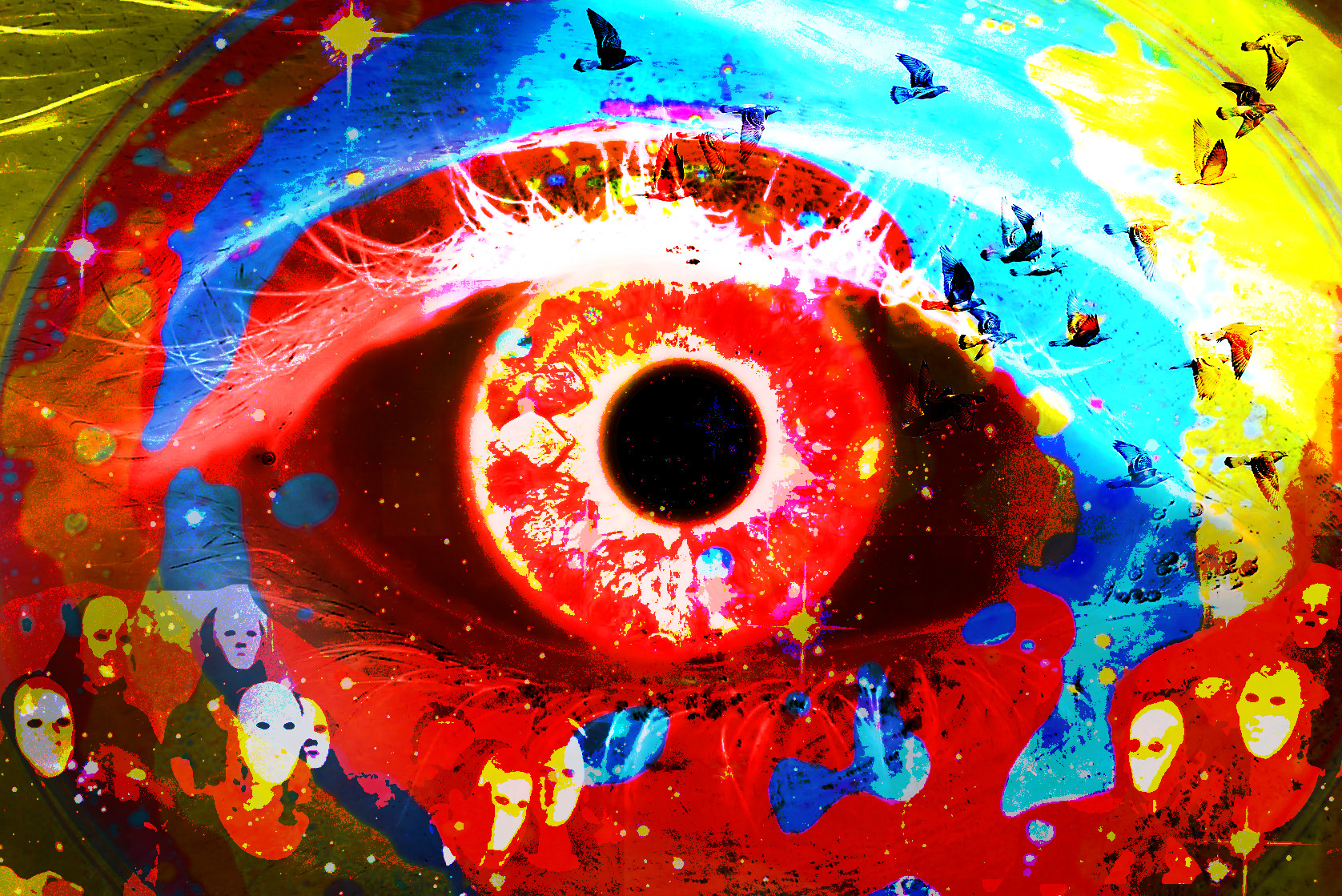
A psychedelic artwork

Psychedelic art (also known as psychedelia) is art, graphics or visual displays related to or inspired by psychedelic experiences and hallucinations known to follow the ingestion of psychedelic drugs such as LSD, psilocybin, and DMT. Coined by British psychologist Humphry Osmond, the term "psychedelic" means "mind revealing". By that definition, all artistic efforts to depict the inner world of the psyche may be considered "psychedelic".

In common parlance "psychedelic art" refers above all to the art movement of the late 1960s counterculture and early 1970s counterculture. Featuring highly distorted or surreal visuals, bright colors and full spectrums and animation (including cartoons) to evoke, convey, or enhance psychedelic experiences.

Psychedelic visual arts were a counterpart to psychedelic rock music. Concert posters, album covers, liquid light shows, liquid light art, murals, comic books, underground newspapers and more reflected not only the kaleidoscopically swirling colour patterns typical of psychedelic hallucinations, but also revolutionary political, social and spiritual sentiments inspired by insights derived from these psychedelic states of consciousness. In the 2000s there has been a revival of psychedelics and psychedelic art with some prominent artists, like Raul Lopez Pomares.

Features

[edit]
A liquid oil projection

Psychedelic visual art is a broad, widely-represented term, though it is commonly identifiable by its use of one or more of the listed subject matters:

  • Fantastic, metaphysical, and surrealistic subject matter
  • Kaleidoscopic, fractal, or paisley patterns
  • Bright and/or highly contrasting colors
  • Extreme depth of detail or stylization of detail, also called Horror vacui style
  • Morphing of objects, themes, and/or collages
  • Phosphenes, spirals, concentric circles, diffraction patterns, and other entoptic motifs
  • Repetition of motifs
  • Innovative typography and hand-lettering, including warping and transposition of positive and negative spaces

Origins

[edit]

Psychedelic art is informed by the notion that altered states of consciousness produced by psychedelic drugs are a source of artistic inspiration. The psychedelic art movement is similar to the surrealist movement in that it prescribes a mechanism for obtaining inspiration. Whereas the mechanism for surrealism is the observance of dreams, a psychedelic artist turns to drug induced hallucinations. Both movements have strong ties to important developments in science. Whereas the surrealist was fascinated by Sigmund Freud's theory of the unconscious, the psychedelic artist has been literally "turned on" by Albert Hofmann's discovery of LSD.

Mikhail Bulgakov was the first writer to describe narcotic hallucinations.Art researchers Tim Lapetino and James Orok trace the connection of psychedelic art with Dadaism, Surrealism, Lettrism, and Situationism.[1][2] Notable figures within the psychedelic art movement include Lautreamont, Louis-Ferdinand Celine, Stanislav Witkevich, Antonin Artaud, Georges Bataille, William Burroughs, De Quincey, Terence McKenna, and Carlos Castaneda.

Early examples of "psychedelic art" are literary rather than visual, although there are some examples in the Surrealist art movement, such as Remedios Varo and André Masson. Other early examples include Antonin Artaud who writes of his peyote experience in Voyage to the Land of the Tarahumara (1937) and Henri Michaux who wrote of his experiments with mescaline and hashish in his 1956 novel, Misérable Miracle.

Aldous Huxley's The Doors of Perception (1954) and Heaven and Hell (1956) remain definitive statements on the psychedelic experience.

Albert Hofmann and his colleagues at Sandoz Laboratories were convinced immediately after its discovery in 1943 of the power and promise of LSD. For two decades following its discovery LSD was marketed by Sandoz as an important drug for psychological and neurological research. Hofmann saw the drug's potential for poets and artists as well, and took great interest in the German writer Ernst Jünger's psychedelic experiments.

Early artistic experimentation with LSD was conducted in a clinical context by Los Angeles–based psychiatrist Oscar Janiger. Janiger asked a group of 50 different artists to each do a painting from life of a subject of the artist's choosing. They were subsequently asked to do the same painting while under the influence of LSD. The two paintings were compared by Janiger and also the artist. The artists almost unanimously reported LSD to be an enhancement to their creativity.

Ultimately it seems that psychedelics would be most warmly embraced by the American counterculture. Beatnik poets Allen Ginsberg and William S. Burroughs became fascinated by psychedelic drugs as early as the 1950s as evidenced by The Yage Letters (1963). The Beatniks recognized the role of psychedelics as sacred inebriants in Native American religious ritual, and also had an understanding of the philosophy of the surrealist and symbolist poets who called for a "complete disorientation of the senses" (to paraphrase Arthur Rimbaud). They knew that altered states of consciousness played a role in Eastern Mysticism. They were hip to psychedelics as psychiatric medicine. LSD was the perfect catalyst to electrify the eclectic mix of ideas assembled by the Beats into a cathartic, mass-distributed panacea for the soul of the succeeding generation.

In 1960s counterculture

[edit]
Cover of the San Francisco Oracle, Volume 1 No. 5, January 1967

Leading proponents of the 1960s psychedelic art movement were San Francisco poster artists such as: Rick Griffin, Victor Moscoso, Bonnie MacLean, Stanley Mouse & Alton Kelley, Bob Masse, and Wes Wilson. Their psychedelic rock concert posters were inspired by Art Nouveau, Victoriana, Dada, and Pop Art. The "Fillmore Posters" were among the most notable of the time. Richly saturated colors in glaring contrast, elaborately ornate lettering, strongly symmetrical composition, collage elements, rubber-like distortions, and bizarre iconography are all hallmarks of the San Francisco psychedelic poster art style. The style flourished from about 1966 to 1972. Their work was immediately influential to vinyl record album cover art, and indeed all of the aforementioned artists also created album covers.

Although San Francisco remained the hub of psychedelic art into the early 1970s, the style also developed internationally: British artist Bridget Riley became famous for her Op art paintings of psychedelic patterns creating optical illusions. Mati Klarwein created psychedelic masterpieces for Miles Davis' Jazz-Rock fusion albums, and also for Carlos Santana's Latin rock. Pink Floyd worked extensively with London-based designers, Hipgnosis to create graphics to support the concepts in their albums. Willem de Ridder created cover art for Van Morrison. Los Angeles area artists such as John Van Hamersveld, Warren Dayton and Art Bevacqua and New York artists Peter Max and Milton Glaser all produced posters for concerts or social commentary (such as the anti-war movement) that were highly collected during this time. Life Magazine's cover and lead article for the September 1, 1967 issue at the height of the Summer of Love focused on the explosion of psychedelic art on posters and the artists as leaders in the hippie counterculture community.

Psychedelic light-shows were a new art-form developed for rock concerts. Using oil and dye in an emulsion that was set between large convex lenses upon overhead projectors the lightshow artists created bubbling liquid visuals that pulsed in rhythm to the music. This was mixed with slideshows and film loops to create an improvisational motion picture art form to give visual representation to the improvisational jams of the rock bands and create a completely "trippy" atmosphere for the audience. The Brotherhood of Light were responsible for many of the light-shows in San Francisco psychedelic rock concerts.

Out of the psychedelic counterculture also arose a new genre of comic books: underground comix. "Zap Comix" was among the original underground comics, and featured the work of Robert Crumb, S. Clay Wilson, Victor Moscoso, Rick Griffin, and Robert Williams among others. Underground Comix were ribald, intensely satirical, and seemed to pursue weirdness for the sake of weirdness. Gilbert Shelton created perhaps the most enduring of underground cartoon characters, "The Fabulous Furry Freak Brothers", whose drugged out exploits held a hilarious mirror up to the hippy lifestyle of the 1960s.

Psychedelic art was also applied to the LSD itself. LSD began to be put on blotter paper in the early 1970s and this gave rise to blotter art, a specialized art form of decorating the blotter paper. Often the blotter paper was decorated with tiny insignia on each perforated square tab, but by the 1990s this had progressed to complete four color designs often involving an entire page of 900 or more tabs. Mark McCloud is a recognized authority on the history of LSD blotter art.

In corporate advertising

[edit]

By the late 1960s, the commercial potential of psychedelic art had become hard to ignore. General Electric, for instance, promoted clocks with designs by New York artist Peter Max. A caption explains that each of Max's clocks "transposes time into multi-fantasy colors."[3] In this and many other corporate advertisements of the late 1960s featuring psychedelic themes, the psychedelic product was often kept at arm's length from the corporate image: while advertisements may have reflected the swirls and colors of an LSD trip, the black-and-white company logo maintained a healthy visual distance. Several companies, however, more explicitly associated themselves with psychedelica: CBS, Neiman Marcus, and NBC all featured thoroughly psychedelic advertisements between 1968 and 1969.[4] In 1968, Campbell's soup ran a poster promotion that promised to "Turn your wall souper-delic!"[5]

The Art Of Peter Max

The early years of the 1970s saw advertisers using psychedelic art to sell a limitless array of consumer goods. Hair products, cars, cigarettes, and even pantyhose became colorful acts of pseudo-rebellion.[6] The Chelsea National Bank commissioned a psychedelic landscape by Peter Max, and neon green, pink, and blue monkeys inhabited advertisements for a zoo.[7] A fantasy land of colorful, swirling, psychedelic bubbles provided the perfect backdrop for a Clearasil ad.[8] As Brian Wells explains, "The psychedelic movement has, through the work of artists, designers, and writers, achieved an astonishing degree of cultural diffusion… but, though a great deal of diffusion has taken place, so, too, has a great deal of dilution and distortion."[9] Even the term "psychedelic" itself underwent a semantic shift, and soon came to mean "anything in youth culture which is colorful, or unusual, or fashionable."[10] Puns using the concept of "tripping" abounded: as an advertisement for London Britches declared, their product was "great on trips!"[11] By the mid-1970s, the psychedelic art movement had been largely co-opted by mainstream commercial forces, incorporated into the very system of capitalism that the hippies had struggled so hard to change.

Other material

[edit]

Examples of other psychedelic art material are tapestry, blacklight posters printed with fluorescent ink against backgrounds of velvet black which are intended for display under an ultraviolet lamp which causes the colors to glow in the dark, paisley printed cloths, tie-dyed or batiked curtains and stickers with designs and slogans written in loopy, art nouveau-like fonts,[12] clothing,[13] canvas and other printed artefacts[14] and furniture.[15]

Digital age

[edit]
Fractal artwork created using a Julia set

Computer art has allowed for an even greater and more profuse expression of psychedelic vision. Fractal generating software gives an accurate depiction of psychedelic hallucinatory patterns, but even more importantly 2D and 3D graphics software allow for unparalleled freedom of image manipulation. Much of the graphics software seems to permit a direct translation of the psychedelic vision. The "digital revolution" was indeed heralded early on as the "New LSD" by none other than Timothy Leary.[16][17]

DeepDream modified toast sandwich

The rave movement of the 1990s was a psychedelic renaissance fueled by the advent of newly available digital technologies. The rave movement developed a new graphic art style partially influenced by 1960s psychedelic poster art, but also strongly influenced by graffiti art, and by 1970s advertising art, yet clearly defined by what digital art and computer graphics software and home computers had to offer at the time of creation. Conversely, the convolutional neural network DeepDream finds and enhances patterns in images purely via algorithmic pareidolia.

Concurrent to the rave movement, and in key respects integral to it, are the development of new mind-altering drugs, most notably, MDMA (Ecstasy). Ecstasy, like LSD, has had a tangible influence on culture and aesthetics, particularly the aesthetics of rave culture. But MDMA is (arguably) not a real psychedelic, but is described by psychologists as an entactogen. Development of new psychedelics such as 2C-B and related compounds (developed primarily by chemist Alexander Shulgin) which are truly psychedelic has provided a fertile ground for artistic exploration since many of the new psychedelics possess their own unique properties that will affect the artist's vision accordingly.

Even as fashions have changed, and art and culture movements have come and gone, certain artists have steadfastly devoted themselves to psychedelia. Well-known examples are Amanda Sage, Alex Grey, and Robert Venosa. These artists have developed unique and distinct styles that while containing elements that are "psychedelic", are clearly artistic expressions that transcend simple categorization. While it is not necessary to use psychedelics to arrive at such a stage of artistic development, serious psychedelic artists are demonstrating that there is tangible technique to obtaining visions, and that technique is the creative use of psychedelic drugs.

Psychedelic artists

[edit]

See also

[edit]

Notes and references

[edit]

Further reading

[edit]
[edit]
Revisions and contributorsEdit on WikipediaRead on Wikipedia
from Grokipedia

Psychedelic art comprises visual works created to replicate or evoke the perceptual distortions and hallucinations associated with psychedelic substances like , typically employing vivid, clashing colors, intricate swirling patterns, and biomorphic or surreal forms. This style crystallized in the mid-1960s amid the American , where artists drew direct inspiration from drug-induced states to challenge conventional representations of reality.
The movement's prominence stemmed from its application in promotional materials for rock concerts and , particularly in San Francisco's district, where designers produced posters featuring vibrating lines, melting text, and optical effects to mirror altered consciousness. Key figures such as pioneered fluid, illegible typography and layered compositions for venues like Auditorium, establishing a visual lexicon that extended to album art and light shows. further disseminated the aesthetic through commercial illustrations, blending cosmic motifs with pop culture icons to achieve widespread commercial success. While psychedelic art symbolized liberation from materialist norms and fostered innovations in , its inextricable link to use provoked backlash as recreational drug excesses overshadowed potential therapeutic insights, contributing to the style's decline by the early 1970s amid legal prohibitions on substances like . Recent digital revivals, incorporating fractals and AI-generated imagery, suggest enduring interest in simulating psychedelic visions without pharmacological means, though empirical studies on their psychological impacts remain nascent.

Definition and Characteristics

Visual and Stylistic Features

Psychedelic art employs vivid, highly saturated colors arranged in stark contrasts to evoke intensity and visual , often from the perceptual distortions reported in hallucinogenic experiences. Intricate geometric patterns and swirling, curvaceous forms predominate, frequently inspired by motifs and Eastern decorative traditions, creating a sense of fluid motion and depth. Optical illusions and vibrations are central stylistic devices, achieved through clashing and repetitive motifs that produce moiré effects or apparent movement, mimicking synesthetic or of . Surreal and distorted imagery, including melting forms, fragmented figures, and fantastical elements, blends reality with dreamlike abstraction to challenge conventional representation. in psychedelic works often features illegible, hand-drawn lettering with elongated, wavy strokes that integrate seamlessly into the overall composition, prioritizing aesthetic impact over readability. These features combine in densely detailed compositions that overload the senses, with layered elements and symmetrical arrangements enhancing the hallucinatory quality, as seen in posters from the 1960s scene where artists like exploited for vibrational effects. The style's emphasis on brightness and pattern density reflects a deliberate mimicry of psychedelic drug-induced visuals, such as enhanced color and , without relying on narrative coherence. Psychedelic experiences, typically induced by serotonergic psychedelics such as lysergic acid diethylamide (LSD) and , produce distinctive visual alterations including enhanced color saturation, geometric hallucinations, and fluid distortions of perceived forms, which directly informed the stylistic hallmarks of psychedelic art. These perceptual changes arise from psychedelics' agonism of 5-HT2A serotonin receptors, leading to hypersynchrony in cortical networks and amplified that manifests as vivid, pattern-forming imagery often described as "form constants" by researchers like Heinrich Klüver in the . Artists in the mid-20th century, particularly during the , drew upon such drug-induced visions to create works that replicated or evoked these phenomena, as evidenced by accounts from figures like , whose 1954 mescaline report in The Doors of Perception detailed "doors of perception" opening to reveal intensified visual fields akin to artistic . The causal connection between these experiences and art lies in artists' deliberate emulation of hallucinatory content; for instance, users reported seeing swirling, radiant motifs and synesthetic overlays, which translated into paintings and graphics featuring melting edges, fractal-like repetitions, and bioluminescent hues to convey the subjective intensity of altered consciousness. Empirical studies confirm that psychedelics disrupt activity, fostering ego-dissolution and heightened that parallels the non-representational, immersive quality of psychedelic artworks, rather than mere stylistic whim. Historical evidence from practitioners, including poster designers for San Francisco's music scene, substantiates this link, as many explicitly credited ingestion—legal until October 1966—for inspiring their output, with visuals designed not just to decorate but to simulate trip-like perceptual shifts. While some psychedelic art predates widespread synthetic psychedelic use, the 1960s surge marked a explicit tethering to pharmacological experiences, distinguishing it from prior visionary traditions by its reliance on reproducible chemical induction rather than meditation or pathology. Recent neuroimaging corroborates the overlap, showing psilocybin's alteration of low-level visual processing—such as texture salience and edge detection—mirrors the optical illusions embedded in psychedelic graphics, suggesting art as a mnemonic or preparatory tool for such states. This representational fidelity underscores psychedelic art's role in documenting empirical phenomenology, though interpretations vary, with some researchers cautioning against over-romanticizing unverified subjective reports amid potential recall biases in post-trip recall.

Historical Precursors

Early Visionary and Optical Influences

Early , characterized by depictions of mystical, fantastical, and otherworldly scenes, provided a foundational influence on the surreal and hallucinatory later adopted in psychedelic art. , a Dutch painter active from around 1450 to 1516, created intricate triptychs such as (c. 1490–1510), featuring bizarre hybrid creatures, dreamlike landscapes, and symbolic narratives that evoke altered perceptual states, prefiguring the visionary intensity of psychedelic imagery. Similarly, (1757–1827), an English poet and artist, illustrated prophetic visions influenced by spiritual revelations, as seen in works like (1794), where ethereal figures and symbolic motifs convey transcendent experiences that resonate with the introspective dimensions of psychedelic expression. These artists' emphasis on inner visions and symbolic distortion, derived from rather than chemical induction, established a tradition of art challenging conventional reality, which psychedelic creators in the explicitly referenced for their non-literal representations of consciousness. Optical art, emerging in the mid-20th century, contributed perceptual and geometric elements that paralleled the visual distortions reported in psychedelic experiences, serving as a direct stylistic precursor. , born in 1906, pioneered with works like Zebra (1937), employing contrasting patterns to generate illusory movement and depth, techniques that manipulated viewer through retinal effects rather than explicit drug references. By the 1950s and 1960s, artists such as (born 1931) advanced this with black-and-white undulating lines in paintings like Movement in Squares (1961), creating pulsating illusions akin to hallucinatory afterimages. Op art's reliance on , moiré patterns, and kinetic vibration influenced psychedelic posters and album covers by providing a visual vocabulary for instability and flux, with exhibitions in 1965, such as The Responsive Eye at the , bridging abstract optical experiments to the burgeoning counterculture's interest in perceptual expansion. This convergence of optical precision and visionary laid the groundwork for psychedelic art's fusion of rational geometric play with irrational, mind-expanding motifs.

Mid-20th Century Experiments

In the mid-20th century, prior to the explosion, isolated scientific and personal experiments with hallucinogens like and prompted early artistic attempts to capture altered perceptual states, laying groundwork for later psychedelic aesthetics. These efforts were often conducted in clinical or introspective contexts rather than communal or commercial ones, focusing on documenting subjective visual phenomena such as distortions, vibrations, and synesthetic overlays. Franco-Belgian poet and artist Henri Michaux initiated systematic experiments with mescaline in January 1955, deriving the substance from peyote cacti to explore its effects on consciousness and mark-making. Over subsequent sessions, he produced approximately 300 drawings in pen, pencil, and charcoal, rendering jittery lines, fragmented forms, and pulsating energies intended to convey the drug's disruptive impact on spatial perception and bodily sensation. Michaux created these works from immediate recollection after the mescaline effects subsided, emphasizing in his 1956 book Miserable Miracle that they represented not direct transcriptions but faithful evocations of the substance's "nauseating reality" and inner turmoil, distinct from his prior abstract style. His approach prioritized empirical self-observation over aesthetic embellishment, influencing subsequent explorations of drug-induced visuals by highlighting mescaline's capacity to dismantle conventional pictorial coherence. Concurrently, integrated into psychedelic studies to assess impacts on . In the , Oscar Janiger administered to over 200 in controlled settings, observing how the compound—typically in 50- to 200-microgram doses—altered drawing processes and outputs. A documented case involved an unidentified receiving two 50-microgram doses of spaced about an hour apart, who then produced nine sequential self-portraits over several hours, illustrating progressive shifts from realistic features to distorted, fluid expressions mirroring escalating perceptual dissolution. These experiments, rooted in psychiatric inquiry rather than artistic intent, yielded artifacts showing intensified color vibrancy, morphing contours, and heightened emotional intensity, providing empirical data on 's influence on visual cognition without endorsing recreational use. Such work underscored causal links between serotonergic psychedelics and perceptual anomalies, though outputs varied by individual baseline skills and dosage, with no uniform "psychedelic style" emerging.

Emergence in the 1960s

San Francisco Counterculture Context

The counterculture of the mid-1960s, particularly in the district, formed the epicenter for psychedelic art's development amid a rejection of mainstream societal norms, including the and consumerist materialism. This movement evolved from the earlier Beat Generation's bohemian ethos but intensified with the influx of youth seeking alternative lifestyles, communal experiments, and sensory expansion through hallucinogens. , synthesized by in 1943 and popularized in the U.S. by figures like , became central, with its perceptual distortions directly influencing artistic expressions that sought to visualize altered states of consciousness. Ken Kesey and his catalyzed this scene through "Acid Tests," multimedia events starting December 4, 1965, in San Jose and extending into by October 1966, where attendees consumed LSD-spiked beverages amid improvisational music, lights, and . These gatherings, featuring the , emphasized spontaneous creativity and sensory overload, laying groundwork for psychedelic aesthetics in visual media. The January 14, 1967, in , attended by 20,000 to 30,000 participants, marked a pivotal convergence of political —such as opposition to —and hippie ideals of and drug exploration, publicized via underground newspapers like the San Francisco Oracle. The ensuing in 1967 drew an estimated 100,000 young people to , fostering a vibrant scene at venues like Auditorium and , where concert posters began embodying psychedelic visuals—vibrant colors, distorted typography, and illusory patterns—to evoke LSD-induced hallucinations. This period's emphasis on experiential art, free from conventional structures, directly spurred the creation of posters and graphics that captured the movement's hallucinatory ethos, blending Eastern mysticism, optical art influences, and drug-fueled visions into a distinctive style. Despite later challenges like overcrowding and drug-related issues, the counterculture's peak provided the fertile ground for psychedelic art's rapid proliferation.

Development of Psychedelic Posters

Psychedelic posters originated in 's burgeoning scene in the mid-1960s, primarily as handbills and announcements for rock concerts at venues like Auditorium and . Promoter Bill Graham commissioned the first notable examples for Fillmore events starting in 1965, marking the shift from standard promotional graphics to visually experimental designs intended to evoke altered states of consciousness. These posters drew from the era's widespread experimentation with and other hallucinogens, aiming to visually simulate psychedelic experiences through distorted forms and intense colors. Robert Wesley "Wes" Wilson pioneered the style in 1965 with his designs for Fillmore Auditorium concerts, introducing swirling, illegible typography inspired by artists like but warped to mimic hallucinatory fluidity. Wilson's approach emphasized curvilinear shapes and overlapping elements, setting a template that other artists adapted for subsequent posters promoting bands such as the and . By 1966, contributed to the under promoter , innovating with optical illusions and complementary color vibrations—such as pairing intense reds with greens—to create visual "afterimages" that pulsed on the page. The "Big Five" artists—Wilson, Moscoso, , , and Alton Kelley—collaborated and competed, producing over 500 distinct posters between 1966 and 1971, with peak output from 1967 to 1969. Their work was printed using photo-offset , which enabled rapid production of vibrant, multi-layered designs on affordable stock paper, often incorporating Day-Glo fluorescent inks for heightened luminosity under . This technique allowed small print shops to handle the high volume demanded by weekly events, though it sometimes resulted in inconsistent registration that added to the organic, mind-bending aesthetic. A pivotal moment came in July 1967 with the "Joint Show" at San Francisco's Moore Gallery, where these artists exhibited together for the first time, elevating posters from to collectible and attracting national attention. The movement's development reflected causal links between venue economics—needing eye-catching ads for emerging rock acts—and cultural shifts toward , though commercial replication later diluted some original innovations. By 1968, stylistic refinements included Griffin's intricate line work and Mouse-Kelley's motifs, broadening the genre's while maintaining ties to the hippie ethos.

Commercialization and Expansion

Applications in Advertising

By the late , corporations recognized the commercial appeal of psychedelic art's vibrant, surreal aesthetics, employing it to target youth demographics amid the counterculture's influence. Artists such as , who popularized cosmic and flowing motifs, produced designs for major brands, integrating hallucinatory patterns with product endorsements to convey innovation and liberation. For example, in 1968, commissioned Max for advertisements featuring psychedelic clocks and optical illusions to promote timepieces and electronics, emphasizing "the absolutely wild, wonderful way to tell time." Beverage companies also embraced the style in the early 1970s. A Pepsi-Cola ad from that decade depicted swirling kaleidoscopic patterns, dancing snacks, and surreal transformations in a manner akin to Max's , aiming to evoke sensory excitement. Similarly, 7-Up aired commercials animated in Max's psychedelic vein, using bold colors and fluid forms to associate the with youthful energy. The trend extended to diverse products, with advertisers applying psychedelic graphics to hair care, automobiles, cigarettes, and between the late and early 1970s. Woolworths UK, for instance, promoted its "Baby Doll" line through groovy, swirling ads in the , leveraging optical vibrations and curvilinear shapes to appeal to emerging consumer tastes. This adoption reflected strategic assimilation of countercultural visuals into mainstream marketing, prioritizing visual impact over original subversive intent.

Use in Other Media and Products

Psychedelic art found extensive application in album covers during the late , where designers employed swirling colors, optical illusions, and surreal motifs to evoke the associated with the era's music. For instance, ' The Psychedelic Sounds of the 13th Floor Elevators (1966) featured bold, fragmented imagery that presaged the style's proliferation, while Love's (1967) incorporated intricate, vibrant patterns reflecting countercultural themes. Pink Floyd's The Piper at the Gates of Dawn (1967) exemplified this with its dreamlike, cosmic visuals, aligning artwork directly with the genre's sensory immersion. In and textiles, psychedelic aesthetics influenced clothing and fabrics from the late into the early , characterized by brilliant, clashing colors and fluid, movement-evoking patterns that mirrored hallucinatory experiences. subculture adopted these designs in garments like tie-dye derivatives and printed dresses, rejecting conventional styles for expressive, anti-consumerist visuals, as documented in period and analyses. Luxurious fabrics with eye-popping motifs became commercial staples, extending the art form into wearable products and home textiles, though often diluted for mass appeal. Beyond apparel, artists like integrated psychedelic elements into consumer products and packaging, mainstreaming the style through items such as posters adapted for merchandise and advertising campaigns that featured ornate, vibrant illustrations. This commercialization included motifs on book covers, novelty goods, and early branding efforts, where the art's visual intensity aimed to capture attention in retail contexts, though critics noted its shift from underground origins to commodified . Such uses proliferated in the , with patterns influencing product designs like wallpapers and household items, blending artistic experimentation with market-driven replication.

Decline and Digital Revival

Post-1960s Waning

Following the peak of psychedelic art in the late , associated with San Francisco's concert poster scene and countercultural publications, the style rapidly declined by the early 1970s due to legal restrictions on hallucinogens and shifting cultural priorities. , central to the aesthetic's inspiration, faced federal starting with emergency scheduling in October 1968, which stigmatized drug-influenced creativity and prompted self-censorship among artists. This backlash extended to visual expression, as galleries and critics distanced themselves from associations with illegal substances, rendering the art by 1970. Commercial co-optation further eroded the movement's subversive appeal, with corporations adopting swirling motifs and vibrant colors for advertising—evident in products from to Campbell's Soup—transforming a countercultural idiom into mainstream . The district, epicenter of the 1967 , unraveled amid overcrowding, crime, and disillusionment, while key countercultural figures like and died in 1970, symbolizing the era's end. As participants aged into the , optimism yielded to economic realities and harder-edged cultural trends like , diminishing demand for psychedelic posters and graphics. Artistic critiques compounded the fade, portraying psychedelic works as superficially decorative and lacking intellectual rigor compared to concurrent high-modernist movements such as and . Lacking canonical figures embraced by institutions, the style remained confined to ephemeral commercial formats, failing to evolve into a sustained movement. By the mid-1970s, psychedelic aesthetics had receded from prominence, surviving only in niche revivals or ironic appropriations, as broader design shifted toward cleaner, postmodern forms.

Contemporary Digital and Therapeutic Contexts

The digital revival of psychedelic art accelerated in the late with the advent of accessible computing power, enabling artists to generate complex geometries that mimic the recursive patterns reported in hallucinogenic states. , emerging prominently from the mid-1980s, utilizes mathematical algorithms to produce self-similar structures with infinite detail, often evoking the visual distortions associated with psychedelics like . Software such as Fractal Explorer and modern tools like 3D have facilitated this, allowing for vibrant, morphing visuals unattainable by traditional media. In the , advancements in AI and further expanded digital psychedelic expression, exemplified by Google's algorithm introduced in 2015, which amplifies patterns to create surreal, hallucinatory imagery resembling psychedelic visions. Artists like Android Jones have leveraged software and VR technologies to craft immersive works that blend organic forms with algorithmic precision, exhibited in festivals such as since the 2000s. These tools democratized creation, leading to widespread use in music videos, album covers, and online communities by the , reviving interest amid a broader psychedelic . Contemporaneously, psychedelic art has integrated into therapeutic contexts within clinical psychedelic-assisted protocols, particularly since the resurgence of research in the early 2000s. In trials involving and , visual art serves as a preparatory tool to familiarize patients with , with studies showing exposure to psychedelic-inspired imagery reduces anxiety pre-session. During integration phases post-dosing, interventions—such as drawing mandalas or viewing projections—aid in processing non-verbal insights, with a 2024 randomized study finding that interaction with psychedelic art correlates with improved emotional regulation and creativity metrics in participants. A 2024 review of clinical practices highlights specific use cases, including as a non-pharmacological adjunct in MDMA-assisted therapy for PTSD, where patients create visuals to externalize trauma narratives, potentially enhancing and insight retention. Empirical data from such interventions, drawn from over 20 peer-reviewed protocols since 2010, indicate modest effect sizes in symptom reduction, though remains debated due to small sample sizes and subjective reporting; proponents attribute benefits to art's in bridging to conscious reflection, while skeptics caution against overinterpreting anecdotal outcomes amid regulatory . This therapeutic application underscores a shift from recreational to evidence-based contexts, with institutions like incorporating art elements in studies since 2006.

Key Artists and Works

Pioneering Poster Designers

pioneered the psychedelic poster aesthetic in 1966 through commissions from promoter Bill Graham for concerts at Auditorium in , where he distorted Art Nouveau-inspired lettering into swirling, elastic forms intended to visually simulate of consciousness. His debut in this vein, a for dated January 1966, is widely regarded as the first true example of the style, featuring elongated, overlapping typography that defied legibility for hallucinatory effect. Wilson produced approximately 40 such posters for that year alone, establishing a template that fused historical graphic influences like the with countercultural experimentation. , Graham's wife and in-house designer after Wilson's departure in 1967, contributed over 30 posters through 1968, employing bold, illustrative motifs and custom lettering derived from Fillmore's blackboard announcements, as seen in her 1967 design for The Yardbirds and . At the under ' Family Dog Productions, advanced optical techniques starting in late 1966, employing complementary color pairs of equivalent brightness—such as yellow on purple—to induce visual vibrations and afterimages replicating or perceptions. His , including posters for in 1967, emphasized geometric patterns and illegible text to prioritize sensory disruption over information. Stanley Mouse and Alton Kelley, collaborating from June 1966 on Avalon posters, adapted Victorian woodcuts and illustrations into dense, ornamental compositions, producing 26 of the next 36 designs for Helms and creating enduring icons like the 1966 "Skull and Roses" imagery borrowed from a 19th-century . joined the scene around 1967, infusing posters with fine-line calligraphy, skeletal motifs, and motifs from surfing culture and underground comics, as in his design and works that layered mystical symbolism. Together, these artists—often termed the "Big Five"—formalized the genre through the 1967 Berkeley Bonaparte agency, which handled printing and distribution of over 700 posters by 1972, prioritizing silkscreen and offset lithography for amid the era's concert boom. Parallel to these concert-focused pioneers, Funky Features, co-founded by Paul Olsen with Jack Leahy and Sam Ridge in San Francisco's Haight-Ashbury in 1967, produced psychedelic posters for head shops using blacklight and thematic designs. Key works include Olsen's "Light My Fire," a Doors-inspired blacklight best-seller, and the collaborative Zodiac series. A 1968 Saturday Evening Post article on the poster craze identified Olsen as a leading Bay Area producer alongside Wes Wilson and Victor Moscoso, noting Funky Features' commercial viability with monthly warehouse distribution grosses of $25,000.

Notable Illustrators and Visionaries

Peter Max (1937–2024), a German-American , developed a distinctive psychedelic style in the 1960s featuring bold colors, cosmic symbols, and curvilinear forms influenced by , , and . His illustrations proliferated in commercial applications, including advertisements for General Electric's 1968 "Cosmos Series" and products like apparel and postage stamps, embodying the era's countercultural optimism. Abdul Mati Klarwein (1932–2002), a German painter and illustrator, crafted surreal visionary works blending psychedelic elements with Tantric and African motifs, gained prominence through album covers such as Miles Davis's (released March 30, 1970) and Santana's (released September 1970). His imagery, characterized by dreamlike compositions and optical illusions, reflected travels to , , and , transcending mere to incorporate metaphysical themes. Alex Grey (born November 29, 1953), an American visionary artist, produces detailed illustrations revealing layered human anatomy intertwined with spiritual energies, often derived from entheogenic experiences and meditation. His seminal Sacred Mirrors series, first exhibited in 1985, depicts translucent bodies exposing skeletal, muscular, and subtle energy systems, influencing psychedelic and therapeutic art contexts. Grey's works, including contributions to Tool's album artwork (1996), emphasize universal consciousness and have been displayed at institutions like the .

Criticisms and Controversies

Debates on Artistic Merit

Critics of psychedelic art have often contended that its merit derives primarily from sensory immediacy rather than intrinsic artistic depth, positioning it as a transient of hallucinogenic experiences rather than a standalone achievement. In a 1984 Artforum retrospective, the style was characterized as "immediate and disposable," with its value "measured only by its effect," leading to widespread disposal of psychedelic objects after initial for head shops. Dealer Ivan Karp dismissed it outright, stating, "It doesn’t exist," implying a lack of independent substance detached from the chemical catalysts like that inspired it. Similarly, critic John Perreault argued that true psychedelic art required for efficacy: "If it didn’t need acid to be effective then it probably wasn’t really psychedelic art; it was probably art." This perspective frames psychedelic visuals—bold colors, optical distortions, and biomorphic forms—as mere imitations of drug-induced hallucinations, prioritizing spectacle over technical mastery or conceptual rigor. Art historian Robert E. L. Masters and psychologist , in their 1968 analysis, noted that such imagery often replicated perceptual anomalies from psychedelics but struggled to transcend them into broader aesthetic innovation. Detractors further highlighted its commercial origins in 1960s posters, suggesting the form's exuberance quickly devolved into monotony, akin to repetitive holiday snapshots devoid of evolving narrative. A related contention labels psychedelic art as , defined as pseudo-art involving emotional manipulation or garish sentimentality without authentic expression. Proponents of this view argue that its clichéd motifs, such as swirling patterns and Day-Glo fluorescents, cater to facile tastes, undermining claims to status; for instance, later installations evoking the style were critiqued as "funny" rather than profound. However, defenders counter that elements do not inherently negate merit, viewing them as stylistic biases rather than disqualifiers, with psychedelic works potentially retaining therapeutic or perceptual value beyond traditional canons. Despite these critiques, some art observers maintain that psychedelic art's innovation in and perceptual expansion warrants reevaluation, influencing subsequent movements like or digital visuals, though its drug dependency raises causal questions about whether alone suffice for enduring artistic legitimacy. Empirical assessments, such as its limited presence in major collections compared to commercial archives, underscore ongoing regarding its transcendence from countercultural ephemera.

Risks Tied to Drug Inspirations

The use of hallucinogenic substances such as , , and to inspire psychedelic art carries risks of acute psychological distress, including intense anxiety, panic attacks, and dissociative states during intoxication, which can disrupt creative processes and lead to emergency medical interventions. These "bad trips" are typically self-limiting but have been documented in clinical settings as causing temporary elevations in , , and body temperature, with rare instances escalating to or behavioral emergencies. While no fatalities are directly attributed to the pharmacological toxicity of or similar psychedelics, the subjective intensity of experiences can precipitate accidents or , particularly when artists experiment in unsupervised environments to capture altered perceptions for visual motifs. Long-term hazards include (HPPD), characterized by recurrent visual disturbances such as trails, halos, or geometric patterns persisting months or years after drug cessation, potentially impairing an artist's ability to discern sober reality from drug-induced echoes in their work. Systematic reviews indicate HPPD affects a subset of users, with Type II variants proving irreversible and linked to serotonergic disruptions, though prevalence remains low at under 5% in surveyed populations. Additionally, psychedelics can trigger or exacerbate latent psychotic episodes in individuals with predispositions, such as spectrum disorders, leading to prolonged delusions or that may confound artistic output with pathological imagery. Case analyses of negative responses highlight anxiety and depression as common sequelae, with implicated in 47% of reported enduring psychiatric symptoms among users. Artists, who empirical studies show exhibit higher rates of psychoactive substance use than non-art professionals, face amplified vulnerabilities due to repeated dosing for inspiration, correlating with elevated incidences of mood disorders and perceptual anomalies. This pattern underscores a causal link between habitual psychedelic experimentation—often pursued to evoke the swirling, synesthetic forms central to the —and heightened psychological morbidity, independent of artistic productivity gains. While therapeutic contexts mitigate some risks through controlled administration, the improvisational, high-dose regimens typical in production lacked such safeguards, contributing to anecdotal reports of creative burnout or institutionalization among practitioners. Overall, these drug-related perils highlight a wherein the perceptual innovations driving psychedelic stem from substances whose neurochemical volatility demands caution, especially absent empirical validation of net benefits for non-clinical .

Cultural Impact and Legacy

Influences on Design and Pop Culture

Psychedelic art profoundly shaped in the mid-1960s, particularly through San Francisco's concert posters featuring Art Nouveau-inspired curvilinear forms, distorted , and vibrant, optically vibrating colors that mimicked hallucinatory experiences. These elements broke from modernist precision, introducing fluid, melting shapes into and influencing subsequent poster and . Designers like pioneered illegible, hand-drawn lettering that prioritized sensory impact over readability, setting precedents for expressive in promotional materials. In music packaging, psychedelic aesthetics defined numerous 1960s album covers, such as Love's Forever Changes (1967) with its surreal collage and The 13th Floor Elevators' The Psychedelic Sounds of... (1966) incorporating hypnotic patterns and bold hues to evoke . This style extended to and promotions, where swirling motifs and Day-Glo palettes proliferated, embedding psychedelic visuals into mainstream promotional culture by the late 1960s. Fashion drew heavily from psychedelic art's emphasis on bold, clashing colors, fractal-like prints, and organic swirls, fueling the counterculture's adoption of fabrics and flowing silhouettes that reflected LSD-induced perceptual shifts. Designers incorporated these into apparel and accessories, influencing wardrobes and later revivals, such as the resurgence of vibrant, pattern-heavy trends in and festival fashion. In broader pop culture, the movement permeated film graphics, branding, and media visuals, with its kaleidoscopic patterns inspiring everything from MTV-era effects to contemporary digital animations. Contemporary design continues to echo these influences, evident in 2020s graphic trends featuring intense gradients and surreal distortions in branding and web interfaces, alongside lines reviving and optical illusions for sustainable, expressive collections. This enduring legacy demonstrates how 1960s psychedelic experimentation catalyzed a shift toward sensory-driven in visual and , persisting through periodic revivals amid renewed interest in altered consciousness.

Broader Societal Ramifications

Psychedelic art served as a visual conduit for the counterculture's challenge to established , embedding motifs of distortion and vibrancy into symbols of sentiment. This aesthetic, prominently featured in posters and underground periodicals, aligned with opposition to the and support for civil rights, catalyzing radical ideation among youth by portraying altered perception as a pathway to societal critique. By 1967, publications like the Oracle utilized such imagery to propagate calls for peace and communal living, contributing to the mobilization of over 400,000 participants in events like the 1969 Woodstock festival, which exemplified the era's fusion of art, music, and activism. The art's emphasis on subjective experience over objective realism fostered a broader cultural pivot toward in and , influencing subsequent generations' of institutional narratives. This shift paralleled the counterculture's integration of Eastern philosophies and , evident in works drawing from and fractal-like patterns, which encouraged exploration of non-materialist paradigms. Empirical analyses link this to enduring changes in social norms, including diminished deference to traditional hierarchies, as seen in the movement's advocacy for personal autonomy that persisted into the 1970s' and phenomena. In modern contexts, psychedelic art's ramifications extend to discourse, where its patterns evoke restorative psychological effects without pharmacological intervention. A 2024 study found that viewing digitally rendered psychedelic artwork elevated viewers' reported emotional and reduced perceived stress, positioning it as a non-invasive tool in clinical environments akin to protocols. This aligns with psychedelics' embedded role in post-New Deal political economies, where cultural expressions like psychedelic visuals have indirectly supported efforts—such as Oregon's 2020 Measure 109 legalizing —by normalizing associative in public consciousness. However, critics attribute to this legacy a facilitation of escapist tendencies, correlating with elevated substance experimentation rates among countercultural adherents, though causal links remain debated in longitudinal data.

References

Add your contribution
Related Hubs
User Avatar
No comments yet.