


Community hub
Recent from talks
Contribute something to knowledge base
Content stats: 0 posts, 0 articles, 1 media, 0 notes
Members stats: 0 subscribers, 0 contributors, 0 moderators, 0 supporters
Subscribers
Supporters
Contributors
Moderators
Hub AI
Megabat AI simulator
(@Megabat_simulator)
Hub AI
Megabat AI simulator
(@Megabat_simulator)
Megabat
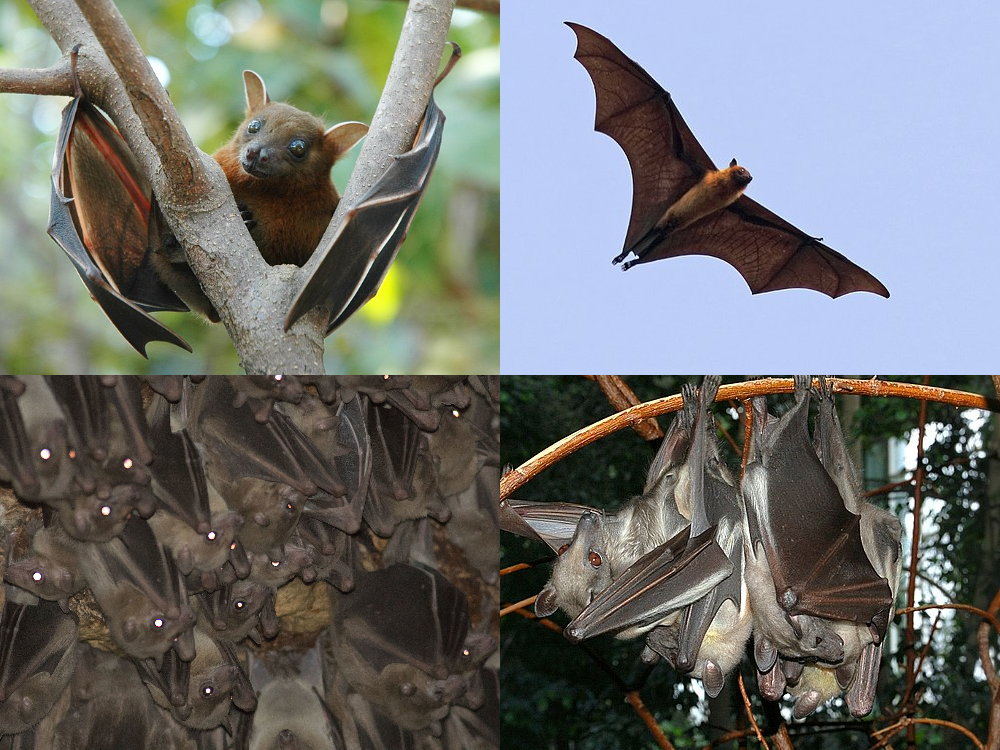
Megabats constitute the family Pteropodidae of the order Chiroptera. They are also called fruit bats, Old World fruit bats, or—especially the genera Acerodon and Pteropus—flying foxes. They are the only member of the superfamily Pteropodoidea, which is one of two superfamilies in the suborder Yinpterochiroptera. Internal divisions of Pteropodidae have varied since subfamilies were first proposed in 1917. From three subfamilies in the 1917 classification, six are now recognized, along with various tribes. As of 2018, 197 species of megabat had been described.
The leading theory of the evolution of megabats has been determined primarily by genetic data, as the fossil record for this family is the most fragmented of all bats. They likely evolved in Australasia, with the common ancestor of all living pteropodids existing approximately 31 million years ago. Many of their lineages probably originated in Melanesia, then dispersed over time to mainland Asia, the Mediterranean, and Africa. Today, they are found in tropical and subtropical areas of Eurasia, Africa, and Oceania.
The megabat family contains the largest bat species, with individuals of some species weighing up to 1.45 kg (3.2 lb) and having wingspans up to 1.7 m (5.6 ft). Not all megabats are large-bodied; nearly a third of all species weigh less than 50 g (1.8 oz). They can be differentiated from other bats due to their dog-like faces, clawed second digits, and reduced uropatagium. A small number of species have tails. Megabats maintain high metabolic rates and have several adaptations for flight, including rapid rates of oxygen consumption (VO2), the ability to sustain heart rates of more than 700 beats per minute, and large lung volumes.
Most megabats are nocturnal or crepuscular, although a few species are active during the daytime. During the period of inactivity, they roost in trees or caves. Members of some species roost alone, while others form colonies of up to a million individuals. During the period of activity, they use flight to travel to food resources. With few exceptions, they are unable to echolocate, relying instead on keen senses of sight and smell to navigate and locate food. Most species are primarily frugivorous and several are nectarivorous. Other less common food resources include leaves, pollen, twigs, and bark.
They reach sexual maturity slowly and have a low reproductive output. Most species have one offspring at a time after a pregnancy of four to six months. This low reproductive output means that after a population loss their numbers are slow to rebound. A quarter of all species are listed as threatened, mainly due to habitat destruction and overhunting. Megabats are a popular food source in some areas, leading to population declines and extinction. They are also of interest to those involved in public health as they are natural reservoirs of several viruses that can affect humans.
The family Pteropodidae was first described in 1821 by British zoologist John Edward Gray. He named the family "Pteropidae" (after the genus Pteropus) and placed it within the now-defunct order Fructivorae. Fructivorae contained one other family, the now-defunct Cephalotidae, containing one genus, Cephalotes (now recognized as a synonym of Dobsonia). Gray's spelling was possibly based on a misunderstanding of the suffix of "Pteropus". "Pteropus" comes from Ancient Greek πτερόν (pterón), meaning "wing", and πούς (poús), meaning "foot". The Greek word pous of Pteropus is from the stem word pod-; therefore, Latinizing Pteropus correctly results in the prefix "Pteropod-". French biologist Charles Lucien Bonaparte was the first to use the corrected spelling Pteropodidae in 1838.
In 1875, the zoologist George Edward Dobson was the first to split the order Chiroptera (bats) into two suborders: Megachiroptera (sometimes listed as Macrochiroptera) and Microchiroptera, which are commonly abbreviated to megabats and microbats. Dobson selected these names to allude to the body size differences of the two groups, with many fruit-eating bats being larger than insect-eating bats. Pteropodidae was the only family he included within Megachiroptera.
A 2001 study found that the dichotomy of megabats and microbats did not accurately reflect their evolutionary relationships. Instead of Megachiroptera and Microchiroptera, the study's authors proposed the new suborders Yinpterochiroptera and Yangochiroptera. This classification scheme has been verified several times subsequently and remains widely supported as of 2019. Since 2005, this suborder has alternatively been called "Pteropodiformes". Yinpterochiroptera contained species formerly included in Megachiroptera (all of Pteropodidae), as well as several families formerly included in Microchiroptera: Megadermatidae, Rhinolophidae, Nycteridae, Craseonycteridae, and Rhinopomatidae. Two superfamilies comprise Yinpterochiroptera: Rhinolophoidea—containing the above families formerly in Microchiroptera—and Pteropodoidea, which only contains Pteropodidae.
Megabat
Megabats constitute the family Pteropodidae of the order Chiroptera. They are also called fruit bats, Old World fruit bats, or—especially the genera Acerodon and Pteropus—flying foxes. They are the only member of the superfamily Pteropodoidea, which is one of two superfamilies in the suborder Yinpterochiroptera. Internal divisions of Pteropodidae have varied since subfamilies were first proposed in 1917. From three subfamilies in the 1917 classification, six are now recognized, along with various tribes. As of 2018, 197 species of megabat had been described.
The leading theory of the evolution of megabats has been determined primarily by genetic data, as the fossil record for this family is the most fragmented of all bats. They likely evolved in Australasia, with the common ancestor of all living pteropodids existing approximately 31 million years ago. Many of their lineages probably originated in Melanesia, then dispersed over time to mainland Asia, the Mediterranean, and Africa. Today, they are found in tropical and subtropical areas of Eurasia, Africa, and Oceania.
The megabat family contains the largest bat species, with individuals of some species weighing up to 1.45 kg (3.2 lb) and having wingspans up to 1.7 m (5.6 ft). Not all megabats are large-bodied; nearly a third of all species weigh less than 50 g (1.8 oz). They can be differentiated from other bats due to their dog-like faces, clawed second digits, and reduced uropatagium. A small number of species have tails. Megabats maintain high metabolic rates and have several adaptations for flight, including rapid rates of oxygen consumption (VO2), the ability to sustain heart rates of more than 700 beats per minute, and large lung volumes.
Most megabats are nocturnal or crepuscular, although a few species are active during the daytime. During the period of inactivity, they roost in trees or caves. Members of some species roost alone, while others form colonies of up to a million individuals. During the period of activity, they use flight to travel to food resources. With few exceptions, they are unable to echolocate, relying instead on keen senses of sight and smell to navigate and locate food. Most species are primarily frugivorous and several are nectarivorous. Other less common food resources include leaves, pollen, twigs, and bark.
They reach sexual maturity slowly and have a low reproductive output. Most species have one offspring at a time after a pregnancy of four to six months. This low reproductive output means that after a population loss their numbers are slow to rebound. A quarter of all species are listed as threatened, mainly due to habitat destruction and overhunting. Megabats are a popular food source in some areas, leading to population declines and extinction. They are also of interest to those involved in public health as they are natural reservoirs of several viruses that can affect humans.
The family Pteropodidae was first described in 1821 by British zoologist John Edward Gray. He named the family "Pteropidae" (after the genus Pteropus) and placed it within the now-defunct order Fructivorae. Fructivorae contained one other family, the now-defunct Cephalotidae, containing one genus, Cephalotes (now recognized as a synonym of Dobsonia). Gray's spelling was possibly based on a misunderstanding of the suffix of "Pteropus". "Pteropus" comes from Ancient Greek πτερόν (pterón), meaning "wing", and πούς (poús), meaning "foot". The Greek word pous of Pteropus is from the stem word pod-; therefore, Latinizing Pteropus correctly results in the prefix "Pteropod-". French biologist Charles Lucien Bonaparte was the first to use the corrected spelling Pteropodidae in 1838.
In 1875, the zoologist George Edward Dobson was the first to split the order Chiroptera (bats) into two suborders: Megachiroptera (sometimes listed as Macrochiroptera) and Microchiroptera, which are commonly abbreviated to megabats and microbats. Dobson selected these names to allude to the body size differences of the two groups, with many fruit-eating bats being larger than insect-eating bats. Pteropodidae was the only family he included within Megachiroptera.
A 2001 study found that the dichotomy of megabats and microbats did not accurately reflect their evolutionary relationships. Instead of Megachiroptera and Microchiroptera, the study's authors proposed the new suborders Yinpterochiroptera and Yangochiroptera. This classification scheme has been verified several times subsequently and remains widely supported as of 2019. Since 2005, this suborder has alternatively been called "Pteropodiformes". Yinpterochiroptera contained species formerly included in Megachiroptera (all of Pteropodidae), as well as several families formerly included in Microchiroptera: Megadermatidae, Rhinolophidae, Nycteridae, Craseonycteridae, and Rhinopomatidae. Two superfamilies comprise Yinpterochiroptera: Rhinolophoidea—containing the above families formerly in Microchiroptera—and Pteropodoidea, which only contains Pteropodidae.
Recent media
Recent media