



Community hub
Recent from talks
Knowledge base stats:
Talk channels stats:
Members stats:
Public transport timetable
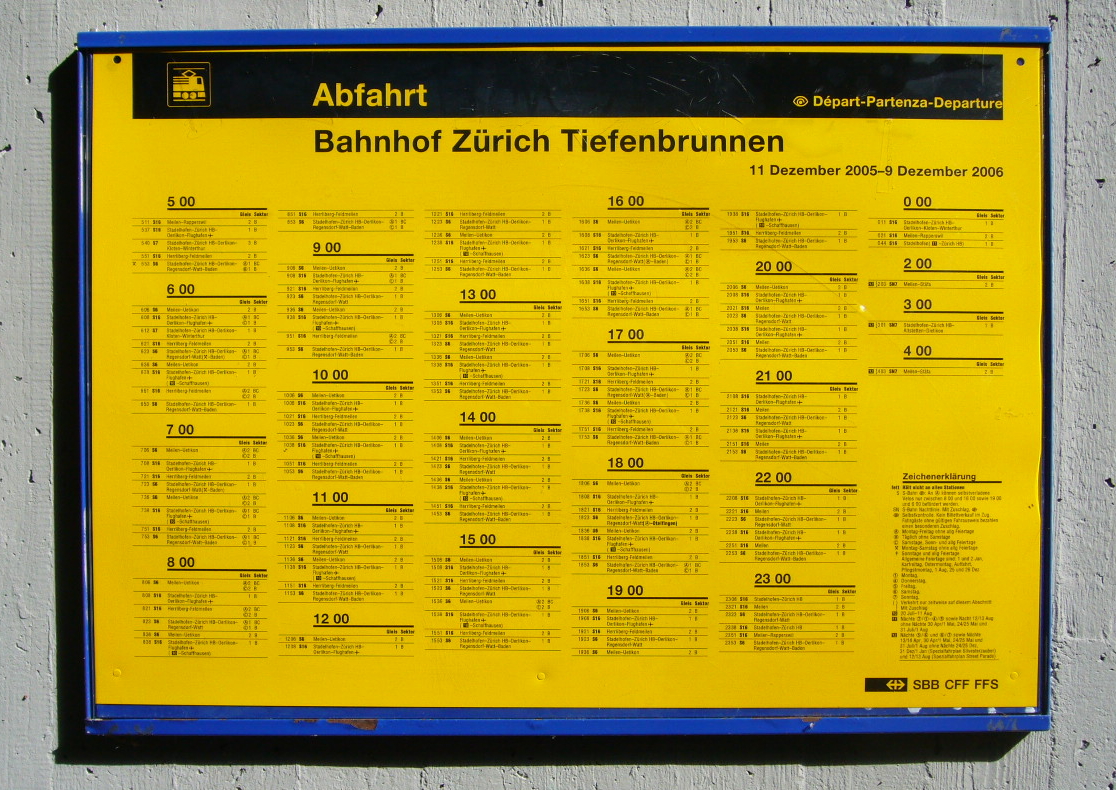
A public transport timetable (also timetable and North American English schedule) is a document setting out information on public transport service times. Both public timetables to assist passengers with planning a trip and internal timetables to inform employees exist. Typically, the timetable will list the times when a service is scheduled to arrive at and depart from specified locations. It may show all movements at a particular location or all movements on a particular route or for a particular stop. Traditionally this information was provided in printed form, for example as a leaflet or poster. It is now also often available in a variety of electronic formats.
In the 2000s, public transport route planners / intermodal journey planners have proliferated and offer traveller the convenience that the computer program looks at all timetables so the traveller doesn't need to.
A "timetable" may also refer to the same information in abstract form, not specifically published, e.g. "A new timetable has been introduced".
The first compilation of railway timetables in the United Kingdom was produced in 1839 by George Bradshaw. Greater speeds and the need for more accurate timings led to the introduction of standard railway time in Great Western Railway timetables in 1840, when all their trains were scheduled to "London time", i.e. Greenwich Mean Time (GMT), which replaced solar time. Until railway time was introduced, local times for London, Birmingham, Bristol and Manchester could differ by as much as 16 to 20 minutes; in India and North America these differences could be 60 minutes or more.
The European Rail Timetable, a compendium of the schedules of major European railway services, has been in publication since 1873 (appearing monthly since 1883). Originally, and for most of its history, it was published by Thomas Cook & Son and included Thomas Cook or Cook's in its title. Although Thomas Cook Group plc ceased publication in 2013, the Thomas Cook European Rail Timetable was revived by a new company in early 2014 as simply the European Rail Timetable. From 1981 to 2010, Cook also produced a similar bi-monthly Overseas volume covering the rest of the world, and some of that content was moved into the European Timetable in 2011.
A timetable can be produced dynamically, on request, for a particular journey on a particular day around a particular time (see journey planner, below), or in a timetable that gives an overview of all services, in a particular category, and is valid for a specified period. The latter could take the form of a book, leaflet, billboard, or a (set of) computer file(s), and makes it much easier to find out, for example, whether a transport service at a particular time is offered every day at that time, and if not, on which days; with a journey planner one may have to check every day of the year separately for this.
Many timetables comprise tables with services shown in columns, and stations or stops on the rows of the table. There will often be separate tables for each direction of travel, and often separate (pairs of) tables for working days, weekends and holidays. Generally the times shown against each station or stop will be the departure time, except for the last stop of the service which will be the arrival time. The left hand column will list the stations in route order, and the other columns are arranged from left to right in chronological order.
If the service is scheduled to wait, both arrival and departure times might be shown on consecutive rows. If a slow service is overtaken by a fast service, the slow service will often occupy more than one column, to keep the times in order. There may be additional rows showing connecting services.
Hub AI
Public transport timetable AI simulator
(@Public transport timetable_simulator)
Public transport timetable
A public transport timetable (also timetable and North American English schedule) is a document setting out information on public transport service times. Both public timetables to assist passengers with planning a trip and internal timetables to inform employees exist. Typically, the timetable will list the times when a service is scheduled to arrive at and depart from specified locations. It may show all movements at a particular location or all movements on a particular route or for a particular stop. Traditionally this information was provided in printed form, for example as a leaflet or poster. It is now also often available in a variety of electronic formats.
In the 2000s, public transport route planners / intermodal journey planners have proliferated and offer traveller the convenience that the computer program looks at all timetables so the traveller doesn't need to.
A "timetable" may also refer to the same information in abstract form, not specifically published, e.g. "A new timetable has been introduced".
The first compilation of railway timetables in the United Kingdom was produced in 1839 by George Bradshaw. Greater speeds and the need for more accurate timings led to the introduction of standard railway time in Great Western Railway timetables in 1840, when all their trains were scheduled to "London time", i.e. Greenwich Mean Time (GMT), which replaced solar time. Until railway time was introduced, local times for London, Birmingham, Bristol and Manchester could differ by as much as 16 to 20 minutes; in India and North America these differences could be 60 minutes or more.
The European Rail Timetable, a compendium of the schedules of major European railway services, has been in publication since 1873 (appearing monthly since 1883). Originally, and for most of its history, it was published by Thomas Cook & Son and included Thomas Cook or Cook's in its title. Although Thomas Cook Group plc ceased publication in 2013, the Thomas Cook European Rail Timetable was revived by a new company in early 2014 as simply the European Rail Timetable. From 1981 to 2010, Cook also produced a similar bi-monthly Overseas volume covering the rest of the world, and some of that content was moved into the European Timetable in 2011.
A timetable can be produced dynamically, on request, for a particular journey on a particular day around a particular time (see journey planner, below), or in a timetable that gives an overview of all services, in a particular category, and is valid for a specified period. The latter could take the form of a book, leaflet, billboard, or a (set of) computer file(s), and makes it much easier to find out, for example, whether a transport service at a particular time is offered every day at that time, and if not, on which days; with a journey planner one may have to check every day of the year separately for this.
Many timetables comprise tables with services shown in columns, and stations or stops on the rows of the table. There will often be separate tables for each direction of travel, and often separate (pairs of) tables for working days, weekends and holidays. Generally the times shown against each station or stop will be the departure time, except for the last stop of the service which will be the arrival time. The left hand column will list the stations in route order, and the other columns are arranged from left to right in chronological order.
If the service is scheduled to wait, both arrival and departure times might be shown on consecutive rows. If a slow service is overtaken by a fast service, the slow service will often occupy more than one column, to keep the times in order. There may be additional rows showing connecting services.