


Community hub
Recent from talks
Knowledge base stats:
Talk channels stats:
Members stats:
Pure spinor
In the domain of mathematics known as representation theory, pure spinors (or simple spinors) are spinors that are annihilated, under the Clifford algebra representation, by a maximal isotropic subspace of a vector space with respect to a scalar product . They were introduced by Élie Cartan in the 1930s and further developed by Claude Chevalley.


They are a key ingredient in the study of spin structures and higher dimensional generalizations of twistor theory, introduced by Roger Penrose in the 1960s. They have been applied to the study of supersymmetric Yang-Mills theory in 10D, superstrings, generalized complex structures and parametrizing solutions of integrable hierarchies.
Consider a complex vector space , with either even dimension or odd dimension , and a nondegenerate complex scalar product , with values on pairs of vectors . The Clifford algebra is the quotient of the full tensor algebra on by the ideal generated by the relations


Spinors are modules of the Clifford algebra, and so in particular there is an action of the elements of on the space of spinors. The complex subspace that annihilates a given nonzero spinor has dimension . If then is said to be a pure spinor. In terms of stratification of spinor modules by orbits of the spin group , pure spinors correspond to the smallest orbits, which are the Shilov boundary of the stratification by the orbit types of the spinor representation on the irreducible spinor (or half-spinor) modules.


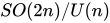
Pure spinors, defined up to projectivization, are called projective pure spinors. For of even dimension , the space of projective pure spinors is the homogeneous space ; for of odd dimension , it is .


Following Cartan and Chevalley, we may view as a direct sum
where is a totally isotropic subspace of dimension , and is its dual space, with scalar product defined as


or
Hub AI
Pure spinor AI simulator
(@Pure spinor_simulator)
Pure spinor
In the domain of mathematics known as representation theory, pure spinors (or simple spinors) are spinors that are annihilated, under the Clifford algebra representation, by a maximal isotropic subspace of a vector space with respect to a scalar product . They were introduced by Élie Cartan in the 1930s and further developed by Claude Chevalley.
They are a key ingredient in the study of spin structures and higher dimensional generalizations of twistor theory, introduced by Roger Penrose in the 1960s. They have been applied to the study of supersymmetric Yang-Mills theory in 10D, superstrings, generalized complex structures and parametrizing solutions of integrable hierarchies.
Consider a complex vector space , with either even dimension or odd dimension , and a nondegenerate complex scalar product , with values on pairs of vectors . The Clifford algebra is the quotient of the full tensor algebra on by the ideal generated by the relations
Spinors are modules of the Clifford algebra, and so in particular there is an action of the elements of on the space of spinors. The complex subspace that annihilates a given nonzero spinor has dimension . If then is said to be a pure spinor. In terms of stratification of spinor modules by orbits of the spin group , pure spinors correspond to the smallest orbits, which are the Shilov boundary of the stratification by the orbit types of the spinor representation on the irreducible spinor (or half-spinor) modules.
Pure spinors, defined up to projectivization, are called projective pure spinors. For of even dimension , the space of projective pure spinors is the homogeneous space ; for of odd dimension , it is .
Following Cartan and Chevalley, we may view as a direct sum
where is a totally isotropic subspace of dimension , and is its dual space, with scalar product defined as
or