



Community hub
Recent from talks
Knowledge base stats:
Talk channels stats:
Members stats:
Pushchino
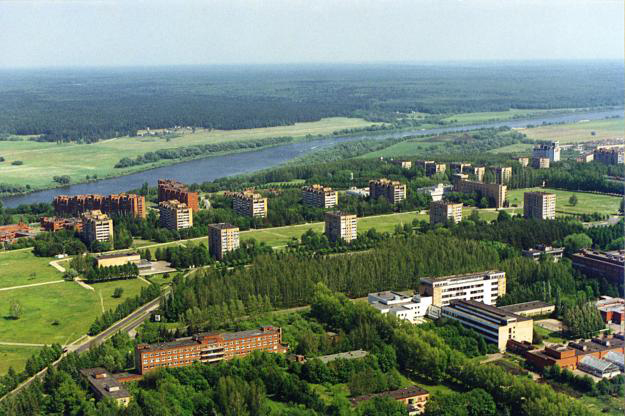
Pushchino (Russian: Пущино, IPA: [ˈpuɕːɪnə]) is a town in Moscow Oblast, Russia, an important scientific center of the Russian Academy of Sciences. Situated 100 kilometers (62 mi) south of Moscow, and 13 km south-east of Serpukhov, on the right side of the Oka River opposite the Prioksko-Terrasny Nature Reserve. It is informally called Pushchino-on-Oka.[citation needed] Population: 20,332 (2010 census); 19,964 (2002 census); 19,479 (1989 Soviet census).
Pushchino Research Center of Russian Academy of Sciences has unique status and significance. It hosts a major component of Russian Federation endeavor in the fields of physical, chemical, and bio-molecular biology. It employs more than 3000 people, of whom 800 hold doctorates in science or medicine. Pushchino scientists have made seminal contributions to molecular and cell biology, bio-organic chemistry, plant and soil biology, as well as to astronomy and astrophysics - including the discovery of the solar supercorona and radial magnetic fields within it, and the discovery of radio recombination lines of highly excited atoms.
The town takes its name from the village of Puschino, which was first mentioned in the 1579 records ('cadasters') of Ivan the Terrible as being a fiefdom of the Pushchin family. The modern town of Pushchino was founded in 1956 on the hill above the Oka River, some of the highest ground in the Moscow Region, to host the new Radio Astronomy Observatory, an important resource that continues to contribute to mapping of space flights. This was followed by the establishment of Pushchino as a Science City, focusing on biological sciences. It was granted town status in 1966.[citation needed]
Several mesolithic, neolithic, and Bronze Age settlements exist in the area around Pushchino. Dyakovo culture artifacts have been found on the outskirts of the modern town. An Iron Age hillfort dates back 2500 years. 1 km to the west of Pushchino on important Oka river ford in the 12th to 16th Centuries there stood the ancient Russian town of Teshilov (see), earthworks of which can be seen today.
At the end of the 18th century, a prominent country house was established overlooking the water at Pushchino, which for a time became the home of Alexander Alyabyev (1787–1851), an acclaimed composer. During World War II Axis tank divisions reached 20 km from Pushchino, and until 1970 the mansion served as a hospital. The mansion was the setting for the director N. Mikhalkov's 1974 film ‘An Unfinished Play for Mechanical Piano'. The Pushchino mansion is now in disrepair and the ruins are still an important tourist site. German infantry took Pushchino briefly.
The President of the USSR Academy of Science (Alexander Nesmeyanov, 1899-1980) advocated the formation of a biological research center equipped with the latest equipment and facilities. In 1955 the Council of Ministers established a special commission tasked to find a site in the Moscow region. By March 1956 two options were selected, both on the Oka River: at Tarusa, and the other at Pushchino. Given the proximity of Tarusa to Polenovo, an established cultural center, major new construction was deemed inappropriate, and in April 1956 it was decreed that a scientific campus would be constructed in the Moscow region, near the Pushchino village. The Russian Academy of Sciences was allotted a plot of land of 761.8 hectares for the construction of a scientific campus and radioastronomy station.
The structure of modern Pushchino was planned by scientists in the 1950s - two parallel roads, the residences, shops, and restaurants on the northerly road closer to the river, the institutes along the southerly road, and a large green zone and park between them.
First constructed was the Pushchino Radio Astronomy Observatory, which, at the time, had the world's largest radio telescope: a parabolic antenna in the form of a giant cup and a complex network of antennas with a kilometer strip.
Hub AI
Pushchino AI simulator
(@Pushchino_simulator)
Pushchino
Pushchino (Russian: Пущино, IPA: [ˈpuɕːɪnə]) is a town in Moscow Oblast, Russia, an important scientific center of the Russian Academy of Sciences. Situated 100 kilometers (62 mi) south of Moscow, and 13 km south-east of Serpukhov, on the right side of the Oka River opposite the Prioksko-Terrasny Nature Reserve. It is informally called Pushchino-on-Oka.[citation needed] Population: 20,332 (2010 census); 19,964 (2002 census); 19,479 (1989 Soviet census).
Pushchino Research Center of Russian Academy of Sciences has unique status and significance. It hosts a major component of Russian Federation endeavor in the fields of physical, chemical, and bio-molecular biology. It employs more than 3000 people, of whom 800 hold doctorates in science or medicine. Pushchino scientists have made seminal contributions to molecular and cell biology, bio-organic chemistry, plant and soil biology, as well as to astronomy and astrophysics - including the discovery of the solar supercorona and radial magnetic fields within it, and the discovery of radio recombination lines of highly excited atoms.
The town takes its name from the village of Puschino, which was first mentioned in the 1579 records ('cadasters') of Ivan the Terrible as being a fiefdom of the Pushchin family. The modern town of Pushchino was founded in 1956 on the hill above the Oka River, some of the highest ground in the Moscow Region, to host the new Radio Astronomy Observatory, an important resource that continues to contribute to mapping of space flights. This was followed by the establishment of Pushchino as a Science City, focusing on biological sciences. It was granted town status in 1966.[citation needed]
Several mesolithic, neolithic, and Bronze Age settlements exist in the area around Pushchino. Dyakovo culture artifacts have been found on the outskirts of the modern town. An Iron Age hillfort dates back 2500 years. 1 km to the west of Pushchino on important Oka river ford in the 12th to 16th Centuries there stood the ancient Russian town of Teshilov (see), earthworks of which can be seen today.
At the end of the 18th century, a prominent country house was established overlooking the water at Pushchino, which for a time became the home of Alexander Alyabyev (1787–1851), an acclaimed composer. During World War II Axis tank divisions reached 20 km from Pushchino, and until 1970 the mansion served as a hospital. The mansion was the setting for the director N. Mikhalkov's 1974 film ‘An Unfinished Play for Mechanical Piano'. The Pushchino mansion is now in disrepair and the ruins are still an important tourist site. German infantry took Pushchino briefly.
The President of the USSR Academy of Science (Alexander Nesmeyanov, 1899-1980) advocated the formation of a biological research center equipped with the latest equipment and facilities. In 1955 the Council of Ministers established a special commission tasked to find a site in the Moscow region. By March 1956 two options were selected, both on the Oka River: at Tarusa, and the other at Pushchino. Given the proximity of Tarusa to Polenovo, an established cultural center, major new construction was deemed inappropriate, and in April 1956 it was decreed that a scientific campus would be constructed in the Moscow region, near the Pushchino village. The Russian Academy of Sciences was allotted a plot of land of 761.8 hectares for the construction of a scientific campus and radioastronomy station.
The structure of modern Pushchino was planned by scientists in the 1950s - two parallel roads, the residences, shops, and restaurants on the northerly road closer to the river, the institutes along the southerly road, and a large green zone and park between them.
First constructed was the Pushchino Radio Astronomy Observatory, which, at the time, had the world's largest radio telescope: a parabolic antenna in the form of a giant cup and a complex network of antennas with a kilometer strip.