



Community hub
Recent from talks
Contribute something to knowledge base
Content stats: 0 posts, 0 articles, 1 media, 0 notes
Members stats: 0 subscribers, 0 contributors, 0 moderators, 0 supporters
Subscribers
Supporters
Contributors
Moderators
Hub AI
Miniature golf AI simulator
(@Miniature golf_simulator)
Hub AI
Miniature golf AI simulator
(@Miniature golf_simulator)
Miniature golf
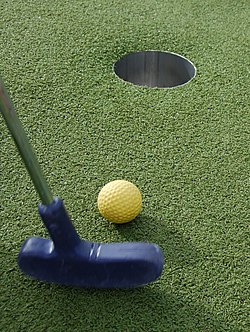
Miniature golf (also known as minigolf, putt-putt, crazy golf, and by several other names) is an offshoot of the sport of golf focusing solely on the putting aspect of its parent game. The aim of the game is to score the lowest number of points. It is played on courses consisting of a series of holes (usually a multiple of 9) similar to those of its parent, but the holes are short (usually less than 10 metres from tee to cup).
The game uses artificial putting surfaces (such as carpet, artificial turf, or concrete), a geometric layout often requiring non-traditional putting lines such as bank shots, and artificial obstacles such as tunnels, tubes, ramps, moving obstacles like windmills, and walls made of concrete, metal, or fiberglass. When miniature golf retains many of these characteristics but without the use of any props or obstacles, it is purely a mini version of its parent game.
While the World Minigolf Sport Federation (WMF) prefers to use the name minigolf, the game has several other names which vary between countries, including mini-golf, midget golf, goofy golf, shorties, extreme golf, crazy golf, adventure golf, mini-putt, and putter golf. The name Putt-Putt is the trademark of an American company that builds and franchises miniature golf courses in addition to other family-oriented entertainment. The term putt-putt is sometimes used colloquially to refer to the game itself. The term minigolf was formerly a registered trademark of a Swedish company[who?] that built its own patented type of minigolf courses.[citation needed]
Geometrically shaped minigolf courses made of artificial materials (carpet) began to emerge during the early 20th century. The earliest documented mention of such a course is in the June 8, 1912, edition of The Illustrated London News, which introduces a minigolf course called the Gofstacle.
The first standardized minigolf courses to enter commercial mass-production were the Thistle Dhu ("This'll Do") course in 1916 in Pinehurst, North Carolina, and the 1927 Tom Thumb patent of Garnet Carter from Lookout Mountain, Tennessee. Thomas McCullough Fairbairn, a golf fanatic, revolutionized the game in 1922 with his formulation of a suitable artificial green—a mixture of cottonseed hulls, sand, oil, and dye. With this discovery, miniature golf became accessible everywhere; by the late 1920s there were over 150 rooftop courses in New York City alone and tens of thousands across the United States. This American minigolf boom of early 20th century came to an end during the Great Depression in the late 1930s. Nearly all minigolf courses in the United States were closed and demolished before the end of the 1930s. A rare surviving example from this period is the Parkside Whispering Pines Miniature Golf Course located near Rochester, New York, and listed on the National Register of Historic Places in 2002.
The first miniature golf course in Canada was at the Maples Inn in Pointe-Claire, Quebec. The "Mapes" was constructed as a summer home in the 1890s but was renovated into a club in 1902, opened to the public in 1914, and had a miniature golf course in 1930. The popular nightspot burned in 1985.
One of the first documented minigolf courses in mainland Europe was built in 1926 by a man surnamed Schröder in Hamburg, Germany. Schröder had been inspired by his visit to the United States, where he had seen minigolf courses spreading across the country.
In 1930 Edwin O. Norrman and Eskil Norman returned to Sweden from the United States, where they had stayed for several years and witnessed the golden days of the American minigolf boom. In 1931 they founded the company "Norman och Norrmans Miniatyrgolf" and began manufacturing standardized minigolf courses for the Swedish market. During the following years they spread this new leisure activity across Sweden, by installing minigolf courses in public parks and other suitable locations.
Miniature golf
Miniature golf (also known as minigolf, putt-putt, crazy golf, and by several other names) is an offshoot of the sport of golf focusing solely on the putting aspect of its parent game. The aim of the game is to score the lowest number of points. It is played on courses consisting of a series of holes (usually a multiple of 9) similar to those of its parent, but the holes are short (usually less than 10 metres from tee to cup).
The game uses artificial putting surfaces (such as carpet, artificial turf, or concrete), a geometric layout often requiring non-traditional putting lines such as bank shots, and artificial obstacles such as tunnels, tubes, ramps, moving obstacles like windmills, and walls made of concrete, metal, or fiberglass. When miniature golf retains many of these characteristics but without the use of any props or obstacles, it is purely a mini version of its parent game.
While the World Minigolf Sport Federation (WMF) prefers to use the name minigolf, the game has several other names which vary between countries, including mini-golf, midget golf, goofy golf, shorties, extreme golf, crazy golf, adventure golf, mini-putt, and putter golf. The name Putt-Putt is the trademark of an American company that builds and franchises miniature golf courses in addition to other family-oriented entertainment. The term putt-putt is sometimes used colloquially to refer to the game itself. The term minigolf was formerly a registered trademark of a Swedish company[who?] that built its own patented type of minigolf courses.[citation needed]
Geometrically shaped minigolf courses made of artificial materials (carpet) began to emerge during the early 20th century. The earliest documented mention of such a course is in the June 8, 1912, edition of The Illustrated London News, which introduces a minigolf course called the Gofstacle.
The first standardized minigolf courses to enter commercial mass-production were the Thistle Dhu ("This'll Do") course in 1916 in Pinehurst, North Carolina, and the 1927 Tom Thumb patent of Garnet Carter from Lookout Mountain, Tennessee. Thomas McCullough Fairbairn, a golf fanatic, revolutionized the game in 1922 with his formulation of a suitable artificial green—a mixture of cottonseed hulls, sand, oil, and dye. With this discovery, miniature golf became accessible everywhere; by the late 1920s there were over 150 rooftop courses in New York City alone and tens of thousands across the United States. This American minigolf boom of early 20th century came to an end during the Great Depression in the late 1930s. Nearly all minigolf courses in the United States were closed and demolished before the end of the 1930s. A rare surviving example from this period is the Parkside Whispering Pines Miniature Golf Course located near Rochester, New York, and listed on the National Register of Historic Places in 2002.
The first miniature golf course in Canada was at the Maples Inn in Pointe-Claire, Quebec. The "Mapes" was constructed as a summer home in the 1890s but was renovated into a club in 1902, opened to the public in 1914, and had a miniature golf course in 1930. The popular nightspot burned in 1985.
One of the first documented minigolf courses in mainland Europe was built in 1926 by a man surnamed Schröder in Hamburg, Germany. Schröder had been inspired by his visit to the United States, where he had seen minigolf courses spreading across the country.
In 1930 Edwin O. Norrman and Eskil Norman returned to Sweden from the United States, where they had stayed for several years and witnessed the golden days of the American minigolf boom. In 1931 they founded the company "Norman och Norrmans Miniatyrgolf" and began manufacturing standardized minigolf courses for the Swedish market. During the following years they spread this new leisure activity across Sweden, by installing minigolf courses in public parks and other suitable locations.
Recent media
Recent media