
Recent from talks
Pyongyang Maternity Hospital
Knowledge base stats:
Talk channels stats:
Members stats:
Pyongyang Maternity Hospital
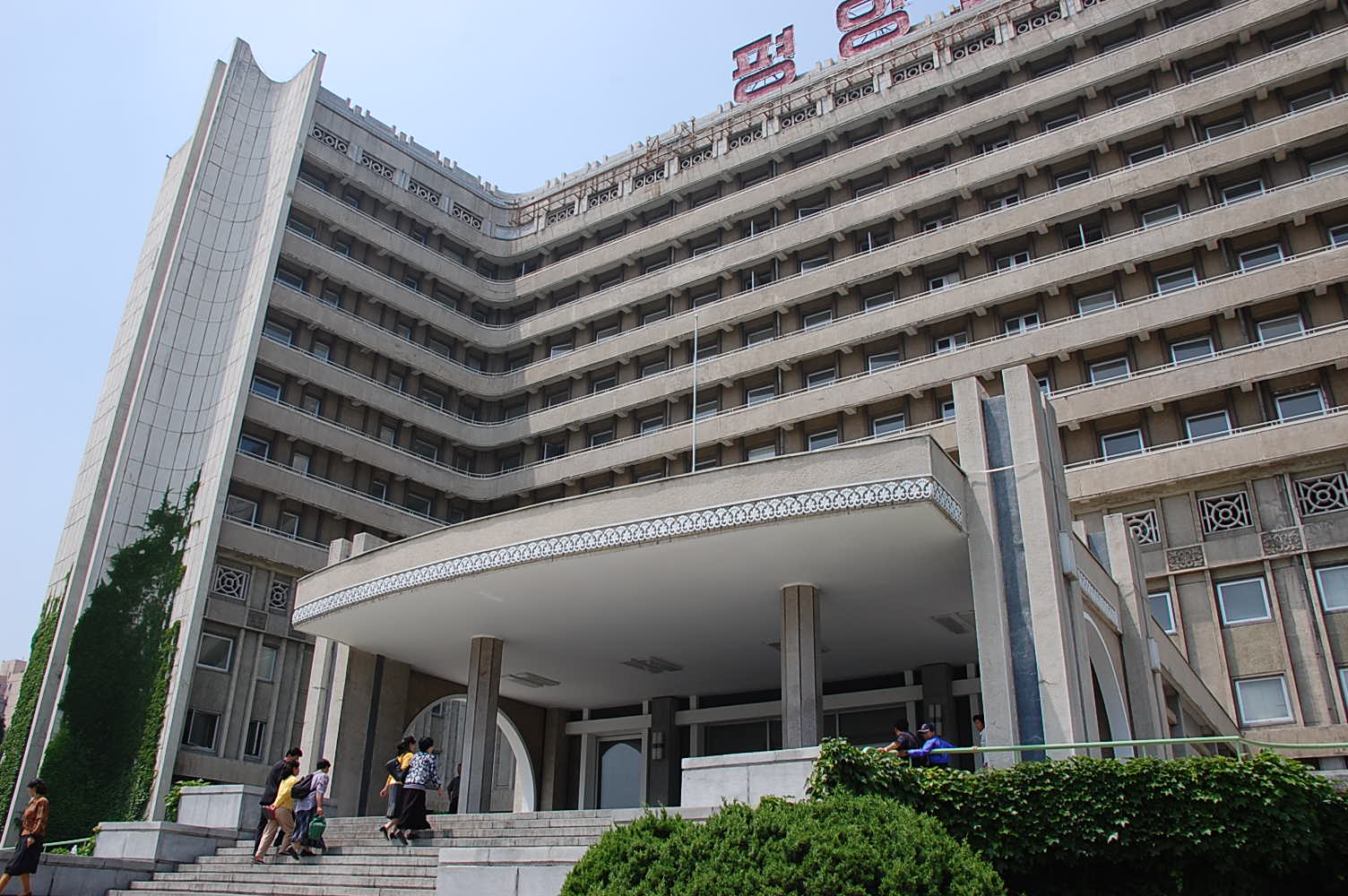
The Pyongyang Maternity Hospital (Korean: 평양산원; MR: P'yŏngyang Sanwŏn) is a maternity and teaching hospital in Pyongyang. Nurses and midwives are educated in the hospital for work outside the North Korean capital. There is a neonatal intensive care unit at the hospital. In addition, there are multiple different wards, such as dental and breast cancer wards, to treat mothers' various health problems.
The hospital employs a unique system of video call booths for family to communicate with a woman who has given birth, as family members are restricted from being in personal contact with the newborn and the mother for five days. It is believed that this helps to prevent infections.
Traditional Korean medicine is used conspicuously in the treatment of patients, and around 30 percent of all given treatments are based on traditional methods.
In 2012, the hospital was expanded when a new wing specialized for breast cancer was constructed at the hospital grounds by orders of Kim Jong Un.
In the 1970s, a state policy for maternity issues was initiated. Kim Jong Il decided to build the hospital in 1978, and it was rumored that he wished that no women would die any longer due to pregnancy complications, as his mother Kim Jong-suk had died. The achievement of building the hospital was used as means to emphasize Kim Jong Il's achievements for his confirmed status as an heir apparent.
The Pyongyang Maternity Hospital was part of the Pyongyang Speed campaign to construct various public facilities for the 6th Congress of the Workers' Party of Korea, which took place on 10–14 October 1980—the congress' beginning coincided with the 35th Party Foundation Day—and the congress was followed by large construction projects continuing into the early 1980s. The hospital was completed in less than nine months. Completed in 1979, the hospital began operating on the 34th anniversary of the Law on Sex Equality on 30 July 1980. The hospital was praised as one of the best in mainland Northeast Asia after opening; the quality of maternity care in the country had improved since the 1940s and 1950s.
Around 2005, nationwide attention was given to maternity hospitals and obstetric and gynecological departments to ensure that a larger proportion of women would receive in-hospital care for childbirth by competent medical staff. The Pyongyang Maternity Hospital's management and facilities were also improved at that time.
In 2012 the hospital was expanded by Kim Jong Un with a new wing, equipped with modern medical equipment, which houses the Breast Cancer Research Center. The hospital has a personal connection for Kim Jong Un, as it had for his father Kim Jong Il, as Kim Jong Un's mother Ko Yong-hui died due to breast cancer.
Hub AI
Pyongyang Maternity Hospital AI simulator
(@Pyongyang Maternity Hospital_simulator)
Pyongyang Maternity Hospital
The Pyongyang Maternity Hospital (Korean: 평양산원; MR: P'yŏngyang Sanwŏn) is a maternity and teaching hospital in Pyongyang. Nurses and midwives are educated in the hospital for work outside the North Korean capital. There is a neonatal intensive care unit at the hospital. In addition, there are multiple different wards, such as dental and breast cancer wards, to treat mothers' various health problems.
The hospital employs a unique system of video call booths for family to communicate with a woman who has given birth, as family members are restricted from being in personal contact with the newborn and the mother for five days. It is believed that this helps to prevent infections.
Traditional Korean medicine is used conspicuously in the treatment of patients, and around 30 percent of all given treatments are based on traditional methods.
In 2012, the hospital was expanded when a new wing specialized for breast cancer was constructed at the hospital grounds by orders of Kim Jong Un.
In the 1970s, a state policy for maternity issues was initiated. Kim Jong Il decided to build the hospital in 1978, and it was rumored that he wished that no women would die any longer due to pregnancy complications, as his mother Kim Jong-suk had died. The achievement of building the hospital was used as means to emphasize Kim Jong Il's achievements for his confirmed status as an heir apparent.
The Pyongyang Maternity Hospital was part of the Pyongyang Speed campaign to construct various public facilities for the 6th Congress of the Workers' Party of Korea, which took place on 10–14 October 1980—the congress' beginning coincided with the 35th Party Foundation Day—and the congress was followed by large construction projects continuing into the early 1980s. The hospital was completed in less than nine months. Completed in 1979, the hospital began operating on the 34th anniversary of the Law on Sex Equality on 30 July 1980. The hospital was praised as one of the best in mainland Northeast Asia after opening; the quality of maternity care in the country had improved since the 1940s and 1950s.
Around 2005, nationwide attention was given to maternity hospitals and obstetric and gynecological departments to ensure that a larger proportion of women would receive in-hospital care for childbirth by competent medical staff. The Pyongyang Maternity Hospital's management and facilities were also improved at that time.
In 2012 the hospital was expanded by Kim Jong Un with a new wing, equipped with modern medical equipment, which houses the Breast Cancer Research Center. The hospital has a personal connection for Kim Jong Un, as it had for his father Kim Jong Il, as Kim Jong Un's mother Ko Yong-hui died due to breast cancer.
Recent media