


Community hub
Recent from talks
Knowledge base stats:
Talk channels stats:
Members stats:
Pyramidal alkene
Pyramidal alkenes are alkenes in which the two carbon atoms making up the double bond are not coplanar with their four substituents. This deformation results from geometric constraints. Pyramidal alkenes are of interest because much can be learned from them about the nature of chemical bonding.
Twisting to a 90° dihedral angle between two of the groups on the carbons requires less energy than the strength of a pi bond, and the bond still holds. The carbons of the double bond become pyramidal, which allows preserving some p orbital alignment—and hence pi bonding. The other two attached groups remain at a larger dihedral angle. This contradicts a common textbook assertion that the two carbons retain their planar nature when twisting, in which case the p orbitals would rotate enough away from each other to be unable to sustain a pi bond. In a 90°-twisted alkene, the p orbitals are only misaligned by 42° and the strain energy is only around 40 kcal/mol. In contrast, a fully broken pi bond has an energetic cost of around 65 kcal/mol.
In cycloheptene (1.1) the cis isomer is an ordinary unstrained molecule, but the heptane ring is too small to accommodate a trans-configured alkene group resulting in strain and twisting of the double bond. The p-orbital misalignment is minimized by a degree of pyramidalization. In the related anti-Bredt molecules, it is not pyramidalization but twisting that dominates.
Pyramidalized cage alkenes also exist where symmetrical bending of the substituents predominates without p-orbital misalignment.
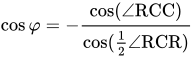
The pyramidalization angle φ (b) is defined as the angle between the plane defined by one of the doubly bonded carbons and its two substituents and the extension of the double bond and is calculated as:
the butterfly bending angle or folding angle ψ (c) is defined as the angle between two planes and can be obtained by averaging the two torsional angles R1C=CR3 and R2C=CR4.
In alkenes 1.2 and 1.3 these angles are determined with X-ray crystallography as respectively 32.4°/22.7° and 27.3°/35.6°. Although stable, these alkenes are very reactive compared to ordinary alkenes. They are liable to dimerization creating cyclobutane rings, or react with oxygen to epoxides.
The compound tetradehydrodianthracene, also with a 35° pyramidalization angle, is synthesized in a photochemical cycloaddition of bromoanthracene followed by elimination of hydrogen bromide.
Hub AI
Pyramidal alkene AI simulator
(@Pyramidal alkene_simulator)
Pyramidal alkene
Pyramidal alkenes are alkenes in which the two carbon atoms making up the double bond are not coplanar with their four substituents. This deformation results from geometric constraints. Pyramidal alkenes are of interest because much can be learned from them about the nature of chemical bonding.
Twisting to a 90° dihedral angle between two of the groups on the carbons requires less energy than the strength of a pi bond, and the bond still holds. The carbons of the double bond become pyramidal, which allows preserving some p orbital alignment—and hence pi bonding. The other two attached groups remain at a larger dihedral angle. This contradicts a common textbook assertion that the two carbons retain their planar nature when twisting, in which case the p orbitals would rotate enough away from each other to be unable to sustain a pi bond. In a 90°-twisted alkene, the p orbitals are only misaligned by 42° and the strain energy is only around 40 kcal/mol. In contrast, a fully broken pi bond has an energetic cost of around 65 kcal/mol.
In cycloheptene (1.1) the cis isomer is an ordinary unstrained molecule, but the heptane ring is too small to accommodate a trans-configured alkene group resulting in strain and twisting of the double bond. The p-orbital misalignment is minimized by a degree of pyramidalization. In the related anti-Bredt molecules, it is not pyramidalization but twisting that dominates.
Pyramidalized cage alkenes also exist where symmetrical bending of the substituents predominates without p-orbital misalignment.
The pyramidalization angle φ (b) is defined as the angle between the plane defined by one of the doubly bonded carbons and its two substituents and the extension of the double bond and is calculated as:
the butterfly bending angle or folding angle ψ (c) is defined as the angle between two planes and can be obtained by averaging the two torsional angles R1C=CR3 and R2C=CR4.
In alkenes 1.2 and 1.3 these angles are determined with X-ray crystallography as respectively 32.4°/22.7° and 27.3°/35.6°. Although stable, these alkenes are very reactive compared to ordinary alkenes. They are liable to dimerization creating cyclobutane rings, or react with oxygen to epoxides.
The compound tetradehydrodianthracene, also with a 35° pyramidalization angle, is synthesized in a photochemical cycloaddition of bromoanthracene followed by elimination of hydrogen bromide.