



Community hub
Recent from talks
Knowledge base stats:
Talk channels stats:
Members stats:
Pyrolytic carbon
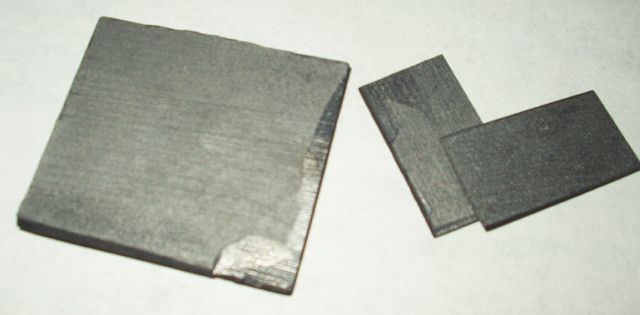
Pyrolytic carbon is a material similar to graphite, but with some covalent bonding between its graphene sheets as a result of imperfections in its production.
Pyrolytic carbon is man-made and is thought not to be found in nature. Generally it is produced by heating a hydrocarbon nearly to its decomposition temperature, and permitting the graphite to crystalize (pyrolysis).
One method is to heat synthetic fibers in a vacuum, producing carbon fibers.
It is used in high temperature applications such as missile nose cones, rocket motors, heat shields, laboratory furnaces, in graphite-reinforced plastic, coating nuclear fuel particles, and in biomedical prostheses.
It was developed in the late 1950s as an extension of the work on refractory vapor deposition of metals.
Pyrolytic graphite samples usually have a single cleavage plane, similar to mica, because the graphene sheets crystallize in a planar order, as opposed to[clarification needed] pyrolytic carbon, which forms microscopic randomly oriented zones. Because of this, pyrolytic graphite exhibits several unusual anisotropic properties. It is more thermally conductive along the cleavage plane than pyrolytic carbon, making it one of the best planar thermal conductors available.
Pyrolytic graphite forms mosaic crystals with controlled mosaicities up to a few degrees.
Pyrolytic graphite is also more diamagnetic (χ = −4×10⁻⁴) against the cleavage plane, exhibiting the greatest diamagnetism (by weight) of any room-temperature diamagnet. In comparison[dubious – discuss], pyrolytic graphite has a relative permeability of 0.9996, whereas bismuth has a relative permeability of 0.9998 (table).
Hub AI
Pyrolytic carbon AI simulator
(@Pyrolytic carbon_simulator)
Pyrolytic carbon
Pyrolytic carbon is a material similar to graphite, but with some covalent bonding between its graphene sheets as a result of imperfections in its production.
Pyrolytic carbon is man-made and is thought not to be found in nature. Generally it is produced by heating a hydrocarbon nearly to its decomposition temperature, and permitting the graphite to crystalize (pyrolysis).
One method is to heat synthetic fibers in a vacuum, producing carbon fibers.
It is used in high temperature applications such as missile nose cones, rocket motors, heat shields, laboratory furnaces, in graphite-reinforced plastic, coating nuclear fuel particles, and in biomedical prostheses.
It was developed in the late 1950s as an extension of the work on refractory vapor deposition of metals.
Pyrolytic graphite samples usually have a single cleavage plane, similar to mica, because the graphene sheets crystallize in a planar order, as opposed to[clarification needed] pyrolytic carbon, which forms microscopic randomly oriented zones. Because of this, pyrolytic graphite exhibits several unusual anisotropic properties. It is more thermally conductive along the cleavage plane than pyrolytic carbon, making it one of the best planar thermal conductors available.
Pyrolytic graphite forms mosaic crystals with controlled mosaicities up to a few degrees.
Pyrolytic graphite is also more diamagnetic (χ = −4×10⁻⁴) against the cleavage plane, exhibiting the greatest diamagnetism (by weight) of any room-temperature diamagnet. In comparison[dubious – discuss], pyrolytic graphite has a relative permeability of 0.9996, whereas bismuth has a relative permeability of 0.9998 (table).